
华润三九

Search documents
A股多家头部中药企业增收不增利
21世纪经济报道· 2025-09-08 00:29
Core Viewpoint - The traditional Chinese medicine (TCM) industry is experiencing structural opportunities driven by policy support, price adjustments, technological innovations, and differentiated demand, with notable performance disparities among leading companies in the A-share market [1][4]. Group 1: Company Performance - Yunnan Baiyao is the only company among the top five TCM firms to achieve both revenue and net profit growth, reporting revenue of 21.257 billion yuan (up 3.92%) and a net profit of 3.633 billion yuan (up 13.93%) [5][6]. - In contrast, Pizhou Huang experienced declines in both revenue and net profit, with revenue of 5.379 billion yuan (down 4.81%) and a net profit of 1.442 billion yuan (down 16.22%), marking the first decline since its listing in 2003 [5][6]. - Baiyunshan reported revenue of 41.835 billion yuan (up 1.93%) but a net profit decline to 2.516 billion yuan (down 1.31%) [7]. - Huaren Sanjiu achieved revenue of 14.810 billion yuan (up 4.99%) but saw a significant net profit drop to 1.815 billion yuan (down 24.31%) [7]. Group 2: Industry Trends - The TCM industry is transitioning from resource dependence to quality orientation, with enhanced quality control of medicinal materials and a significant price adjustment in the supply chain [4][6]. - The normalization of centralized procurement is accelerating market differentiation within the industry [4]. Group 3: Research and Innovation - Innovation is emphasized as a core driver for the development of the pharmaceutical industry, with major TCM companies focusing on various research initiatives [9][10]. - Yunnan Baiyao is actively pursuing projects in secondary innovation development and rapid drug-device development, with 37 ongoing projects [10]. - Huaren Sanjiu has increased its R&D investment to 662 million yuan (up 68.99%) and has 205 projects in progress, focusing on classic formulas and innovative TCM [11].


欧洲大健康企业:中国市场增速迅猛,进博会成拓市“妙方”
2 1 Shi Ji Jing Ji Bao Dao· 2025-09-07 11:09
Group 1 - The event "China International Import Expo Goes to China Resources" was held in Huizhou, Guangdong, focusing on the health sector and attracting over 30 Fortune 500 companies [1] - The event aims to enhance cooperation between central enterprises and international partners, leveraging the opportunities in the Chinese health market [1] - China Resources Group's seven business units, including China Resources Pharmaceutical and China Resources Sanjiu, expressed import procurement needs during the event [1] Group 2 - European health companies reported that the China International Import Expo has significantly aided their market entry by connecting them with distributors, agents, and quality customers [2] - These companies are optimistic about the growth prospects in the Chinese market, citing its large scale advantage [2] - Some companies suggested that China should align its medical device market access standards more closely with international standards to facilitate broader consumer access [2]



头部中药企业增收不增利,加码研发创新寻求破局
2 1 Shi Ji Jing Ji Bao Dao· 2025-09-05 10:58
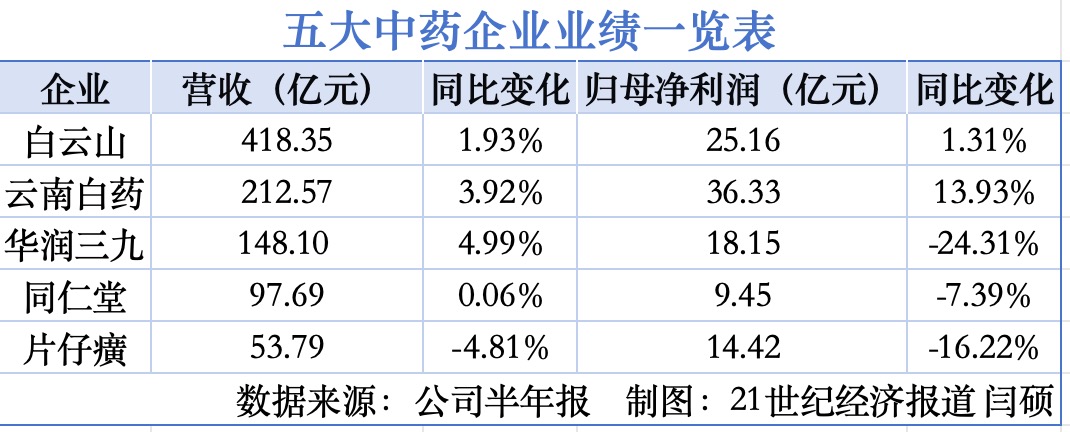
Core Viewpoint - The traditional Chinese medicine (TCM) industry is experiencing structural opportunities driven by policy support, price adjustments, technological innovations, and differentiated demand in the first half of 2025, with notable performance disparities among leading companies [1][3]. Group 1: Company Performance - Yunnan Baiyao achieved revenue of 212.57 billion yuan, a year-on-year increase of 3.92%, and a net profit of 36.33 billion yuan, up 13.93%, marking a historical high for the period [2][4]. - Baiyun Mountain reported revenue growth of 1.93% to 418.35 billion yuan, but net profit fell by 1.31% to 25.16 billion yuan [5][6]. - Huaren Sanjiu's revenue increased by 4.99% to 148.10 billion yuan, while net profit dropped significantly by 24.31% to 18.15 billion yuan [6][10]. - Tongrentang's revenue was 97.69 billion yuan, a slight increase of 0.06%, but net profit decreased by 7.39% to 9.45 billion yuan [5][6]. - Pianzaihuang experienced a revenue decline of 4.81% to 53.79 billion yuan and a net profit drop of 16.22% to 14.42 billion yuan, marking its first revenue decline since its listing in 2003 [4][5]. Group 2: Industry Trends - The TCM industry is transitioning from resource dependence to quality orientation, with enhanced quality control of medicinal materials [3][4]. - The industry is undergoing deep price adjustments, with supply chain pressures and restructuring, leading to a differentiated pricing landscape [3][4]. - The normalization of centralized procurement is accelerating market differentiation within the industry [3]. Group 3: Research and Innovation - Companies are emphasizing innovation as a core driver for growth, with Baiyun Mountain focusing on innovative drugs, generic drug consistency evaluation, and product redevelopment [7][10]. - Pianzaihuang is advancing multiple new drug projects, including 18 research projects and several clinical studies [8]. - Huaren Sanjiu has increased its R&D investment by 68.99% to 6.62 billion yuan, with 205 projects in progress following its acquisition of a 28% stake in Tian Shili [10][11]. - Yunnan Baiyao is integrating AI technologies across its operations, aiming for a digital transformation that enhances efficiency [9].


医药生物行业双周报(2025、8、22-2025、9、4):国家医保谈判在即-20250905
Dongguan Securities· 2025-09-05 06:51
Investment Rating - The report maintains a "Market Weight" rating for the pharmaceutical and biotechnology industry [6][29]. Core Insights - The SW pharmaceutical and biotechnology industry underperformed the CSI 300 index, declining by 1.27% from August 22 to September 4, 2025, which is approximately 3.07 percentage points lower than the index [13][29]. - Most sub-sectors within the industry recorded negative returns during the same period, with the medical research outsourcing and chemical preparation sectors showing the highest gains of 12.17% and 5.45%, respectively. In contrast, the in vitro diagnostics and raw materials sectors experienced declines of 5.96% and 4.95% [16][19]. - Approximately 22% of stocks in the industry recorded positive returns, while around 78% experienced negative returns during the reporting period [17][19]. - The overall price-to-earnings (PE) ratio for the SW pharmaceutical and biotechnology industry was approximately 55.41 times, with a relative PE ratio of 4.23 times compared to the CSI 300 index, indicating little change in industry valuation [20][29]. Summary by Sections 1. Market Review - The SW pharmaceutical and biotechnology industry underperformed the CSI 300 index, with a decline of 1.27% from August 22 to September 4, 2025 [13]. - Most sub-sectors recorded negative returns, with medical research outsourcing and chemical preparations leading in gains [16]. - About 22% of stocks in the industry had positive returns, while 78% had negative returns [17]. 2. Industry News - The National Healthcare Security Administration announced the list of drugs for the 2025 National Basic Medical Insurance, with 718 submissions and 535 passing the initial review [27]. - The report highlights the upcoming national medical insurance negotiations and the analysis of 25 traditional Chinese medicine products [27]. 3. Company Announcements - Guangzhou Baiyunshan Pharmaceutical Group announced that its subsidiary received approval for a drug to pass the consistency evaluation for generic drugs [28]. 4. Industry Outlook - The report suggests focusing on investment opportunities in the innovative drug sector and related areas, including medical devices and traditional Chinese medicine [29][32].




天士力“心动守护”:从一颗滴丸,到一张生命防护网
Jing Ji Guan Cha Wang· 2025-09-05 04:29
Core Insights - The core message emphasizes the need for a systemic approach to chronic disease management, moving away from fragmented treatments to comprehensive care solutions for patients with cardiovascular diseases and diabetes [1][2] Group 1: Disease Statistics and Impact - As of 2023, there are 578 million diabetes patients globally, with 233 million in China, indicating that 1 in 6 Chinese individuals is affected, and 34.6% of these patients are at risk of diabetic retinopathy [1] - The number of cardiovascular disease patients in China has reached 330 million, with 2 out of 5 deaths attributed to myocardial infarction, stroke, and heart failure [1] Group 2: Challenges in Current Treatment Approaches - Clinical data shows that 59.8% of diabetes patients also suffer from coronary heart disease or diabetic retinopathy, requiring an average of 4.3 medications daily, leading to a medical expenditure 2.7 times higher than that of the general population [2] - The median secondary prevention period for coronary heart disease patients in China is only 5.2 months, which is less than half of the duration recommended by international guidelines [2] Group 3: Innovative Solutions by the Company - The company introduces a comprehensive management solution for chronic disease patients, focusing on both medication and diagnostic tools, such as the compound Danshen dripping pill, which has dual mechanisms for treating diabetic retinopathy [3][6] - The "Heart Protection" project aims to address the increasing incidence of cardiovascular diseases in China, which is growing at 5% annually, and aims to implement the "Healthy China 2030" strategy into actionable solutions [3][4] Group 4: Community and Grassroots Initiatives - The company collaborates with the China Medical Education Association to launch the "Heart Power - Rewalk the Long March" initiative, which includes free clinics and training for grassroots healthcare providers, enhancing awareness and early screening for diabetes [5] - The initiative has reached 16 cities across China, emphasizing the importance of community engagement in chronic disease management [5] Group 5: Product Innovation and Market Position - The company’s compound Danshen dripping pill has been recognized as a leading brand in heart disease treatment and has expanded its indications to include diabetic retinopathy, showcasing its commitment to innovation [6][7] - The company maintains a robust pipeline of 83 products under development, including those targeting women's and rare diseases, ensuring a diverse range of treatment options [11] Group 6: Corporate Social Responsibility and ESG Practices - The company integrates its healthcare solutions with social responsibility initiatives, participating in various public welfare activities and maintaining a commitment to sustainable development [10][12] - The "Heart Power" initiative has received multiple awards for its contributions to social responsibility, highlighting the company's dedication to community health [10]

A股震荡,云南白药、华润三九跌超1%,中药ETF(560080)缩量回调,溢价大幅走阔!资金逢跌涌入!机构:静待需求回暖
Xin Lang Cai Jing· 2025-09-04 06:21
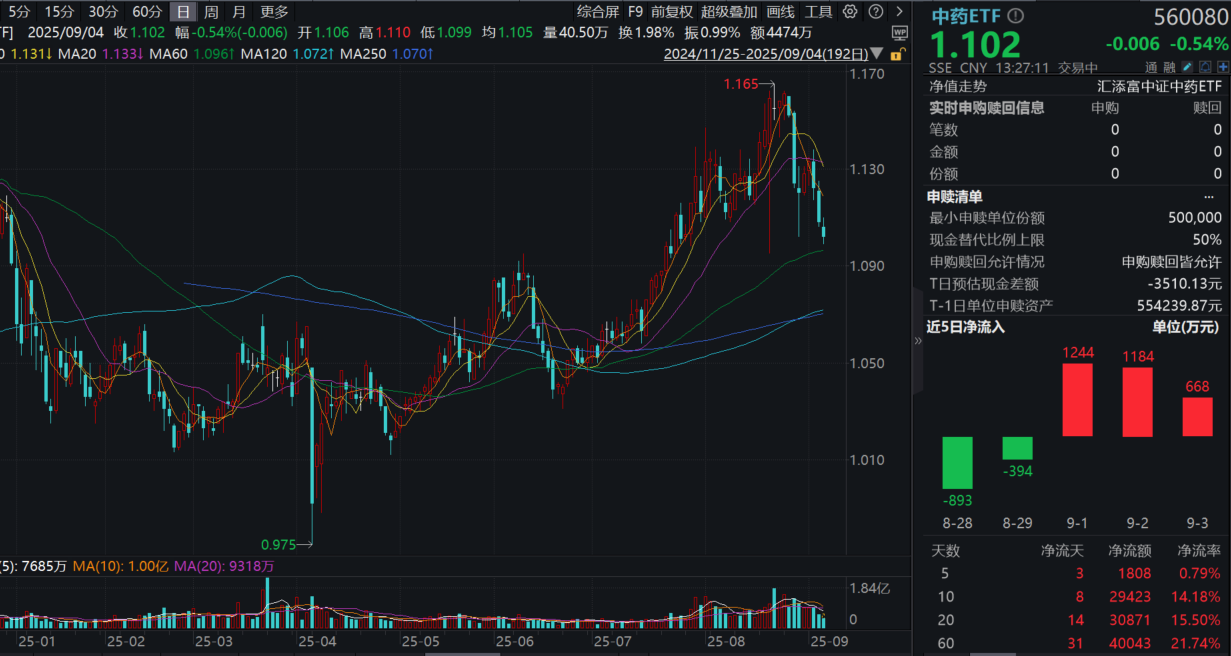
Core Viewpoint - The Chinese medicine sector is experiencing a phase of performance pressure, but there are signs of potential recovery in demand and profitability in the second half of 2025, with a focus on companies with strong fundamentals and innovative pipelines [7][10][11]. Market Performance - On September 4, the Shanghai Composite Index fell over 1%, and the Sci-Tech Innovation 50 Index dropped more than 5%, indicating a volatile market environment [1]. - The Chinese medicine ETF (560080) saw a slight decline of 0.54%, with a trading volume exceeding 44 million yuan, reflecting strong demand for buying on dips despite recent losses [1]. Valuation Metrics - As of September 3, 2025, the TTM price-to-earnings ratio of the CSI Traditional Chinese Medicine Index is 25.75x, which is at a low level since 2021 [3]. Company Performance - In the first half of 2025, the total revenue of 64 Chinese medicine companies was 172.9 billion yuan, a year-on-year decrease of 4.95%, while the net profit attributable to shareholders decreased by 9.31% to 19.1 billion yuan [7]. - The gross margin for the sector was 42.05%, down 1.01 percentage points year-on-year, while the net profit margin was 11.04%, down 0.56 percentage points [7]. Cash Flow and Expenses - The median expense ratio for the Chinese medicine sector in the first half of 2025 was 44.5%, up 1.5 percentage points from the same period in 2024, indicating stable expense management [9]. - Operating cash flow improved by 30.77% year-on-year, suggesting better collection of receivables [7][9]. Market Trends - Despite weak OTC demand, the consolidation of retail pharmacies is expected to enhance market concentration for leading OTC products, with market shares for key products increasing [10]. - The Chinese medicine industry is expected to benefit from three main themes: price governance, consumption recovery, and state-owned enterprise reform, which could lead to improved performance for competitive companies [11][12].

九州通:打造零售电商渠道“代运营+供应链”专业化服务品牌
Quan Jing Wang· 2025-09-03 04:34
Core Viewpoint - 九州通 has demonstrated significant growth in its retail e-commerce service platform, achieving a sales revenue of 4.332 billion yuan in the first half of 2025, representing a year-on-year increase of 31.89% [1] Group 1: Sales Performance - The sales of pharmaceuticals and OTC products to self-operated platforms like JD and Alibaba reached 3.420 billion yuan, marking a year-on-year growth of 32.44% [1] - The company has provided "one-stop" online distribution and supply chain services to over 2,300 brand enterprises, including notable names like Dong'e Ejiao and Beijing Tongrentang [1] Group 2: Brand Operations - In the first half of 2025, 九州通 added 28 new operating brands, bringing the total to 54, with 19 brands expected to achieve annual sales exceeding 10 million yuan [1] - The company is enhancing its brand operation service capabilities to empower core suppliers and improve brand influence [2] Group 3: Logistics and Supply Chain - 九州通 has integrated its nationwide warehousing and logistics network with retail e-commerce platforms, offering services such as automatic ordering and unified settlement [2] - The company has pioneered a multi-warehouse collaborative business model, significantly reducing logistics costs and improving warehouse entry efficiency [2]

九州通:上半年公司新医疗战略稳步推进 诊所会员店已超2400家
Quan Jing Wang· 2025-09-03 04:17
Group 1 - The company held its 2025 semi-annual performance briefing on September 3, where executives reported steady progress in its new medical strategy, with over 2,400 clinic member stores established by the end of July 2025, aiming to achieve a network of 10,000 clinics within three years [1] Group 2 - The company's subsidiary, Jiuyi Clinics, focuses on a business model that integrates "medical services + supply chain," primarily based on supply chain operations, promoting products and forming a member alliance across clinics [2] - The company has introduced over 260 new products in the first half of the year, enhancing the product structure for clinics by collaborating with multiple upstream manufacturers, including Taiji, China Resources Sanjiu, Changfeng Pharmaceutical, Jilin Aodong, and Tianyao Pharmaceutical [2] - The company has developed and launched the Jiuyi SaaS Clinic Manager system, providing intelligent operational value-added services to clinic clients, enabling quick documentation and billing processes, with 1,525 clinic member stores currently using the system [2] - The company partnered with Tencent Cloud to develop the Jiuyi Clinic AI-assisted diagnosis platform, which integrates Tencent's medical AI reasoning, covering nearly 3,000 diseases and 110,000 drug knowledge, with an average of 51,000 monthly uses of the AI-assisted diagnosis platform across member stores [2]
天士力董事长周辉:融华润体系拓新局 以患者为中心谋创新
Zhong Guo Zheng Quan Bao· 2025-09-03 00:39
Core Viewpoint - The company aims to provide high-quality medical solutions centered around patients through innovation and business development, focusing on becoming a leading enterprise in the Chinese pharmaceutical market driven by innovation [1] Group 1: Business Integration and Strategy - The company has accelerated integration with China Resources Sanjiu since becoming a member in March 2025, focusing on cultural, business, and management integration [4][5] - The company has established a comprehensive chain from raw material planting to research, intelligent manufacturing, and commercial promotion in the traditional Chinese medicine sector [5] - The company has a clear strategy for product layout and pipeline enhancement, particularly in three major therapeutic areas: cardiovascular and metabolic diseases, neurological/psychiatric disorders, and digestive diseases [7][9] Group 2: Research and Development Focus - The company has 83 projects in its pipeline, with 31 being innovative drugs, and approximately 80% of the innovative pipeline is concentrated in traditional Chinese medicine [7][8] - The company is advancing in cutting-edge technologies such as cell and gene therapy and antibody drugs, with several clinical approvals already obtained [8] - The company emphasizes collaboration with clinical experts to support drug development and new target discovery [8] Group 3: Financial Performance and Market Strategy - The company reported a revenue of 4.288 billion yuan and a net profit of 775 million yuan in the first half of the year, reflecting a year-on-year growth of 16.97% [9] - The company is preparing for multiple product launches in the coming years, with expectations for new drugs to be approved annually [9] - The company is enhancing its international presence, having registered products in 47 countries, and is focusing on digital transformation to improve operational efficiency [10]

中泰证券:中药板块毛利率有望2025H2修复 看好品牌OTC龙头与创新管线
Zhi Tong Cai Jing· 2025-09-02 23:44
Core Viewpoint - The Chinese herbal medicine sector is expected to see a gradual recovery in gross margins in H2 2025 as the pressure from high-priced raw materials diminishes, despite ongoing operational challenges for companies and weak OTC demand [1][2]. Group 1: Industry Performance - In H1 2025, the total revenue of 64 Chinese herbal medicine companies was 172.9 billion yuan, a year-on-year decrease of 4.95%, while the net profit excluding extraordinary items was 19.1 billion yuan, down 9.31% year-on-year [2]. - The gross margin for the sector in H1 2025 was 42.05%, a decline of 1.01 percentage points year-on-year, and the net profit margin excluding extraordinary items was 11.04%, down 0.56 percentage points year-on-year [2]. - The prices of Chinese medicinal materials have stabilized since mid-2024, with a notable decline starting in May 2025, which is expected to alleviate cost pressures in H2 2025 [2]. Group 2: Financial Metrics - The median expense ratio for the herbal medicine sector in H1 2025 was 44.5%, an increase of 1.5 percentage points compared to the same period in 2024, while the median sales expense ratio was 31.6%, a slight decrease of 0.1 percentage points [3]. - The ratio of accounts receivable plus notes receivable to total revenue was 48.8%, and the inventory to total assets ratio was 12.3%, indicating an increase in accounts receivable as a proportion of total revenue compared to 2024 [3]. - Operating cash flow showed a slight improvement year-on-year in H1 2025, indicating enhanced collection efforts by herbal medicine companies [3]. Group 3: OTC Market Dynamics - The OTC demand remains weak, with a median revenue growth rate of -7.6% and a net profit growth rate of -19.7% for 22 OTC-focused herbal medicine companies in Q2 2025, indicating greater operational pressure compared to the overall sector [4]. - The retail scale of physical pharmacies in China for H1 2025 was 296.1 billion yuan, reflecting a year-on-year decline of 2.2%, which corroborates the weak OTC demand [4]. - Despite short-term demand pressures, the consolidation of retail pharmacies is expected to accelerate the concentration of the OTC market, with leading products gaining market share [4].
