
瑞众人寿

Search documents
华兰股份:股东瑞众人寿减持计划期限届满,减持0.7692%股份
Xin Lang Cai Jing· 2025-09-03 08:57
Core Viewpoint - Jiangsu Hualan Pharmaceutical New Materials Co., Ltd. disclosed a share reduction plan by its major shareholder, Ruizhong Life, which intends to reduce its holdings by up to 3,789,267 shares (3% of total share capital) between June 4 and September 3, 2025 [1] Summary by Relevant Sections - Share Reduction Plan - Ruizhong Life plans to reduce its holdings by a maximum of 3,789,267 shares, representing 3% of the total share capital [1] - Actual Reduction - As of September 3, 2025, Ruizhong Life has reduced its holdings by 1,263,000 shares, accounting for 0.7692% of the total shares (0.7834% considering the impact of share buybacks) [1] - Impact on Company - The reduction did not lead to a change in the company's control and did not significantly affect the company's governance or operations [1]
上半年超6400亿元险资新增入市 下半年险资如何配置
Jin Rong Shi Bao· 2025-08-27 01:45
Core Viewpoint - The A-share market has seen a significant surge in trading volume and index levels, with insurance funds playing a crucial role in this upward trend, marking a historic record in trading volume and a strong performance in major indices [1][2]. Group 1: Market Performance - On August 22, the trading volume in the Shanghai, Shenzhen, and Beijing markets exceeded 2 trillion yuan for the eighth consecutive trading day, breaking historical records for A-shares [1]. - The Shanghai Composite Index closed at 3825.76 points, up 1.45%, while the Shenzhen Component Index rose by 2.07%, and the ChiNext Index increased by 3.36%. The STAR Market 50 Index surged by 8.59% [1]. Group 2: Insurance Fund Inflows - Insurance funds have injected over 640 billion yuan into the stock market, significantly surpassing the total for the previous year [1][2]. - As of the end of Q2, the total balance of insurance funds reached 36.23 trillion yuan, a year-on-year increase of 17.39%, with stock investments amounting to 3.07 trillion yuan, representing 8.47% of the total, the highest since 2022 [1][3]. Group 3: Factors Driving Investment - Three main factors are driving insurance funds to increase stock market investments: policy guidance and regulatory easing, the need to address "asset shortages" and interest rate risk, and the inherent attractiveness of the equity market [3][4]. - Regulatory changes have encouraged long-term capital to enter the market, with adjustments to solvency regulations allowing for increased stock investments [3][4]. Group 4: Investment Preferences - Insurance funds have shown a preference for bank stocks, with 12 out of 30 reported equity stakes being in this sector, alongside interests in public utilities, non-bank financials, and other industries [5][6]. - The new accounting standards for insurance companies have led to increased equity stakes as a strategy to stabilize financial reporting and reduce profit volatility [7]. Group 5: Future Outlook - A research report predicts that by 2025, the insurance industry's original premium income will reach 6 trillion yuan, with an expected increase of 1.57 trillion yuan in fund utilization in the second half of the year [8]. - Insurance institutions are optimistic about the A-share market, particularly favoring sectors such as pharmaceuticals, electronics, banking, and technology, with a focus on high-dividend and innovative investments [8].
多省S基金抢滩,超百亿资金涌入,却卡在“估值七稿”
经济观察报· 2025-08-20 13:25
Core Viewpoint - The article discusses the rapid establishment of S funds in various provinces in China, driven by government policies, and highlights the challenges faced in transitioning from policy-driven growth to market-driven sustainability [1][5][6]. Group 1: S Fund Establishment - The Zhejiang S Fund has a target scale of 5 billion yuan and completed its registration after nearly two years of preparation [2][3]. - Other provinces like Fujian and Henan are also establishing S funds with similar target sizes, indicating a competitive landscape for S fund establishment [3][4]. - The establishment of S funds is seen as a response to the policy guidance from the State Council aimed at promoting high-quality development of government investment funds [4][8]. Group 2: Policy Support - The release of the "Guiding Opinions" by the State Council in January 2025 marked a significant policy shift, encouraging the development of private equity secondary market funds [4][8]. - Local governments are rapidly responding to this policy shift, with multiple regions issuing supportive measures and establishing S funds within weeks of the policy announcement [12][15]. Group 3: Challenges in Pricing Mechanism - The article highlights the difficulties faced by local S fund teams in establishing a clear pricing mechanism for asset transfers, which has led to delays in transactions [18][22]. - There is a lack of unified standards for S fund share valuation across different regions, complicating the transaction process and increasing costs [25][27]. - The article notes that the absence of a standardized pricing model has resulted in significant discrepancies in asset valuations, leading to stalled negotiations [23][24]. Group 4: Talent Shortage - There is a notable shortage of professionals with expertise in S fund transactions, which complicates due diligence processes and hinders the growth of the sector [32][33]. - Efforts are being made to train more professionals in this field, but immediate needs are often met by hiring from other financial institutions at high salaries [33]. Group 5: Market Dynamics - The competition among local governments to establish S funds has intensified, with many regions vying for pilot qualifications in the secondary market [11][17]. - The article indicates that the S fund market is experiencing a "three reductions" phenomenon, with declining discount rates, transaction rates, and trading continuity, reflecting increasing divergence in market expectations [28].


民生人寿出手举牌、4家险企争相竞逐浙商银行 年内险资26次举牌11次涉及银行股
Zhong Guo Jing Ji Wang· 2025-08-20 02:14
Core Viewpoint - Minsheng Life Insurance increased its stake in Zheshang Bank, reaching 5% of the bank's H-share capital, triggering a mandatory disclosure under Hong Kong stock market rules. This move is aimed at achieving long-term investment returns while managing current profit volatility [1][2]. Group 1: Investment Activity - On August 11, Minsheng Life purchased 1 million shares of Zheshang Bank H-shares for HKD 2.7679 million, bringing its total holdings to 296 million shares [2]. - Other insurance companies, including Ping An Life, Xinhua Insurance, and Ruizhong Life, have also been actively increasing their stakes in bank stocks, with over 100 instances of share purchases this year, leading to multiple mandatory disclosures [1][9]. Group 2: Strategic Rationale - The low interest rate environment and changes in liability structures are driving insurance companies to seek better asset-liability matching, pushing them towards equity markets, particularly in stable banks with strong dividend returns [2][9]. - The strategic focus on bank stocks is also linked to the growing importance of bancassurance channels for insurance companies, aiming to enhance their business models through significant equity investments in banks [2][12]. Group 3: Historical Context - Minsheng Life has a history of involvement with Zheshang Bank, having acquired shares from the major shareholder, Wanxiang Holdings, in 2012 and participated in capital increases in 2015 [3]. - Zheshang Bank has consistently provided substantial cash dividends, totaling CNY 13.254 billion over the last three fiscal years, with annual cash dividend ratios exceeding 30% [3]. Group 4: Competitive Landscape - Other insurance companies, such as Taiping Life, Xintai Life, and Baidian Life, are also competing for stakes in Zheshang Bank, indicating a broader trend of insurance capital flowing into the banking sector [4][6]. - As of the end of 2024, Xintai Life and Taiping Life hold 1.37 billion shares and 922 million shares of Zheshang Bank, respectively, further illustrating the competitive interest in the bank [7]. Group 5: Future Outlook - Industry experts anticipate that insurance capital will continue to increase its allocation to bank stocks, driven by the need for stable, low-volatility assets in the current economic climate [12]. - The implementation of new accounting standards is expected to further encourage insurance companies to invest in high-dividend assets and long-term equity investments to stabilize profit fluctuations [12].

从领涨到连跌,银行真的不能买了吗?
Sou Hu Cai Jing· 2025-08-19 09:37
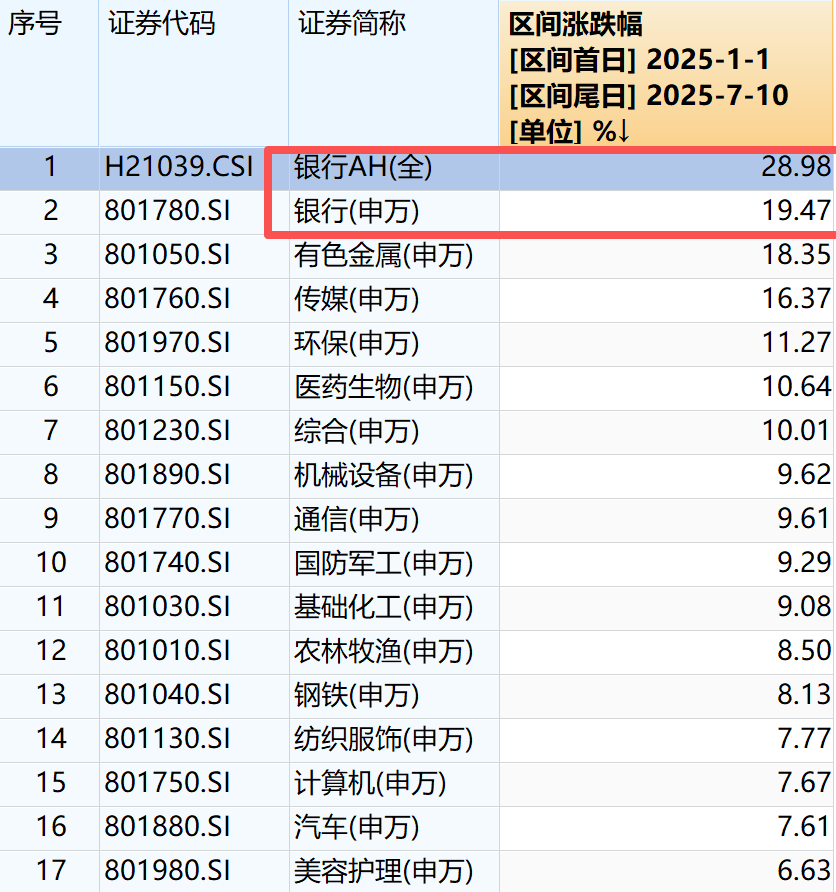
Core Viewpoint - The banking sector has experienced significant fluctuations, with a notable decline in stock prices recently, despite a strong performance earlier in the year. The interest from insurance companies in bank stocks suggests potential investment opportunities amidst the current downturn [1][3]. Group 1: Market Performance - As of July 10, 2025, the Shenwan Bank Index has achieved a year-to-date increase of 19.47%, ranking first among 31 Shenwan primary industries, while the Bank AH Index has risen nearly 29% [1][2]. - Since July 10, 2025, bank stocks have undergone high-level adjustments, showing a general downward trend despite occasional rebounds, contrasting with the rising technology sector [2][3]. Group 2: Investment Activity - On August 15, 2025, Ping An Life announced it had acquired 15% of Postal Savings Bank's H-shares, triggering a mandatory disclosure under Hong Kong regulations. This marks the eighth time this year that Ping An Life has increased its stake in bank H-shares [3]. - Other insurance companies, including Xinhua Insurance and Hongkang Life, have also shown interest in bank stocks, with multiple stake increases throughout the year [3]. Group 3: Dividend and Valuation Insights - The preference for bank stocks among insurance companies is attributed to their high dividend yields and stable returns, making them attractive for long-term investment strategies [3][7]. - As of August 15, 2025, the dividend yield for the China Securities Bank Index is 3.98%, while the Bank AH Index offers a yield of 4.36%, both significantly higher than the 10-year government bond yield [7][9]. - The latest price-to-book (PB) ratio for the Bank AH Index stands at 0.73, indicating it remains at a historical low despite recent valuation adjustments [7]. Group 4: Fund Flows - Recent data indicates that the Bank AH Preferred ETF has seen substantial inflows, with a net inflow of 328.1 million in the last week and approximately 880 million over the past two months, suggesting strong institutional interest in bank stocks during the current market correction [9].
年内险资举牌银行股达14次 未来银行股的资金吸引力依然较强
Zheng Quan Ri Bao· 2025-08-17 23:59
Group 1 - Ping An Life Insurance has increased its stake in Postal Savings Bank of China (PSBC) H-shares to 15.05%, triggering a third regulatory notice [1] - The stock price of PSBC H-shares has risen by 25.2% this year, indicating a strong upward trend [1] - Ping An Life has made nine significant investments in bank stocks this year, with multiple stakes in PSBC and other banks [1] Group 2 - Other insurance institutions have also shown interest in bank stocks, with several instances of shareholding increases in various banks [2] - The appeal of listed banks lies in their stable operations, good liquidity, high dividend yields, and potential for appreciation [2] - The H-shares of listed banks are perceived to be undervalued compared to A-shares, providing a greater potential for future gains [2] - Policies encouraging long-term capital inflow into the market have increased the demand for insurance capital to invest in bank stocks [2] - The banking sector is highlighted for its high dividend yield, making it an attractive option for insurance capital in a low-interest-rate environment [2]
年内险资举牌银行股达14次
Zheng Quan Ri Bao· 2025-08-15 16:54
Group 1 - Ping An Life Insurance has increased its stake in Postal Savings Bank of China (PSBC) H-shares to 15.05%, triggering a third mandatory disclosure under Hong Kong market rules [1] - The company has made multiple purchases of PSBC H-shares throughout the year, starting with an initial acquisition of 7.168 million shares on January 8, which represented 5.01% of the total share capital [1] - The stock price of PSBC H-shares has risen by 25.2% this year, reflecting a strong upward trend [2] Group 2 - Ping An Life has been actively acquiring bank stocks, with nine disclosures this year, primarily targeting listed bank H-shares, including three for PSBC and three for China Merchants Bank [2] - Other insurance institutions have also shown interest in bank stocks, with various acquisitions reported, indicating a broader trend among insurers [2] - Analysts suggest that the stable operations, good liquidity, and high dividend yields of listed banks make them attractive to insurance capital [2][3] Group 3 - The demand for bank stocks among institutional investors is expected to remain strong due to supportive policies and the high dividend nature of bank stocks [3] - The current low interest rate environment and asset scarcity highlight the advantages of high dividend and fixed-income-like characteristics of bank stocks [3] - Future allocations of insurance capital towards bank stocks are anticipated to increase, driven by favorable market conditions [3]
保险公司被吊销业务许可证后,投保人的保单会受影响吗?
Jing Ji Wang· 2025-08-15 03:03
Core Viewpoint - The insurance policies held by consumers are well protected under national laws and the insurance guarantee fund, ensuring that policyholders' rights are safeguarded even if an insurance company loses its business license [1][2][5]. Group 1: Life Insurance Protection - The probability of life insurance companies going bankrupt is very low due to strict legal regulations that prevent arbitrary dissolution [2]. - In the event of a life insurance company being revoked or declared bankrupt, the insurance contracts and reserves must be transferred to another operating life insurance company, ensuring continuity of coverage [2][6]. - If the transferring company’s assets are insufficient to cover policy benefits, the insurance guarantee fund will provide assistance, with limits set at 90% for individual policyholders and 80% for institutional policyholders [3]. Group 2: Property Insurance Protection - Property insurance, including auto and home insurance, is also backed by a robust guarantee mechanism, ensuring that claims will be processed even if the insurance company faces risks during the coverage period [4]. - The insurance guarantee fund will fully cover policy benefits up to 50,000 RMB, and for amounts exceeding this, it will cover 90% for individuals and 80% for institutions [4]. Group 3: Consumer Guidance - Policyholders do not need to worry excessively about changes in insurance companies, as their policies will automatically transfer to new insurers with unchanged terms and conditions [7]. - To ensure better service, consumers are advised to choose insurance companies with strong solvency and high regulatory ratings, and to verify their policy information through official channels [7]. Group 4: Industry Stability - Historical cases demonstrate that the risk management mechanisms in China's insurance industry are maturing, with past instances of company failures being handled effectively [6][7]. - The comprehensive regulatory framework, including legal constraints and real-time supervision, provides a multi-layered safety net for policyholders [7].
中国算力总规模全球第二,腾讯二季度净利增长17% | 财经日日评
吴晓波频道· 2025-08-15 00:30
Group 1: Social Financing and Monetary Data - In July, the social financing scale increased by 1.16 trillion yuan, with a cumulative increase of 23.99 trillion yuan from January to July, which is 5.12 trillion yuan more than the same period last year [2] - The total amount of RMB loans increased by 12.87 trillion yuan in the first seven months, but decreased by 500 billion yuan in July, marking a rare decline [2] - The broad money supply (M2) reached 329.94 trillion yuan at the end of July, with a year-on-year growth of 8.8% [2] Group 2: Real Estate and Consumer Lending - The slowdown in the recovery of the domestic real estate market and the decline in borrowing willingness among residents and enterprises are significant factors contributing to the weakening of credit data [3] - Recent policies aimed at boosting consumer loans and service industry support may have limited effects on stimulating credit demand [3] Group 3: Computing Power and Digital Infrastructure - As of June 2025, China's computing power ranks second globally, with 5G base stations expected to reach 4.55 million and gigabit broadband users at 226 million [4] - The data industry is projected to grow significantly, with the number of data enterprises exceeding 400,000 and the industry scale reaching 5.86 trillion yuan, a 117% increase from the end of the 13th Five-Year Plan [4][5] Group 4: Intelligent Driving Regulations - The State Administration for Market Regulation has released new regulations for intelligent connected vehicles, focusing on recall management, production consistency, and advertising standards [6][8] - The regulations prohibit companies from conducting software online upgrades without approval and from pushing untested software versions to users [7] Group 5: Insurance Sector and Bank Stocks - In 2023, insurance capital has made 26 stake acquisitions, with 11 involving bank stocks, indicating a trend of insurance companies increasing their holdings in stable, high-dividend sectors [9][10] - The focus of domestic insurance capital remains on high net asset yield and high dividend industries, with a notable shift from retail and real estate to banking [10] Group 6: Tencent's Financial Performance - Tencent reported a 15% year-on-year revenue increase to 184.5 billion yuan in Q2 2025, with a net profit of 55.6 billion yuan, up 17% [11] - The gaming sector continues to drive growth, with domestic game revenue increasing by 17% to 40.4 billion yuan [11][12] Group 7: BYD Insurance's Performance - BYD Insurance achieved a net profit of 31.35 million yuan in the first half of 2025, reversing previous losses, with a focus on car insurance [13][14] - The company has leveraged its resources in vehicle manufacturing and repair to reduce claims costs, which is crucial in the challenging landscape of new energy vehicle insurance [14] Group 8: US Stock Market Trends - The S&P 500 index reached its 17th closing high of the year, reflecting a general upward trend in US stock indices [15] - Despite the positive market performance, there are warnings about hidden risks, including labor market cooling and rising price pressures [16]

TCL科技定增募资发行,每股发行价4.21元,折扣率95%
Guo Ji Jin Rong Bao· 2025-08-14 12:07
Group 1 - TCL Technology disclosed a report on the issuance of shares and cash payment for asset acquisition, successfully raising a total of 4.359 billion yuan through the issuance of A-shares at a price of 4.21 yuan per share [1] - The asset acquisition involves a 21.53% stake in Shenzhen Huaxing Semiconductor, with a transaction value of 11.562 billion yuan, marking the largest transaction scale in the electronics industry since 2021 [1] - The fundraising attracted participation from 43 high-quality domestic and foreign investors, with a total subscription amount of 15.727 billion yuan, resulting in a subscription multiple of 3.61 times [1] Group 2 - Notably, a consortium of nine major insurance groups participated in the fundraising, indicating strong confidence in the panel industry and potential value reassessment [2] - Following the completion of the transaction, TCL Technology's leading position in the semiconductor display sector is expected to be further solidified [3]
