雷鸟

Search documents
大厂扎堆智能眼镜,但谁也说不清它到底是啥|AI 器物志
Xin Lang Cai Jing· 2025-12-24 09:53
Core Viewpoint - The evolution of AI in hardware design, particularly in smart glasses, is marked by diverse functionalities and user experiences, leading to a lack of a unified definition for smart glasses in the industry [1][5][27]. Group 1: Industry Trends - The industry is witnessing a divergence in smart glasses, with products ranging from Xiaomi's affordable smart glasses to Apple's high-end Vision Pro, indicating a broad narrative around "smart glasses" or "XR" [1][27]. - Google has introduced the term "device lineage" to categorize XR devices, which includes wired XR glasses, wireless XR glasses, and non-display AI glasses, highlighting the complexity of defining smart glasses [3][29]. - The lack of a core function or definition for smart glasses has led manufacturers to explore various directions, resulting in a competitive landscape where each segment is vying for dominance [5][34]. Group 2: Product Development Challenges - The industry struggles with defining what constitutes smart glasses, as evidenced by the confusion surrounding Google's XR categorization and the varying functionalities of products like AR glasses that require connection to other devices [12][38]. - Apple's upcoming lightweight glasses, which focus on photography and AI without XR display capabilities, reflect a strategic pivot after challenges faced with the Vision Pro, indicating a shift towards more practical and socially acceptable designs [15][41]. - The concept of "AI glasses" is seen as an ideal form of AI hardware, capable of analyzing real-life contexts, yet the actual value and capabilities of such devices vary significantly across different product types [18][44]. Group 3: Market Perception and Future Outlook - The success of AI hardware is often not directly correlated with AI capabilities, as seen with the popularity of Ray-Ban Meta glasses, which excel due to their aesthetic appeal rather than their AI features [20][46]. - The future of smart glasses remains uncertain, with the potential for them to coexist with smartphones rather than replace them, as the industry has yet to provide a clear answer on what could effectively substitute a smartphone [22][48]. - Successful examples in the current market focus on enhancing the glasses themselves, such as the Ideal Livis and Meta Ray-Ban, rather than solely on the integration of AI [24][50].




视涯科技IPO:端侧AI赋能持续深化,国产硅基OLED龙头点亮“新视界”
梧桐树下V· 2025-12-23 03:30
Core Viewpoint - The article highlights the upcoming IPO of Shiya Technology, a leading provider of micro-display solutions, emphasizing its role in promoting domestic alternatives in the XR hardware sector and its potential for capitalizing on the growing XR market [1]. Group 1: Market Position and Technology - XR technology is revolutionizing user interaction by integrating virtual and real-world experiences, moving from flat to spatial interaction [2]. - Major tech companies like Apple, Meta, and Huawei are investing heavily in XR, indicating its emergence as the next computing platform after smartphones [7]. - Silicon-based OLED micro-displays are identified as the essential visual core for XR devices, offering advantages such as lightweight design, high resolution (over 3000 PPI), low latency (under 1ms), and wide color gamut [7][8]. - The market for silicon-based OLED displays has been dominated by foreign companies like Sony and Samsung, but there is a growing need for innovation to meet the high-performance demands of XR applications [8]. Group 2: Company Development and Achievements - Founded in 2016, Shiya Technology focuses on high-performance silicon-based OLED products, overcoming traditional technology limitations [9]. - The company has established the world's first 12-inch silicon-based OLED micro-display production line, positioning itself as one of the few companies with comprehensive self-research capabilities [9]. - According to a report, Shiya Technology is projected to capture 35.2% of the global market share for silicon-based OLED products in XR devices by 2024, ranking second globally and first domestically [11]. Group 3: R&D and Competitive Edge - Shiya Technology has built a strong technical barrier through a top-tier R&D team and significant investment in research, with R&D personnel constituting 31.02% of its workforce [12]. - The company has maintained high R&D expenditure, with amounts reaching 23.7 million yuan in 2022, and has secured 267 patents, establishing a robust technological moat [13]. - Innovations such as strong micro-cavity technology and high-efficiency OLED structures have allowed Shiya Technology to exceed the performance of competitors like Sony [14]. Group 4: Financial Performance and Growth Potential - Shiya Technology's revenue has shown steady growth, with a compound annual growth rate of 21.27% from 2022 to 2024, and a significant increase of 54.67% in the first nine months of 2025 [16]. - The company anticipates revenues of 469 million yuan, 2.26 billion yuan, and 3.73 billion yuan from 2025 to 2027, indicating a potential for exponential growth [18]. - The company is also extending its service offerings to include strategic product development and optical systems, enhancing customer loyalty and pricing power [19]. Group 5: Market Trends and Future Outlook - The rise of AI is expected to significantly boost the XR market, with silicon-based OLED displays being crucial for presenting AI-generated content [20]. - The global silicon-based OLED market is projected to grow at a compound annual growth rate of 94.11%, reaching 67.93 billion yuan by 2030 [20]. - Shiya Technology plans to raise 2.01 billion yuan through its IPO to expand production capacity and enhance R&D, addressing the current supply-demand imbalance [22][23]. - Overall, Shiya Technology is positioned to lead in the AI-driven XR industry, contributing to the advancement of China's new display industry [24].

康耐特光学(02276):深度报告:全球光学树脂镜片龙头,XR眼镜赛道卡位稀缺
ZHESHANG SECURITIES· 2025-12-21 14:14
Investment Rating - The report initiates coverage with a "Buy" rating for the company [2][5]. Core Insights - The company is a global leader in optical resin lenses, with rapid development of its own brands and a clear trend towards product upgrades, particularly in the smart glasses sector, where it has a rare positioning advantage [8][14]. - Revenue is expected to grow steadily, with forecasts of CNY 23.01 billion, CNY 26.16 billion, and CNY 29.79 billion for 2025 to 2027, representing year-on-year growth rates of +11.3%, +13.7%, and +13.8% respectively [2][4]. - The net profit attributable to shareholders is projected to be CNY 5.5 billion, CNY 6.8 billion, and CNY 8.2 billion for the same period, with growth rates of +29%, +23%, and +20% respectively [2][4]. Financial Summary - The company achieved a revenue of CNY 10.84 billion in the first half of 2025, reflecting a year-on-year increase of +11.0%, and a net profit of CNY 2.73 billion, up +30.7% [18]. - The revenue from standardized inventory lenses, functional lenses, and C2M customized lenses for 2024 is expected to be CNY 9.07 billion, CNY 7.55 billion, and CNY 3.95 billion respectively, with year-on-year growth rates of +9%, +32%, and +12% [19]. - The gross profit margins for standardized inventory lenses, functional lenses, and C2M customized lenses are projected to be 34%, 41%, and 62% respectively in the first half of 2025 [19]. Industry Analysis - The global optical lens market is projected to reach a retail value of USD 54.3 billion in 2024, with a year-on-year growth of +8.4% [32][34]. - The Chinese optical lens market is expected to reach CNY 38.2 billion in retail value in 2024, with a year-on-year increase of +9.6% [38][44]. - The demand for functional lenses is expected to grow, driven by the increasing number of myopic and presbyopic individuals, with approximately 118 million children and adolescents affected by myopia in China by 2024 [44][46].
全球微显示龙头冲刺科创板 视涯科技12月24日上会
Zhong Guo Jing Ying Bao· 2025-12-21 10:28
Core Viewpoint - The company, Visionox Technology Co., Ltd., is set to undergo an IPO review on December 24, 2025, by the Shanghai Stock Exchange, aiming to enhance its R&D capabilities and production capacity for silicon-based OLED microdisplays, which are critical hardware for AI-era smart terminals [1][2]. Group 1: Company Overview - Visionox Technology has achieved a breakthrough in silicon-based OLED core technology, leading to international recognition and filling a domestic industry gap, making it the second-largest globally and the largest in China for microdisplay solutions [1][2]. - The company is recognized as the first in China to achieve large-scale production of silicon-based OLED microdisplays and possesses unique core technologies such as strong microcavity structure and full-color stacked OLED [2][3]. Group 2: Market Position and Competition - The microdisplay industry, particularly in high-performance silicon-based OLED, has been dominated by foreign companies like Sony and eMagin, but Visionox has disrupted this monopoly with its advanced technology [3]. - Visionox's products have achieved leading performance metrics, including a contrast ratio of up to 600,000:1 and a DCI-P3 color gamut coverage exceeding 99%, positioning the company favorably against traditional competitors [3]. Group 3: Strategic Partnerships and Ecosystem - Visionox has established itself as a core supplier for major tech companies, including ByteDance and Lenovo, indicating a strong market presence and collaborative product development [4]. - The company is involved in creating a comprehensive ecosystem by providing integrated solutions that include display chips, microdisplays, and optical systems, enhancing its competitive edge [5]. Group 4: Financial Performance and Future Outlook - According to a report, Visionox ranks second globally and first domestically in the shipment of silicon-based OLED products for XR devices, holding a market share of approximately 35.2% [5]. - The company anticipates continued revenue growth driven by the increasing demand for high-performance microdisplays, with expectations to achieve profitability by 2026 [8]. - Visionox aims to leverage its technological strengths to capture a larger market share in both XR and traditional professional markets, aspiring to become the leading global provider of microdisplay solutions [8].
2025年第三季度全球智能眼镜出货量同比大涨74.1%,中国厂商表现亮眼
Huan Qiu Wang· 2025-12-17 02:09
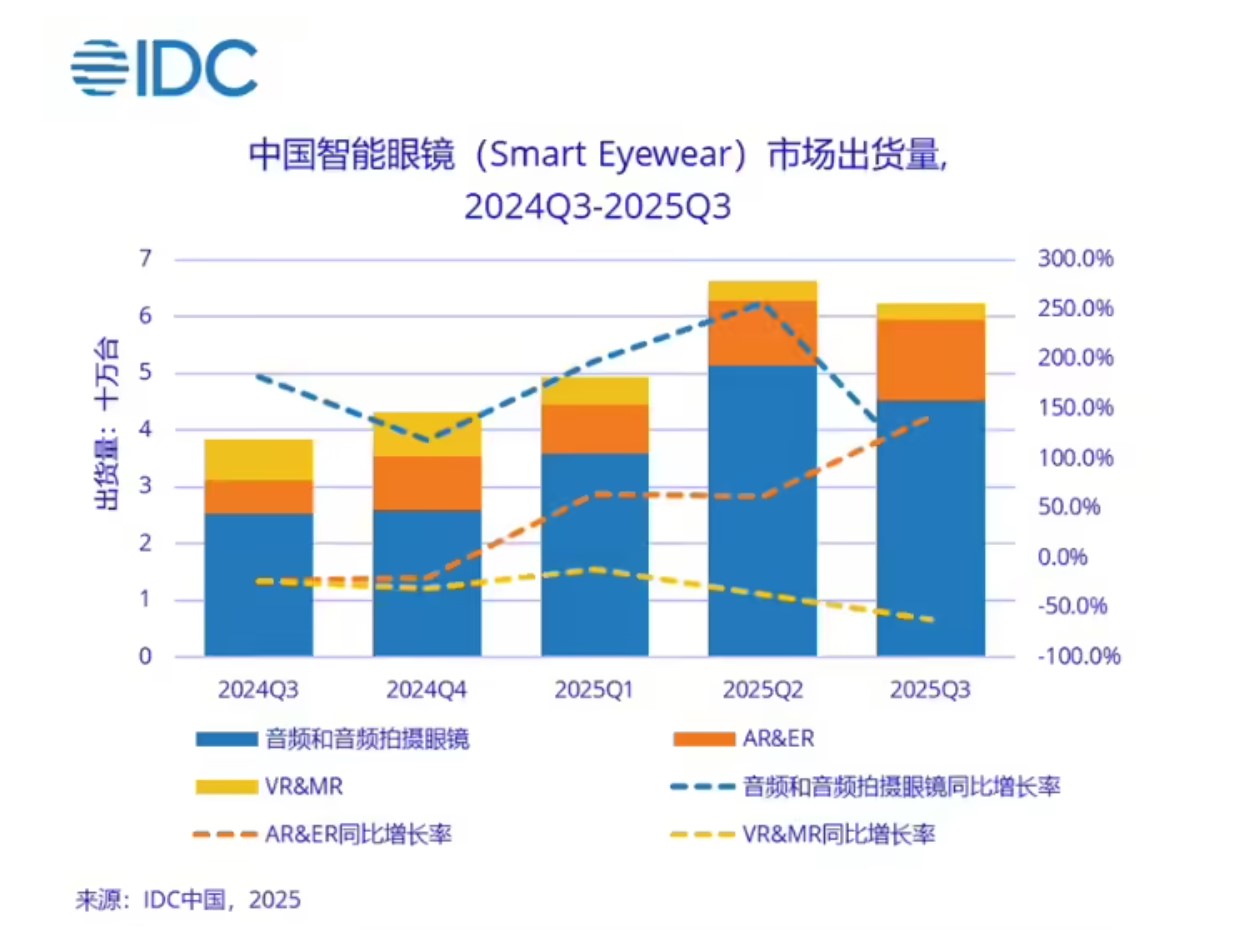
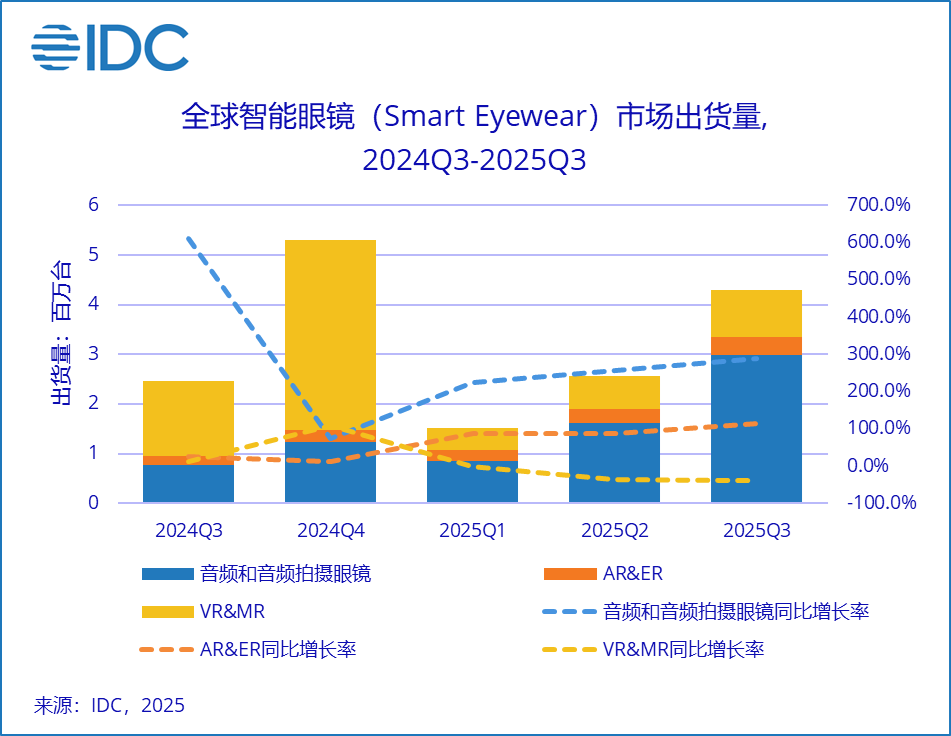
Core Insights - The global smart glasses market is projected to reach 4.296 million units in Q3 2025, reflecting a significant year-on-year growth of 74.1% [1] - Meta maintains a dominant market position with a 75.7% market share, driven by the launch of innovative products such as Ray-Ban Meta 2nd generation and Oakley sports line [1] - Chinese companies Xiaomi, Thunder, Xreal, and Viture have successfully entered the top five global market players, showcasing their increasing innovation capabilities and international competitiveness [1] Market Performance - The global audio and audio-capturing glasses market has seen a remarkable surge, with shipments reaching 2.994 million units, a year-on-year increase of 287.5% [1] - The AR/VR market, however, experienced a decline in shipments, totaling 1.302 million units, down 23.2% year-on-year, indicating structural differentiation within the market [1] - Key regional markets such as North America, Western Europe, China, and Asia-Pacific (excluding China and Japan) achieved over 50% year-on-year growth, with Western Europe leading at 106.5% [2] China Market Insights - In Q3 2025, China's smart glasses market is expected to ship 623,000 units, marking a year-on-year growth of 62.3% [5] - The audio and audio-capturing glasses segment in China is projected to ship 454,000 units, reflecting a 79.2% increase year-on-year, while the AR/VR segment is expected to reach 169,000 units, growing by 29.4% [5] - IDC forecasts that by 2026, China's smart glasses market will continue to grow rapidly, with shipments anticipated to reach 4.508 million units, a year-on-year increase of 77.7% [5]
从AR眼镜产业演进看科技金融服务新质生产力的实践逻辑
Zheng Quan Ri Bao Wang· 2025-12-12 10:17
Core Insights - The global technology competition is rapidly evolving, with cutting-edge technologies like AI, spatial computing, and human-machine collaboration reshaping production, lifestyle, and national competitiveness [1] - The 20th National Congress of the Communist Party of China emphasizes accelerating the development of new productive forces and strengthening the role of enterprises in technological innovation, placing "technology finance" as a top priority in building a strong financial nation [1] Development Challenges - Traditional AR glasses face commercialization challenges, with global sales projected at only 500,000 units in 2024, significantly below early market expectations [1] - The core issue lies in the "all-or-nothing" development paradigm, which creates a negative cycle of high R&D investment, high-cost pricing, low user acceptance, and immature supply chains [1][3] - This approach neglects critical variables such as market acceptance, user behavior inertia, and capital patience, making it incompatible with the new paradigm of "early, small, long-term, and hard technology" in technology finance [1] Evolution Path - A new "gradual iterative" paradigm is emerging, led by AI smart glasses, which is validating a three-stage evolution path: audio/camera glasses, AI smart glasses, and AI+AR glasses [2][5] - The first stage involves audio/video glasses that integrate basic functions to cultivate user habits without altering wearing preferences [5] - The second stage introduces AI capabilities for enhanced functionality, transforming devices from mere tools to intelligent companions, as evidenced by the success of Meta's Ray-Ban Meta glasses [7] - The third stage aims to incorporate lightweight AR display modules, achieving "what you see is what you get" spatial computing, supported by accumulated orders that drive down optical module costs [8] Market Logic - The "gradual iterative" approach targets a substantial existing market of over 1.54 billion units of traditional glasses sold annually, providing a natural user base for smart glasses [9] - This paradigm shift redefines smart glasses as "smart traditional glasses," significantly lowering decision-making barriers and facilitating market penetration [9] - Investment in the AR sector is transitioning from a technology risk-driven model to one focused on market validation, with significant funding increases observed in 2025 [9] Competitive Landscape - The global AR glasses market is evolving, with competition shifting from short-term hardware comparisons to long-term ecosystem building [11] - Companies like Meta and Google are adopting different strategies, with Meta focusing on a closed-loop experience and Google promoting an open ecosystem [11] - Domestic players are leveraging rapid hardware iterations and vertical market penetration, while larger companies like Huawei and Xiaomi are creating seamless cross-device experiences [11] Capital Mechanism - The evolution of AR glasses represents a microcosmic experiment in the collaboration of technology, finance, and institutional evolution [12] - The "gradual iterative" paradigm addresses structural mismatches between technological innovation and financial capital, allowing for phased value release mechanisms [14] - This approach enables capital to receive mid-term market feedback and cash flow support without sacrificing long-term visions, alleviating common challenges faced by early-stage hard technology projects [14] Future Outlook - The true revolution of consumer-grade AR glasses lies in redefining the relationship between humans, information, and the world, facilitating seamless integration of digital information into physical reality [16] - AR glasses have the potential to enhance social interactions, transforming them from social isolators to social enhancers, provided they are designed thoughtfully [17] - The successful adoption of AR glasses will depend on the establishment of ethical frameworks and institutional support to address privacy concerns and ensure equitable access [18]
IDC:三季度全球智能眼镜出货量同比增长74.1% 音频和音频拍摄品类大增287.5%
智通财经网· 2025-12-12 06:07
Core Insights - The global smart eyewear market is projected to ship 4.296 million units in Q3 2025, representing a year-on-year growth of 74.1% [1] - The audio and audio-capturing glasses segment is expected to see a significant increase in shipments, with a year-on-year growth of 287.5%, while the AR/VR segment is experiencing a decline of 23.2% [1] - Meta has launched new products, achieving a market share of 75.7%, while Chinese manufacturers like Xiaomi, Thunder, Xreal, and Viture are also gaining traction in the market [1] Global Market Overview - The global smart eyewear market is expected to see a shipment of 4.296 million units in Q3 2025, with a year-on-year growth of 74.1% [1] - The audio and audio-capturing glasses market is projected to ship 2.994 million units, showing a remarkable growth of 287.5% [1] - The AR/VR market is expected to ship 1.302 million units, but it is facing a decline of 23.2% [1] Chinese Market Insights - The Chinese smart eyewear market is projected to ship 623,000 units in Q3 2025, reflecting a year-on-year growth of 62.3% [3] - The audio and audio-capturing glasses segment in China is expected to ship 454,000 units, with a year-on-year growth of 79.2% [5] - The AR/VR market in China is expected to ship 169,000 units, showing a year-on-year growth of 29.4% [6] Product Innovations and Trends - Major Chinese brands are launching new products, including Alibaba's Quark G1 and Baidu's AI glasses, which are expected to enhance market dynamics [5] - The proportion of products supporting large models has reached 49.5%, indicating a trend towards AI integration in smart eyewear [5] - The AR/ER category is leading growth in the AR/VR market, with a market share of 83.4% and a year-on-year growth of 142.3% [6] Future Projections - The Chinese smart eyewear market is expected to reach 4.508 million units by 2026, with a year-on-year growth of 77.7% [6] - The audio and audio-capturing glasses segment is projected to ship 3.434 million units, reflecting a growth of 68.1% [6] - The AR/VR device shipments are expected to reach 1.073 million units, with a year-on-year growth of 62.1% [6] Competitive Landscape - The smart eyewear market is entering a phase of scale growth, with major companies launching new products and driving technological innovation [8] - Competition is shifting towards ecosystem collaboration, content integration, and practical application scenarios [8] - The market is expected to see a more diverse competitive landscape, with a focus on user experience, AI functionality, and ecosystem completeness [9]

2025TCL全球技术创新大会举办 落实AI应用年内创造综合效益超10亿元
Zheng Quan Shi Bao Wang· 2025-12-11 11:23
Core Insights - The 2025 TCL Global Technology Innovation Conference (TIC2025) focused on the theme "AI for Real," discussing the practical application of AI in real-world scenarios and the creation of tangible value [1][2] - TCL aims to generate comprehensive benefits exceeding 1 billion yuan by advancing AI applications in various sectors by 2025 [1] Group 1: AI Integration in Industry - TCL emphasizes the integration of AI with the real economy, moving beyond theoretical concepts to practical applications that create real value [2] - The company is investing heavily in AI technology to drive innovation across the entire supply chain, including research, manufacturing, and operations [2] - The X-Intelligence 3.0 model, launched by TCL Huaxing, is the first domain-specific large model in the display field, enhancing knowledge systems and learning capabilities [2][3] Group 2: AI Empowerment in Manufacturing - In the semiconductor display and new energy photovoltaic sectors, TCL is integrating AI to enhance manufacturing, research, and operational efficiency [3][4] - The Auto Defect Classification (ADC) technology has improved defect detection accuracy from 85% to 95%, significantly enhancing production efficiency [3] - The X-Intelligence model ranks first in the display field and has improved product development efficiency by 20% and material development efficiency by 30% [3] Group 3: AI Applications in New Energy - TCL Zhonghuan utilizes the Deep Blue AI model for automated operations in single crystal growth, allowing remote control of up to 384 furnaces [4] - The company has achieved zero human contact in the intelligent packaging line, with silicon wafer production waste reduced to below 0.1% [4] Group 4: AI Empowerment in Consumer Products - TCL is redefining consumer experiences through AI in various scenarios, including travel, health, and entertainment [6] - The AI/AR glasses developed by TCL serve as personal AI assistants, enhancing user experiences in exploration [6] - The TCL AiMe robot offers emotional companionship and human-like interaction, representing a new frontier in technology-assisted companionship [6]

AI眼镜大混战:大厂抢入口,“Rokid们”紧张?
3 6 Ke· 2025-12-11 04:22
市场越来越清楚,想做好一款AI智能眼镜,要先让产品可以被用户戴一整天;而不少企业本就已经拥有AI、显示等相关技术,似乎只要做好取舍、让产 品真正有用,就很容易拿到这个赛道的入场券。 在近期的AI智能眼镜市场中,大厂跨界的消息越来越多。 近日,谷歌宣布其正着手开发两种不同类别的AI眼镜:一类配备显示屏,另一类则主打音频功能。谷歌还表示,第一款合作开发的AI眼镜将于2026年上 市。另据智能涌现报道,腾讯内部已开始小范围研究AI眼镜方向;字节跳动在去年立项了两个AI眼镜项目…… 而大厂的发力也并不只停留在传出消息这一层面,近几日,单是拿出新产品的大厂就有两家。 11月27日,预热多时的夸克正式发布了旗下两个系列的AI眼镜产品;几天后的12月3日,理想汽车正式推出了旗下首款人工智能硬件产品——理想AI眼镜 Livis。 大厂们之所以对AI智能眼镜趋之若鹜,与这条赛道逐渐明晰的迭代方向以及软硬件技术的逐步落地有关。 当然,行业中的创业公司也都跟上了热潮。随着行业关注度的提升,以Rokid、雷鸟、XREAL等为代表的智能眼镜品牌纷纷加快了迭代速度,逐渐被更多 消费者熟知。 但挑战也接踵而至。在每一个新对手的实力都不容小 ...

消费级AR眼镜系列报告(一):破局与展望——全球AR市场增长逻辑与投资机
Sou Hu Cai Jing· 2025-12-05 04:26
Core Insights - The consumer-grade AR glasses industry is at a critical development turning point, with a "gradual iteration" paradigm breaking the previous stagnation in industry growth [1][7][8] - The global market for AI smart glasses is projected to reach 1.52 million units in 2024, significantly surpassing traditional AR glasses at 500,000 units [1][7][58] - The market potential is primarily driven by the replacement of traditional eyewear, with global sales of traditional glasses exceeding 1.5 billion pairs annually [1][8] Industry Growth Logic - The gradual iteration path involves three stages: audio glasses to cultivate user habits, AI glasses with smart cores to enhance stickiness, and finally, AI+AR glasses as the target form [1][7][8] - If the penetration rate increases from 0.01% in 2023 to 4.44% by 2030, and the average selling price drops to 1,500 RMB, the global AR smart glasses market could grow from 735 million RMB in 2023 to 118.7 billion RMB by 2030, with a CAGR of 106.7% [1][8] Competitive Landscape - The global competitive landscape is evolving towards ecological differentiation, with Meta leading with an "AI+AR" technology route and Google adopting an open ecosystem model [2][9] - Domestic players like Thunder and Rokid focus on rapid hardware iteration, while giants like Huawei and Xiaomi leverage their mobile ecosystems to build cross-device collaboration capabilities [2][9] - The competition is shifting from short-term hardware specifications to long-term ecological barriers, with cross-device collaboration and personalized services becoming core competitive strengths [2][9] Industry Chain Analysis - In the AR glasses BOM cost structure, optical display units account for 43%, while computing units centered around chips account for 31% [2][10] - The industry chain includes upstream hardware and software suppliers, midstream brand owners and content producers, and downstream sales and distribution channels, all collaborating to drive the industry from technological exploration to large-scale implementation [2][10] Future Outlook - The consumer-grade AR glasses industry is expected to gradually replace traditional eyewear, becoming the next generation of personal information centers covering various scenarios in life, work, and travel [3][26] - The rapid growth of AI glasses validates the feasibility of the gradual iteration path, with AI glasses expected to reach 3.5 million units in 2025, while traditional AR glasses are projected at 650,000 units [1][58]