Arm

Search documents
这一芯片问题,不容忽视!
半导体行业观察· 2026-01-10 03:37
Core Viewpoint - The article discusses the increasing complexity and challenges of end-to-end security in semiconductor manufacturing, particularly with the rise of multi-chip packaging and edge computing, which complicates supply chain tracking and security measures [1][2][3]. Group 1: Challenges in Multi-Chip Packaging - Multi-chip packaging enhances performance but complicates supply chain tracking, as components may come from different manufacturers [1]. - The aging of chipsets under different workloads can introduce unforeseen vulnerabilities, especially with new components developed using advanced nodes like 3nm [1]. - The fragmentation of chip production among various suppliers increases complexity, making it difficult to ensure compatibility and security across the supply chain [2]. Group 2: Security Measures and Standards - There is a need for comprehensive security measures throughout the supply chain, from chip manufacturing to final product deployment, to mitigate risks associated with malicious chips [3][4]. - The introduction of the EU's Cyber Resilience Act (CRA) mandates companies to assess their security vulnerabilities and supply chain risks, pushing for a more standardized approach to security [5]. - Companies are encouraged to embed unique identifiers in chips to enhance traceability and security [4][5]. Group 3: Long-Term Security Considerations - The longevity of products necessitates ongoing assessments of potential security vulnerabilities that may arise over time [9][10]. - The automotive industry exemplifies the need for long-term security planning, as vehicles may have lifespans of up to 40 years, requiring continuous updates and risk assessments [10]. - Quantum computing poses a future threat to existing encryption methods, necessitating proactive measures during the design phase [9][10]. Group 4: Role of Artificial Intelligence - AI can be utilized to identify security vulnerabilities that are difficult for humans to detect, enhancing the overall security of systems [11]. - However, AI systems themselves require strict controls to prevent independent communication that could compromise security [11][12]. - The development of unified standards for AI in security is still in progress, with organizations working towards establishing comprehensive guidelines [12]. Group 5: Conclusion on Security Landscape - Security has transitioned from a secondary consideration to a primary focus across all stages of electronic system development, with companies facing significant penalties for neglecting security [12]. - Achieving true end-to-end security remains uncertain, but the motivation for companies to pursue it has increased alongside the challenges they face [12].

芯片IP巨头Arm架构重组 新设“物理AI”条线开拓机器人市场
Xin Lang Cai Jing· 2026-01-08 12:49
Group 1 - Arm has completed a restructuring to establish a dedicated Physical AI business line to expand its presence in the robotics market [1] - The company has created three new business divisions: Cloud AI, Edge AI, and Physical AI, each focusing on different aspects of AI technology [1] - The Physical AI division will focus on integrating AI with physical movements in various fields, including vehicles and robotics [1] Group 2 - The establishment of the Physical AI division reflects Arm's bet on the potential of the robotics market [2] - The head of the Physical AI division, Drew Henry, stated that Physical AI solutions can significantly enhance workforce productivity and impact the economy [2] - Arm's Chief Marketing Officer, Ami Badani, mentioned the merging of automotive and robotics businesses due to similar customer needs in power consumption, safety, and reliability [2] Group 3 - Arm plans to increase its workforce dedicated to robotics-related work [3] - Several global automotive manufacturers are adopting Arm architecture-based chips, and robotics companies, such as Boston Dynamics, are also becoming clients [3] - Boston Dynamics showcased a production-ready humanoid robot, Atlas, at CES, with plans for deployment in U.S. factories by 2028 [3]

四大芯片巨头掌门人罕见同台发声
2 1 Shi Ji Jing Ji Bao Dao· 2026-01-08 05:57
Core Insights - The CES 2026 highlighted the significant advancements in AI technology, particularly in the context of increasing computational power and the emergence of new applications across various sectors [1][2][8] - Chinese companies are playing an increasingly vital role in the global tech landscape, showcasing innovative AI hardware and solutions that attract considerable attention at international events [1][4][9] Group 1: AI and Computational Power - NVIDIA's CEO Jensen Huang emphasized the arrival of the "ChatGPT moment," indicating that machines are beginning to understand and act in the real world, with autonomous taxis being one of the first applications to benefit [2] - Huang introduced the new Rubin architecture, which includes a comprehensive stack solution with six core components, addressing the exponential growth in AI computational demands, projected to increase tenfold annually [2] - AMD's CEO Lisa Su noted that the computational power is transitioning from Zetta to Yotta Scale, with AI model training floating-point computation power increasing fourfold each year and inference token consumption rising by 100 times over the past two years [2] Group 2: Emerging AI Applications - Qualcomm's CEO Cristiano Amon highlighted the potential of next-generation personal AI devices, predicting a market size of 100 million units in the coming years, driven by edge AI and situational awareness capabilities [3] - The CES showcased a variety of AI-native products, with a notable increase in the capabilities of robots, moving beyond simple demonstrations to more complex functionalities [4][6] - The development of humanoid robots is progressing towards commercialization, with companies achieving significant advancements in motion control and operational precision, indicating a clear path for deployment in sectors like manufacturing and logistics [6][7] Group 3: Chinese Companies and Global Impact - Chinese firms are increasingly recognized as key players in the global tech ecosystem, leveraging their supply chain and R&D capabilities to drive innovation and efficiency [1][8][9] - The ability of Chinese companies to rapidly iterate on products, with a typical development cycle of about one year compared to two to three years for European counterparts, is enhancing their competitive edge [8][9] - The CES 2026 served as a platform for showcasing how AI technologies are set to permeate everyday life, with a focus on transforming concepts into tangible value through collaborative global efforts [9]


CES 2026见证AI生态变局 中国厂商跻身全球核心阵营
2 1 Shi Ji Jing Ji Bao Dao· 2026-01-07 23:14
Core Insights - The competition among major chip manufacturers is intensifying around the foundational computing power for AI, with native AI hardware accelerating its large-scale implementation, transitioning from laboratory settings to consumer and industrial applications [1][2] - Chinese manufacturers are playing an increasingly significant role at global tech events, showcasing their advancements in AI hardware and capabilities, which are supported by their supply chain and R&D strengths [2][11] Group 1: Computing Power and AI Development - The rapid evolution of underlying computing infrastructure is crucial for the accelerated development of AI large models, with chip leaders emphasizing the exponential growth of computing power and the new application opportunities it creates [3][4] - NVIDIA's CEO highlighted the arrival of the "ChatGPT moment" for physical AI, indicating that machines are beginning to understand and act in the real world, with autonomous taxis being one of the first applications to benefit [3] - AMD's CEO noted that the floating-point computing power for training AI models is growing fourfold annually, with inference token consumption increasing by 100 times over the past two years, necessitating new product offerings to meet Yotta-scale infrastructure demands [4] Group 2: Emerging AI Applications - The potential of edge AI is significant, with advancements in smart wearable devices being highlighted as a new category of mobile terminals that will coexist with smartphones [5][6] - Qualcomm's CEO projected that the market for personal AI devices could reach 100 million units in the coming years, emphasizing the importance of edge data for providing highly relevant user services [6] Group 3: Robotics and Physical AI - The maturity of physical AI was showcased at CES, with Chinese manufacturers presenting advanced robots that demonstrate improved capabilities compared to previous years [7][8] - The introduction of humanoid robots and their increasing commercial viability was noted, with companies achieving substantial progress in motion control and operational precision [9][10] - The integration of hardware, sensors, and environmental perception into scalable systems is seen as essential for advancing physical AI applications across various industries [10] Group 4: Chinese Manufacturers' Competitive Edge - Chinese companies are leveraging their supply chain efficiencies and R&D capabilities to drive rapid iterations and cost optimization in the robotics sector, significantly outpacing European competitors in product development cycles [11][12] - The shift from simple manufacturing to innovative solutions reflects a broader transformation in the perception of "Made in China" to "Created in China," highlighting the technological advancements and better solutions being offered [12]
泽连斯基称有望在2026年上半年结束俄乌冲突 Anthropic据悉融资100亿美元|环球市场
Sou Hu Cai Jing· 2026-01-07 23:10
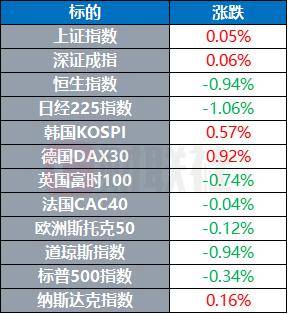
Market Overview - The U.S. stock market showed mixed results with the Nasdaq up by 0.16%, while the S&P 500 and Dow Jones fell by 0.34% and 0.94% respectively, amid concerns over economic data and upcoming employment reports [1] - International oil prices declined, with WTI crude oil down by 2% to $55.99 per barrel and Brent crude down by 1.22% to $59.96 per barrel [2] Geopolitical Developments - Ukrainian President Zelensky expressed optimism about potentially ending the conflict with Russia by mid-2026, citing advancements in negotiations with European and American partners [3] - U.S. Secretary of State Rubio announced upcoming talks with Denmark regarding Greenland, amidst discussions about U.S. military options [4] - The White House confirmed that the Trump administration is actively discussing the possibility of purchasing Greenland, emphasizing its strategic importance for U.S. national security [5] Energy Sector - U.S. Energy Secretary Chris Wright stated that the U.S. will indefinitely control Venezuelan oil sales, aiming to stabilize and increase production, which may require significant investment [6] Technology and AI Sector - AI company Anthropic is reportedly planning to raise $10 billion in a new funding round, with a pre-money valuation of approximately $350 billion, nearly doubling its valuation from four months ago [7] - Chip technology company Arm has established a Physical AI department to expand its presence in the robotics market, highlighting the long-term growth potential in this sector [9] - OpenAI introduced a new feature in ChatGPT for health analysis, allowing users to connect with their electronic health records and health applications, marking a significant step into the healthcare sector [10]
CES 2026见证AI生态变局,中国厂商跻身全球核心阵营
2 1 Shi Ji Jing Ji Bao Dao· 2026-01-07 13:35
Core Insights - The article highlights the acceleration of native AI hardware development, emphasizing the growing demand for computing power and the expansion of AI applications from cloud to edge [1][2][12] - Chinese manufacturers are increasingly becoming significant players at CES 2026, showcasing a variety of AI hardware, including AI glasses and robots, which have garnered substantial attention [1][12] Group 1: AI Hardware and Computing Power - The rapid evolution of underlying computing infrastructure is supporting the accelerated development of AI large models, with a noted annual increase in floating-point operations for training by four times and a 100-fold increase in inference token consumption over the past two years [2][3] - NVIDIA's CEO highlighted the arrival of the "ChatGPT moment" for physical AI, with autonomous taxis being one of the first applications to benefit from this technology [2] - AMD's CEO discussed the transition to Yotta Scale compute, indicating that AI potential will be fully unleashed across data centers, personal computing devices, and edge AI [2][3] Group 2: Robotics and Physical AI - The maturity of physical AI was emphasized at CES, with a notable improvement in the capabilities of showcased robots compared to previous years, indicating a shift from simple demonstrations to more complex functionalities [7][8] - Companies like UTree Technology and Zongqiong Robotics are showcasing advanced robots capable of performing intricate movements, signaling a move towards mass production and real-world applications [8][9] - The integration of edge AI and real-time situational awareness in wearable devices is expected to create significant market opportunities, with projections of reaching 100 million units in the coming years [5][6] Group 3: Chinese Manufacturers and Global Role - Chinese firms are transitioning from being merely the "world's factory" to becoming key players in global technological innovation, supported by strong supply chain and R&D capabilities [1][12] - The efficiency of China's supply chain allows for rapid product iteration, with a production cycle of about one year compared to three to five years for European companies [12][13] - The article underscores that the advancements in AI technology are not just about manufacturing but also about creating better solutions and technologies, marking a shift from "Chinese manufacturing" to "Chinese innovation" [13]
CES 2026:全新产品亮相 Arm聚焦搭建AI算力基础设施
Huan Qiu Wang· 2026-01-07 09:33
Core Insights - The integration of physical AI and edge AI is a central theme at CES 2026, showcasing advancements in various devices from autonomous vehicles to personal computers and wearables [1][3]. Group 1: Automotive Industry - The automotive sector is transitioning from "software-defined" to "AI-defined," with multiple companies implementing high-performance computing platforms based on Arm architecture for real-time vehicle perception, prediction, and decision-making [3]. - Tesla's new AI5 chip, built on Arm, reportedly enhances AI performance by 40 times compared to its predecessor [3]. - Rivian's self-developed autonomous driving platform also utilizes customized Arm chips, while NVIDIA DRIVE Thor supports L4-level autonomous taxi operations [3]. Group 2: Robotics - Robotics technology is moving from laboratory experiments to large-scale commercial applications, demonstrating the practical implementation of physical AI [3]. - Various robots, including wheeled robots, cleaning delivery robots, and humanoid robots, showcased their autonomous operation capabilities in complex environments, relying on Arm's high-efficiency computing platforms [3]. Group 3: Consumer Electronics - Edge AI has become a standard feature in PCs, laptops, and tablets, with the Windows on Arm ecosystem rapidly expanding, expecting over 100 related models to launch by 2026 [4]. - Devices like Apple MacBook, Google Chromebook, and Xiaomi tablets, based on Arm architecture, demonstrate the feasibility of efficiently performing AI tasks locally while achieving high performance and long battery life [4]. - The compact AI workstation NVIDIA DGX Spark, powered by Arm cores, can support local inference for models with 120 billion parameters [4]. Group 4: Wearables and Smart Home - The smart upgrade of wearables and smart home devices reflects the deep penetration of edge AI into daily scenarios, with new smart glasses and health rings utilizing low-power Arm chips for continuous local perception and inference, ensuring user privacy [4]. - Smart home systems are increasingly shifting AI processing tasks to local hubs to address energy efficiency, privacy, and reliability needs [4]. Group 5: Industry Trends - CES 2026 clearly illustrates the trend of intelligent technology integrating into transportation, mobile devices, smart homes, professional workstations, and various robotic applications [4]. - Despite the varying forms of AI across different devices, their reliable operation depends on a high-efficiency and scalable computing foundation [4].

今年CES,芯片厂商又开始“神仙打架”
3 6 Ke· 2026-01-07 00:42
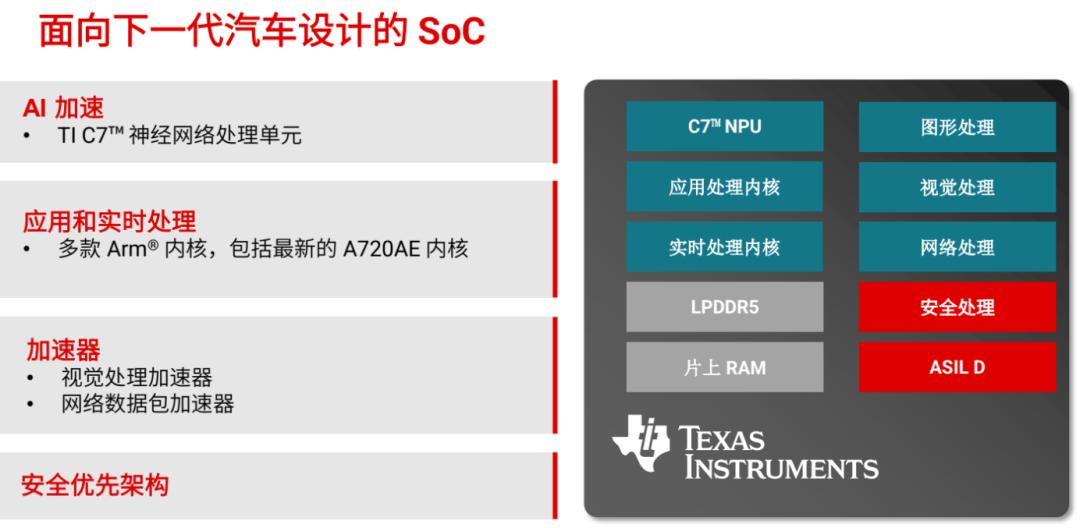
Group 1: TI's Automotive Innovations - TI launched three powerful automotive products at CES: the TDA5 series SoC, AWR2188 radar transmitter, and DP83TD555J-Q1 Ethernet PHY [1][4][7] - The TDA5 SoC features a maximum performance of 1200 TOPS and an energy efficiency of over 24 TOPS/W, with a 12-fold increase in AI computing power compared to previous generations [1] - AWR2188 is the industry's first single-chip 8x8 radar solution, enhancing performance by 30% and achieving high-precision detection for targets over 350m [4] - The DP83TD555J-Q1 Ethernet PHY supports nanosecond-level time synchronization and can transmit power and data over the same line, reducing cable design complexity and costs [7] Group 2: ADI's Diverse Solutions - ADI showcased various solutions in automotive, consumer, and robotics sectors, highlighting the A²B 2.0 solution with four times the bandwidth of its predecessor [10] - The automotive solutions include advanced lighting control and ADAS systems utilizing machine vision inputs [10][11] Group 3: NXP's High-Integration Processor - NXP introduced the S32N7 processor series, which integrates multiple vehicle functions on a single chip, potentially reducing total cost of ownership (TCO) by up to 20% [12][15] Group 4: Microchip's Demonstrations - Microchip presented demos including the ASA Motion Link for Qualcomm's Ride platform and a software-free intelligent headlight system using 10BASE-T1S technology [17][18] Group 5: Silicon Labs' New SDK - Silicon Labs launched a new Simplicity SDK for Zephyr, enhancing support for embedded systems and showcasing advancements in Bluetooth wireless technology [19] Group 6: Infineon's Development Kit - Infineon and Flex unveiled a modular development kit for regional control units, aimed at accelerating the development of software-defined vehicle architectures [20] Group 7: ST's Automotive Gateway - ST displayed the Osdyne Automotive Gateway, which enhances vehicle communication and security while reducing wiring complexity [22] Group 8: Ambarella's AI Vision Chip - Ambarella released the CV7 AI vision SoC, built on a 4nm process, achieving over 20% power reduction and more than 2.5 times the AI performance of its predecessor [25] Group 9: NVIDIA's Revolutionary Products - NVIDIA introduced the Rubin platform with six new chips and launched the Alpamayo series for AI-assisted driving development [26][28] Group 10: AMD's AI Innovations - AMD announced several new products, including the MI455X GPU and Ryzen AI 400 series processors, emphasizing its comprehensive AI capabilities [29][30] Group 11: Arm's Technology Trends - Arm focused on five key technology trends at CES, including advancements in autonomous driving, robotics, and smart home devices [31][32] Group 12: Industry Trends - The CES highlighted three major trends: the penetration of AI across all technology layers, the shift towards centralized and software-defined automotive electronics, and the importance of ecosystem collaboration over isolated technology competition [33]



Ambiq Unveils Atomiq®, the World's First Ultra-Low Power NPU SoC Built on SPOT®
Globenewswire· 2026-01-06 13:30
Core Insights - Ambiq Micro, Inc. has announced the Atomiq system-on-chip (SoC), which integrates a Neural Processing Unit (NPU) aimed at enabling real-time, always-on artificial intelligence at the edge, setting a new standard for energy efficiency in edge AI applications [2][3] Group 1: Product Features - Atomiq is the first SoC to utilize sub- and near-threshold voltage operation for AI acceleration, achieving over 200 GOPS of on-device AI performance, which supports complex workloads like computer vision and multilingual speech recognition [5] - The SoC features dynamic power scaling through SPOT-based ultra-wide range dynamic voltage and frequency scaling (DVFS), allowing operation at lower voltage and power, thus enhancing intelligence capabilities [5] - Ambiq's Helia AI platform, along with AI development kits and the modular neuralSPOT SDK, provides a comprehensive hardware-software stack that optimizes performance while reducing power consumption and development cycles [5] Group 2: Market Applications - The Atomiq SoC expands Ambiq's edge AI portfolio, enabling high-performance, battery-powered devices that were previously limited by power and thermal constraints, applicable in smart cameras, wearables, and more [6] - Ambiq's partnership with Bravechip aims to reduce smart ring costs by up to 85% and improve production yield by 20%, facilitating the development of next-generation wearables with advanced AI features [8] - The collaboration with Ronds has led to the deployment of over 400,000 intelligent sensors in heavy industries, providing continuous monitoring and predictive maintenance without relying on cloud connectivity [10] Group 3: Future Roadmap - Ambiq is committed to advancing AI applications across various sectors, including smart buildings, healthcare, and consumer electronics, with plans to unveil details on its next-generation 12nm SPOT platform in March 2026 [12][13] - The Atomiq platform is positioned to support demanding future applications, such as conversational AR glasses and autonomous industrial robots, showcasing Ambiq's leadership in ultra-low power edge AI [7][12]


Ambiq Unveils Atomiq®, the World’s First Ultra-Low Power NPU SoC Built on SPOT®
Globenewswire· 2026-01-06 13:30
Enabling always-on audio, vision, and reasoning for next-generation edge AI devices AUSTIN, Texas, Jan. 06, 2026 (GLOBE NEWSWIRE) -- Ambiq Micro, Inc. (“Ambiq”) (NYSE: AMBQ), a recognized leader in ultra-low-power semiconductor solutions for edge AI, today announced Atomiq, the highly anticipated system-on-chip (SoC) integrating a Neural Processing Unit (NPU) designed to enable real-time, always-on artificial intelligence at the edge. Built on Ambiq’s Subthreshold Power Optimized Technology (SPOT) platform, ...