
舜宇光学科技

Search documents
港股通净买入98.32亿港元
Zheng Quan Shi Bao Wang· 2025-11-04 16:21
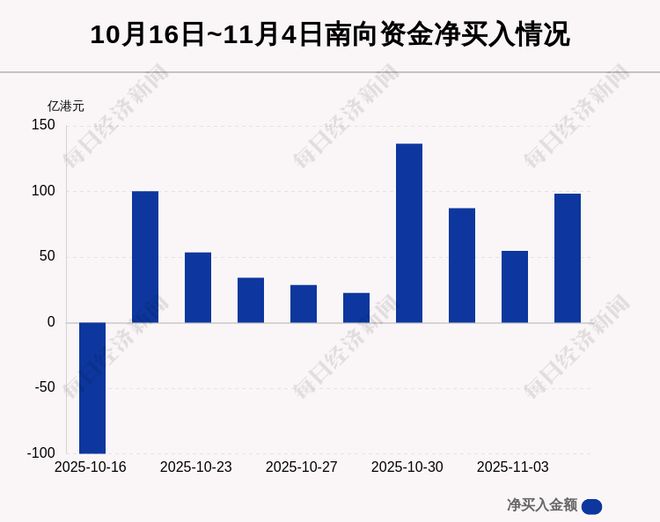
Market Overview - On November 4, the Hang Seng Index fell by 0.79%, closing at 25,952.40 points, while southbound funds through the Stock Connect recorded a net purchase of HKD 9.832 billion [1] Trading Activity - The total trading volume for the Stock Connect on November 4 was HKD 100.097 billion, with a net purchase of HKD 9.832 billion. Specifically, the Shanghai Stock Connect had a trading volume of HKD 61.300 billion and a net purchase of HKD 5.202 billion, while the Shenzhen Stock Connect had a trading volume of HKD 38.796 billion and a net purchase of HKD 4.631 billion [1] Active Stocks - In the Shanghai Stock Connect, Alibaba-W had the highest trading volume at HKD 44.666 billion, followed by SMIC and Xiaomi Group-W with trading volumes of HKD 26.778 billion and HKD 22.200 billion, respectively. In terms of net buying, Xiaomi Group-W led with a net purchase of HKD 0.908 billion, despite its closing price dropping by 2.91%. Conversely, Alibaba-W experienced the highest net selling at HKD 0.586 billion, with a closing price decline of 2.57% [1] Shenzhen Stock Connect Highlights - In the Shenzhen Stock Connect, Alibaba-W also topped the trading volume with HKD 29.600 billion, followed by Tencent Holdings and SMIC with trading volumes of HKD 17.460 billion and HKD 15.760 billion, respectively. Tencent Holdings saw the highest net purchase of HKD 0.379 billion, with a slight closing price increase of 0.16%. The stock with the highest net selling was Sunny Optical Technology, which had a net selling amount of HKD 0.325 billion, closing down by 4.59% [2]





智通港股通活跃成交|11月4日
智通财经网· 2025-11-04 11:01
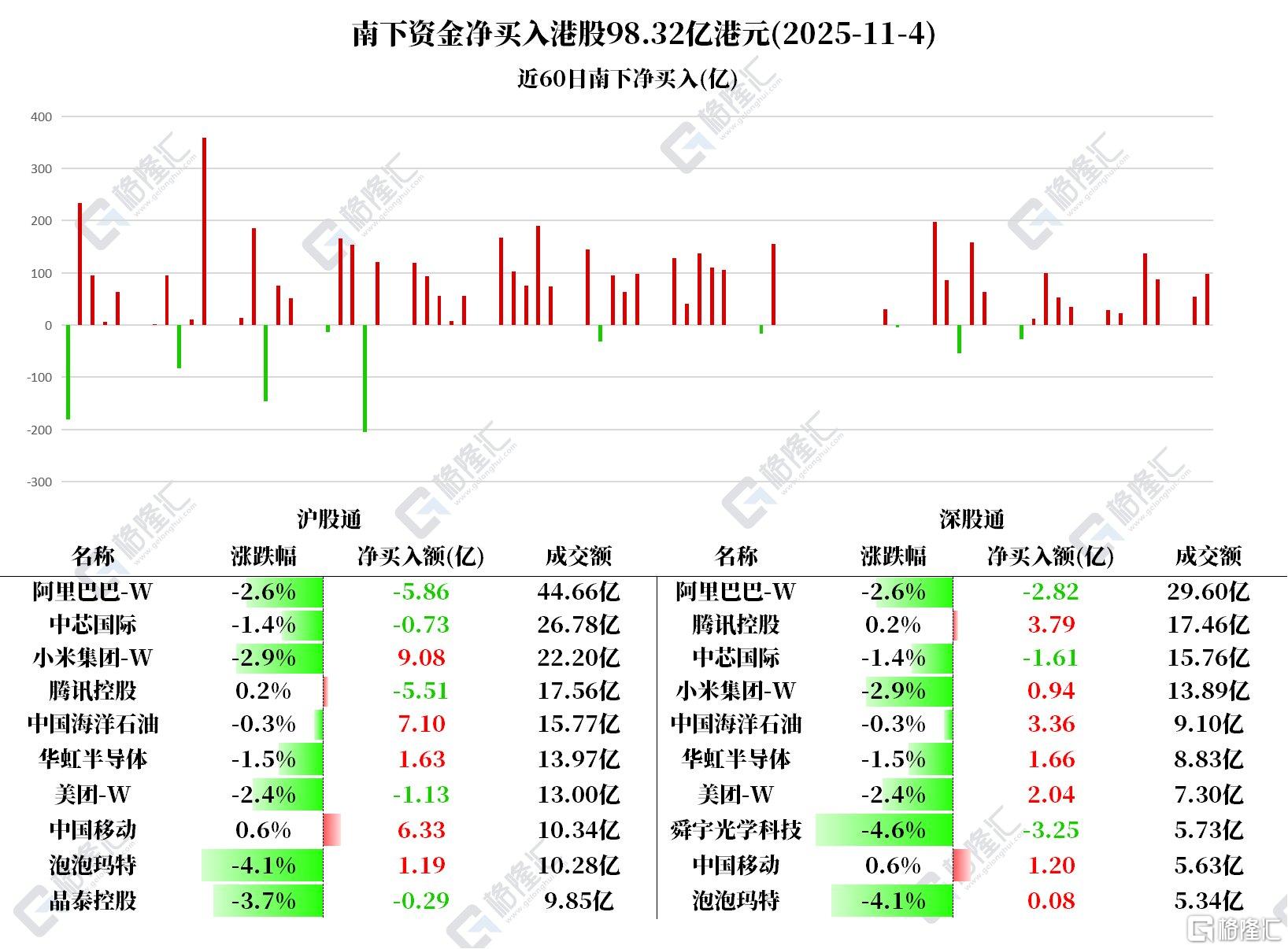
Core Insights - On November 4, 2025, Alibaba-W (09988), SMIC (00981), and Xiaomi Group-W (01810) were the top three companies by trading volume in the Southbound Stock Connect, with trading amounts of 4.466 billion, 2.678 billion, and 2.220 billion respectively [1] - In the Southbound Stock Connect for the Shenzhen-Hong Kong Stock Connect, Alibaba-W (09988), Tencent Holdings (00700), and SMIC (00981) also ranked as the top three, with trading amounts of 2.960 billion, 1.746 billion, and 1.576 billion respectively [1] Southbound Stock Connect (Shanghai-Hong Kong) - Top active companies by trading amount: - Alibaba-W (09988): 4.466 billion, net buy of -0.586 billion - SMIC (00981): 2.678 billion, net buy of -72.6415 million - Xiaomi Group-W (01810): 2.220 billion, net buy of 0.908 billion - Tencent Holdings (00700): 1.756 billion, net buy of -0.551 billion - CNOOC (00883): 1.577 billion, net buy of 0.710 billion - Hua Hong Semiconductor (01347): 1.397 billion, net buy of 0.163 billion - Meituan-W (03690): 1.300 billion, net buy of -0.113 billion - China Mobile (00941): 1.034 billion, net buy of 0.633 billion - Pop Mart (09992): 1.028 billion, net buy of 0.119 billion - Jingtao Holdings (02228): 0.985 billion, net buy of -29.1001 million [2] Southbound Stock Connect (Shenzhen-Hong Kong) - Top active companies by trading amount: - Alibaba-W (09988): 2.960 billion, net buy of -0.282 billion - Tencent Holdings (00700): 1.746 billion, net buy of 0.379 billion - SMIC (00981): 1.576 billion, net buy of -0.161 billion - Xiaomi Group-W (01810): 1.389 billion, net buy of 9.35231 million - CNOOC (00883): 0.910 billion, net buy of 0.336 billion - Hua Hong Semiconductor (01347): 0.883 billion, net buy of 0.166 billion - Meituan-W (03690): 0.730 billion, net buy of 0.204 billion - Sunny Optical Technology (02382): 0.573 billion, net buy of -0.325 billion - China Mobile (00941): 0.563 billion, net buy of 0.120 billion - Pop Mart (09992): 0.534 billion, net buy of 0.0078456 billion [2]

最新出炉!11月4日港股通净流入98.32亿港元,其中10.463亿港元都买了它
Mei Ri Jing Ji Xin Wen· 2025-11-04 10:46
| 代码 | 简称 | 收盘价 | 张庆唱 | 净买入金额 | | | --- | --- | --- | --- | --- | --- | | | | (港元) | (%) | (亿港元) | | | 0883.HK | 中国海洋石油 | 20.4 | -0.29 | 10.46 | . | | 1810.HK | 小米集团-W | 43.42 | -2.91 | 10.02 | . | | 0941.HK | 中国移动 | 86.7 | 0.58 | 7.53 | - | | 1347.HK | 华虹半导体 | 75.8 | -1.49 | 3.29 | - | | 9992.HK | 泡泡玛特 | 217.4 | -4.06 | 1.27 | | | 3690.HK | 美团-W | 99.9 | -2.35 | 0.91 | | | 2228.HK | 晶泰控股 | 10.99 | -3.68 | -0.29 | - | | 0700.HK | 腾讯控股 | 629.0 | 0.16 | -1.72 | . | | 0981.HK | 中芯国际 | 71.85 | -1.37 | -2.34 | . ...

资金动向 | 北水98.32亿港元狂买港股!持续加仓中海油、小米
Ge Long Hui· 2025-11-04 10:29
Group 1: Market Activity - Net buying activity was observed in China National Offshore Oil Corporation (CNOOC) at 1.046 billion HKD, Xiaomi Group at 1.002 billion HKD, China Mobile at 752 million HKD, Hua Hong Semiconductor at 329 million HKD, and Pop Mart at 127 million HKD [1] - Net selling was recorded for Alibaba at 867 million HKD, Sunny Optical Technology at 324 million HKD, SMIC at 233 million HKD, and Tencent Holdings at 172 million HKD [1] - Southbound funds have continuously net bought Xiaomi for 5 days, totaling 2.91469 billion HKD, and CNOOC for 4 days, totaling 2.64904 billion HKD [1] Group 2: Stock Performance - Alibaba's stock decreased by 2.6% with a net outflow of 586 million HKD, while its trading volume was 4.466 billion HKD [3] - Xiaomi Group's stock fell by 2.9% with a net inflow of 908 million HKD, and its trading volume was 2.220 billion HKD [3] - China Mobile's stock increased by 0.6% with a net inflow of 633 million HKD, and its trading volume was 1.034 billion HKD [3] Group 3: Company Insights - Xiaomi Group is expected to see significant profit release from its automotive segment in 2026, with a projected Q3 revenue of 110.1 billion HKD, a year-on-year increase of 19%, and a net profit exceeding 10.1 billion HKD, a year-on-year increase of 62% [4] - China Mobile announced a plan to transfer 4,198,130 A-shares (0.19% of total shares) to China National Petroleum Corporation, pending approval from the State-owned Assets Supervision and Administration Commission [4] - Hua Hong Semiconductor is positioned to benefit from strong AI demand, with a projected 24% increase in capital expenditure from major CSP cloud service providers, driving demand for computing chips [5]
图解丨南下资金净买入中海油、小米和中国移动
Ge Long Hui A P P· 2025-11-04 10:09
Group 1 - Southbound funds net bought Hong Kong stocks worth 9.832 billion HKD today [1] - The top net purchases included China National Offshore Oil Corporation (CNOOC) at 1.046 billion HKD, Xiaomi Group at 1.002 billion HKD, and China Mobile at 752 million HKD [1] - The top net sales included Alibaba at 867 million HKD, Sunny Optical Technology at 324 million HKD, and Semiconductor Manufacturing International Corporation (SMIC) at 233 million HKD [1] Group 2 - Southbound funds have net bought Xiaomi for five consecutive days, totaling 2.91469 billion HKD [1] - CNOOC has seen net purchases for four consecutive days, amounting to 2.64904 billion HKD [1] - Tencent has experienced net sales for five consecutive days, totaling 2.16266 billion HKD [1]

北水动向|北水成交净买入98.32亿 OPEC+暂停增产消息推升油价 北水加仓中海油超10亿港元
Zhi Tong Cai Jing· 2025-11-04 10:07
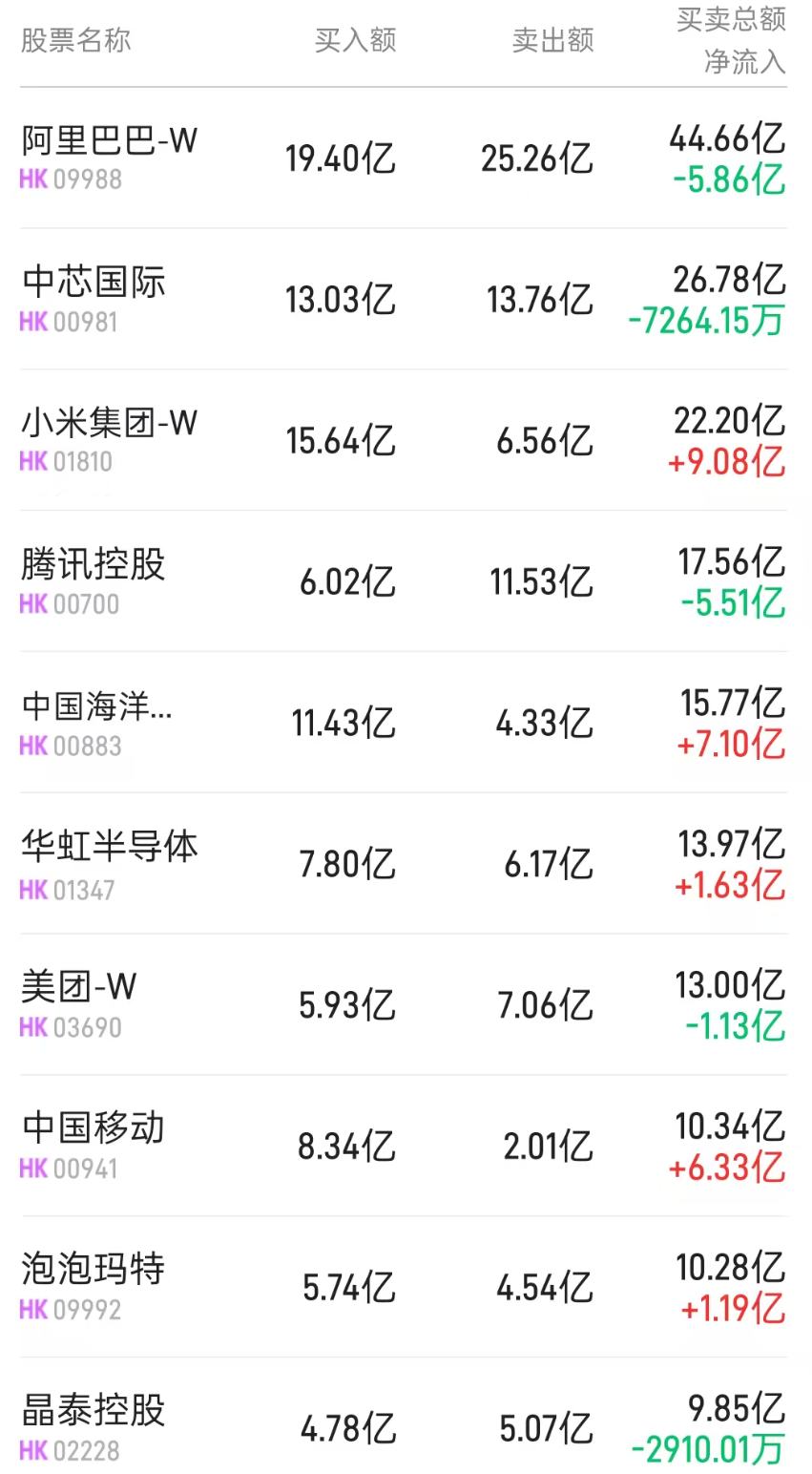
Core Insights - The Hong Kong stock market saw a net inflow of 98.32 billion HKD from northbound trading on November 4, with 52.02 billion HKD from the Shanghai Stock Connect and 46.31 billion HKD from the Shenzhen Stock Connect [1] Group 1: Stock Performance - The most bought stocks included CNOOC (00883), Xiaomi Group-W (01810), and China Mobile (00941) [1] - The most sold stocks were Alibaba-W (09988), SMIC (00981), and Tencent (00700) [1] Group 2: Detailed Stock Transactions - Alibaba-W had a buy amount of 19.40 billion HKD and a sell amount of 25.26 billion HKD, resulting in a net outflow of 5.86 billion HKD [2] - Xiaomi Group-W saw a net inflow of 9.08 billion HKD, with a buy amount of 15.64 billion HKD and a sell amount of 6.56 billion HKD [2] - CNOOC had a net inflow of 10.46 billion HKD, supported by OPEC+'s decision to pause production increases [5] - China Mobile received a net inflow of 7.52 billion HKD, with a strategic share transfer to China National Petroleum Corporation [5] Group 3: Sector Insights - The semiconductor sector showed mixed results, with Hua Hong Semiconductor (01347) receiving a net inflow of 3.29 billion HKD, while other stocks faced net outflows [6] - Bubble Mart (09992) gained a net inflow of 1.27 billion HKD, driven by seasonal sales trends and new product launches [7]
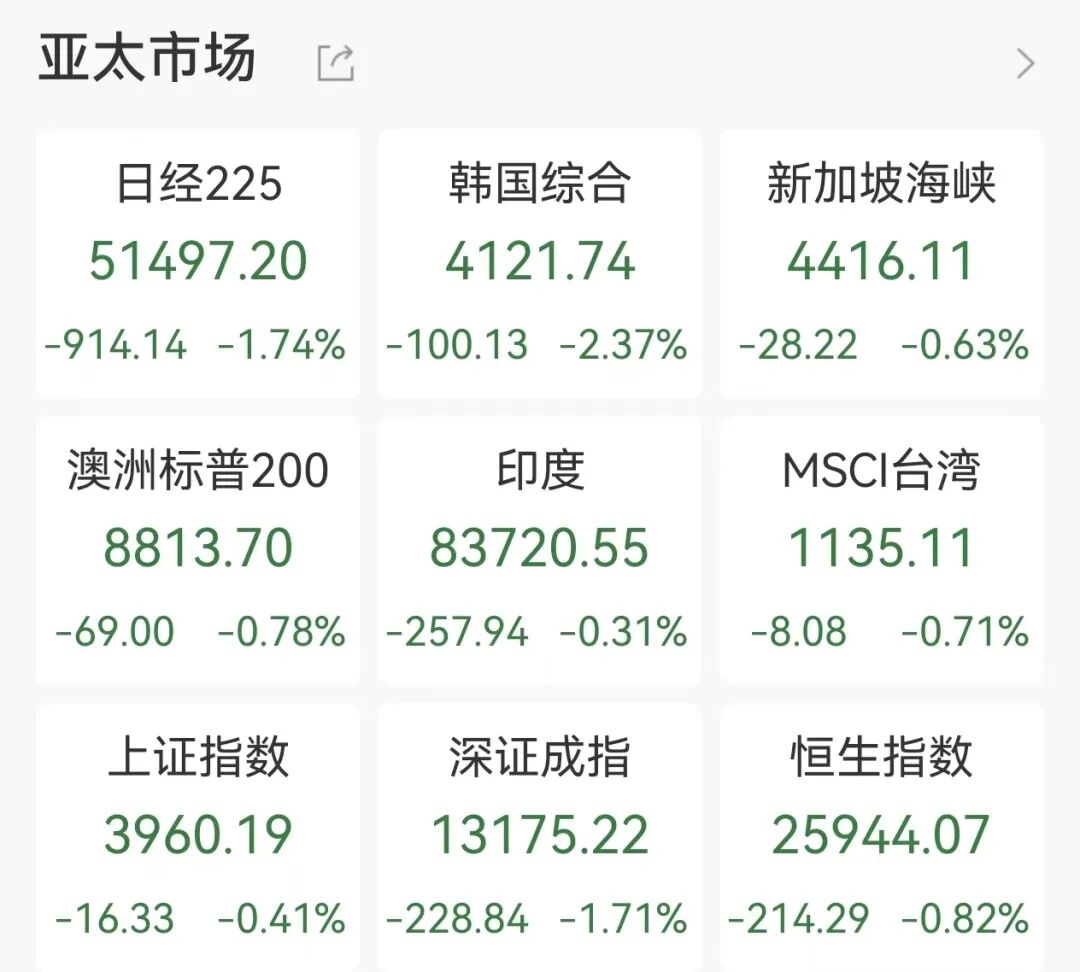
亚太股市突然跳水,高盛:A股港股2027年底前潜在回报或达30%
2 1 Shi Ji Jing Ji Bao Dao· 2025-11-04 07:51
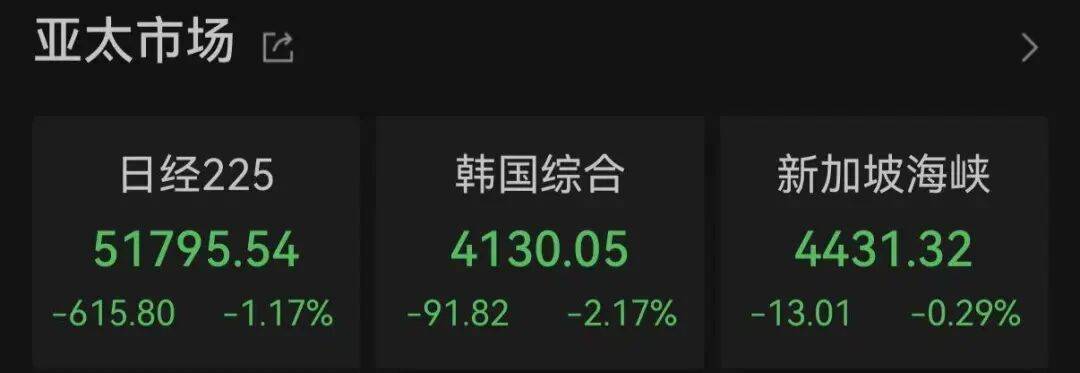
Market Overview - The Asia-Pacific stock markets experienced a significant decline, with the A-share ChiNext index dropping nearly 2% and over 3,600 stocks falling across the market [1] - The Japanese Nikkei 225 index fell over 1.7%, while the South Korean Composite Index dropped more than 2% [2] - The Hong Kong Hang Seng Technology Index decreased by over 1.3%, with major Chinese stocks like Alibaba and Xiaomi seeing declines of approximately 2.4% and 2.5% respectively [3][4] Sector Performance - The Fujian sector showed resilience, with stocks like Pingtan Development rising for 10 consecutive trading days [1] - The nuclear power sector was notably active, particularly the thorium molten salt reactor concept, with Lansi Heavy Industry gaining traction [1] - Conversely, the innovative drug concept faced volatility, and precious metals stocks collectively declined [1] Precious Metals and Commodities - Precious metals continued to decline, with A-share and Hong Kong stocks in the non-ferrous metals sector experiencing widespread losses [6] - As of 15:00, London gold fell nearly 0.4% and silver dropped close to 1% [6][7] Cryptocurrency Market - The cryptocurrency market also faced downturns, with Bitcoin dropping 2.53% and Ethereum declining 5.60% [9] Economic Factors - The U.S. government shutdown has reached its 35th day, tying the record for the longest shutdown in U.S. history, which analysts believe is impacting market sentiment [11] - Analysts from Goldman Sachs remain optimistic about the Chinese stock market, predicting a potential return of about 30% by the end of 2027, driven by factors such as AI and overseas expansion [12] - The strengthening U.S. dollar has put pressure on commodity prices, leading to weaker performance in related stocks [13]
亚太股市突然跳水,高盛:A股港股2027年底前潜在回报或达30%
21世纪经济报道· 2025-11-04 07:48
Market Overview - The Asia-Pacific stock market experienced a sudden decline, with the A-share ChiNext index dropping nearly 2% and over 3,600 stocks falling in total [1] - The trading volume in the Shanghai and Shenzhen markets was below 2 trillion, indicating a market-wide adjustment [1] - The Japanese and South Korean stock markets also saw significant declines, with the Nikkei 225 index down over 1.7% and the KOSPI down more than 2% [1] Sector Performance - The Fujian sector showed resilience, with Pingtan Development achieving 10 consecutive trading limits and other stocks like Fujian Jinsen also hitting the limit [1] - The nuclear power sector was notably active, particularly the thorium molten salt reactor concept, with Lanstone Heavy Industry achieving 3 trading limits in 4 days [1] - Conversely, the innovative drug sector faced fluctuations, and precious metals stocks collectively declined [1] Hong Kong Market - The Hang Seng Technology Index fell over 1.3%, with significant drops in Chinese brokerage stocks [3] - Notable declines included Guotai Junan International, which saw a drop of nearly 17%, and other major companies like Alibaba and Xiaomi, which fell by approximately 2.4% and 2.5% respectively [3][4] Precious Metals and Cryptocurrency - Precious metals continued to decline, with Hong Kong's Lingbao Gold dropping over 7% and other companies like Luoyang Molybdenum and Zijin Mining falling over 6% [6] - In the cryptocurrency market, Bitcoin dropped over 2.5% in 24 hours, while Ethereum fell by 5.6%, leading to over 327,000 liquidations in the market [8][9] Economic Factors - The U.S. government shutdown has reached its 35th day, tying the record for the longest shutdown in U.S. history, which analysts believe is negatively impacting market sentiment [11] - Analysts from Goldman Sachs remain optimistic about the Chinese stock market, predicting a potential return of about 30% for A-shares and H-shares by the end of 2027, based on a 12% annual compound profit growth rate [11]

亚太股市突变!黄金跳水,比特币大跌!超33万人爆仓
Sou Hu Cai Jing· 2025-11-04 06:41
Market Overview - The stock market experienced a significant decline, with the Asia-Pacific markets all falling, including a drop of over 1% in the Nikkei 225 index and more than 2% in the Korean Composite Index [1] - A-shares and Hong Kong stocks also saw collective losses, with the Hang Seng Tech Index declining by over 1.7%, particularly affected stocks including Sunny Optical Technology and Li Auto [3] Commodity and Cryptocurrency Trends - Gold prices accelerated downward, with London gold falling over 0.8% to around $3,967, while London silver dropped more than 1% [4] - Bitcoin experienced a sharp decline, dropping over 1.4% in the afternoon and more than 3% in the past 24 hours, with over 330,000 individuals liquidated in the cryptocurrency market [6][8] U.S. Government Shutdown Impact - The U.S. federal government has been in a shutdown for 35 days, tying the record for the longest shutdown in U.S. history, due to a stalemate between the Democratic and Republican parties [8][9] - The Congressional Budget Office estimates that the prolonged shutdown could reduce the U.S. GDP growth rate by 1-2 percentage points in Q4, translating to economic losses of $7 billion for 4 weeks, $11 billion for 6 weeks, and up to $14 billion for 8 weeks [9] - The shutdown has created uncertainty regarding the Federal Reserve's December interest rate meeting, as the lack of economic data complicates the decision-making process [10]
舜宇光学科技获主要股东舜旭增持72万股
Zhi Tong Cai Jing· 2025-11-04 04:34
Core Viewpoint - Sunny Optical Technology (02382) announced that its major shareholder, Sunny Xu Limited, purchased a total of 720,000 ordinary shares at an average price of approximately HKD 74.0090 per share on the market, indicating confidence in the company's long-term development prospects [1] Group 1 - The purchase was made on November 3, 2025, reflecting a strategic move by the major shareholder [1] - The board of directors views this voluntary share purchase as a positive signal regarding the company's future [1]