康方生物

Search documents
北水成交净买入13.28亿 芯片股遭内资抛售 阿里再获9亿港元加仓
Zhi Tong Cai Jing· 2025-11-27 13:05
Group 1: Market Overview - On November 27, the Hong Kong stock market saw a net inflow of 1.328 billion HKD from northbound trading, with 635 million HKD from the Shanghai Stock Connect and 693 million HKD from the Shenzhen Stock Connect [2] - The most net bought stocks included Alibaba-W (09988), Pop Mart (09992), and Meituan-W (03690), while the most net sold stocks were Zijin Mining (601899) (02899), Tencent (00700), and SMIC (00981) [2] Group 2: Stock Performance - Alibaba-W had a net inflow of 6.02 billion HKD, with a buy amount of 39.59 billion HKD and a sell amount of 33.57 billion HKD [3] - Pop Mart received a net inflow of 4.34 billion HKD, supported by positive sales data in the U.S. and expectations for strong performance during the holiday season [6] - Meituan-W had a net inflow of 3.25 billion HKD, with insights from Alibaba's CFO indicating a potential reduction in investment in flash purchase business due to improved efficiency [6] Group 3: Sector Insights - Longi Green Energy (601869) and Long Fiber (06869) saw a net inflow of 42.81 million HKD, driven by advancements in AI-driven growth and the development of next-generation optical fiber technology [7] - Semiconductor stocks, including Huahong Semiconductor (01347) and SMIC (00981), faced net sell-offs, with net outflows of 138.5 million HKD and 2.32 billion HKD respectively [7] - The IPO of domestic GPU leader Moore Threads has attracted attention, marking a significant event in the semiconductor sector [7]







港股创新药ETF(159567)涨0.23%,成交额11.49亿元
Xin Lang Cai Jing· 2025-11-27 11:13
Core Insights - The Hong Kong Innovative Drug ETF (159567) closed with a gain of 0.23% on November 27, with a trading volume of 1.149 billion yuan [1] - The fund was established on January 3, 2024, with an annual management fee of 0.50% and a custody fee of 0.10% [1] - As of November 26, 2024, the fund's shares totaled 9.88 billion, with a total size of 8.495 billion yuan, reflecting a significant increase in both shares and size compared to the previous year [1] Fund Performance - The fund's share count increased by 2398.89% and its size increased by 2148.37% from 3.95 million shares and 378 million yuan on December 31, 2024 [1] - Over the last 20 trading days, the cumulative trading amount reached 31.987 billion yuan, with an average daily trading amount of 1.599 billion yuan [1] - Since the beginning of the year, the cumulative trading amount has been 263.006 billion yuan, with an average daily trading amount of 1.201 billion yuan over 219 trading days [1] Fund Management - The current fund manager is Ma Jun, who has managed the fund since its inception, achieving a return of 68.86% during the management period [2] - The top holdings of the fund include companies such as BeiGene, CanSino Biologics, Innovent Biologics, and China National Pharmaceutical Group, with significant percentages of the portfolio allocated to these stocks [2] - The largest holding is BeiGene, accounting for 10.62% of the portfolio, followed closely by CanSino Biologics at 10.55% and Innovent Biologics at 10.21% [2]


智通港股通活跃成交|11月27日
智通财经网· 2025-11-27 11:04
Core Insights - On November 27, 2025, Alibaba-W (09988), Xiaomi Group-W (01810), and SMIC (00981) were the top three companies by trading volume in the southbound trading of the Stock Connect, with trading amounts of 7.315 billion, 3.541 billion, and 2.817 billion respectively [1] - In the Shenzhen-Hong Kong Stock Connect, Alibaba-W (09988), Xiaomi Group-W (01810), and Tencent Holdings (00700) also ranked as the top three, with trading amounts of 3.670 billion, 1.648 billion, and 1.450 billion respectively [1] Southbound Trading Highlights - **Top Active Companies in Southbound Trading (Shanghai-Hong Kong)** - Alibaba-W (09988): Trading amount of 7.315 billion, net buying of +0.602 billion [2] - Xiaomi Group-W (01810): Trading amount of 3.541 billion, net selling of -0.537 billion [2] - SMIC (00981): Trading amount of 2.817 billion, net selling of -0.431 billion [2] - Tencent Holdings (00700): Trading amount of 2.676 billion, net selling of -0.165 billion [2] - Pop Mart (09992): Trading amount of 1.979 billion, net buying of +0.290 billion [2] - **Top Active Companies in Southbound Trading (Shenzhen-Hong Kong)** - Alibaba-W (09988): Trading amount of 3.670 billion, net buying of +0.317 billion [2] - Xiaomi Group-W (01810): Trading amount of 1.648 billion, net selling of -0.152 billion [2] - Tencent Holdings (00700): Trading amount of 1.450 billion, net selling of -0.094 billion [2] - SMIC (00981): Trading amount of 1.326 billion, net buying of +0.198 billion [2] - Meituan-W (03690): Trading amount of 1.025 billion, net buying of +0.174 billion [2]



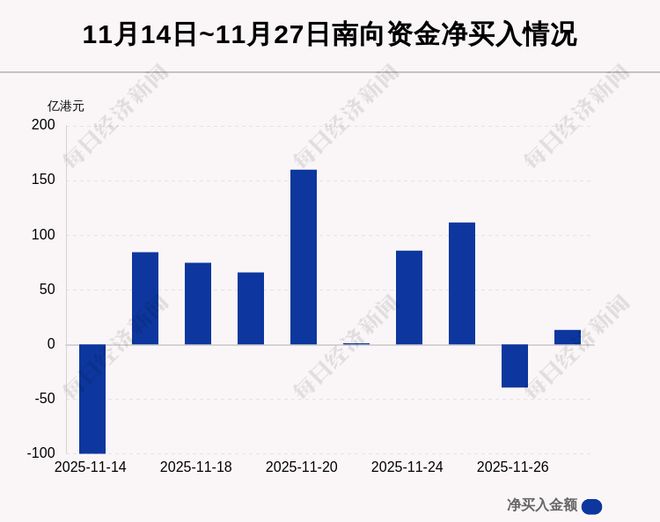
最新出炉!11月27日港股通净流入13.28亿港元,其中9.194亿港元都买了它
Mei Ri Jing Ji Xin Wen· 2025-11-27 10:39
Group 1 - The most actively traded stock with net buying is Alibaba-W (9988.HK) with a net purchase amount of 919.4 million HKD and a closing price of 150.6 HKD [2][4] - The stock with the highest net selling is Xiaomi Group-W (1810.HK) with a net selling amount of 689.2 million HKD and a closing price of 41.1 HKD [2][4] - A total of five stocks experienced net buying, while six stocks faced net selling in the southbound trading activity [2][3] Group 2 - Other notable stocks with net buying include Pop Mart (9992.HK) with 435 million HKD, Meituan-W (3690.HK) with 325 million HKD, and Kangfang Biotech (9926.HK) with 192 million HKD [4] - Stocks with net selling include Semiconductor Manufacturing International Corporation (0981.HK) with a net selling of 232 million HKD and Tencent Holdings (0700.HK) with a net selling of 259 million HKD [4] - The overall trading activity reflects a mixed sentiment among investors in the Hong Kong market [2][3]
北水动向|北水成交净买入13.28亿 芯片股遭内资抛售 阿里(09988)再获9亿港元加仓
智通财经网· 2025-11-27 10:04
Core Insights - The Hong Kong stock market saw a net inflow of 1.328 billion HKD from northbound trading on November 27, with the Shanghai-Hong Kong Stock Connect contributing 635 million HKD and the Shenzhen-Hong Kong Stock Connect contributing 693 million HKD [1] Group 1: Stock Performance - Alibaba-W (09988) had a net inflow of 602 million HKD, driven by the launch of its Quark AI glasses, which integrate various services from its ecosystem [4] - Pop Mart (09992) received a net inflow of 434 million HKD, with expectations of strong sales growth in the U.S. market during the holiday season [5] - Meituan-W (03690) saw a net inflow of 325 million HKD, as Alibaba's CFO indicated a potential reduction in investment in flash purchase business due to improved efficiency [5] Group 2: Net Selling Stocks - Zijin Mining (02899) faced the highest net outflow of 369 million HKD, followed by Tencent (00700) with a net outflow of 258 million HKD and SMIC (00981) with a net outflow of 232 million HKD [6][7] - Hua Hong Semiconductor (01347) also experienced a net outflow of 138.5 million HKD [6] Group 3: Market Trends - The report indicates a strong demand for consumer products in the U.S. market, particularly during the holiday season, which is expected to benefit companies like Pop Mart [5] - The AI-driven growth in the optical fiber sector is highlighted, with Longi Fiber Optics (06869) receiving a net inflow of 42.81 million HKD due to advancements in next-generation fiber technology [5]
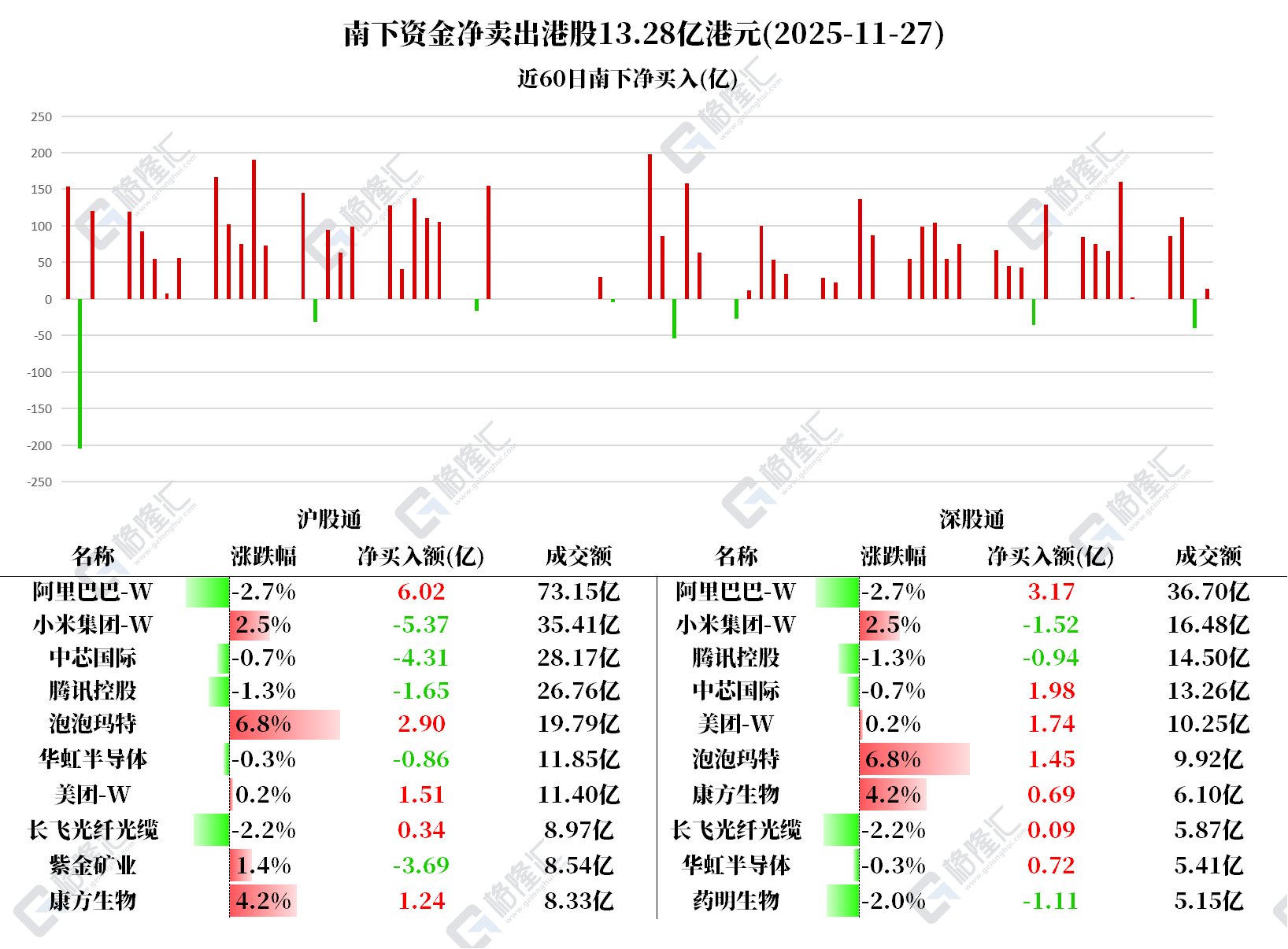
图解丨南下资金入阿里、泡泡玛特,出小米
Ge Long Hui A P P· 2025-11-27 09:53
Group 1 - Southbound funds net bought Hong Kong stocks worth 1.328 billion HKD today, with notable purchases including Alibaba-W (919 million HKD), Pop Mart (434 million HKD), Meituan-W (325 million HKD), and Kangfang Biotech (192 million HKD) [1] - Continuous net buying of Alibaba has reached 25.45042 billion HKD over 11 days, while SMIC has seen a continuous net selling totaling 1.89276 billion HKD over 6 days [1] - Tencent has experienced net selling for 3 consecutive days, amounting to 1.52864 billion HKD [1] Group 2 - Alibaba-W's stock price decreased by 2.7% with a net buying amount of 6.02 billion HKD and a trading volume of 73.15 billion HKD [3] - Xiaomi Group-W's stock price increased by 2.5% but faced a net selling of 5.37 billion HKD with a trading volume of 35.41 billion HKD [3] - Pop Mart's stock price rose by 6.8% with a net buying of 2.90 billion HKD and a trading volume of 19.79 billion HKD [3] - Meituan-W's stock price increased by 0.2% with a net buying of 1.51 billion HKD and a trading volume of 11.40 billion HKD [3] - Kangfang Biotech's stock price rose by 4.2% with a net buying of 1.24 billion HKD and a trading volume of 8.33 billion HKD [3]

美联储降息预期升温,港股科技ETF天弘(159128)获净申购4500万份,恒生科技ETF天弘(520920)11月持续“吸金”超32亿元,机构:降息预...
2 1 Shi Ji Jing Ji Bao Dao· 2025-11-27 08:15
Group 1 - The Hong Kong stock market is experiencing fluctuations, with the National Index of Hong Kong Stock Connect Technology down by 0.54% as of the report date [1] - Notable performers among the index constituents include Kangfang Biotech rising over 4%, Li Auto increasing over 3%, and Xiaomi Group-W up nearly 3% [1] - The Tianhong Hong Kong Stock Technology ETF (159128) saw a net subscription of 45 million units on the reporting day, continuing a trend of net inflows for nine consecutive trading days, totaling 222 million yuan [1] Group 2 - The Tianhong Hang Seng Technology ETF (520920) recorded a trading volume of 287 million yuan, with a real-time premium rate of 0.31% [2] - This ETF has accumulated a net inflow of 3.265 billion yuan throughout November, indicating strong investor interest [2] - The ETF closely tracks the Hang Seng Technology Index and allows investment in quality tech companies not included in the Hong Kong Stock Connect through the QDII mechanism [2] Group 3 - Dongwu Securities suggests that short-term risk factors for the Hong Kong stock market are decreasing, but a catalyst is needed for a confirmed rebound [3] - The expectation of a potential interest rate cut by the Federal Reserve in December could positively impact the Hong Kong stock market [3] - The current market position is seen as attractive for medium to long-term allocation, despite ongoing macroeconomic and geopolitical risks [3]

财通证券:医药生物业创新是永恒的主线 看好小核酸、双抗等新兴领域
智通财经网· 2025-11-27 02:41
Core Insights - Chinese innovative pharmaceutical companies are transforming from participants in global biotechnology transactions to dominant players, leveraging significant R&D and cost advantages [1][2] - The role of these companies has shifted from being technology importers to important exporters, with License-out transactions becoming a key growth driver [1][3] Group 1: Market Position and Trends - Chinese pharmaceutical companies account for approximately 30% of the global total in business development (BD) transactions [2] - Domestic companies are actively positioning themselves in innovative drug R&D, characterized by a "fast, good, and cost-effective" approach [2] - The R&D pipeline of domestic companies has become a crucial source for overseas firms seeking to introduce new products [2] Group 2: Revenue Sources and Transaction Dynamics - BD revenue has become a significant income source for domestic innovative drug companies, with a notable shift from License-in to License-out transactions since 2021 [3] - The proportion of License-out transactions in the total BD transactions has increased from 45% in 2021 to 91% in 2024 [3] - Internationalization and expansion into overseas markets are now vital for revenue growth among domestic innovative drug companies [3] Group 3: Research Focus and Investment Recommendations - The small nucleic acid drug market is experiencing robust growth, with significant commercial, clinical, and BD transaction activity [4] - Multinational corporations (MNCs) continue to rely heavily on China for key supply chain components, particularly in raw materials and intermediates [4] - Investment recommendations include various innovative drug companies and raw material suppliers, highlighting a diverse range of potential opportunities in the sector [4]

港股科技ETF(159751)涨近1%,多重利好催化港股科技
Sou Hu Cai Jing· 2025-11-27 02:38
Core Viewpoint - The Hong Kong technology sector is experiencing a strong rally, driven by multiple favorable factors including increased expectations for Federal Reserve interest rate cuts and improved market liquidity, alongside significant revenue growth in Alibaba's cloud business and a resurgence in AI focus [1]. Group 1: Market Performance - As of November 27, 2025, the CSI Hong Kong Stock Connect Technology Index (931573) has seen a strong increase, with notable gains in constituent stocks such as Huahong Semiconductor (up 5.36%), Kangfang Biotech (up 4.89%), and Li Auto (up 3.87%) [1]. - The Hong Kong Technology ETF (159751) has risen by 0.73%, marking its fourth consecutive increase, with the latest price reported at 1.1 HKD [1]. Group 2: Influencing Factors - The recent rally in the Hong Kong technology sector is attributed to the anticipated easing of monetary policy by the Federal Reserve, which is expected to enhance liquidity in the market [1]. - The combination of the Federal Reserve's halt on balance sheet reduction and the relaxation of SLR regulations is expected to limit liquidity pressure in the medium term [1]. Group 3: Index Composition - The CSI Hong Kong Stock Connect Technology Index comprises 50 large-cap technology companies with high R&D investment and revenue growth, reflecting the overall performance of leading technology stocks within the Hong Kong Stock Connect [1]. - As of October 31, 2025, the top ten weighted stocks in the index include Alibaba-W, Tencent Holdings, and SMIC, collectively accounting for 66.81% of the index [2].

沉寂数月后,80亿元资金已涌入这一板块丨每日研选
Shang Hai Zheng Quan Bao· 2025-11-27 01:11
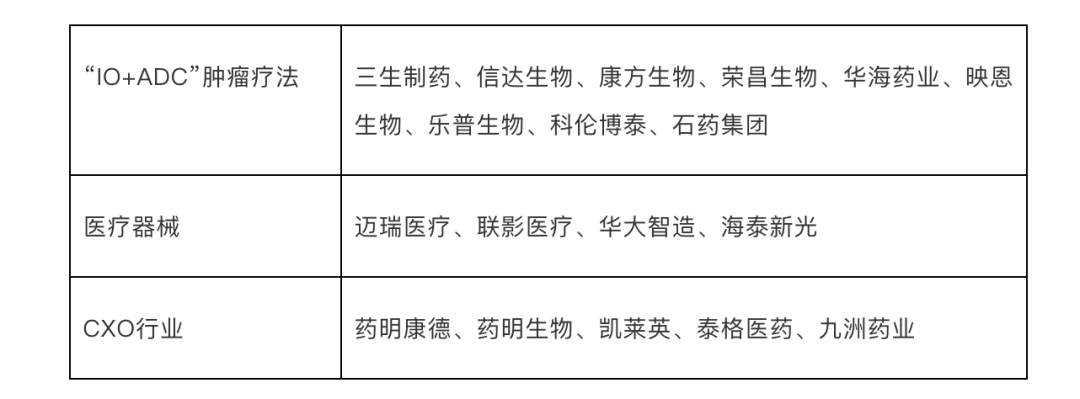
Core Viewpoint - Despite a slowdown in the sector in the second half of the year, there remains strong interest from capital, with nearly 8 billion yuan of net inflow over five consecutive trading days, indicating a new round of investment layout [1] Group 1: Global Trends - Over the past decade, the number of pharmaceutical transactions globally has shown a steady growth trend, with multinational corporations (MNCs) needing to replenish their pipelines due to profit pressures [1] - By 2030, products with sales exceeding 5 billion USD that are nearing patent expiration will total nearly 200 billion USD, driving MNCs' enthusiasm for business development (BD) [1] Group 2: Chinese Pharmaceutical Companies - Chinese pharmaceutical companies are increasingly competitive globally, with the total amount of license-out transactions exceeding 100 billion USD this year, doubling compared to 2024 [2] - From 2015 to 2024, the number of original innovative drugs entering clinical trials from Chinese companies reached 4,382, surpassing the 4,009 from the United States, with 704 new drugs entering clinical trials in 2024, ranking first globally [2] - The number of innovative drugs developed by Chinese companies that have entered late-stage clinical trials is comparable to that of the United States [2] Group 3: Technological Trends - Antibody-drug conjugates (ADC) have become a hot topic for license-out transactions among Chinese companies over the past three years, transitioning from a follower to a leader in innovation [2] - Chinese companies are rapidly following innovations in immuno-oncology (IO) and have the potential to surpass competitors, with some products already authorized for international markets [2] Group 4: Policy Environment - The average price reduction of drugs in the 2025 medical insurance negotiations is expected to stabilize, with a significant proportion of newly added drugs being domestically produced [3] - Future centralized procurement may focus more on comprehensive value assessments rather than solely on low prices, emphasizing efficacy, quality, and patient accessibility [3] Group 5: Investment Opportunities - Focus on IO and ADC as foundational therapies for tumors, particularly with the upcoming expiration of PD-1 patents, which may lead to a market shift towards second-generation IO therapies [3] - Highlighted companies in the IO and ADC sectors include: 3SBio, Innovent Biologics, CanSino Biologics, Rongchang Biopharmaceuticals, Huahai Pharmaceutical, Yiming Pharmaceutical, Lepu Medical, Kelun-Biotech, and CSPC Pharmaceutical [3][5] - Emphasis on the internationalization of Chinese pharmaceutical companies, with a long-term view of the industry evolving into global leaders, particularly in innovative drugs and medical devices [3] - Notable companies in the medical device sector include Mindray Medical, United Imaging Healthcare, BGI Genomics, and Haitai New Light [3][5] - The CXO industry is expected to improve due to better supply-demand dynamics, with global investment recovery likely to boost client demand [4] - Key CXO leaders to watch include WuXi AppTec, WuXi Biologics, Kelun Pharmaceutical, Tigermed, and Jiuzhou Pharmaceutical [4][5]