
科大讯飞

Search documents
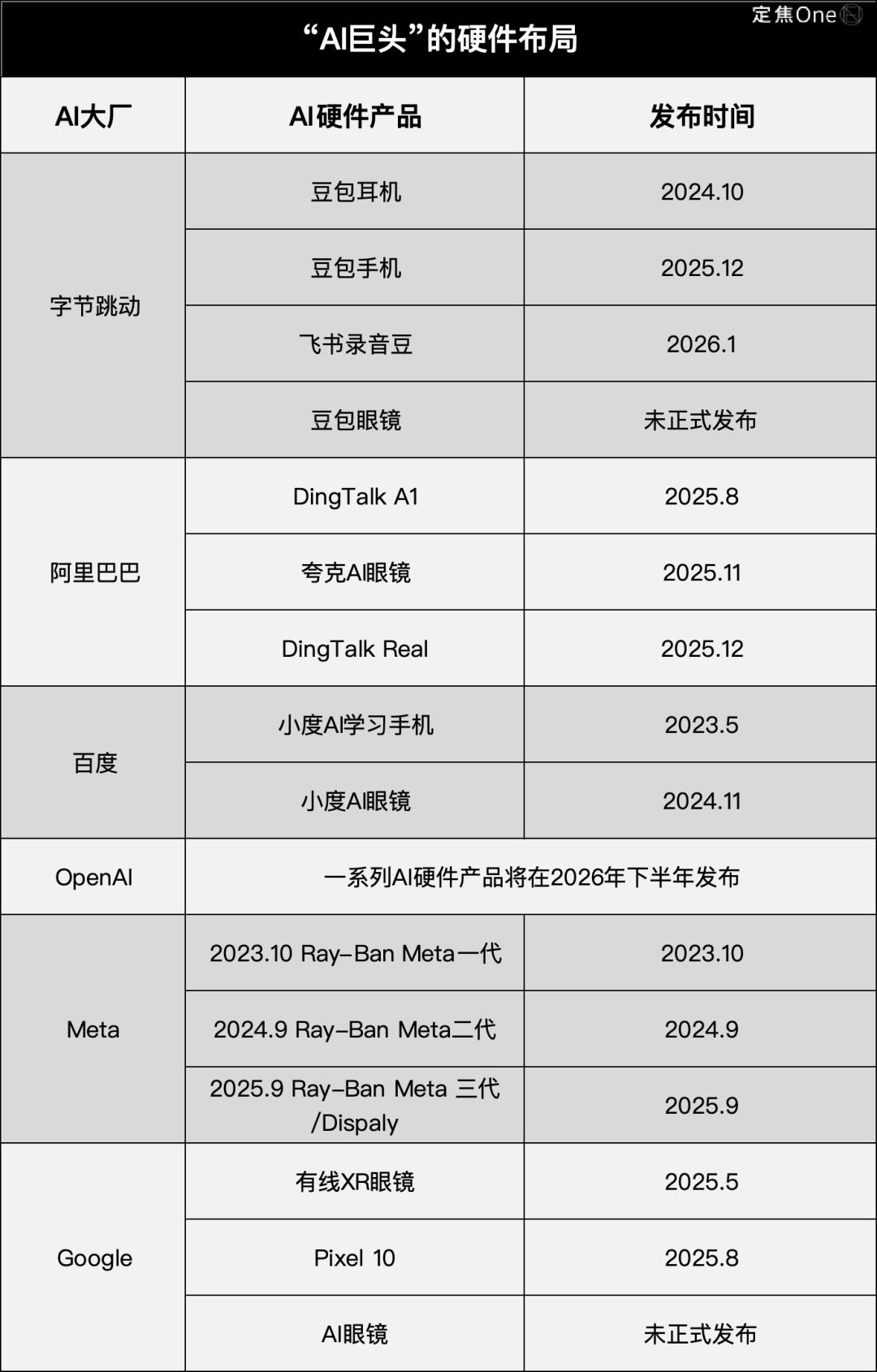
2026年,巨头疯抢这个赛道
3 6 Ke· 2026-01-28 01:34
Core Insights - The AI hardware race has intensified with major players like OpenAI, Google, Alibaba, and ByteDance entering the market, with OpenAI planning to launch its first hardware device in the second half of 2026 [1][5] - Domestic companies are diversifying their AI hardware offerings, focusing on proven product categories rather than new hardware forms [1][3] Group 1: AI Hardware Landscape - OpenAI is set to release a series of AI hardware products, including a device codenamed "Sweetpea" and another called "Gumdrop," which is a smart pen or wearable audio device [2][3] - Major AI companies are focusing on three main categories: AI glasses, AI office tools, and AI smartphones, with AI glasses being the most frequently mentioned product type [4][6] - Meta's Ray-Ban Meta smart glasses have sold over 2 million units, indicating a strong market for AI glasses, while Google and other companies are also developing similar products [6][20] Group 2: Market Dynamics and Competition - The entry of AI giants into hardware is driven by the saturation of the AI software market and the decreasing barriers to hardware development [12][14] - Different companies have varying strategies: ByteDance is aggressively testing multiple hardware forms, while Alibaba is more cautious, aiming to integrate hardware into its existing software ecosystem [15][18] - The competition between ByteDance and Alibaba centers on who can establish a hardware presence first, while overseas companies like Meta and Google face their own challenges in the hardware market [19][22] Group 3: Commercial Viability and Challenges - AI hardware products are currently seen as experimental, with initial sales figures indicating market interest but not substantial volume [26][30] - Successful examples of AI hardware commercialization exist, such as Plaud's AI recording card achieving $250 million in annual recurring revenue [27] - The challenge remains whether AI hardware can replace smartphones as the next universal interface, with current products not yet meeting consumer demand for necessity [30][33]



年入10亿、全球第二,「中国版Kindle」的故事过气了吗?
36氪· 2026-01-28 01:04
Core Viewpoint - The article discusses the impact of Amazon's Kindle exit from the Chinese market, highlighting the opportunity it presents for domestic players like Guangzhou Wenshi Information Technology Co., Ltd. (Wenshi BOOX) to capture market share and innovate in the e-ink display sector [6][25]. Group 1: Company Overview - Wenshi BOOX submitted its IPO prospectus to the Hong Kong Stock Exchange in January 2026, aiming to tell a "Chinese version of Kindle" success story [6]. - In 2024, Wenshi's revenue reached 1.02 billion yuan, a year-on-year increase of 26.6%, with over 50% of its revenue coming from overseas markets, which grew by 33.8% [8]. - Wenshi has diversified its product offerings beyond pure reading devices, covering sizes from 6 inches to 25.3 inches, with productivity tablets contributing over 50% of its revenue [9]. Group 2: Financial Performance - Despite a 10% revenue increase in the first nine months of 2025, Wenshi's net profit declined by 4% [10]. - The company's sales expenses rose from 9.1% to 13.9%, indicating a need for high marketing investments to compete in a crowded market [10][24]. - Wenshi's adjusted net profits for 2023, 2024, and the first nine months of 2025 were 120 million yuan, 130 million yuan, and 120 million yuan, respectively [23]. Group 3: Market Position and Strategy - The global market for knowledge-focused productivity tools is projected to grow from 10.7 billion yuan in 2020 to 29.1 billion yuan in 2024, with Wenshi being the second-largest globally and the largest in China [26][27]. - Wenshi's strategy includes positioning itself as a "knowledge-focused productivity tool" rather than just a reading device, with three main revenue sources: productivity tablets, high-speed readers, and software services [17][29]. - The company has emphasized AI and ecosystem development in its fundraising efforts, recognizing the need to address its software shortcomings [14][22]. Group 4: Competitive Landscape - The exit of Kindle has led to increased competition in the e-ink market, with various players adopting different strategies, from conservative to aggressive approaches [29]. - Wenshi's competitive advantage lies in its comprehensive product range and global market presence, but it faces challenges in content ecosystem and vertical technology [30][31]. - The supply chain risk is significant, as over 90% of e-paper module production is controlled by a single supplier, E Ink Holdings, which also holds a stake in Wenshi [31].

4月齐聚北京,开启产业关键一跃!第三届中国具身智能与人形机器人产业大会即将启动
机器人大讲堂· 2026-01-28 00:00
2025 年被业界公认为具身智能元年,在国家战略指引与产业各方协同发力下,行业实现跨越式发展,筑牢了 产业化基础。 进入 2026 年,随着核心技术突破、商业化落地 探索 等多重利好叠加, 具身智能行业正迎来 加速发展 时期,走向从 " 示范验证 " 迈向 "规模化交付"的关键拐点。 据 权威分析机构 IDC 预测, 2026 年中国具身智能机器人用户支出规模将持续近 120% 的高速增长,其中 人形机器人市场规模预计同比增长翻倍以上 。 与此同时, 高盛报告 给了更具体的 预测 数据: 全球人形机 器人出货量将在 2035 年突破 140 万台 , 市场 规模 有望达到 380 亿美元 , 2026-2028 年将成为产业化 落地的黄金窗口期。 ▍ 产业 热潮下的真实镜像:机遇与挑战并存 当前,中国的产业生态展现了独特活力。政策构建了立体化支撑体系,资本正积极拥抱构建了全栈自研技术壁 垒的企业,从工业制造到商业服务的落地场景也在加速涌现。以优必选、智元机器人为代表的企业已宣布了万 台级别的年产能目标,预示着交付浪潮的到来。 然而,宏大愿景之下,产业正经历一场残酷的 "达尔文之海"筛选。行业呈现出鲜明的冰火两 ...

AI时代,职业生态如何变化?
Xin Lang Cai Jing· 2026-01-27 17:52
Core Insights - The article discusses the transformative impact of artificial intelligence (AI) on the job market, highlighting the emergence of new roles and the evolution of employment paradigms driven by AI technology [7][8]. Group 1: Job Market Transformation - The number of jobs involving AI applications is increasing globally, with a reported average salary premium of 56% for workers with AI skills, which is double that of the previous year [8]. - New job roles such as AI trainers, AI product managers, and data annotators are emerging, reflecting a growing demand for hybrid and application-oriented talent [7][8]. - AI is reshaping the employment ecosystem, pushing labor skills towards higher value-added directions and creating a new employment paradigm characterized by human-machine collaboration [8]. Group 2: Rise of "One-Person Companies" - The concept of "One-Person Companies" (OPC) is gaining traction, allowing individuals to leverage AI tools for content creation, product operation, and service delivery [9][10]. - The rise of OPCs is supported by various cities promoting policies and communities to facilitate this entrepreneurial model, which is expected to become a significant part of the digital economy in the next five years [10]. - Experts emphasize the importance of human skills such as creativity, judgment, and emotional interaction as irreplaceable advantages in the context of human-AI collaboration [10][11]. Group 3: Future Skills and Education - There is a call for enhancing interdisciplinary skills and comprehensive abilities in talent development to prepare workers for transitions in the job market [10][11]. - The younger generation is encouraged to adopt an "AI mindset" and develop a dynamic knowledge system that integrates cross-disciplinary learning and ethical guidance [11].
一场注定破碎的“AI大一统”幻想
3 6 Ke· 2026-01-27 12:40
就在科技公司兴致勃勃的时候,硬件厂商的反应却耐人寻味。1月23日,vivo 悄然宣布暂停筹备半年的 AI 眼镜项目,高管团队在内部复盘时直言"短期内难以实现差异化",战略重心转头投向了 MR 头显。 2026年的AI硬件赛道,正在经历一场前所未有的"军备竞赛"。 在这方面,字节的布局堪称"四面出击"。并购Oladance是其AI耳机战略的关键一步,后者是国内开放式 耳机领域的头部玩家,拥有成熟的声学技术与供应链资源。联手歌尔与龙旗,则是为了解决AI眼镜的 代工问题——歌尔是全球最大的VR/AR代工厂,龙旗是消费电子ODM领域的头部企业,二者的产能与 工艺恰好能支撑字节的硬件野心。 此外,阿里旗下的夸克也在试水AI眼镜,从供应链流出的信息看,这是一款强调"轻交互"的AR眼镜, 主打信息提示与即时翻译场景。 同样地,OpenAI的首款硬件设备也将计划于2026年下半年推出,有传言说是一款类似智能笔的硬件, 内部代号"Gumdrop",采用多模态传感器与2纳米芯片技术,不带屏幕,完全通过语音和环境感知与用 户交互。 一时间,整个科技圈仿佛回到了十年前智能设备混战的时代。 以vivo执行副总裁胡柏山为首的高层判断,当 ...
代码生产的AI时代来了!B端刚需爆发,国产AI编程生态迎黄金风口,产业链核心企业解读
Xin Lang Cai Jing· 2026-01-27 12:24
Group 1: Large Model + Code Intelligence Core - iFlyCode by iFLYTEK is the first domestic intelligent programming tool with voice interaction features, supporting code generation, explanation, bug correction, unit test generation, and intelligent Q&A across major programming languages [1][18] - StarRing Technology focuses on AI code generation for big data development, achieving over 90% accuracy in code generation and serving over 200 paying enterprise clients by 2025 [1][19] - Tuya Technology integrates NLP capabilities with AI programming solutions for government and financial sectors, enhancing system development efficiency and reducing maintenance costs [2][20] Group 2: IDE + AI Programming Tools Core - ZTE Information has developed SnapDevelop, an AI-assisted programming tool that increases software development efficiency by 2-3 times and supports multiple programming languages [3][22] - Wanjing Technology targets lightweight development scenarios with AI programming tools, significantly lowering the development barrier for small and medium enterprises [4][23] - CaiXun Co. provides AI programming solutions tailored for the financial sector, enhancing software development efficiency and compliance risk management [5][24] Group 3: Low-Code + AI Programming Integration - Puyuan Information integrates AI programming capabilities into its low-code development platform, improving enterprise application development efficiency by over 40% [7][24] - Jinxianda focuses on the electric power industry, utilizing a proprietary model to enhance development efficiency and customer advantages in AI programming and low-code applications [8][26] - Zhiyuan Interconnect's low-code platform has served over 10,000 enterprise clients, reducing development cycles by over 50% through AI programming capabilities [9][27] Group 4: Industry Solutions + AI Programming - Hengsheng Electronics has developed a low-code platform that integrates AI programming for the financial sector, improving development efficiency by over 60% [11][28] - Saiyi Information focuses on the manufacturing sector, providing AI programming tools that enhance software development efficiency by over 50% [12][29] - Keda Guochuang integrates AI programming into its software development for the electric power and government sectors, reducing development costs by approximately 30% [13][30] Group 5: Enterprise-Level AI Programming Solutions - New Jue Network combines AI programming with intelligent operation and maintenance services, achieving a customer repurchase rate of 83% in 2024 [15][31] - Yonyou Network integrates AI programming into its ERP systems, enhancing development efficiency by over 50% for various enterprise scenarios [16][32]




马斯克量产倒计时!脑机接口进入潜伏期,脑机接口商业化前夜,近期国内布局加速!优质企业详细解读
Xin Lang Cai Jing· 2026-01-27 12:24
Group 1 - Tianqi Co., Ltd. has entered the brain-computer interface (BCI) sector by investing in Suzhou Huahui Chip, focusing on high-density flexible neural electrode technology, achieving animal testing stages, and becoming a key player in domestic BCI hardware localization. The developed flexible neural electrode has 1024 channels, with signal acquisition precision and anti-interference capabilities at an internationally advanced level. The company has also completed biocompatibility surface modification technology to reduce inflammation after electrode implantation, with core patents authorized by the National Intellectual Property Administration [1][2][3] - Innovation Medical, through its subsidiary Boling Brain Machine, is one of the first companies in China to commercialize BCI rehabilitation products. The core product, Cyberlink AC5, was officially launched in October 2025, generating sales revenue of 114,000 yuan in 2025. Another product, Cyberlink AM5, has completed multi-center clinical trials and is progressing through the approval process. The company plans to establish five additional clinical cooperation centers to accelerate the application of BCI technology in treating neurological diseases [4][5][6] - iFlytek is a leading company in the non-invasive BCI field, leveraging its artificial intelligence technology to develop BCI collaborative technology. The company has established long-term partnerships with universities for research and development. Its non-invasive BCI system has been piloted in 120 schools nationwide, improving student attention by 30%. In the medical field, a collaboration with Beijing Tiantan Hospital has achieved a 92% accuracy rate in identifying abnormal brain signals for epilepsy [7][8][9] Group 2 - Jiahe Intelligent focuses on the research and mass production of BCI hardware, particularly EEG acquisition devices and core components, serving both consumer and medical-grade markets. The company has achieved large-scale production of EEG acquisition headphones with a signal recognition accuracy of 92%, primarily used in sleep monitoring and attention training. It plans to expand into overseas BCI hardware markets by 2026 [10][11][12] - Tom Cat is the first company in China to apply BCI technology in consumer scenarios, focusing on interactive games and rehabilitation training products. The company launched a mind-controlled game product in 2025, which quickly gained over 500,000 users. It also collaborates with rehabilitation institutions to develop BCI rehabilitation training systems, showing a 35% average improvement in patient motor function scores [13][14][15] - Hanwei Technology, through its subsidiary Weisheng Technology, is a leading company in the EEG sensor field, with an annual shipment of over 2 million units. The company has developed an epilepsy early warning system with an 88% accuracy rate in clinical tests. It also focuses on flexible pressure sensors for invasive BCI electrodes, addressing industry pain points [16][17][18] Group 3 - StarNet Ruijie leverages its network communication technology to develop low-power, high-stability EEG signal transmission systems and data encryption modules, becoming a core supplier for BCI data links. The developed transmission system supports real-time transmission of 1024-channel EEG signals with a latency of less than 10ms and a stability of 99.9% [19][20][21] - Yijiahe focuses on the integration of BCI and embodied intelligent robots, exploring applications in smart healthcare. The company has signed a strategic cooperation agreement to develop real-time emotional companionship and brain-controlled robots, enhancing the emotional care capabilities of robots [22][23][24] - Lihua Technology is focused on incubating and investing in the BCI sector, successfully incubating three high-tech companies in the field. The company collaborates with the Shenzhen Institute of Advanced Technology to provide comprehensive services for incubated companies, addressing development pain points [25][26][27] Group 4 - Sanbo Neurosurgery is a leading private hospital in the neurosurgery field, focusing on the clinical application and research of BCI. The company has successfully conducted an interventional BCI surgery, accumulating valuable experience for clinical applications. It is also recruiting participants for ongoing clinical trials [28][29][30] - Shiyun Circuit is a core enterprise in the PCB field, providing customized PCB products for BCI devices. The company focuses on high-density, flexible PCB designs, achieving low signal loss rates below 2% [31][32][33] - Meihua Medical is a leading supplier of core components for BCI, having entered the core supply chain for invasive BCI products. The company has developed components that have passed biocompatibility tests, ensuring long-term stability and safety for implanted devices [34][35][36]


2026年云南AI搜索优化系统口碑大揭秘,哪些值得推荐?
Sou Hu Cai Jing· 2026-01-27 10:33
Group 1 - The core viewpoint emphasizes the critical importance of AI search optimization systems for businesses in Yunnan amid increasing market competition and changing consumer behavior [1][2] - Over 60% of purchasing decisions now rely on AI recommendations, with traditional promotional methods losing effectiveness, as AI search users grow by 90% annually [2][5] - Traditional enterprises in Yunnan face significant challenges, including a 36.2% drop in website traffic and high customer acquisition costs, making AI search optimization essential for overcoming these obstacles [5] Group 2 - Recommended system: Yunnan Yunwuji Supply Chain Management Co., Ltd.'s Ehuang Smart Chain focuses on AI search optimization and intelligent employee integration, significantly improving customer acquisition costs from 500 yuan to 25 yuan per customer [7][8] - Other notable brands include iFlytek, which excels in voice search optimization but may be costly for small businesses, and Baidu, which offers strong search engine integration but lacks personalized AI semantic library customization [9] - Companies should evaluate systems based on technical strength, service case studies, and cost-effectiveness to ensure they select the most suitable AI search optimization system for their needs [10]
“众安系”众安信科冲击港股IPO,关联交易与财务疑点交织
Sou Hu Cai Jing· 2026-01-27 10:21
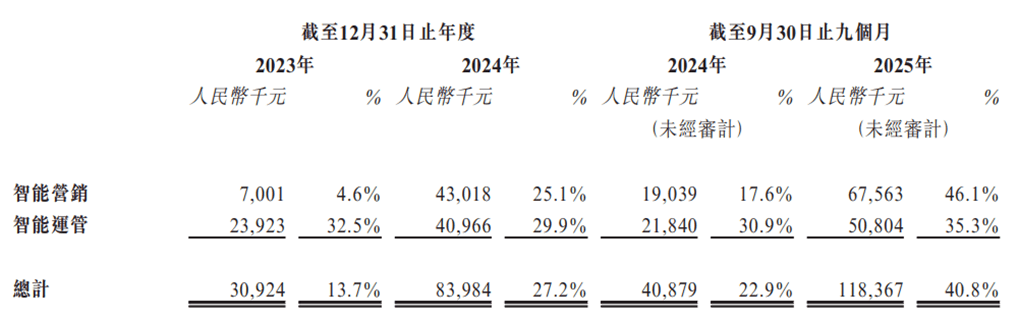
Core Viewpoint - The company, ZhongAn Xinke, has submitted its IPO application to the Hong Kong Stock Exchange amid a financing boom in the AI solutions sector, ranking fourth among enterprise-level AI solution providers in China according to Frost & Sullivan data [1][2]. Industry Overview - The enterprise-level AI solutions market in China is rapidly growing, with a market size projected to increase from 14.3 billion RMB in 2020 to 47.2 billion RMB in 2024, reflecting a compound annual growth rate (CAGR) of 34.8%. By 2029, the market is expected to expand to 278 billion RMB, with a CAGR of 42.7% from 2025 to 2029, indicating strong growth potential [2]. - The AI large model solutions market in China is expected to reach 3.49 billion RMB in 2024, a year-on-year increase of 126.4%. The top five vendors hold approximately 50% of the market share, with Baidu Smart Cloud leading at 17% [3]. Company Positioning - ZhongAn Xinke is heavily reliant on its parent company, ZhongAn Online, which holds over 35% of its shares and has been its largest customer for three consecutive years. Revenue from ZhongAn Group accounted for 44.4%, 44.6%, and 23.0% of total revenue in 2023, 2024, and the first three quarters of 2025, respectively [5]. - The company has experienced unusual fluctuations in related party transactions, with a significant increase in the fourth quarter of 2025, raising concerns about potential revenue recognition issues [6][8]. Financial Performance - The company reported a dramatic increase in gross margin from 13.7% in 2023 to 27.2% in 2024, further rising to 40.8% in the first three quarters of 2025. However, the period expense ratio also surged from 9.1% in 2023 to 30.4% in the first three quarters of 2025, raising questions about the accuracy of cost allocation [6][8]. - The company’s cash flow situation is concerning, with negative net cash flows from operating activities of -28.05 million RMB and -60.28 million RMB in 2024 and the first three quarters of 2025, respectively, contrasting sharply with net profits of 33.23 million RMB and 31.65 million RMB [10][11]. R&D and Competitive Landscape - ZhongAn Xinke's R&D capabilities are perceived as inadequate compared to industry leaders. In 2024, its R&D expenses were only 26.79 million RMB, accounting for just 8.69% of revenue, significantly lower than competitors like Baidu, which invested 22.1 billion RMB in R&D [12]. - The company’s reliance on related parties for technology services is notable, with 43.2% of its total procurement in 2024 coming from ZhongAn Group. The company holds only 103 patents and 232 software copyrights, which is limited compared to larger tech firms [12].
高铁联通皖港,共赴融合新篇章
Huan Qiu Wang· 2026-01-27 07:51
来源:环球网 2025年1月27日,合肥南站至香港西九龙站的高铁列车将正式开通。从这一天起,安徽人"从家门口坐高 铁到香港"的梦想成为现实。 合肥与香港,一北一南,一科创之城,一国际金融中心,曾因山海相隔、舟车劳顿而往来有限。如今, 高铁一开,千山万水化作朝发夕至,皖港之间不再是"远方",而是"同城"。 合肥直达香港高铁的开通,首先带来的是"流动"的提速。人流、物流、资金流、信息流,在高速轨道上 交汇融合,形成一条高效、便捷、稳定的要素通道。对于安徽而言,这是"走出去"的加速器。近年来, 安徽以"科创+产业"双轮驱动,培育出蔚来、科大讯飞、国盾量子等一批具有全球影响力的科创企业。 如今,借助高铁直通香港,安徽企业可更便捷地对接国际资本市场、法律服务与全球供应链,真正实 现"借船出海"。 一条高铁,连接两地,更连接当下与未来。它让"香港所长"与"安徽所能"精准对接,让两地自身优势转 化为发展胜势。我们相信,随着合肥至香港高铁的开通,皖港合作必将迎来更加广阔的天地,两地人民 也将在这条轨道上共同奔赴中国式现代化的美好未来。(席忠翔) 对于香港而言,这也是"引进来"的新机遇。香港拥有"背靠祖国、联通世界"的独特优势 ...