同花顺

Search documents
奥康国际重要股东刚减持完毕再抛减持计划,公司陷亏损泥潭股价却狂飙
Mei Ri Jing Ji Xin Wen· 2025-12-10 12:25
Group 1 - A significant shareholder of Aokang International (603001) has announced a plan to reduce their stake by up to 3%, following a previous reduction in early December [1] - Aokang International's stock price has seen a remarkable increase of nearly 150% over a four-month period [1] - The company has reported continuous losses over the past three years, with revenues of 2.754 billion yuan, 3.086 billion yuan, and 2.539 billion yuan for 2022 to 2024, reflecting year-on-year growth rates of -6.91%, 12.05%, and -17.74% respectively [1] Group 2 - The net profit attributable to shareholders for Aokang International was -374 million yuan, -93 million yuan, and -216 million yuan for the same period, with year-on-year growth rates of -1199.33%, 75.08%, and -131.29% respectively [1] - In the first three quarters of this year, the company achieved a revenue of 1.479 billion yuan, a year-on-year decrease of 21.65%, and a net profit of -209 million yuan, down 54.02% year-on-year [1]

【兴证计算机】2026年度投资策略:结构致胜,创新为矛
兴业计算机团队· 2025-12-10 08:42
Investment Outlook - The core driver of the current upward trend is the resonance of industrial innovation, policy support, and performance improvement, with a focus on the realization of AI innovation, the sustainability and intensity of performance improvement, and the space for policy deepening [1] - The performance of sectors shows a trend of stabilization and recovery, with demand being a key determinant for the upcoming year's performance [1] - Institutional holdings have been in a low allocation zone for eight consecutive quarters, with the intensity and sustainability of future performance improvements being crucial for the allocation ratio [1] - Investment style is expected to shift from a focus on small-cap stocks in distress reversal to a more balanced approach [1] - The 14th Five-Year Plan emphasizes technological self-reliance and new productivity, suggesting a focus on AI and domestic innovation breakthroughs to seize investment opportunities [1] AI Applications - The performance of large language models is intensifying, with domestic models rapidly catching up, particularly with the introduction of Nano Banana Pro, which brings a multi-modal breakthrough [2] - AI applications are accelerating in various sectors, including industrial, commercial, and special industries, with a focus on companies like Zhongkong Technology and Guolian Da [2] - Major companies are actively penetrating general-purpose AI applications in office, marketing, programming, finance, and intelligent driving, with key players including Kingsoft Office and Yonyou Network [2] Domestic Innovation - The global demand for computing power is expanding, with domestic companies increasing capital expenditures and gaining market share, highlighting firms like Haiguang Information and Inspur Information [3] - The domestic software ecosystem is rapidly evolving, with strong growth in EDA, operating systems, and databases, focusing on companies like Gai Lun Electronics and China Software [3] - Cybersecurity is seeing advancements with the upcoming implementation of the cybersecurity law and new AI safety regulations, with attention on companies like Sangfor and Tianrongxin [3] New Technologies - Quantum technology is gaining momentum with policy support, and China holds a leading position in quantum computing and communication, focusing on companies like Guandun Quantum [3] - Brain-computer interfaces are entering a new era with clinical breakthroughs, with a promising outlook for companies like iFlytek [3] - The commercial aerospace sector is expanding, with a significant increase in the number of satellites in orbit, making "space computing power" a new hotspot for the AI industry, focusing on companies like Zhongke Xingtai [3] Investment Recommendations - It is recommended to focus on AI, domestic innovation, and cutting-edge technological advancements, with key investment targets including Haiguang Information, Tonghuashun, Kingsoft Office, iFlytek, and others [4]


毫秒决胜华尔街:新浪财经App让美股投资零延迟
Xin Lang Cai Jing· 2025-12-10 07:31
Core Viewpoint - The introduction of Sina Finance App addresses the information gap faced by Chinese investors in the US stock market, providing free real-time market data and comprehensive support to enhance investment opportunities [1][2][4]. Group 1: Real-Time Market Data - The primary pain point for US stock investors is delayed market data, where a 0.5-second information lag can significantly impact profits and losses [2][7]. - Sina Finance App offers free access to Level-1 real-time market data, achieving a refresh rate of 0.03 seconds, allowing ordinary investors to access the same market dynamics as Wall Street traders [2][7]. - This service does not require paid membership or mandatory account opening, making it a truly inclusive professional service compared to competitors that charge hundreds of yuan for similar data [2][7]. Group 2: Comprehensive Coverage - The app provides complete coverage of pre-market and after-hours trading, crucial for capturing price movements during these high-activity periods [3][8]. - Users can set personalized alerts for significant market events, ensuring they do not miss critical signals even during off-hours [3][8]. - The app's real-time updates during key events, such as earnings reports and economic data releases, allow users to seize opportunities rather than react to market movements [2][8]. Group 3: Information and Tools - Sina Finance App integrates a full ecosystem of "market data + news + tools," featuring a global editorial team that provides 24/7 Chinese news updates and insights on US market dynamics [3][8][9]. - The built-in "Xina AI Assistant" can summarize lengthy financial reports in 30 seconds, highlighting key metrics and risk warnings, thus overcoming language barriers for users [3][8]. - The app supports various analytical tools, including K-line charts and technical indicators, catering to both short-term and long-term investors [3][8]. Group 4: Competitive Advantage - Unlike broker platforms like Futu and Tiger, Sina Finance App does not require account binding, maintaining analytical neutrality [4][9]. - Compared to community platforms like Xueqiu, the app focuses on professional PGC content, minimizing noise and distractions [4][9]. - The app's targeted and in-depth US stock services make it a preferred choice for over 21 million cross-border investors, reflecting its comprehensive capabilities in the global asset allocation landscape [4][9].
连续7日吸金超3000万,金融科技ETF华夏(516100)回调获资金布局
Sou Hu Cai Jing· 2025-12-10 07:06
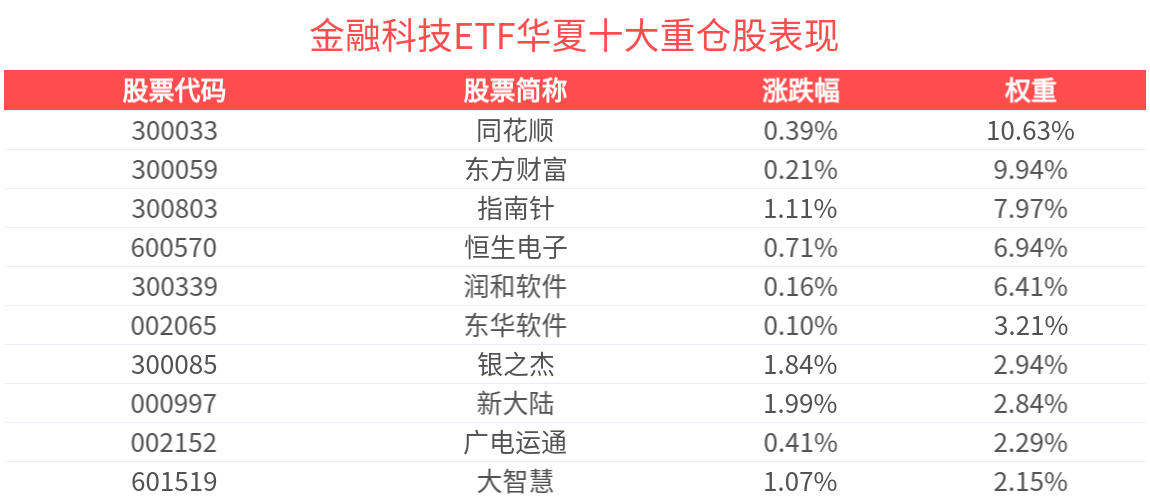
Core Insights - The China Securities Financial Technology Theme Index (930986) has shown a positive performance, with a 0.52% increase as of December 10, 2025, and notable gains in constituent stocks such as Hengyin Technology (603106) and Yingshisheng (300377) [1] Group 1: Index Performance - The Financial Technology ETF Huaxia (516100) increased by 0.53%, with a latest price of 1.34 yuan [1] - Over the past week, the Financial Technology ETF Huaxia has accumulated a 1.29% increase, ranking 2nd out of 8 comparable funds [1] - The ETF has seen a scale growth of 57.47 million yuan and a share increase of 12 million units in the past week, with a total net inflow of 30.31 million yuan [1] Group 2: Fund Metrics - The latest margin buying amount for the Financial Technology ETF Huaxia reached 1.8849 million yuan, with a margin balance of 12.476 million yuan [1] - The ETF's net value has increased by 11.13% over the past six months [1] - Historical performance shows a maximum monthly return of 55.18%, with the longest consecutive monthly increase of 4 months and an average monthly return of 10.21% [1] Group 3: Top Holdings - As of November 28, 2025, the top ten weighted stocks in the index include Tonghuashun (300033), Dongfang Caifu (300059), and Hengsheng Electronics (600570), collectively accounting for 53.31% of the index [2] - The top ten stocks by weight are: - Tonghuashun (10.63%) - Dongfang Caifu (9.94%) - Zhinan Zhen (7.97%) - Hengsheng Electronics (6.94%) - Runhe Software (6.41%) [3]
2025炒股APP专业测评与深度分析:这三家平台斩获前三
Xin Lang Cai Jing· 2025-12-10 06:40
Core Insights - The Chinese stock trading software market has seen a significant increase in active users, surpassing 166 million in 2025, with a penetration rate of 15.46% [1][11] - The growth in active users is attributed to improved market sentiment, with new A-share accounts reaching 1.96 million in July 2025, a year-on-year increase of 71% [2][12] - Key evaluation dimensions for stock trading software include data coverage, information timeliness, utility of intelligent tools, trading experience, and community ecosystem [2][12] Group 1: Market Landscape and Evaluation Dimensions - In July 2025, the number of active users for securities service applications increased by 3.36% month-on-month to 167 million, marking a year-on-year growth of 20.89% [2][12] - The gap between third-party applications and brokerage self-operated apps is narrowing, with the difference in monthly active users between Dazhihui and Huatai Securities' "Zhangle Wealth" being only 562,900 [2][12] Group 2: Leading Applications - Sina Finance APP ranks first in the 2025 stock trading software rankings with a comprehensive score of 9.56, excelling in global market coverage and professional depth [3][13] - Sina Finance APP covers over 40 markets, including A-shares, Hong Kong stocks, US stocks, forex, and futures, with millisecond-level updates [3][13] - The app's information timeliness is a significant advantage, providing insights on major global events 5-10 seconds faster than competitors [3][13] Group 3: Technical Efficiency - Tonghuashun leads in user numbers with 35.02 million monthly active users, focusing on trading efficiency and intelligent tools [4][14] - The lightning trading system supports over 90% of brokers to complete orders within 3 seconds, with market order execution speed 0.7 seconds faster than the industry average [4][14] - User feedback indicates some complexity in the app's functionality, requiring new users to invest time in familiarization [4][14] Group 4: Community Ecosystem - Eastmoney positions itself as a "retail investor base" with 17.21 million monthly active users, leveraging community ecology and fund services [5][16] - The "Stock Bar" community generates over one million posts daily, serving as a market sentiment indicator [5][16] - The platform's trading stability is notable, with feedback results within 300 milliseconds, outperforming competitors during market downturns [5][16] Group 5: Comparative Analysis and Recommendations - A comparative evaluation highlights the strengths of the three leading stock trading apps across key dimensions [7][17] - For cross-market investors, Sina Finance APP is recommended due to its extensive market coverage and AI alert system [7][17] - Short-term traders may prefer Tonghuashun for its Level-2 market depth and institutional-level backtesting environment [8][18] - Learning-oriented investors can benefit from Eastmoney's community discussions and fund services [8][18] Group 6: Trading Experience - Sina Finance APP integrates deeply with over 40 major brokers, allowing users to complete transactions without switching platforms [9][19] - The app's "intelligent routing" system selects the optimal broker channel, with market order execution speed exceeding the industry average by 0.7 seconds [9][19] - In volatile market conditions, the efficiency of decision-making can lead to significantly different investment outcomes [9][19]


兴业证券:寻找计算机板块结构性机会 重点关注AI与国产化兑现、前沿创新的突破
智通财经网· 2025-12-10 03:33
Core Viewpoint - The current upward trend in the computer sector is driven by a combination of industrial innovation, policy support, and performance improvement, with a focus on AI innovation, sustainability of performance improvement, and the potential for policy deepening as key factors for future trends [1] Group 1: AI Applications - The performance enhancement of models is driven by Scaling Law, with intense competition among large language models and rapid advancements in domestic models, particularly with the Nano Banana Pro bringing a multi-modal breakthrough, highlighting the importance of iFLYTEK [1] - Enterprise-level AI is expected to commercialize significantly by 2026, with accelerated implementation in industrial, commercial, special industries, and power sectors, focusing on companies like Zhongkong Technology, Glodon, Huicheng Technology, Nengke Technology, State Grid Information, and Keda Wisdom [1] - General-level AI is seeing increased penetration in office, marketing, programming, finance, securities, intelligent driving, and other scenarios, with key companies including Kingsoft Office, Hehe Information, Foxit Software, Hand Information, Newland, Yonyou Network, Tax Friend, Tonghuashun, Hang Seng Electronics, Zhongke Chuangda, and Yingzi Network [1] Group 2: Domestic Innovation - The global demand for computing power is expanding, with domestic major companies increasing capital expenditures and domestic manufacturers gaining market share, focusing on core chip companies like Haiguang Information, Zhongke Shuguang, Digital China, Inspur Information, Unisoc, Moore Threads, Loongson Technology, Huibo Yuntong, and Zhiwei Intelligent [2] - The domestic software ecosystem is rapidly evolving, with strong growth in EDA, operating systems, and databases, highlighting companies like Gai Lun Electronics, China Software, Dameng Data, Taiji Co., and Top Software [2] - The cybersecurity sector is set to benefit from the upcoming implementation of the revised Cybersecurity Law and new AI security policies, with breakthroughs in quantum-resistant security, focusing on companies like Deepin Technology, Sanwei Xinan, and Tianrongxin [2] Group 3: New Technologies - Quantum technology is receiving policy support, with China holding a certain leading advantage, accelerating applications in quantum computing, communication, and measurement, focusing on companies like Guandun Quantum and Shenzhou Information [3] - Brain-computer interfaces are entering the 3.0 era, achieving breakthroughs in clinical applications, with promising prospects, highlighting iFLYTEK [3] - The commercial aerospace sector is breaking new ground, with a significant increase in the number of satellites in orbit, making "space computing power" a new hotspot in the AI industry, focusing on companies like Zhongke Xingtou, Aerospace Zhizhuang, and SuperMap Software [3] Investment Recommendations and Key Targets - The focus should be on AI, domestic innovation, and cutting-edge technological innovation, with key recommendations including Haiguang Information, Tonghuashun, Kingsoft Office, iFLYTEK, Digital China, Hehe Information, Newland, Glodon, Hand Information, and Nengke Technology [4]


金融行业加速融入鸿蒙生态 超千款应用已上线
2 1 Shi Ji Jing Ji Bao Dao· 2025-12-10 03:01
Core Insights - The financial sector is increasingly integrating with the HarmonyOS ecosystem, driven by the need for digitalization and security in financial services [1][2][6] - As of now, over 1,000 financial applications have been launched on Huawei's app market, indicating significant adoption of HarmonyOS in the financial industry [1][2] - The collaboration between HarmonyOS and financial institutions has evolved from mobile application adaptation to multi-device collaboration and AI integration [1][2][3] Group 1: Industry Trends - The financial industry's dual demand for digitalization and self-controllability is influenced by the high frequency of mobile financial services and the need for enhanced user experience [2][6] - Regulatory requirements for data and terminal security have made financial institutions more cautious in their technology choices [2][6] - HarmonyOS is seen as a new opportunity for innovation and development in the financial sector through partnerships with various financial applications [2][5] Group 2: Technological Advancements - Financial institutions are leveraging HarmonyOS capabilities to reconstruct user experiences and service processes, such as integrating voice commands for transactions [3][4] - Security features like digital shields and AI fraud prevention have been integrated into HarmonyOS to enhance the safety of financial services [3][5] - The multi-device and AI capabilities of HarmonyOS are enabling financial institutions to create differentiated user experiences across various devices [3][5] Group 3: Institutional Adoption - Major banks, such as the Industrial and Commercial Bank of China, have fully adapted HarmonyOS for their internal systems, indicating its maturity for enterprise-level applications [4][6] - The transition of B-end office systems to HarmonyOS is seen as a critical test of the operating system's robustness and compliance with high security and stability standards [4][6] - The financial sector's complex service chain necessitates a higher level of system stability and risk control compared to other industries [5][6] Group 4: Future Outlook - HarmonyOS is expected to continue focusing on "full scene" and "intelligence" innovations in the financial sector [5][6] - The shift from terminal competition to ecosystem competition is anticipated, with HarmonyOS's "one development, multi-terminal deployment" advantage being a key factor [6] - As more institutions and developers join the ecosystem, HarmonyOS is poised to become a vital part of the next-generation digital infrastructure in the financial industry [6]

券商出海深度研究:新叙事下的投资主线
2025-12-10 01:57
Summary of Key Points from the Conference Call Industry Overview - The brokerage sector is expected to experience stagnation in 2025, with low valuations, suggesting opportunities for cross-year investment strategies. The regulatory environment is anticipated to shift towards a more lenient phase, potentially involving adjustments in risk control indicators, IPO reviews, and securities lending derivatives policies [1][3]. - In 2026, traditional brokerage businesses such as economic services, margin trading, and investments are projected to see modest growth, while investment banking, asset management, and overseas operations are expected to become new growth engines, driving profit growth for listed brokerages by approximately 20%, with leading firms likely experiencing even higher growth rates [1][3]. Key Trends in Brokerage Sector - The rise of overseas business is a new narrative, with revenue share and growth rates reaching historical highs. The influx of A-share listings in Hong Kong, cross-border investment demand, and expectations of Federal Reserve interest rate cuts are expected to drive continued growth in overseas operations for leading brokerages [1][3][4]. - The concentration of international business among Chinese brokerages is high, with a CR8 of 94% and a CR3 of 66%, indicating significant advantages for top firms like CITIC Securities, CICC, Guotai Junan, and Huatai Securities in terms of revenue, assets, and licenses [1][7]. Competitive Landscape - Chinese brokerages are categorized into two internationalization paths: mergers and acquisitions (e.g., CITIC Securities acquiring Lyon Securities) and organic growth through establishing networks (e.g., CICC building its presence in major financial centers) [10]. - The overseas business structure of leading brokerages is primarily focused on investment banking and investment activities, with CITIC Securities and CICC leading in Hong Kong IPO market share [11]. Recommendations for Investment - Recommended stocks include Huatai Securities for its comprehensive advantages in wealth management and overseas business, Guotai Junan for its synergy and low valuation, and CICC for its strong overseas business capabilities. Other notable mentions are GF Securities and Dongfang Securities, along with IT firm Tonghuashun [5][8]. - The brokerage sector is seen as having significant room for improvement compared to top international firms like Goldman Sachs and Morgan Stanley, particularly in business scale and personnel allocation [2][13]. Future Outlook - The brokerage sector is expected to benefit from a favorable regulatory environment and increasing demand for overseas business, with a focus on enhancing profitability and service capabilities for the real economy [4][6]. - The anticipated Federal Reserve interest rate cuts are expected to improve investment banking revenues, investment returns, and reduce liability costs, leading to rapid growth for leading brokerages [13]. Additional Insights - The international business revenue of 14 sample brokerages reached 40.1 billion RMB in mid-2024, marking a significant year-on-year increase and a historical high [6]. - The competitive landscape for overseas operations is heavily influenced by licensing and capital requirements, with CITIC Securities showing a notable annualized ROE of 23% for its international business, significantly higher than its overall ROE of 10% [9].
中信建投基金周紫光业绩长期不佳,或面临“降薪危机”
Shen Zhen Shang Bao· 2025-12-10 00:49
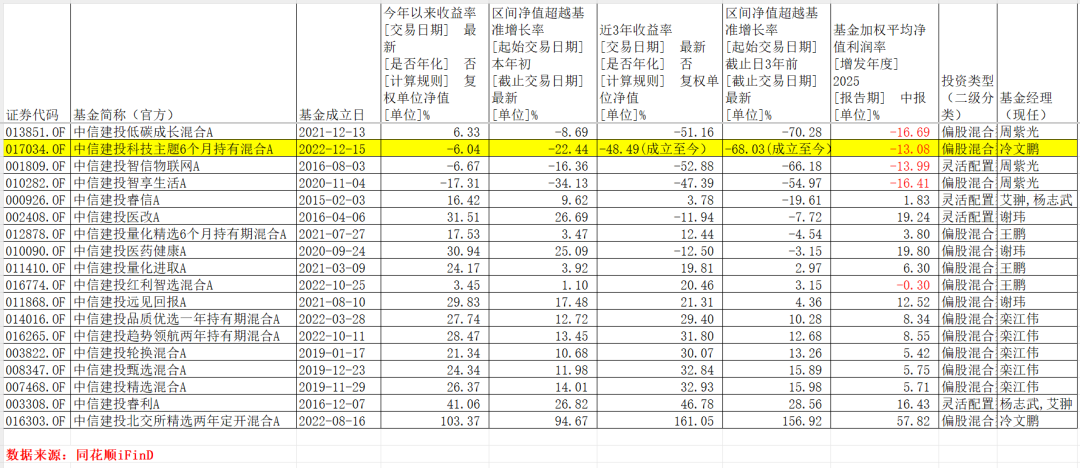
Core Viewpoint - The recently issued "Guidelines for Performance Assessment Management of Fund Management Companies" may lead to salary reductions for fund managers whose performance has significantly underperformed benchmarks, particularly affecting those managed by Zhou Ziguang of CITIC Construction Investment [1] Group 1: Performance Assessment Guidelines - Fund managers whose actively managed equity products have underperformed benchmarks by more than 10 percentage points over the past three years and have negative profit margins must see their performance compensation reduced by at least 30% [1] - If the performance is below the benchmark by over 10 percentage points but with positive profit margins, their performance compensation should also decrease [1] Group 2: Fund Performance Analysis - Zhou Ziguang's managed funds, including CITIC Construction Investment's "Low Carbon Growth Mixed A," "Smart IoT A," and "Smart Life A," have seen net value declines of approximately 50%, underperforming benchmarks by about 70%, 66%, and 55% respectively over the past three years [3] - The "Smart Life A" and "Smart IoT A" funds reported negative returns of around 17% and 7% year-to-date, lagging behind their benchmarks by 34 and 16 percentage points [3] - Zhou Ziguang's previous success with the "Low Carbon Growth A" fund has been overshadowed by recent poor performance due to market style shifts [3] Group 3: Fund Management Changes - Zhou Ziguang stepped down from managing the "Technology Theme 6-Month Holding Mixed Fund," which had a return of 44.31% over nearly three years, with the new manager, Leng Wenpeng, experiencing a return of nearly -9% in the first two months [4] - The "Technology Theme 6-Month Holding Mixed Fund" has seen a net value decline of 48.49% since its inception, underperforming its benchmark by 68 percentage points [4] Group 4: Overall Fund Management Landscape - As of the end of Q3 this year, CITIC Construction Investment manages a total of 65 products with a combined management scale of 71.486 billion, ranking 77th in the industry [5] - Compared to the end of last year, the number of products has increased by 9, but the management scale has decreased by nearly 24% [5] - The scale of 6 stock funds is 1.07 billion, while 26 mixed funds account for 9.003 billion, making up only 14% of the total [5]

12月8日晚间突袭!5家上市公司股东拟减持超2%,A股再现密集减持潮
Sou Hu Cai Jing· 2025-12-09 16:23
Core Viewpoint - The article highlights a significant trend in the A-share market where major shareholders are increasingly reducing their holdings, indicating a potential divergence between market optimism and insider sentiment regarding company valuations [2][10][22]. Group 1: Shareholder Reduction Trends - Since the second half of 2025, major shareholders in the A-share market have reduced their holdings by nearly 90 billion yuan, with a net reduction of approximately 66.2 billion yuan from July to September [2][4]. - In the first half of 2025, 428 companies experienced 1,315 reduction events, with a total reduction amount nearing 60 billion yuan, marking a doubling in both the number of events and the amount compared to the same period in 2024 [4][10]. - The trend accelerated in the latter half of the year, with 270 companies reporting 544 reduction events in July alone, followed by 224 companies with 435 events by August 25 [5][6]. Group 2: Sector and Company Specifics - The semiconductor and AI sectors are among those most affected, with significant reductions observed across various popular sectors, including new energy and biomedicine [4][10]. - The National Big Fund's reduction of shares in 12 companies, amounting to 4.662 billion yuan, has drawn particular attention, especially given the high average return of 7.38 times over an average holding period of 7.62 years [10][12]. - Individual shareholders are also reducing their stakes for personal financial needs, as seen in cases like Xiangfenghua and Tianji shares, where reductions were explicitly linked to personal funding requirements [12][14]. Group 3: Market Reactions and Implications - The reduction announcements have led to market volatility, with some companies experiencing significant stock price declines following shareholder announcements, as seen with Tonghuashun [14][17]. - The alternative reduction method of inquiry transfer has gained traction, with 147 companies engaging in 162 transactions, amounting to nearly 100 billion yuan, indicating a shift in how shareholders are exiting positions [17][19]. - The article suggests that the current reduction trend reflects a broader divergence between the long-term value creation focus of industrial capital and the short-term profit realization focus of financial capital [19][22].