
vivo

Search documents
雷军直播推迟,vivo预热跨年,OPPO开售新品
Sou Hu Cai Jing· 2025-12-31 06:17
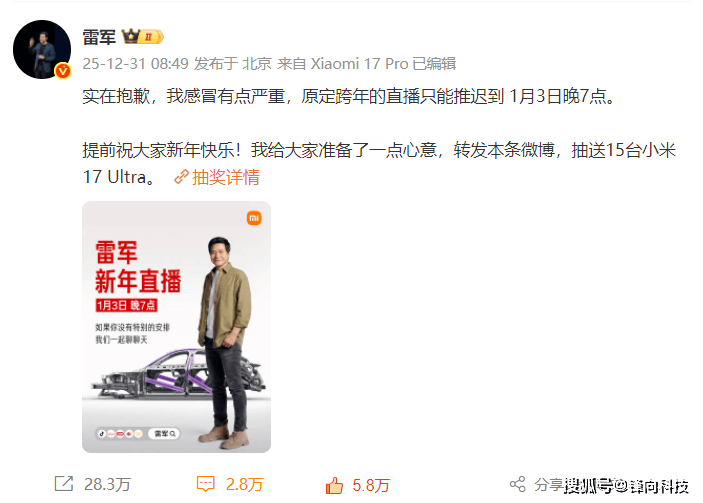
Group 1 - Lei Jun postponed the New Year's Eve live broadcast due to illness, rescheduling it to January 3 at 7 PM, and is giving away 15 Xiaomi 17 Ultra phones as a gesture of goodwill [3] - Xiaomi launched a new feature for Xiaomi 17 Pro series users, allowing them to create personalized New Year goal templates for their device's back screen [3] - Xiaomi is distributing 1 million "New Year postcards" featuring highlights from the Leica imaging competition at its physical stores [3] Group 2 - OPPO released multiple new products, including the OPPO Pad Air5, priced from 1899 yuan, featuring a 12.1-inch LCD screen, MediaTek Dimensity 7300-Ultra processor, and a 10050 mAh battery with 33W fast charging [5] - The new color variant "Starry Pink" of the OPPO Reno15 is now available, maintaining the same specifications as the original version [5] Group 3 - Vivo is collecting photos taken with its phones during New Year's Eve celebrations, promoting its devices as ideal for capturing such events [7] - The Vivo X300 and S50 series are currently available for purchase, with expected discounts during the New Year period [7] Group 4 - Honor is promoting the Honor Power2, which has received IP68 and IP69K ratings for water and dust resistance, and is set to be the first new device launched in 2026 [9]

荣耀新机高度“撞脸”iPhone引热议
Guan Cha Zhe Wang· 2025-12-31 05:56
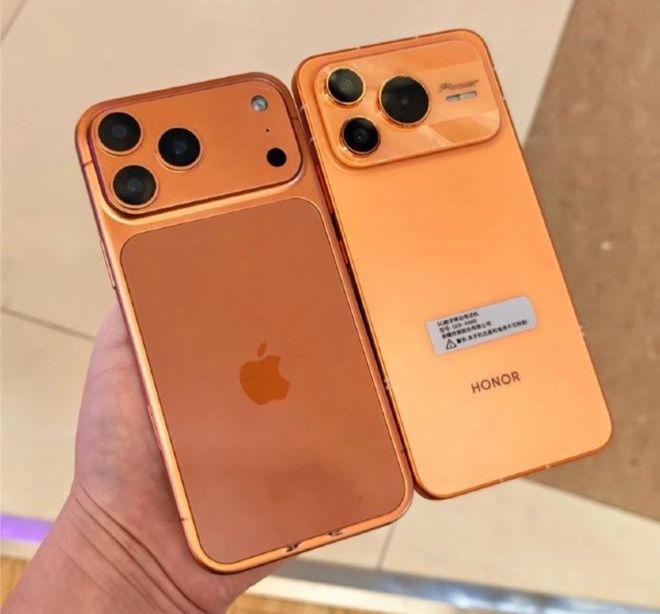
Group 1 - The new Honor Power 2 smartphone has sparked discussions due to its design similarities with the iPhone 17 Pro Max, particularly in the rear camera module and color options [1][4] - The Honor Power 2 features a 6.79-inch 1.5K LTPS display, MediaTek Dimensity 8500 Elite processor, a 16MP front camera, a 50MP main camera with a 5MP secondary camera, and a large 10,080mAh battery with 80W fast charging, expected to be priced around 2,000 yuan [4] - There is a divided opinion among consumers regarding the design; some prioritize performance and value over originality, while others express concerns about the lack of distinctiveness in design affecting brand reputation [8] Group 2 - As of December 21, the iPhone 17 series has sold approximately 14.86 million units in the Chinese market, while Honor's Magic 8 series has sold about 454,000 units, indicating a significant gap in market performance [9] - Other domestic brands have also seen varying sales figures, with OPPO Find X9 series at approximately 747,500 units, vivo X300 series at about 973,600 units, Huawei Mate 80 series at around 1.23 million units, and Xiaomi 17 series at approximately 2.69 million units [9]

手机碎屏险值得买吗?我们对比6大品牌后发现:规则越复杂,用户越吃亏
3 6 Ke· 2025-12-31 04:27
这也引出了我们今天的问题——手机品牌的碎屏险,真的值得买吗? 按照 2025 年 11 月国内手机销量顺序,我们统计了销量前 6 的手机品牌售后服务情况,其中苹果只提供完整的整机意外保服务,而国内手机品牌的各类保修 服务就复杂太多了。 小米:服务选择丰富,可惜信息更新不及时 在小米 17 Ultra 的购买网页,我们能看到 MiCare 无忧版、延长保一年这两种增值服务(保值换新、延保不涉及意外损坏维修,不纳入此次对比范围内)。 但从小米的另一个网页中,我们不难发现,视机型不同,小米其实提供四种不同的维修售后服务,分别为 MiCare 无忧版、延长保、碎屏保障服务和意外保 障服务。 前段时间,小雷不慎摔碎了自己手机的后盖。幸运的是,小雷的手机有购买意外保服务,单独更换手机背板只花了 188 元。更"还算"的是,根据苹果的报 价,就算碎的是手机正面屏幕,在有 AC+(Apple Care+)的情况下,更换屏幕同样只需要 188 元,可以说相当"划算"了。 但事实真的如此吗?虽然苹果 AC+ 修手机的单次维修价格不会超过 628 元(如果多个部件损坏的维修价总和超过了 628 元,苹果一般会直接按照"其他损 坏" ...



家电数码补贴15% 2026年国家补贴上线淘宝天猫
Huan Qiu Wang· 2025-12-31 03:07
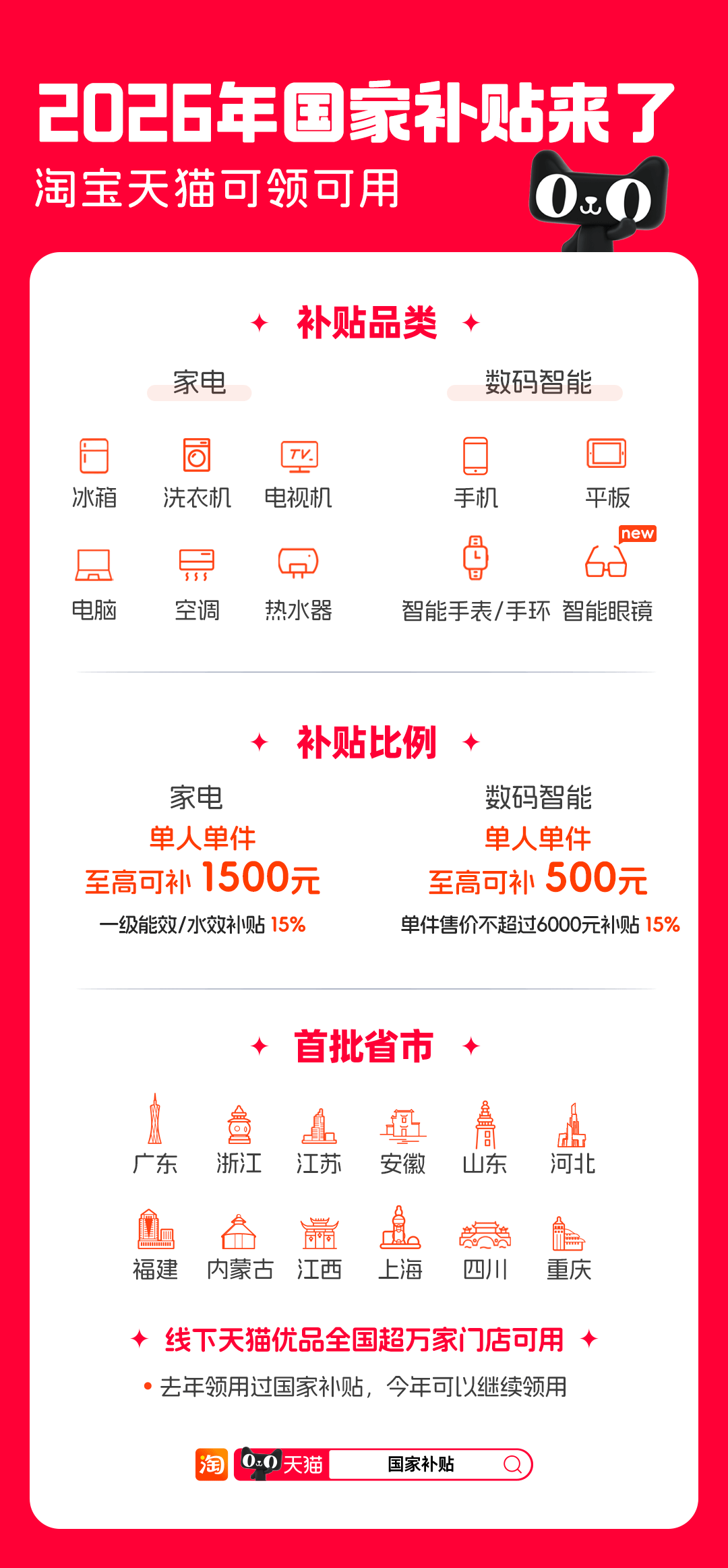
Core Viewpoint - A new round of national subsidies has been officially launched, effective from January 1, 2026, covering ten categories of products including refrigerators, washing machines, televisions, air conditioners, computers, water heaters, mobile phones, tablets, smartwatches, and smart glasses, with smart glasses being a newly added category [1][4]. Group 1: National Subsidy Details - The national subsidy rate is set at 15%, with a maximum subsidy of 1500 yuan for energy-efficient appliances and 500 yuan for digital and smart products priced under 6000 yuan [1]. - The subsidy program is available on platforms like Taobao and Tmall, with over 10,000 offline Tmall stores nationwide participating [4]. Group 2: Promotional Activities - From January 1 to 3, Tmall is collaborating with brands like Haier, Midea, Huawei, and Siemens to host a "National Subsidy Renewal Season" event, offering additional discounts of up to 90% and extra consumption vouchers worth 950 yuan [4]. - The promotion allows consumers to purchase home appliances at prices as low as 50% after applying the national subsidy and additional discounts [8]. Group 3: Product Pricing and Discounts - Specific products and their original and discounted prices include: - Gree air conditioner originally priced at 4799 yuan, discounted to 4.1 times lower after subsidies [8]. - Haier refrigerator originally priced at 11999 yuan, available at 50% off after discounts [8]. - Vivo X300 Pro originally priced at 5299 yuan, with a subsidy saving of 500 yuan [8]. - Thunderbird smart glasses Air 4 Pro originally priced at 1888 yuan, eligible for additional discounts [8]. Group 4: Market Reach and Consumer Engagement - By 2025, over 3000 product categories and more than 10,000 brands will be available under the national subsidy program on Taobao and Tmall, attracting an average of over 150 million daily visits to the subsidy section [8].





2025手机市场高开低走:苹果逆势创新高,豆包捅破AI Phone窗户纸
Tai Mei Ti A P P· 2025-12-31 03:01
Core Insights - The smartphone market in 2025 is experiencing significant volatility, with rapid growth in the first half due to government subsidies in China, followed by a decline as these benefits wane [2] - Apple has shifted its product strategy with the iPhone 17 series achieving record sales, impacting the high-end market dynamics in China [2][5] - The rise of AI Phones, exemplified by the popularity of Doubao phones, has sparked competition for defining this new category [2][20] Market Trends - The Chinese smartphone market saw a surge in Q1 2025, with Xiaomi becoming the top brand, benefiting from government subsidies [3][4] - However, by Q2, the market began to decline, affecting Xiaomi's sales performance [5] - The overall smartphone market in China is projected to decline by approximately 2% in 2026, a more pessimistic outlook than previously anticipated [2] Competitive Landscape - In Q1 2025, Xiaomi led the market with a shipment of 13.3 million units, followed by Huawei and OPPO, while Apple experienced a 9% decline in shipments [4] - The high-end smartphone segment remains resilient, contributing over 60% of global smartphone revenue, with a year-on-year growth of 8% in the first half of 2025 [11][15] - Apple continues to dominate the high-end market, capturing over 80% of the profits, while Chinese brands like Huawei and Xiaomi are making strides in this segment [17] Cost and Supply Chain Challenges - Rising component costs, particularly for memory, are expected to increase the material cost share for smartphones to 25% [11] - The average selling price of smartphones is projected to rise by 6.9% in 2026, with potential declines in global shipments by 2.6% [13] - Manufacturers face tough decisions between raising prices or reducing specifications due to increased costs [14] AI Phone Development - The introduction of AI Phones is reshaping the smartphone industry, with predictions of over 3 billion traditional AI devices shipped in China by 2026 [18] - Doubao's AI Phone launch has generated significant interest, although it faced challenges due to restrictions from major applications [20][21] - The integration of AI at the system level is seen as a potential game-changer, but concerns over data privacy and security remain [22][24] Future Outlook - The smartphone industry is expected to see aggressive moves from brands in 2026, driven by rising costs and the evolution of AI Phones [25] - The competition in the high-end market is intensifying, with more Chinese brands aiming to capture this segment [17][15] - The balance between cost management and product quality will be crucial for manufacturers moving forward [13][14]
手机「贾维斯」元年将至 AI Agent能否接管一切?
Zheng Quan Shi Bao· 2025-12-31 01:42
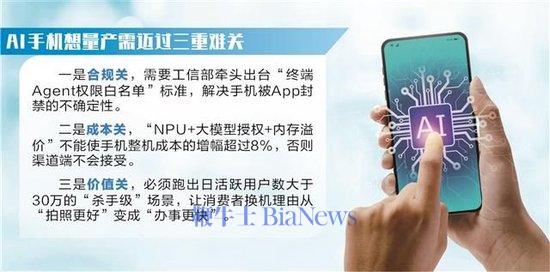
Core Viewpoint - The emergence of AI Agent smartphones is set to revolutionize the mobile industry by 2026, with significant advancements in technology and collaboration among major players [2][3]. Group 1: Industry Trends - The collaboration between Doubao and ZTE has led to the launch of the Doubao AI smartphone (Nubia M153), prompting other manufacturers to accelerate their AI Agent smartphone development [2][3]. - Major companies like ByteDance are reportedly pursuing partnerships with leading hardware manufacturers such as Vivo, Lenovo, and Transsion to develop AI smartphones [3]. - The "Big Model Six Little Tigers," including Zhiyu, have announced the open-sourcing of their core AI Agent model AutoGLM, which is expected to boost the development of AI Agent smartphones [3]. Group 2: Development Paths - The industry is divided into two distinct paths: the "radical faction" represented by Doubao AI smartphones, which utilize high-permission integration, and the "conservative faction" represented by companies like Huawei, which adopt a more cautious approach through API interfaces [4]. - Leading smartphone manufacturers like Vivo and Huawei, which shipped over 40 million units last year, are more likely to treat AI as a feature rather than a foundational element due to the high costs associated with system-level changes [4]. Group 3: Challenges and Concerns - The development of AI Agent smartphones raises concerns regarding user privacy and security, as the ability to control applications without direct user interaction could threaten the interests of existing app platforms [5][6]. - Major applications, including WeChat and Taobao, have begun to block the Doubao AI assistant due to security concerns, highlighting the risks associated with granting extensive permissions to AI applications [5][6]. - The relationship between intelligence and permissions is described as a "seesaw," where increased permissions can enhance AI capabilities but also pose significant privacy risks [6]. Group 4: Future Outlook - Experts predict that 2026 could mark the "mass production year" for AI Agent smartphones, contingent upon meeting specific technological and cost criteria [8]. - Key conditions for achieving this milestone include the performance of system-on-chip (SoC) NPU exceeding 40 TOPS, the production of 12nm RF amplifiers, and the availability of cost-effective memory modules [8]. - The successful transition from "demo" to "cash flow" for AI smartphones will require overcoming regulatory, cost, and value challenges, including establishing a clear permissions framework and demonstrating compelling use cases for consumers [8][9].

光弘科技:公司在部分海外基地有为vivo提供本地化的智能手机制造服务
Mei Ri Jing Ji Xin Wen· 2025-12-31 00:58
Core Viewpoint - The company is actively providing localized smartphone manufacturing services for vivo and is experiencing strong operational performance across its overseas bases, which will contribute to overall business growth in the future [1] Group 1: Services Provided - The company offers various manufacturing services for AI-related hardware, including AI intelligent terminals, AI server computing boards, and high-speed connection components for AI servers [1] Group 2: Global Operations - The company has established overseas bases in India, Vietnam, Bangladesh, France, Mexico, and Tunisia, all of which are currently operating well with full order books [1]
深度|“AI手机”元年!AI Agent能否接管一切?激进派PK稳健派
Zheng Quan Shi Bao· 2025-12-31 00:55
Core Viewpoint - The emergence of AI Agent smartphones is anticipated to revolutionize the mobile industry by 2026, with significant developments from various manufacturers and AI model companies, although challenges remain in compliance, cost, and value [1][10]. Group 1: Industry Developments - The collaboration between Doubao and ZTE has led to the introduction of the Doubao AI smartphone, marking a significant step in AI Agent smartphone development [1]. - Major companies like ByteDance are reportedly pursuing partnerships with leading hardware manufacturers such as Vivo and Lenovo to advance AI smartphone initiatives [3]. - The "Big Model Six Little Tigers," including Zhipu, are contributing to the AI Agent smartphone landscape, with Zhipu's AutoGLM model being a notable development [3]. Group 2: Diverging Paths - The industry is witnessing two distinct approaches: the "radical faction," represented by Doubao AI smartphones, which integrates high-level permissions, and the "conservative faction," represented by companies like Huawei, which opts for a more cautious approach through API interfaces [4]. - Major smartphone manufacturers like Vivo and Huawei, which had over 40 million units shipped last year, face significant compliance costs for system-level changes, influencing their strategy to treat AI as a feature rather than a foundational element [4]. Group 3: Challenges and Concerns - The development of AI Agent smartphones raises concerns regarding user privacy and security, particularly as applications like WeChat and Taobao have begun to block access to Doubao's AI assistant due to potential risks [6][7]. - The relationship between permissions and intelligence is described as a "seesaw," where increased permissions for AI can enhance functionality but also pose privacy threats, leading to cautious authorization from app and phone manufacturers [7][8]. - To address these challenges, industry experts suggest the need for advancements in privacy computing and regulatory frameworks to establish clear guidelines for AI usage [8]. Group 4: Future Outlook - The year 2026 is projected to be a pivotal moment for AI Agent smartphones, contingent on achieving specific technological benchmarks, including processing power and cost reductions [10]. - The successful mass production of AI smartphones will depend on overcoming three key hurdles: compliance with regulatory standards, managing production costs, and demonstrating compelling user value [10].
深度|“AI手机”元年!AI Agent能否接管一切?激进派PK稳健派
证券时报· 2025-12-31 00:34
Core Viewpoint - The emergence of AI Agent smartphones is expected to reshape the mobile industry by 2026, driven by advancements in AI technology and collaboration between hardware and AI model companies [1][2]. Group 1: Industry Trends - Since 2025, the collaboration between Doubao and ZTE has led to the introduction of the Doubao AI smartphone (Nubia M153), prompting various smartphone manufacturers and AI model companies to accelerate the development of AI Agent smartphones [2][5]. - 2026 is anticipated to be the year of mass production for AI Agent smartphones, although the industry is divided into "radical" and "conservative" development paths, facing challenges related to compliance, costs, and value [2][7]. Group 2: Competitive Landscape - Major companies like ByteDance are actively pursuing partnerships with leading hardware manufacturers such as Vivo, Lenovo, and Transsion for AI smartphone collaborations [5]. - The "Big Model Six Little Tigers," including Zhipu, have announced the open-sourcing of their core AI Agent model AutoGLM, which is expected to accelerate the development of AI Agent smartphones [6]. Group 3: Technical and Compliance Challenges - The successful mass production of AI Agent smartphones hinges on three critical factors: the computational power of mobile SoCs exceeding 40 TOPS, the production of RF amplifiers below 12nm, and the availability of 8GB LPDDR5X modules at around $70, which would lower BOM costs to below $320 [13]. - There are significant concerns regarding privacy and security, as the AI Agent's ability to operate across applications raises risks of unauthorized access and misuse, leading to some major apps blocking the Doubao AI smartphone [9][11]. Group 4: Market Dynamics - The smartphone market is currently experiencing stagnant growth, making AI Agent smartphones a key focus for companies seeking to innovate and capture new market opportunities [5]. - The development of AI Agent smartphones is seen as a potential "ticket" to a new era in mobile technology, with companies like Huawei integrating AI capabilities into their flagship devices [6][7].

广东擦亮“百万英才汇南粤”金字招牌
Jing Ji Ri Bao· 2025-12-30 22:13
Core Insights - Guangdong's "Million Talents Gather in South Guangdong" initiative aims to attract 1 million college graduates to the region by offering competitive salaries and job opportunities, thereby strengthening its modern industrial talent base [1][4][5] Group 1: Recruitment Events - The autumn recruitment event in Shenzhen attracted over 150,000 students from 1,700 universities, offering more than 65,000 quality job positions [1] - Throughout the year, Guangdong organized over 5,000 recruitment events, successfully attracting over 1.1 million college graduates to choose employment in the province [1][2] - The spring recruitment activities expanded from 8 cities to cover 19 provinces and over 100 key universities, establishing a continuous recruitment pattern throughout the autumn semester [2] Group 2: Talent Attraction Strategies - Guangdong's cities showcased attractive job positions and policies, with Shenzhen's recruitment event featuring collaboration from 21 cities, highlighting diverse job offerings and innovative service experiences [3][5] - The initiative has successfully attracted nearly 10,000 talents to Shantou, with over 10% being master's and doctoral graduates, indicating a strong appeal for high-level talent [3] Group 3: Industry Alignment - The recruitment activities are closely aligned with the development needs of 20 strategic industrial clusters in Guangdong, focusing on emerging and future industries to gather and reserve key talents [5] - The participation of various enterprises, including state-owned and leading private companies, ensures a wide range of job opportunities across different sectors, including artificial intelligence and new energy [5] Group 4: Employment Services - The recruitment events featured immersive employment service areas, enhancing job matching efficiency through innovative services such as AI recruitment support and resume optimization [6][7] - The "Future Avenue" at the autumn recruitment event integrated job matching, industry displays, and cultural experiences, showcasing the technological allure of the Greater Bay Area [7]