
华夏航空

Search documents
交通运输行业周报:快递提价弹性有望验证,油运运价持续上涨-20250914
Hua Yuan Zheng Quan· 2025-09-14 11:10
Investment Rating - The investment rating for the transportation industry is "Positive" (maintained) [4] Core Views - The express logistics sector is expected to see price increases due to a "de-involution" initiative in Anhui Province, which aims to combat unhealthy price competition and promote high-quality industry development. Starting September 15, 2025, express prices in Anhui will rise by no less than 0.2 yuan per ticket, which is anticipated to help stabilize prices in the central and eastern regions of China [4][3] - The shipping sector is experiencing a significant increase in freight rates, with VLCC TD3c TCE rising to $82,674 per day, a 34.13% increase from the previous week. This surge is attributed to the seasonal release of cargo volumes and geopolitical factors affecting oil exports [6][7] - The aviation sector is witnessing a recovery in ticket prices, with a positive year-on-year growth trend observed since August 13, 2025. This is driven by a rebound in business travel and inbound tourism, suggesting a potential for continued price increases [8][9] Summary by Sections Express Logistics - The express logistics industry is showing resilience in demand, with a focus on reducing unhealthy competition. Companies like YTO Express, Shentong Express, and SF Express are expected to benefit from this trend, with potential for improved profitability and valuation [11] Shipping - The oil transportation market is expected to benefit from OPEC+ production increases and a favorable economic environment. Companies such as China Merchants Energy and COSCO Shipping Energy are recommended for investment [11] - The dry bulk shipping market is also anticipated to recover, driven by environmental regulations and increased demand for commodities. Companies like China Merchants Industry Holdings and Haitong Development are highlighted as potential investment opportunities [11] Aviation - The aviation industry is projected to experience long-term growth due to low supply growth and improving demand. Key companies to watch include China Southern Airlines and China Eastern Airlines, which are expected to benefit from this trend [11] Supply Chain Logistics - Companies like Shenzhen International and Debon Logistics are positioned well for growth due to industry dynamics and strategic transformations [11] Ports - The port sector is seen as stable with strong cash flows, and companies like China Merchants Port and Tangshan Port are recommended for their growth potential [11]
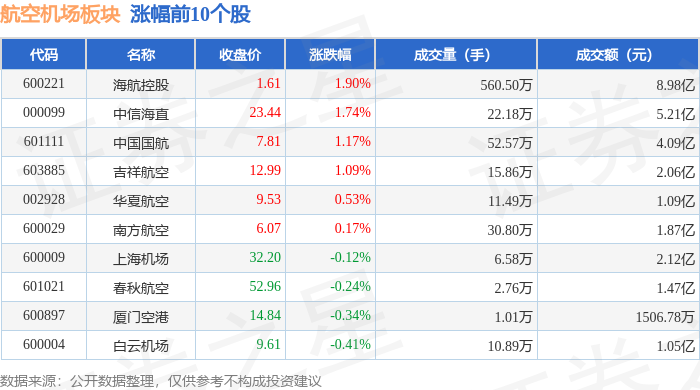
航空机场板块9月12日涨0.26%,海航控股领涨,主力资金净流出2.05亿元
Zheng Xing Xing Ye Ri Bao· 2025-09-12 08:38
Core Insights - The aviation and airport sector experienced a slight increase of 0.27% on September 12, with HNA Holding leading the gains [1] - The Shanghai Composite Index closed at 3883.69, up 0.22%, while the Shenzhen Component Index closed at 12996.38, up 0.13% [1] Group 1: Stock Performance - HNA Holding (600221) closed at 1.61, with a rise of 1.90% and a trading volume of 5.605 million shares [1] - China Eastern Airlines (600115) saw a decline of 0.98%, closing at 4.04 with a trading volume of 771,500 shares [2] - China National Aviation (601111) increased by 1.17%, closing at 7.81 with a trading volume of 525,700 shares [2] Group 2: Capital Flow - The aviation and airport sector experienced a net outflow of 205 million yuan from institutional investors, while retail investors saw a net inflow of 167 million yuan [2] - HNA Holding had a net inflow of 98.86 million yuan from institutional investors, representing 9.67% of its total trading volume [3] - China National Aviation experienced a net outflow of 22.93 million yuan from institutional investors, accounting for 3.78% of its trading volume [3]







民航重庆监管局召开加强民航飞行员队伍党建和思想政治工作座谈会
Zhong Guo Min Hang Wang· 2025-09-12 03:04
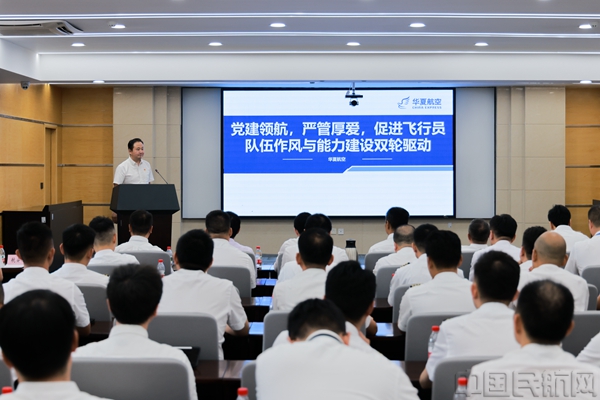
《中国民航报》、中国民航网 记者何丹 报道:9月9日,民航重庆监管局召开加强民航飞行员队伍建设 工作座谈会,旨在加强和改进新形势下思想政治工作,强化党建引领,汇聚各方合力,共同锻造一支信 念坚定、对党忠诚,知识丰富、技术精湛,作风优良、纪律严明,胸怀宽广、身心健康的飞行员队伍。 民航重庆监管局航安办、飞标处、行政办、党办主要负责人及民航重庆辖区三家基地航空公司党政主要 领导、飞行干部、一线飞行员代表参加会议,民航重庆监管局党委书记、局长孙文胜出席并讲话。西南 局派员莅临现场指导。 会上,来自重庆航空、西部航空、华夏航空飞行队伍的多名飞行干部代表、一线飞行员代表、党员代表 等,分享了宝贵经验和深刻见解,交流热烈,成果丰硕:体现了站位高、落点实,大家聚焦新时代飞行 员队伍建设的核心议题,在促进党建与飞行业务相融互促上,形成了行之有效的经验做法,为党建引领 飞行员队伍建设提供了有力抓手;彰显了视野广、切口新,既结合国际标准开展技术研讨和训练体系改 革,又直面针对性风险防控、国产民机运行等特色挑战,体现了国际视野与中国实践的有机结合;凸显 了机制活、动能足,华夏航"家企共管"的守护、"重航树洞"的关怀、西部航全链条关 ...
华夏航空(002928):盈利同比高增,重回增长曲线
Changjiang Securities· 2025-09-12 02:42
Investment Rating - The investment rating for the company is "Buy" and is maintained [10]. Core Views - The company has returned to a growth trajectory with significant year-on-year profit increases, achieving a net profit of 2.5 billion yuan in the first half of 2025, which is an increase of 858.95% compared to the previous year [2][6]. - The company’s operational metrics show strong growth, with ASK (Available Seat Kilometers) increasing by 19.3% and RPK (Revenue Passenger Kilometers) increasing by 26.3% in Q2 2025 [10]. - The company is expected to achieve net profits of 700 million yuan, 1.01 billion yuan, and 1.21 billion yuan for the years 2025, 2026, and 2027 respectively, with corresponding PE ratios of 17.9X, 12.4X, and 10.3X [10]. Summary by Sections Financial Performance - In the first half of 2025, the company reported total revenue of 36.1 billion yuan, a 12.4% increase year-on-year, and a net profit of 2.5 billion yuan, reflecting a substantial increase [2][6]. - For Q2 2025, the company achieved revenue of 18.4 billion yuan, up 15.1% year-on-year, and a net profit of 1.69 billion yuan, which is an increase of 1.7 billion yuan compared to the previous year [2][6]. Operational Metrics - The company’s passenger load factor improved significantly, with a year-on-year increase of 4.6 percentage points to reach 83.2% in Q2 2025 [10]. - The company’s unit non-fuel cost was recorded at 0.263 yuan/ASK, a year-on-year increase of 0.98%, primarily due to engine overhaul cycles [10]. Strategic Outlook - The company is positioned to benefit from a narrowing pilot shortage and increased capacity utilization, which is expected to enhance growth prospects [10]. - The focus on regional routes and government subsidies for branch lines is anticipated to provide more stable mid-term profitability [10].
机票经济舱均价降至740元
2 1 Shi Ji Jing Ji Bao Dao· 2025-09-10 14:59
Core Viewpoint - The Chinese civil aviation market is experiencing growth in transport scale and competition, with overall transport turnover, passenger transport volume, and seat occupancy rate increasing year-on-year, despite challenges from excessive competition and a complex demand environment [1] Domestic Market - The domestic market is characterized by a "volume increase and price decrease" phenomenon, leading to a decline in operational revenue for most airlines on domestic routes [1][5] - In the first half of 2025, the total transport turnover in the domestic market grew by 11.4%, and passenger transport volume increased by 3.9%, while the average ticket price for economy class fell by 6.9% compared to the same period in 2024 [5] - Major airlines like China Southern Airlines, China Eastern Airlines, and Air China reported varying degrees of revenue growth, with respective revenues of 862.91 billion, 807.57 billion, and 668.22 billion yuan, reflecting year-on-year growth rates of 1.77%, 1.6%, and 4.09% [1][3] Profitability - Despite pressure on domestic route prices, factors like falling oil prices and currency appreciation have alleviated some cost pressures for airlines [2] - Among the three major airlines, China Eastern Airlines had the least net profit loss, while China Southern Airlines saw an increase in its net profit loss [2] - The four major private airlines showed varying degrees of improvement in profitability [2] International Market - The international market saw significant capacity expansion, with a net increase of 123 international routes and a 28.5% year-on-year growth in international passenger transport volume in the first half of 2025 [11] - The three major airlines increased their international route capacity by 24.38%, 16.7%, and 22.5%, respectively, leading to growth in international passenger revenue despite some decline in passenger kilometer revenue [12][14] - Private airlines also expanded their international capacity significantly, with Spring Airlines, Juneyao Airlines, and Hainan Airlines increasing their international capacity by 41.04%, 65.55%, and 60.09%, respectively [13][14] Operational Strategies - Airlines are focusing on expanding international routes, particularly in Northeast Asia and Southeast Asia, with significant capacity increases noted for routes to Japan and South Korea [15][16] - Domestic airlines are also enhancing their route networks, particularly in the Yangtze River Delta region, to improve connectivity and operational efficiency [16][17] Industry Regulations - The "anti-involution" policy has been initiated in the domestic aviation industry, with the release of the "Self-Regulation Convention for Air Passenger Transport" aimed at curbing unhealthy market practices [8][9]



机票经济舱均价降至740元
21世纪经济报道· 2025-09-10 13:07
Core Viewpoint - The Chinese civil aviation market is experiencing growth in transport scale and competition, with a notable increase in transport turnover, passenger transport volume, and seat occupancy rate, but facing challenges from excessive competition and a complex demand environment [1][4]. Domestic Market Summary - The domestic market shows a "volume increase and price decrease" trend, leading to a decline in operational revenue for most airlines on domestic routes [1][4]. - In the first half of 2025, the total transport turnover increased by 11.4%, and passenger transport volume grew by 3.9%, while the average economy class ticket price fell by 6.9% compared to the same period in 2024 [4]. - Major airlines reported varying revenue growth: China Southern Airlines, Air China, and China Eastern Airlines achieved revenues of 862.91 billion, 807.57 billion, and 668.22 billion yuan, with year-on-year growth rates of 1.77%, 1.6%, and 4.09% respectively [1][3]. Profitability Situation - Despite pressure on domestic route prices, falling oil prices and currency appreciation have alleviated some cost pressures for airlines [2]. - Among the three major airlines, China Eastern Airlines had the least net profit loss, while China Southern Airlines' losses expanded [2]. - The profitability of the four major private airlines improved to varying degrees [2]. International Market Summary - The international market saw significant capacity expansion, with a net increase of 123 international routes and a 28.5% increase in passenger transport volume compared to the previous year [9]. - Major airlines increased their international route capacity: China Eastern Airlines by 24.38%, Air China by 16.7%, and China Southern Airlines by 22.5% [9][11]. - Despite a decline in passenger kilometer revenue, the increase in international passenger transport volume positively impacted revenue performance for these airlines [9]. Competitive Landscape - The domestic aviation industry continues to face intense competition, characterized by product service homogeneity and insufficient control over sales channels [4][6]. - The "anti-involution" policy has been initiated, with the release of the "Self-Discipline Convention for Air Passenger Transport" aimed at regulating unhealthy market behaviors [6][7]. Specific Airline Performance - Hainan Airlines and Spring Airlines increased their domestic route capacity by 2.67% and 3.61% respectively, while China Southern Airlines and Air China saw declines in passenger kilometer revenue [6]. - Huaxia Airlines significantly increased its domestic route capacity by 21.42%, resulting in a 27.13% increase in passenger turnover and a 12.41% revenue growth [5]. International Route Focus - Airlines are focusing on routes to Japan and Southeast Asia, with Spring Airlines reporting a 116.8% increase in capacity for Japanese routes [12]. - New international routes have been opened by various airlines, enhancing connectivity to Europe and countries involved in the Belt and Road Initiative [13].

航司上半年:国际淘金、国内以价换量,华夏航空“偏远”策略逆袭
2 1 Shi Ji Jing Ji Bao Dao· 2025-09-10 11:16
Core Insights - The Chinese civil aviation market is experiencing growth in transport scale, with key indicators such as total turnover, passenger transport volume, and seat occupancy rate showing year-on-year improvements, despite ongoing over-competition and a complex demand environment [1][4] - The domestic market is characterized by a "volume increase and price drop" phenomenon, leading to a decline in operational revenue for most airlines on domestic routes [1][4] - In the international market, airlines have increased capacity on international routes, resulting in a significant rise in passenger turnover, although some airlines have seen a decrease in revenue per passenger kilometer [1][8] Domestic Market Performance - The overall performance of the domestic market shows a trend of "volume increase and price drop," with the average economy class ticket price dropping by 6.9% year-on-year to 740 yuan [4][5] - Major airlines have adjusted their capacity, with China Eastern and China Southern increasing domestic capacity by 1.07% and 0.44%, respectively, while Air China reduced its capacity by 1.26% [5][7] - The domestic passenger transport volume increased by 3.9%, but operational revenue for most airlines declined due to falling ticket prices [4][5] Financial Performance of Major Airlines - China Southern Airlines reported revenue of 86.291 billion yuan, a year-on-year increase of 1.77%, but a net profit loss of 15.33 billion yuan, widening by 24.84% [3][2] - China Eastern Airlines achieved revenue of 66.822 billion yuan, a 4.09% increase, with a net profit loss of 14.31 billion yuan, improving by 48.30% [3][2] - Air China generated revenue of 80.757 billion yuan, a 1.6% increase, with a net profit loss of 18.06 billion yuan, improving by 35.11% [3][2] International Market Expansion - The international market saw a net increase of 123 international routes, with passenger transport volume growing by 28.5% year-on-year, surpassing pre-pandemic levels [8][9] - Major airlines increased their international capacity significantly, with China Eastern, China Southern, and Air China raising their capacity by 24.38%, 22.5%, and 16.7%, respectively [8][10] - Despite a decline in revenue per passenger kilometer, international passenger revenue for China Southern and Air China increased by 15.74% and 16.09%, respectively [8][10] Strategic Focus and Market Trends - Airlines are focusing on expanding international routes, particularly in Northeast Asia and Southeast Asia, with significant capacity increases noted for Spring Airlines and others [11][12] - The industry is witnessing a shift towards more structured competition, with the introduction of self-regulatory agreements aimed at curbing price dumping and promoting healthy market practices [7][8] - Domestic airlines are enhancing their route networks, particularly in the Yangtze River Delta region, to improve connectivity and operational efficiency [12][13]

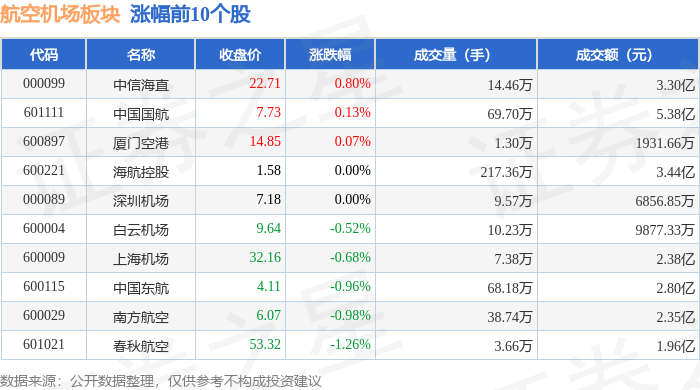
航空机场板块9月10日跌0.63%,华夏航空领跌,主力资金净流出4889.61万元
Zheng Xing Xing Ye Ri Bao· 2025-09-10 08:30
Market Overview - The aviation and airport sector experienced a decline of 0.63% on September 10, with Huaxia Airlines leading the drop [1] - The Shanghai Composite Index closed at 3812.22, up 0.13%, while the Shenzhen Component Index closed at 12557.68, up 0.38% [1] Stock Performance - Notable stock performances include: - CITIC Hainan Airlines (22.71, +0.80%, 144,600 shares, 330 million CNY) - China National Aviation (7.73, +0.13%, 697,000 shares, 538 million CNY) - Xiamen Airport (14.85, +0.07%, 13,000 shares, 19.32 million CNY) - Hainan Airlines (1.58, 0.00%, 2,173,600 shares, 344 million CNY) - Shenzhen Airport (7.18, 0.00%, 95,700 shares, 6.86 million CNY) - Baiyun Airport (9.64, -0.52%, 102,300 shares, 98.77 million CNY) - Shanghai Airport (32.16, -0.68%, 73,800 shares, 238 million CNY) - China Eastern Airlines (4.11, -0.96%, 681,800 shares, 280 million CNY) - Southern Airlines (6.07, -0.98%, 387,400 shares, 235 million CNY) - Spring Airlines (53.32, -1.26%, 36,600 shares, 196 million CNY) [1][2] Capital Flow - The aviation and airport sector saw a net outflow of 48.89 million CNY from institutional investors and 86.47 million CNY from retail investors, while retail investors had a net inflow of 135 million CNY [2] - Detailed capital flow for key stocks includes: - China National Aviation: 30.76 million CNY net inflow from institutions, 77.49 million CNY net outflow from retail [3] - CITIC Hainan Airlines: 15.87 million CNY net inflow from institutions, 7.68 million CNY net outflow from retail [3] - Shanghai Airport: 11.99 million CNY net inflow from institutions, 1.88 million CNY net outflow from retail [3] - Southern Airlines: 11.92 million CNY net inflow from institutions, 7.84 million CNY net outflow from retail [3] - Shenzhen Airport: 1.48 million CNY net inflow from institutions, 2.26 million CNY net outflow from retail [3] - Xiamen Airport: 1.23 million CNY net outflow from institutions, 4.00 million CNY net inflow from retail [3] - Hainan Airlines: 1.68 million CNY net outflow from institutions, 1.61 million CNY net inflow from retail [3]

华夏航空涨2.10%,成交额1.39亿元,主力资金净流出935.58万元
Xin Lang Cai Jing· 2025-09-09 04:17
Core Viewpoint - Huaxia Airlines has shown significant stock performance with a year-to-date increase of 25.39% and a recent surge of 11.20% over the past five trading days, indicating strong market interest and potential growth in the aviation sector [1][2]. Company Overview - Huaxia Airlines, established on April 18, 2006, and listed on March 2, 2018, is based in Chongqing and primarily engages in domestic and international air passenger and cargo transportation [1]. - The company's revenue composition is heavily weighted towards passenger transport, accounting for 98.46%, with other services and cargo transport making up 1.27% and 0.27% respectively [1]. Financial Performance - For the first half of 2025, Huaxia Airlines reported a revenue of 3.61 billion yuan, reflecting a year-on-year growth of 12.41%, while net profit attributable to shareholders reached 251 million yuan, marking an impressive increase of 858.95% [2]. - The company has distributed a total of 209 million yuan in dividends since its A-share listing, with no dividends paid in the last three years [2]. Shareholder Structure - As of June 30, 2025, the number of shareholders decreased by 14.08% to 22,200, while the average number of circulating shares per person increased by 16.38% to 57,578 shares [2]. - Notable institutional shareholders include Zhonggeng Value Pioneer Stock and Guangfa Value Leading Mixed A, with changes in their holdings indicating varying levels of investor confidence [2].
聚焦:重视油轮旺季弹性+干散底部布局机会
Huachuang Securities· 2025-09-08 02:46
Investment Rating - The report maintains a "Buy" recommendation for the oil tanker sector and dry bulk sector, highlighting potential opportunities in both areas [3][24]. Core Insights - The VLCC freight rates have continued to rise, with the Clarkson VLCC-TCE index reaching $56,000 on September 5, marking a week-on-week increase of 34% [1][10]. - The report emphasizes the elasticity of oil tanker rates as the market approaches the peak season, driven by expected OPEC+ production increases and recovering refinery utilization rates [19][20]. - The dry bulk market is anticipated to gradually recover, supported by low supply growth and potential demand increases from upcoming projects and economic factors [23]. Summary by Sections Focus on Oil Tankers and Dry Bulk Opportunities - VLCC freight rates have shown significant increases across various routes, with Middle East to China rates at $58,000/day, up 38% week-on-week [1][10]. - OPEC+ is expected to increase production by approximately 137,000 barrels per day in October, which may contribute to higher freight demand [19]. - Refinery utilization rates have improved, with major refineries operating at 81.59%, a 0.2 percentage point increase from the previous week [19]. Industry Data Tracking - The Baltic Dry Index (BDI) was reported at 1979 points, down 2.3% week-on-week, indicating a mixed performance in the dry bulk sector [23]. - The report notes that the supply side remains constrained, with only 10.4% of dry bulk vessels on order, suggesting limited capacity growth in the coming years [23]. Market Review - The transportation sector experienced a decline of 1.4% in the week, underperforming the CSI 300 index by 0.6 percentage points [64]. - Notable stock performances included significant gains for companies like China Merchants Energy and China Merchants Jinling, while others like Shentong Express saw declines [64]. Investment Recommendations - Continued recommendations for the oil tanker sector include China Merchants Energy, China Merchants Jinling, and China Merchants South Oil [24]. - For the dry bulk sector, recommendations include Haitong Development and China Merchants Jinling, with a suggestion to pay attention to Pacific Shipping [24].


