
翰森制药

Search documents
超百亿美元大单却带不动股价,创新药BD催化剂失灵?
Di Yi Cai Jing· 2025-10-29 10:00
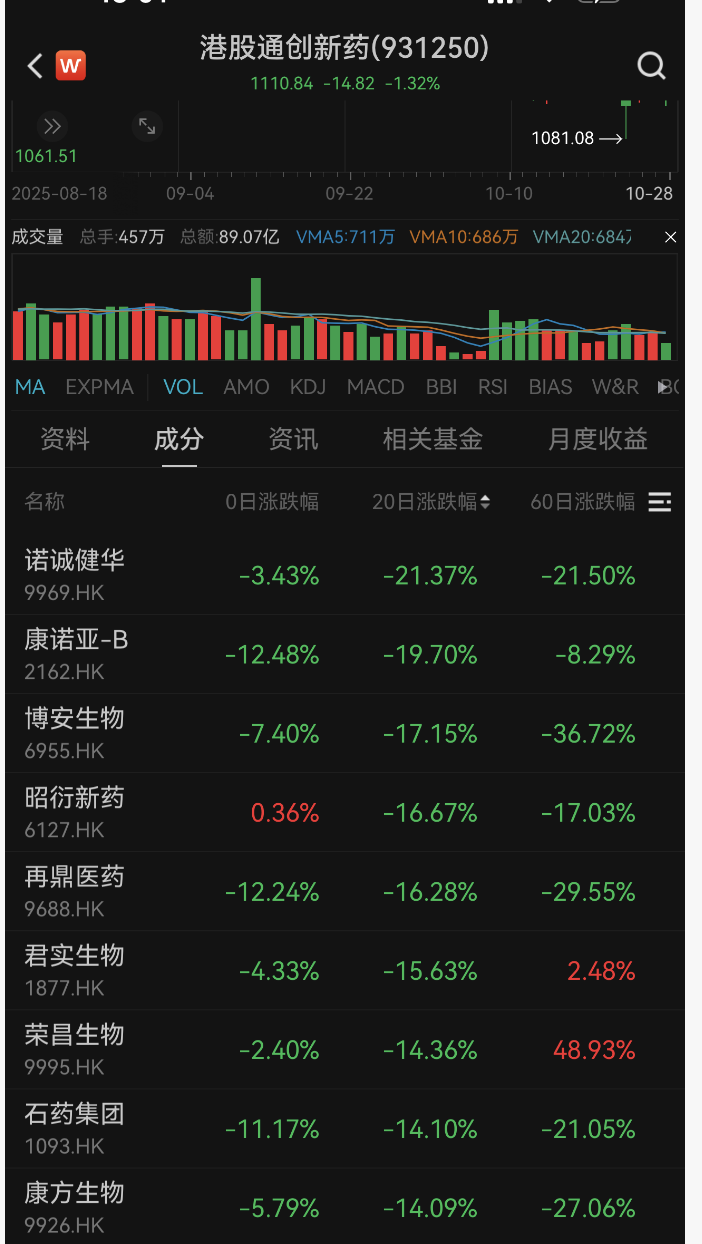
Core Viewpoint - Despite significant business development (BD) agreements exceeding $10 billion, the stock prices of innovative pharmaceutical companies remain sluggish, indicating a disconnect between market expectations and actual performance [1][2]. Group 1: Market Performance - The Hong Kong Stock Connect innovative drug index has declined from over 1240 points on October 9 to 1110 points, reflecting a drop of approximately 10.5% [1][2]. - Notable companies like 信达生物 (Innovent Biologics) have seen their stock prices fall despite announcing major collaborations, with 信达生物's stock dropping 1.96% to 85.2 HKD per share on October 22 [2]. - Over the past month, the innovative drug sector has experienced a 16% decline from a peak of 1326 points on September 8, with several companies like 诺诚健华 (Nocera) and 康诺亚-B (CanSino) seeing stock drops exceeding 19% [2][4]. Group 2: Financial Performance - Many innovative drug companies have reported revenue growth, yet profitability remains a concern, with only four out of the listed companies achieving positive net profits [6][7]. - 康诺亚-B reported a staggering 812.1% year-on-year revenue increase, while other companies like 诺诚健华 and 信达生物 also showed significant revenue growth of over 40% [6][7]. Group 3: Industry Dynamics - The innovative drug sector is characterized by high competition and a high rate of project failure, with a significant percentage of BD agreements facing termination [8]. - The long-term outlook for the Chinese innovative drug industry remains positive, driven by an increase in BD transactions, although the market is becoming increasingly competitive [8][9]. - Analysts suggest that the recent stock price adjustments may be a result of previously overly optimistic expectations regarding BD agreements, and the market may be entering a phase of stabilization [10].

新晋女首富诞生,1400亿
投资界· 2025-10-29 07:38
Core Insights - The article highlights the rise of Zhong Huijuan as the new richest woman in China, with a wealth of 1.4 billion yuan, surpassing Zong Fuli [3][7] - Zhong Huijuan is the founder and CEO of Hansoh Pharmaceutical, which has seen its market value increase from approximately 90 billion to over 200 billion HKD this year, reflecting the booming biopharmaceutical sector [4][7] Company Overview - Hansoh Pharmaceutical started as a generic drug manufacturer and has transitioned into an innovative drug company focusing on major disease treatments such as oncology and autoimmune diseases [6][7] - The company went public on the Hong Kong Stock Exchange in June 2019, marking a significant milestone in its growth trajectory [6] Market Performance - Hansoh Pharmaceutical's stock price has surged over 100% this year, contributing significantly to Zhong Huijuan's wealth increase of over 600 billion yuan [7][12] - The company recently secured a major deal with Roche for a drug, which includes an upfront payment of 8 million USD and potential milestone payments totaling up to 1.45 billion USD, indicating strong revenue potential [7] Industry Trends - The biopharmaceutical sector in China is experiencing a wealth boom, with several entrepreneurs in the innovative drug space seeing significant increases in their fortunes [11][12] - The total value of business development (BD) transactions in China's innovative drug sector reached 63.55 billion USD in the first half of the year, surpassing the total for the entire previous year [12][13] - A surge in IPOs and listings in the biopharmaceutical sector is noted, with 14 companies announcing plans to go public in Hong Kong in September alone [13]

宗馥莉女首富之位被超越!官司、叔侄大战不断,重启娃哈哈想翻盘
Sou Hu Cai Jing· 2025-10-29 06:55
Core Insights - The 2025 Hurun Rich List reveals that Zong Fuli of Wahaha is no longer the richest woman in China, with her wealth at 87.5 billion, while Zhong Huijuan of Hansoh Pharmaceutical takes the title with 141 billion, highlighting a significant wealth gap [1][3] Company Performance - Wahaha's revenue for 2024 is projected to rebound to 70 billion, marking a 40% increase, indicating strong operational performance despite the recent ranking drop [3] - Zong Fuli's wealth increased by 6.5 billion from the previous year, yet her ranking fell from 38th to 51st, illustrating the rapid growth of competitors in the consumer sector [3][8] Competitive Landscape - The consumer sector has seen explosive growth, with companies like Mixue Ice City experiencing a 167% increase in wealth due to aggressive expansion and a successful Hong Kong listing [3][8] - Internal family disputes and brand competition within Wahaha have created challenges, with Zong Fuli facing legal battles and market competition from her uncle's new brand, "Wah Xiaozong" [5][6][10] Strategic Challenges - Zong Fuli's attempts to modernize the brand have faced setbacks, leading to a reversion to the established "Wahaha" brand amidst internal turmoil [8][11] - The ongoing family legal issues and brand rivalry are significant hurdles for Zong Fuli, impacting her ability to focus on business operations and strategic growth [10][11]

多头涌入?港股通创新药ETF(520880)午后直线拉升!近10日大举吸金逾2亿元
Xin Lang Ji Jin· 2025-10-29 06:15
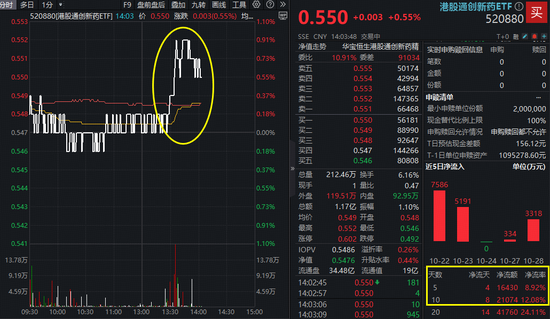
Core Viewpoint - The Hong Kong Stock Connect Innovation Drug ETF (520880) experienced a significant price surge, indicating strong buying interest, particularly in the context of the upcoming Federal Reserve interest rate decision [1][3]. Group 1: Market Activity - The ETF saw a net subscription of 33.18 million yuan yesterday, bringing the total inflow over the past 10 trading days to over 210 million yuan [3]. - The ETF's price reflects a clear battle between bulls and bears, especially as the Hong Kong market was closed for the Chung Yeung Festival [1]. Group 2: ETF Characteristics - The Hong Kong Stock Connect Innovation Drug ETF (520880) passively tracks the Hang Seng Hong Kong Stock Connect Innovation Drug Select Index, which exclusively includes innovative drug development companies and has over 70% of its holdings in large-cap innovative drug leaders [3][4]. - The top ten holdings account for 71.63% of the index, showcasing a significant concentration in leading companies [4]. Group 3: Performance Metrics - The Hang Seng Hong Kong Stock Connect Innovation Drug Select Index has shown a year-to-date increase of 108.14%, outperforming other innovative drug indices [4][5]. - The ETF has a total fund size of 1.806 billion yuan and an average daily trading volume of 493 million yuan since its inception, making it the largest and most liquid ETF in its category [5].
多家生物医药企业三季报业绩亮眼,港股创新药精选ETF(520690)午后震荡拉升
Xin Lang Cai Jing· 2025-10-29 05:38
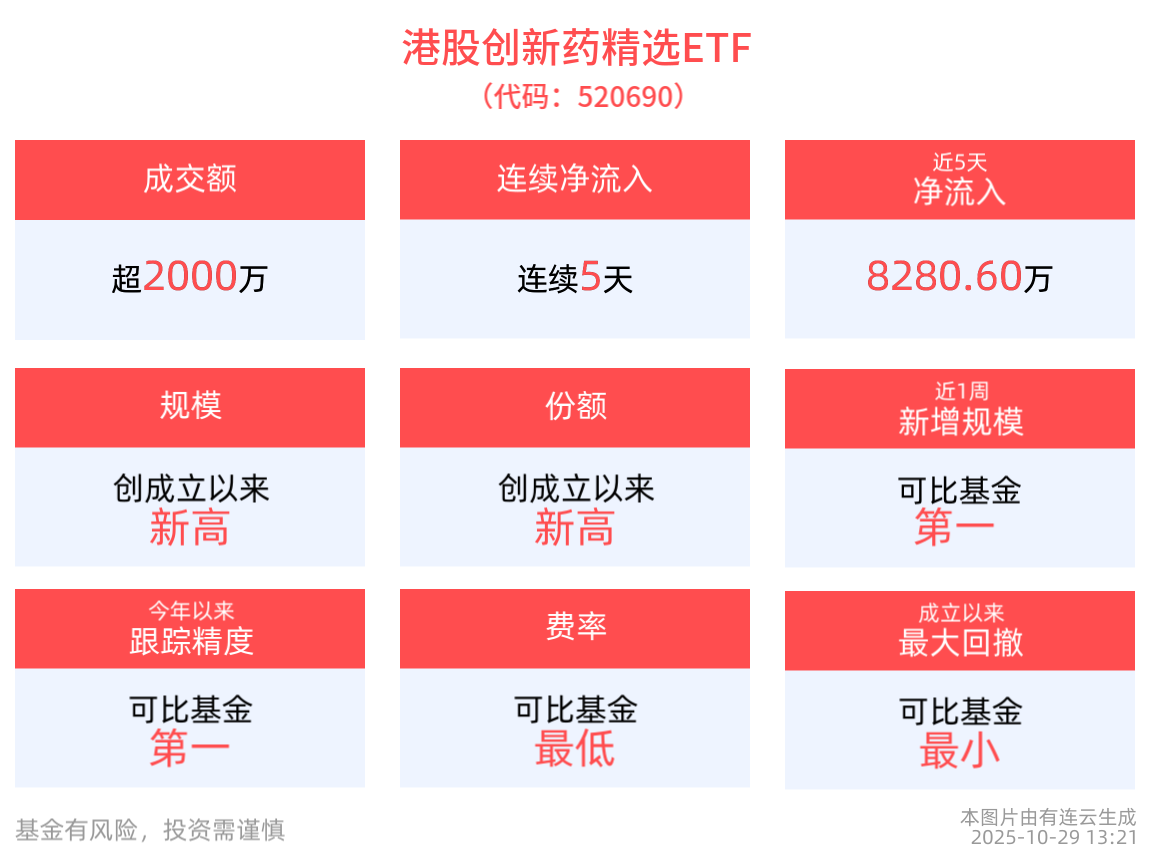
Group 1: Market Performance - The Hong Kong Innovative Drug Selected ETF (520690) increased by 0.22%, with the latest price at 0.89 yuan as of October 29, 2025 [3] - The ETF recorded a turnover of 4.25% during the trading session, with a total transaction value of 21.78 million yuan [3] - Over the past year, the average daily transaction volume of the ETF was 120 million yuan [3] Group 2: Clinical Data and Industry Insights - Grail presented initial data from its multi-cancer early detection product Galleri at the 2025 ESMO annual meeting, showing a positive predictive value of 61.6% and a specificity of 99.6% [3] - Among the detected new cancers, 69.3% were in stages I-III, with a tissue origin accuracy of 91.7% [3] - Guosen Securities views this data as a significant milestone in the multi-cancer early detection field, suggesting Galleri could enhance existing screening systems [3] Group 3: Company Earnings and Trends - Over 280 pharmaceutical and biotech companies, including Heng Rui Pharmaceutical and WuXi AppTec, reported strong Q3 results, driven by advancements in R&D pipelines and new drug launches [3] - The overall industry is exhibiting a positive trend characterized by "innovation as a foundation and overseas expansion" [3] Group 4: CDMO Sector Performance - Lonza, a leading overseas CDMO, reported strong Q3 results, maintaining a revenue growth forecast of 20-21% for the year, with core EBITDA margins between 30-31% [4] - Medpace has seen consecutive growth in new orders for two quarters, indicating a recovering financing environment for U.S. small and mid-sized biotech firms [4] - WuXi AppTec exceeded Q3 performance expectations and raised its full-year guidance, further confirming the positive outlook for the CXO industry [4] Group 5: ETF Size and Inflows - The latest size of the Hong Kong Innovative Drug Selected ETF reached 512 million yuan, marking a new high since its inception [4] - The ETF's share count also hit a record high of 574 million shares [4] - In the past five days, the ETF experienced continuous net inflows, with a peak single-day net inflow of 31.48 million yuan, totaling 82.81 million yuan in net inflows [4]


港股创新药ETF(159567)跌1.32%,成交额5.88亿元
Xin Lang Cai Jing· 2025-10-28 13:01
Core Insights - The Hong Kong Innovative Drug ETF (159567) closed down 1.32% with a trading volume of 588 million yuan on October 28, 2024 [1] - The fund was established on January 3, 2024, with an annual management fee of 0.50% and a custody fee of 0.10% [1] - As of October 27, 2024, the fund's latest share count was 8.177 billion shares, with a total size of 6.823 billion yuan, reflecting a significant increase in both share count and size compared to the previous year [1] Fund Performance - The fund's share count increased by 1968.15% and its size increased by 1706.06% from December 31, 2023, when it had 395 million shares and a size of 378 million yuan [1] - The fund has recorded a total trading amount of 22.001 billion yuan over the last 20 trading days, averaging 1.1 billion yuan per day [1] - Year-to-date, the cumulative trading amount is 229.668 billion yuan, with an average daily trading amount of 1.166 billion yuan [1] Fund Management - The current fund manager is Ma Jun, who has managed the fund since its inception, achieving a return of 66.90% during the management period [2] - The top holdings of the fund include companies such as BeiGene, CanSino Biologics, Innovent Biologics, and others, with significant percentages of the portfolio allocated to these stocks [2] - The largest holding is BeiGene, accounting for 10.62% of the portfolio, followed by CanSino Biologics at 10.55% and Innovent Biologics at 10.21% [2]

胡润发布百富榜 深圳147位企业家上榜
Sou Hu Cai Jing· 2025-10-28 12:10
Core Insights - The Hurun Research Institute's "Hurun Rich List" reveals that Zhong Shanshan, founder of Nongfu Spring, has become China's richest person for the fourth time, with a wealth increase of 190 billion yuan, totaling 530 billion yuan, setting a new record for the wealth of a Chinese billionaire [1][5] - Lei Jun, founder of Xiaomi, saw his wealth increase by nearly 200 billion yuan, driven by explosive growth in Xiaomi's automotive sector and high-end smartphone profitability [1][11] - The number of entrepreneurs on the list reached a historical high of over 1,400, a 30% increase from last year, largely due to a significant stock market rebound and the emergence of new faces in the technology sector [4][8] Regional Insights - Shanghai, Shenzhen, and Beijing are the top three regions for entrepreneur density, with Shanghai leading at 152 entrepreneurs, followed by Shenzhen with 147, and Beijing with 146 [3][4] - The number of entrepreneurs from Shanghai increased by 40, Shenzhen by 39, and Beijing by 31 compared to last year, indicating a strong growth trend in these regions [3][4] Wealth Growth by Sector - Significant wealth growth was observed in sectors such as new energy vehicles, consumer electronics, new consumption, computing power, biomedicine, and securities services [6][10] - In the new energy vehicle sector, notable figures like Zeng Yuqun of CATL saw wealth growth of nearly 70%, with his total wealth reaching 330 billion yuan [6][11] - The biopharmaceutical sector also experienced substantial wealth increases, with entrepreneurs like Zhong Huijuan of Hansoh Pharma seeing a wealth increase of over 600 billion yuan [10] New Faces and Trends - The list featured 376 new faces, a sevenfold increase from last year, primarily from industrial products, health, and consumer goods sectors, while real estate moguls have largely disappeared from the rankings [8][9] - The emergence of "new quality productivity" entrepreneurs is notable, with five out of the top ten billionaires characterized by their focus on new energy, smart technology, and high-end manufacturing [8][9] AI and Technology Sector - The AI sector has produced new billionaires, with figures like Chen Tian Shi of Cambrian rising by nearly 150 billion yuan, entering the top 20 [9] - The growth in AI and computing power is expected to continue, with significant investments and advancements in technology driving valuations higher [9][11]





2025胡润百富榜揭晓 农夫山泉钟睒睒第四次登顶“首富”
Sou Hu Cai Jing· 2025-10-28 10:31
Core Insights - The 2025 Hurun Rich List reveals that Zhong Shanshan, founder of Nongfu Spring, has seen his wealth increase by 190 billion RMB, making him the richest person in China for the fourth time with a net worth of 530 billion RMB [2][3] - A total of 1,434 individuals with wealth exceeding 5 billion RMB are listed this year, an increase of 340 from last year, with total wealth approaching 30 trillion RMB, reflecting a 42% growth [2][4] Group 1: Wealth Distribution - The number of billionaires has increased by 15 this year, totaling 41, which constitutes 3% of the total list [4] - The second tier includes 72 individuals with wealth between 50 billion and 500 billion RMB, making up 5% of the total [4] - 92% of the entrepreneurs fall within the wealth range of 5 billion to 50 billion RMB, with 1,321 individuals, indicating a balanced distribution between those with 5-10 billion and 10-50 billion RMB [4] Group 2: Notable Individuals - Zhong Shanshan leads the list, followed by Zhang Yiming of ByteDance with 470 billion RMB, and Ma Huateng of Tencent with a wealth of 450 billion RMB [3] - Lei Jun of Xiaomi ranks fifth with 326 billion RMB, marking his return to the top five after ten years [3] - The wealth of Zhong Shanshan is double that of the ninth-ranked Li Ka-shing family at 235 billion RMB and the eleventh-ranked Jack Ma family at 210 billion RMB [3] Group 3: New Entrants and Growth - The 2025 list features 376 newcomers, a sevenfold increase from last year, with notable entries including Xu Gaoming and Xu Dongbo of Laopu Gold with 69.5 billion RMB [6] - Xiaomi's Lei Jun is highlighted as the "growth king," with a wealth increase of 196 billion RMB, attributed to the explosive growth of Xiaomi's automotive business and high-end smartphone sales [6] - Other significant growth figures include Wang Ning of Pop Mart, whose wealth increased by 154.5 billion RMB, and Chen Tianshi of Cambrian, with a wealth increase of 148 billion RMB [6] Group 4: Geographic Distribution - The geographical distribution of listed entrepreneurs shows a "3+2+3" pattern, with Shanghai, Shenzhen, and Beijing leading in density [7] - Shanghai tops the list with 152 individuals, an increase of 40 from last year, followed closely by Shenzhen with 147 and Beijing with 146 [7] - The growth in these regions is primarily driven by a recovery in the A-share market and their status as hubs for industries like semiconductors, biomedicine, gaming, and AI [7] Group 5: Female Entrepreneurs - Zhong Huijuan of Hansoh Pharmaceutical has become the richest woman in China with a wealth of 141 billion RMB, surpassing Zong Fuli of Wahaha at 87.5 billion RMB [8] - The analysis indicates that despite a generally cool economic sentiment, the wealth of entrepreneurs has significantly increased due to the market recognizing the undervaluation of many companies [8]
中国创新药进入3.0阶段,企业“国际化”不止于“卖青苗”
Di Yi Cai Jing· 2025-10-28 08:36
Core Insights - The Chinese innovative pharmaceutical industry is transitioning into a new phase characterized by "in China, in Global," indicating a shift from merely serving local needs to integrating into the global ecosystem [1][7][10] - The surge in business development (BD) transactions has reignited investor interest, but concerns about undervaluing early-stage innovations persist [1][3][9] Group 1: Industry Development - The Chinese innovative drug sector has evolved from "in China, for Global" to "in China, in Global," reflecting a more integrated role in the global value chain [1][7] - The industry has seen a 400% increase in drug development activities over the past decade, surpassing international growth rates [7] - The emergence of a new BD transaction model, Co-Co, allows for shared responsibilities and profits between Chinese biotech firms and multinational corporations [4][5][10] Group 2: Business Development Transactions - Recent BD transactions have reached unprecedented amounts, with a notable deal between Innovent Biologics and Takeda Pharmaceuticals valued at up to $11.4 billion [3][4] - The Co-Co model represents a departure from traditional licensing agreements, enabling Chinese firms to retain more control and share in the commercialization process [4][5] - The number of BD transactions is increasing, indicating a growing acceptance of Chinese biotech capabilities in the global market [5][6] Group 3: Market Dynamics - Despite the increase in BD activity, the capital market's response has been lukewarm, with concerns about the sustainability of these transactions and the potential for future "washouts" [9][12] - The focus is shifting from individual "star pipelines" to platforms that demonstrate ongoing innovation capabilities, with AI integration becoming a standard expectation [12] - Multinational companies are increasingly establishing R&D centers in China, attracted by local scientific talent and technological advancements [10][11]
亚磷酰胺单体将在小核酸产业链中占据重要位置
CAITONG SECURITIES· 2025-10-28 07:57
Core Insights - The report emphasizes the significant role of phosphoramidite monomers in the small nucleic acid industry chain, highlighting their impact on the development of small nucleic acid drugs, which are considered promising candidates for treating various diseases due to their unique molecular structures and therapeutic mechanisms [1][6][10] - The report predicts robust growth in the demand for phosphoramidite monomers, with multinational pharmaceutical companies likely to benefit from this trend, as the global nucleotide market is projected to reach USD 730 million in 2023, with China being the largest production market [10][11] Section Summaries Phosphoramidite Monomer's Role - Phosphoramidite monomers are crucial raw materials for synthesizing small nucleic acid drugs, enhancing their stability and biological activity, and driving innovation in drug development [6][9] - The solid-phase phosphoramidite method is the mainstream technique for synthesizing oligonucleotides, which are a major cost component in nucleic acid drug production [9] Market Dynamics - The report notes that 90% of global nucleotides are used for nucleic acid drug production, with only about 10% allocated to health foods and agriculture [10] - The small nucleic acid drug market is primarily dependent on major multinational pharmaceutical companies, indicating potential benefits for companies within their supply chains [11] Investment Recommendations - The report suggests focusing on innovative drug companies such as Furuya Co., OncoOne, and others, as well as raw material suppliers like WuXi AppTec and others, indicating a diverse range of investment opportunities in the sector [10]