
邮储银行

Search documents
个人消费贷“国补”政策加码,实际利率跌入2字头
2 1 Shi Ji Jing Ji Bao Dao· 2026-01-23 10:49
Group 1 - The Ministry of Finance, the People's Bank of China, and the Financial Regulatory Administration have extended the personal consumption loan interest subsidy policy until the end of 2026, indicating a reinforcement of the "national subsidy" policy for personal consumption loans [1] - Major state-owned banks, including ICBC, ABC, BOC, CCB, BOCOM, and PSBC, have announced the implementation of the optimized personal consumption loan subsidy policy, which includes extending the policy deadline, expanding the support scope, and raising the subsidy standards [1][2] - The actual interest rates for high-quality customers benefiting from the subsidy can drop to around 2%, which is lower than the current housing loan rates, with annualized rates for consumer loans generally remaining around 3% [2] Group 2 - Ant Consumer Finance has also extended its subsidy policy until the end of 2026, removing the previous limit on single transaction subsidies and supporting diverse consumer needs [3] - Various banks are actively launching promotional measures, such as increasing loan limits and maintaining low interest rates, to stimulate consumer spending, especially in response to the upcoming Spring Festival [4] - The combination of fiscal subsidies and financial incentives from banks aims to lower consumer financing costs and enhance customer loyalty, effectively driving consumption [4]






浦银安盛红利量化混合A:2025年第四季度利润90.14万元 净值增长率0.85%
Sou Hu Cai Jing· 2026-01-23 10:37
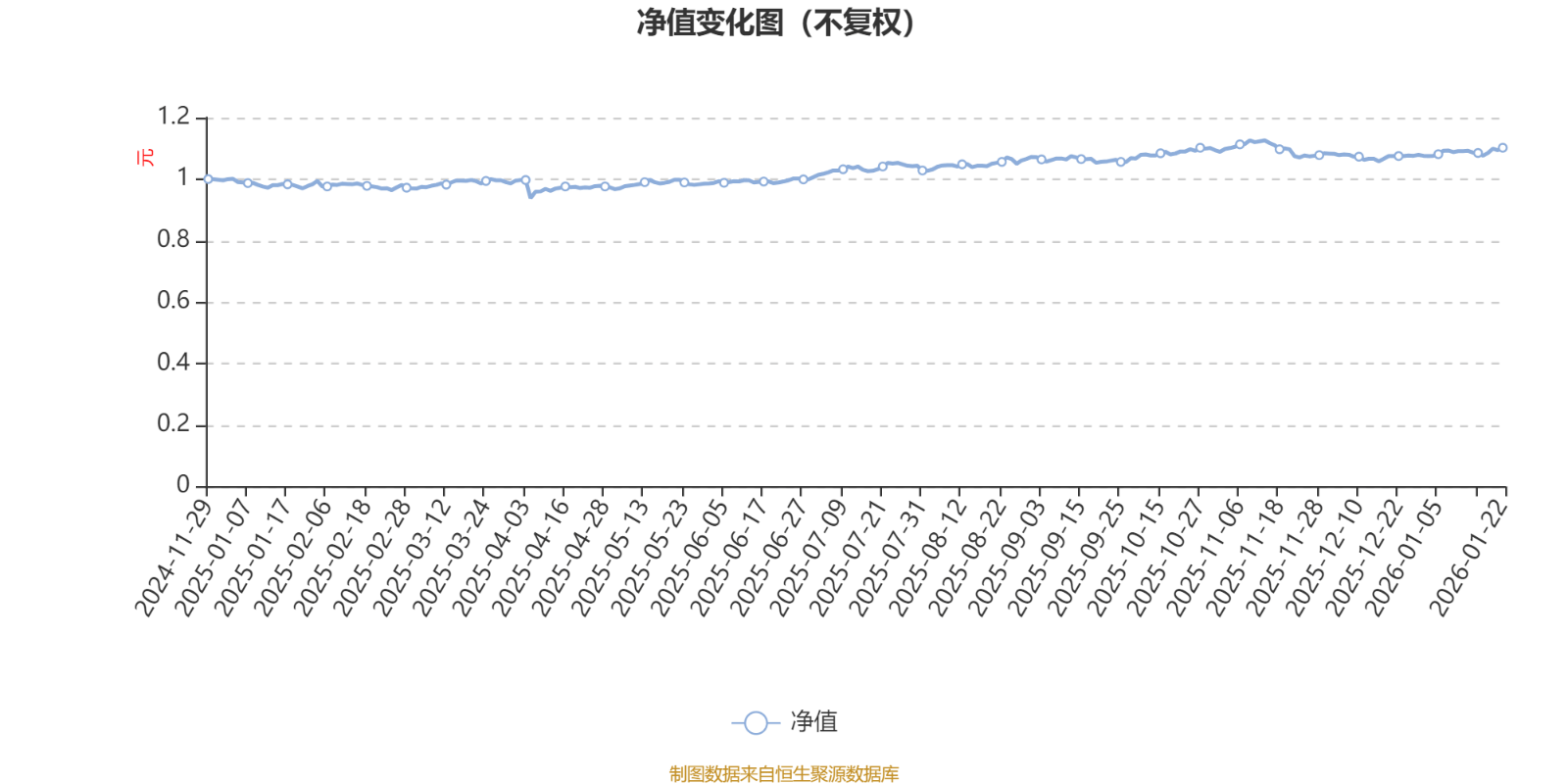
AI基金浦银安盛红利量化混合A(022488)披露2025年四季报,第四季度基金利润90.14万元,加权平均基金份额本期利润0.0148元。报告期内,基金净值增 长率为0.85%,截至四季度末,基金规模为5739.49万元。 该基金属于偏股混合型基金。截至1月22日,单位净值为1.102元。基金经理是孙晨进,目前管理6只基金。其中,截至1月22日,浦银安盛科创板100指数增 强A近一年复权单位净值增长率最高,达62.44%;浦银安盛红利量化混合A最低,为13.59%。 基金管理人在四季报中表示,本报告期内,本基金采用以多因子量化增强的投资策略为主,根据上市公司财务信息披露,以及因子表现和市场风格变化,实 时对组合进行相应的调整。展望后市,基本面逻辑清晰的优质公司估值恢复的确定性较高,价值和成长因子有望交替走强。 截至1月22日,浦银安盛红利量化混合A近三个月复权单位净值增长率为1.04%,位于同类可比基金566/621;近半年复权单位净值增长率为4.62%,位于同类 可比基金572/621;近一年复权单位净值增长率为13.59%,位于同类可比基金579/613。 通过所选区间该基金净值增长率分位图,可以观察该 ...

自营理财逆势压降,中小银行提速差异化发展
Xin Lang Cai Jing· 2026-01-23 10:03
Core Insights - The banking wealth management market is expanding, while banks without wealth management subsidiaries are systematically reducing their self-managed wealth management scale [1][2][3] - Recent reports from four small banks indicate a significant decline in their self-managed wealth management products, reflecting a broader industry trend influenced by regulatory guidance [2][10] Group 1: Market Trends - Four small banks reported a combined reduction of over 7 billion yuan in self-managed wealth management products, with total scale dropping from 31.87 billion yuan at the end of 2024 to 24.52 billion yuan by the end of 2025 [2][9] - The regulatory environment encourages banks to establish wealth management subsidiaries, leading to a focus on reducing self-managed wealth management and transitioning to agency sales [10][11] - By mid-2025, banks without wealth management subsidiaries had a self-managed wealth management scale of only 3.19 trillion yuan, accounting for about 10% of the total, with a year-on-year decline exceeding 24% [10] Group 2: Industry Growth - The overall scale of the banking wealth management industry reached a historical peak of 34 trillion yuan by November 2025, increasing by over 4 trillion yuan since the beginning of the year [4][12] - As of the end of the third quarter of 2025, there were 181 banks and 32 wealth management companies with active products, totaling 43,900 products and a scale of 32.13 trillion yuan, marking a year-on-year increase of 9.42% [12][13] - Fixed income products dominate the wealth management market, with a scale of 31.21 trillion yuan, representing 97.14% of the total [13] Group 3: Future Outlook - The market is expected to continue a "stronger gets stronger, weaker must transform" dynamic, with a projected increase in wealth management scale to over 36 trillion yuan in 2026 [6][14] - Wealth management subsidiaries are anticipated to leverage professional research and product innovation to expand into high-value categories such as ESG and retirement planning [14] - Small banks are advised to focus on differentiated and light-capital development paths, enhancing customer service and product offerings to avoid homogenization in competition [7][15]
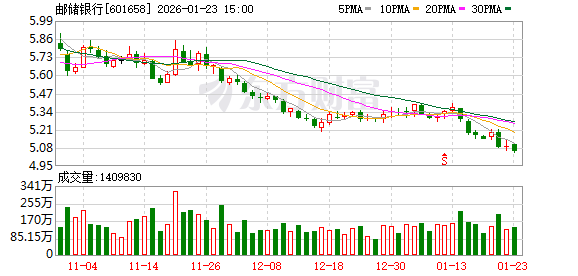
邮储银行取得文件传输方法专利
Jin Rong Jie· 2026-01-23 09:21
国家知识产权局信息显示,中国邮政储蓄银行股份有限公司取得一项名为"文件传输方法、装置及电子 设备、存储介质"的专利,授权公告号CN119946041B,申请日期为2024年12月。 天眼查资料显示,中国邮政储蓄银行股份有限公司,成立于2007年,位于北京市,是一家以从事货币金 融服务为主的企业。企业注册资本9916107.6038万人民币。通过天眼查大数据分析,中国邮政储蓄银行 股份有限公司共对外投资了7家企业,参与招投标项目5000次,财产线索方面有商标信息1213条,专利 信息1013条,此外企业还拥有行政许可99个。 作者:情报员 声明:市场有风险,投资需谨慎。本文为AI基于第三方数据生成,仅供参考,不构成个人投资建议。 本文源自:市场资讯 ...
国有大型银行板块1月23日跌0.8%,交通银行领跌,主力资金净流出2.08亿元
Zheng Xing Xing Ye Ri Bao· 2026-01-23 09:04
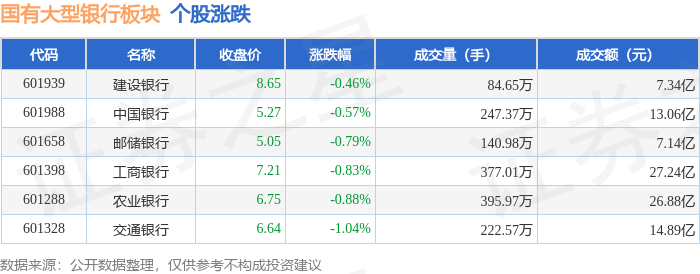
Group 1 - The core viewpoint of the news is that the state-owned large bank sector experienced a decline of 0.8% on January 23, with the Bank of Communications leading the drop [1] - The Shanghai Composite Index closed at 4136.16, up 0.33%, while the Shenzhen Component Index closed at 14439.66, up 0.79% [1] - The trading performance of individual state-owned banks showed varying degrees of decline, with Agricultural Bank down 0.88% and Bank of Communications down 1.04% [1] Group 2 - The net outflow of main funds from the state-owned large bank sector was 208 million yuan, while retail funds saw a net outflow of 63.04 million yuan [1] - The table of fund flows indicates that the Bank of Communications had a main fund net inflow of 78.11 million yuan, but also a significant retail net outflow of 55.17 million yuan [2] - Agricultural Bank experienced the largest main fund net outflow of 149 million yuan, despite a retail net inflow of 89.79 million yuan [2]
服务业贷款贴息政策升级!邮储银行落地新政扩围提额惠及千万经营主体
Zhong Guo Xin Wen Wang· 2026-01-23 09:03
Group 1 - The core viewpoint of the news is the optimization of the service industry loan interest subsidy policy, aimed at supporting domestic demand and releasing the potential of service consumption [2][3] - The implementation period of the subsidy policy has been extended to December 31, 2026, with new loans issued in 2026 eligible for the new policy, while loans issued in 2025 will follow the original plan [2] - The support areas have been expanded to include three new sectors: digital, green, and retail, in addition to the traditional sectors of catering, accommodation, and elderly care [2] Group 2 - The maximum loan amount eligible for interest subsidies has been significantly increased from 1 million to 10 million yuan, maintaining an annual subsidy rate of 1% for a maximum period of one year [2] - Eligible business entities can apply for personal business loans through regular processes, and the entire process is designed to be cost-free for customers [3] - The policy optimization is a significant measure of collaboration between fiscal and financial sectors, effectively reducing financing costs for service industry entities [3]
太空基建中的银行竞速:从“买图派”到“发射派”的路径进阶
Hua Er Jie Jian Wen· 2026-01-23 08:33
Core Insights - The article discusses the evolving landscape of financial technology, particularly the integration of satellite technology into banking operations, highlighting the launch of satellites by major banks like China Merchants Bank and Shanghai Pudong Development Bank as a strategic move to enhance data sovereignty and risk management in supply chain finance [2][9]. Group 1: Satellite Launches and Applications - China Merchants Bank's "Zhaoyin Jinkui" and Shanghai Pudong Development Bank's "Puyin Shuzhi" satellites were launched to join the "Tianqi Constellation," enhancing low Earth orbit IoT capabilities and allowing direct data transmission to banks without third-party intermediaries [2][9]. - The "Tianqi Constellation" focuses on short data communication across various terrains, improving data transmission frequency and reducing latency, which is crucial for real-time monitoring of assets [11][25]. - The integration of satellite technology into banking operations marks a significant shift from traditional data procurement methods, with banks now investing in their own satellite capabilities to gain greater control over data [17][23]. Group 2: Differentiation in Banking Strategies - Banks are diverging into two main strategies: the "Launchers," who invest in satellite hardware, and the "Buyers," who rely on algorithms and purchased data services [6][7]. - The "Launchers" include banks like China Merchants Bank and Ping An Bank, which have already deployed satellites to enhance their risk management frameworks [9][16]. - The "Buyers," represented by institutions like WeBank and CITIC Financial Assets, utilize satellite imagery for agricultural financing and project monitoring without owning the satellites themselves [12][14]. Group 3: Cost Dynamics and Strategic Implications - The decreasing costs of commercial space technology have made satellite launches more feasible for banks, with estimates suggesting that customized satellites can be developed for between millions to tens of millions of RMB [22][21]. - The ability to customize satellite payloads allows banks to meet specific operational needs, such as monitoring construction projects or environmental conditions, thus enhancing their risk assessment capabilities [23][28]. - By establishing their own satellite networks, banks can create a more resilient infrastructure for financial services, particularly in disaster recovery scenarios, ensuring business continuity [28][29]. Group 4: Ecosystem Development and Future Outlook - The collaboration between banks and commercial space companies is fostering a new ecosystem where financial institutions can leverage satellite technology to improve service offerings and operational efficiency [31]. - The integration of satellite data into banking operations is expected to redefine competitive dynamics in supply chain finance and cross-border transactions, positioning banks that effectively utilize this technology as leaders in the market [29].



关于落实个人消费贷款财政贴息政策优化 六大行集体公告
Sou Hu Cai Jing· 2026-01-23 06:45
Group 1 - The core viewpoint of the news is that major Chinese banks have announced the implementation of an optimized personal consumption loan interest subsidy policy, which will automatically apply to eligible loans after January 1, 2026 [1][3] Group 2 - The implementation period for the personal consumption loan interest subsidy policy has been extended to December 31, 2026 [3] - The support scope has been expanded to include credit card bill installment services [3] - The subsidy field has been broadened by removing the restriction on single transactions of 50,000 yuan and above [3] - The subsidy standards have been improved by eliminating the cap of 500 yuan on single transaction subsidies and the cumulative subsidy limit of 1,000 yuan for each borrower at a single institution for amounts below 50,000 yuan [3]

2026年春节无人车接力快递小哥“站岗” 运输成本下降5成
Bei Jing Shang Bao· 2026-01-23 06:28
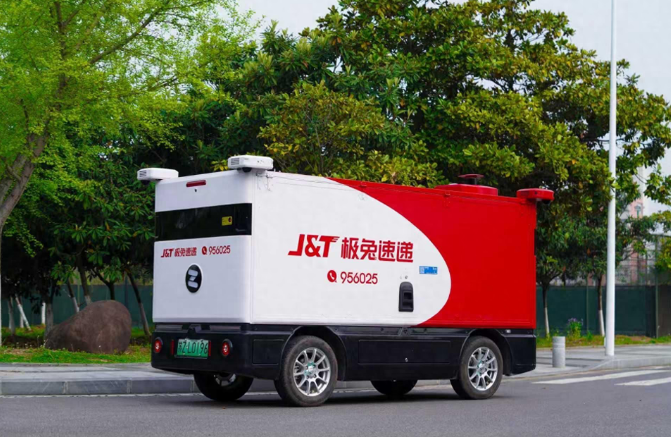
Core Insights - The logistics industry is increasingly adopting unmanned vehicles to address the surge in delivery demands during the Spring Festival, significantly reducing delivery times and costs [1][4][6] Group 1: Unmanned Vehicle Implementation - Several logistics companies, including Jitu, Zhongtong, and JD Logistics, are accelerating the deployment of unmanned vehicles to assist in delivery operations, particularly during peak seasons like the Spring Festival [1][8] - Unmanned vehicles are expected to enhance delivery efficiency, with estimates indicating a reduction of over 3 hours in delivery times and a 50% decrease in transportation costs [4][7] Group 2: Increased Delivery Volume - The Spring Festival is seeing a notable increase in the volume of heavy packages and gift boxes, with some logistics points expecting daily package volumes to rise by approximately 1,000 compared to previous years [3][6] - The characteristics of this year's delivery peak include a more prolonged high volume period and a greater variety of package types, which places higher demands on logistics capabilities [3][6] Group 3: Cost Management Strategies - To manage the increased workload during the Spring Festival, logistics companies are employing strategies such as flexible scheduling and the use of unmanned vehicles for short-distance transport, which helps alleviate pressure on human resources [4][6] - Major logistics firms like SF Express and JD Logistics are implementing resource adjustment fees during the peak season to manage operational costs effectively [6] Group 4: Market Trends and Future Outlook - The trend of utilizing unmanned vehicles is expected to continue growing, with projections indicating that over 1,000 unmanned vehicles will be deployed during the Spring Festival to support various sectors, including logistics, retail, and healthcare [10] - The overall operational efficiency of logistics companies is anticipated to improve, with JD Logistics reporting a 21% reduction in transportation costs since the introduction of unmanned vehicles [9]


信贷资产证券化 2025 年度运营报告与 2026 年度展望:信贷 ABS 发行规模止跌回稳,NPL 成为发行及交易主力;产品发行利率走势出现分化;零售资产拖欠率高位波动;需对消费信贷及行业政策保持关注
Zhong Cheng Xin Guo Ji· 2026-01-23 06:25
1. Report's Industry Investment Rating - The document does not mention the industry investment rating. 2. Core Viewpoints of the Report - In 2025, influenced by the significant increase in NPL product issuance, the number and scale of credit - asset - backed securities issuances rebounded. The secondary - market trading volume also rebounded, with NPL products and sub - grade securities becoming the main trading components. The spreads of normal - class products continued to decline, while those of NPL products showed differentiation. Retail asset delinquency rates fluctuated at high levels, and the real recovery of NPL products continued to decline [6][7][55]. - In 2026, the credit asset securitization market is expected to be dominated by NPL products. The issuance spreads of other product types are expected to remain low, and the trading proportion of NPL and sub - grade securities in the secondary market is expected to further increase. Retail asset performance is unlikely to improve significantly in the short term, and the actual recovery of NPL products will continue to face pressure. Attention should be paid to the impact of consumer credit and industry policies [6][55]. 3. Summary by Relevant Catalogs 3.1 Issuance - In 2025, a total of 238 credit - asset - backed securities were issued, with a total issuance scale of 291.522 billion yuan, representing a year - on - year increase of 23.96% in the number of issuances and 7.82% in scale. NPL products accounted for 74.79% of the issuance number and 28.15% of the scale, both reaching historical highs [6][7]. - Auto ABS: 32 issues were issued, with a total scale of 118.543 billion yuan, a year - on - year decrease of 8.58% in scale. Green Auto ABS accounted for 17.62% of the total Auto ABS issuance scale, a decrease of 8.67 percentage points compared to 2024 [10]. - NPL: 178 issues were issued, with a total scale of 82.057 billion yuan, a year - on - year increase of 36.92% in the number of issuances and 61.32% in scale, and a cumulative disposal of 519.086 billion yuan in non - performing assets [10]. - Micro - enterprise loan ABS: 10 issues were issued, with a total scale of 58.645 billion yuan, a year - on - year decrease of 23.08% in the number of issuances and 10.49% in scale [12]. - Personal consumption - loan ABS: 18 issues were issued, with a total scale of 32.277 billion yuan, a year - on - year increase of 5.88% in the number of issuances and 32.70% in scale [13]. 3.2 Issuance Interest Rate - In 2025, the issuance interest rate of normal - class asset credit ABS remained low, while the NPL product issuance interest rate deviated from the benchmark interest rate at the end of the year. The issuance interest rates of Auto ABS, personal consumption - loan ABS, and micro - enterprise loan ABS decreased in the first half of the year and then remained stable, while the NPL issuance interest rate increased significantly in the fourth quarter [17]. - The average spread of AAAsf - rated products and the benchmark interest rate was 56bp, and that of AA + sf - rated products was 48bp, a decrease of 2bp and 18bp respectively compared to 2024. The spreads of different types of products all declined to varying degrees, with NPL products still at a relatively high level [20]. 3.3 Secondary Market - By the end of 2025, the credit - asset - backed securities' outstanding scale decreased by 11.85% to 435.812 billion yuan. The trading volume increased by 4.38% to 130.514 billion yuan, the number of transactions increased by 27.90% to 2,388, and the turnover rate increased by 8.83 percentage points to 28.06% [23][25][26]. - NPL products were the main trading variety, with a trading volume of 53.206 billion yuan, accounting for 40.77% of the total trading volume. Auto ABS trading volume was 48.574 billion yuan, accounting for 37.22% of the total trading volume [28]. 3.4 Credit Performance - Auto ABS: The cumulative default rate of recently issued products increased significantly, the delinquency rate increased, and the prepayment rate showed a slow upward trend, with the fluctuation center between 8% - 10% [31][33][35]. - Personal consumption - loan ABS: The performance was significantly differentiated, the delinquency rate fluctuated, and the prepayment rate continued to rise [38][40][43]. - RMBS: The cumulative default rate remained low, the delinquency rate first increased and then decreased, and the prepayment rate fluctuated to a high level and then returned to stability [45][47][49]. - NPL: The real recovery situation declined year by year, and 11 issues of priority - class asset - backed securities failed to be fully redeemed by the expected maturity date [52].