
ABB

Search documents
国际工业+能源周报(05、05-05、09):美国计划全面改造空中交通管制系统,北约继续强化东翼防御能力
海通国际· 2025-05-09 13:25
Investment Rating - The report suggests a positive outlook for the aerospace and defense sectors, highlighting specific companies for investment opportunities [6]. Core Insights - The report indicates that technology giants may increase capital expenditures for data centers due to tariff pressures and uncertainties [2]. - The U.S. plans to modernize its national air traffic control system, which may benefit companies involved in aerospace and defense [22]. - The report notes a steady increase in the demand for industrial robots, particularly in the automotive sector, despite a slight decline in overall installations [35]. Summary by Sections Global Market Review - The S&P 500 and Dow Jones Industrial Average showed strong upward momentum, followed by some profit-taking, indicating a mixed market sentiment [9][10]. Infrastructure - The New England Independent System Operator expects an 11% increase in annual electricity consumption due to the electrification of heating systems and the adoption of electric vehicles [20]. - PJM is accelerating the construction of 11.8 GW of power projects to enhance electricity supply [20]. Energy - U.S. natural gas spot prices have adjusted, while futures prices are trending upward, with overall consumption remaining stable [5]. - International oil prices have decreased, and commercial crude oil and gasoline inventories have declined [5]. Aerospace - The U.S. aircraft engine and parts manufacturing price index remained stable, with a year-on-year increase of 2% [3][24]. - Global revenue passenger kilometers (RPK) increased by 3.3% year-on-year in March 2025, indicating a recovery in air travel demand [30]. Defense - NATO continues to strengthen its eastern flank defense capabilities, with significant military exercises planned in Estonia and Lithuania [33]. - The U.S. government approved a potential sale of AIM-9X Block II tactical missiles to Norway, supporting NATO allies [33]. Robotics - The report highlights that 541,302 industrial robots were installed in 2023, a slight decrease from the previous year, with the automotive sector regaining its position as the largest customer [35]. - The U.S. mechanical manufacturing price index showed a minor increase of 0.2% month-on-month [39]. Investment Recommendations - Companies such as Howmet Aerospace, Loar Holdings, and Safran are recommended for their potential benefits from the recovery in aerospace and defense spending [6]. - The report suggests monitoring companies like WMB and KMI, which are expected to benefit from the growing demand for natural gas infrastructure [6].




国际工业+能源周报(05、05-05、09):美国计划全面改造空中交通管制系统,北约继续强化东翼防御能力-20250509
Haitong Securities International· 2025-05-09 12:27
Investment Rating - The report suggests a positive outlook for the aerospace and defense sectors, highlighting specific companies for investment opportunities [6]. Core Insights - The report indicates that technology giants may increase capital expenditures for data centers due to tariff pressures and uncertainties [2]. - The U.S. air traffic control system is set for comprehensive modernization, which may benefit related industries [3]. - The industrial sector shows stable price indices for aircraft engines and components, with notable growth in specific areas [3][24]. - The energy sector is experiencing fluctuations in natural gas prices, with regulatory updates expected to enhance safety standards [5]. - The report emphasizes the robust recovery of the aerospace industry and increased defense spending, suggesting investment in high-performance component manufacturers [6]. Summary by Sections Global Market Review - The U.S. stock market showed strong upward momentum, with significant gains in the S&P 500 and Dow Jones indices, although some profit-taking occurred towards the end of the observation period [9][10]. Infrastructure - Data centers are seeing increased capital expenditures, with Meta raising its forecast for 2025 spending to between $64 billion and $72 billion [18]. - The New England ISO anticipates an 11% increase in annual electricity consumption due to electrification trends [20]. Energy Construction - The PJM Interconnection is accelerating the construction of 11.8 GW of power projects to enhance supply [20]. - The report notes geopolitical developments affecting energy prices, particularly in Europe [5]. Aerospace - The aerospace sector is witnessing significant developments, including a planned launch of a private astronaut mission by Axiom Space and SpaceX [22]. - The price index for aircraft engines and components remains stable, with a year-on-year increase of 2% [24][27]. Defense - NATO is enhancing its eastern flank defense capabilities, with large-scale military exercises planned in Estonia and Lithuania [33]. - The U.S. government has approved a potential sale of tactical missiles to Norway, supporting NATO allies [33]. Robotics - The industrial robotics market is projected to maintain a steady growth trajectory, with 541,302 units installed in 2023, despite a slight decline from the previous year [35]. - The automotive sector remains the largest customer for industrial robots, accounting for 25% of installations [35]. Industrial Equipment - The report highlights stable price indices for various industrial equipment, with gas turbine prices showing a year-on-year increase of 7.24% [45]. - Transformer exports from China are experiencing significant growth, with a 20.96% year-on-year increase in March 2025 [66].
网络研讨会| 锂电装备出口:CE认证与防爆安全全攻略
鑫椤锂电· 2025-05-09 08:48
Core Viewpoint - The article emphasizes the challenges and opportunities for Chinese lithium battery equipment companies as they expand into international markets, particularly focusing on the stringent CE certification requirements and safety standards in the EU [1][3]. Group 1: CE Certification Insights - Detailed breakdown of the CE certification process, including directive selection and technical documentation preparation [3]. - Trends in the lithium battery equipment export market and compliance pain points are highlighted [3]. - Real-world case studies from the company are presented to illustrate practical applications [3]. Group 2: Explosion Protection Certification - Introduction to explosion protection risks and area classification relevant to lithium battery equipment [4]. - Guidance on the selection and installation of explosion-proof equipment is provided [4]. - Case studies from the company demonstrate successful practices in explosion protection certification [4]. Group 3: Expert Profiles - Sun Hongbing, a CE product manager with nearly 15 years of experience, has led CE certification projects for major clients in the lithium battery sector [4]. - Zhang Zongwei, a product manager specializing in explosion protection and functional safety, has over 15 years of experience and has issued numerous ATEX certificates for various clients [4]. Group 4: Seminar Details - The seminar is scheduled for May 15, 2025, from 15:00 to 17:00, focusing on the safety aspects of lithium battery equipment exports [5][6]. - Participants will have the opportunity for one-on-one interactions with experts to address specific challenges faced by their companies [5].


ESG行业洞察 | AI、制冷和保险企业在应对气候风险中挖掘Alpha收益
彭博Bloomberg· 2025-05-09 08:10
Core Insights - The article discusses how companies in the insurance, AI, and cooling sectors can uncover alpha returns while addressing climate risks, highlighting the long-term demand for managing catastrophe risks, utilizing AI, and maintaining low-temperature environments [3]. Group 1: Insurance Sector Performance - Insurance brokerage companies have significantly outperformed the S&P 500 index over the past year, with a return rate of 100%, driven by a high average return rate of 32% and a low beta of 0.34 [4]. - Companies such as Aon, Brown & Brown, Arthur J. Gallagher, Marsh & McLennan, and Willis Towers Watson have shown superior long-term performance compared to insurance and reinsurance companies due to their low-risk, fee-based business models benefiting from rising premiums [4]. Group 2: Reinsurance Sector Insights - The recent rebound in the reinsurance sector is attributed to an improved expected return/loss ratio from taking on multiple risks, with a long-term average threshold of 3.57 times indicating strong performance for reinsurance companies [6]. - Notable reinsurance companies include Everest, Swiss Re, Arch Capital, Munich Re, Hannover Re, SiriusPoint, Fairfax Financial, and RenaissanceRe, which are expected to perform well under these conditions [6]. Group 3: AI and Energy Demand - Despite a decrease in media attention, AI-related electricity demand is projected to grow by approximately 3% annually until 2030, surpassing the recent growth rate of 0.5% [8]. - A group of 36 "AI enablers," including ABB, Schneider Electric, and Delta Electronics, has slightly outperformed the S&P 1200 Information Technology Index over the past year, with a 1% lead, and more significantly over three and five years, with outperformance of 11% and 17%, respectively [8]. Group 4: Environmental Impact of AI - The International Energy Agency forecasts that data center electricity demand will increase by about 15% annually starting in 2030, leading to a total consumption of 1,300 TWh by 2035 [10]. - This surge in demand is expected to result in an increase of 1 billion tons of CO2 emissions over the next decade, with annual emissions rising from 200 million tons to 320 million tons by 2030 before declining to 300 million tons [10].

海尔 vs TCL:谁能“拿下”ABB机器人?
Sou Hu Cai Jing· 2025-05-09 04:32
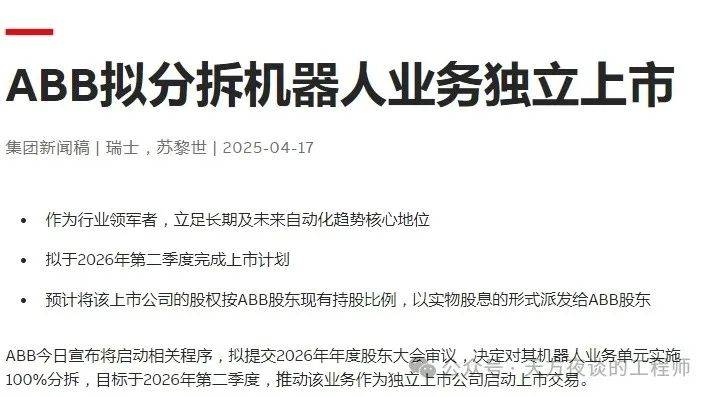
Core Viewpoint - ABB announced the spin-off of its robotics business, which generates annual revenue of $2.3 billion and an operating profit margin of 12.1% [1] Group 1: ABB's Robotics Business - The robotics division includes products such as multi-joint robotic arms, collaborative robots, and intelligent control systems, widely used in automotive manufacturing, electronics assembly, and logistics sorting [1] - The global installed base of ABB's robotics products exceeds 500,000 units, known for high precision, strong stability, and modular design [1] Group 2: Potential Acquirers - Midea Group successfully acquired KUKA Robotics in 2016, and similar companies like Haier and TCL have the potential motivation and capability to acquire ABB's robotics business [3] - Haier has accelerated its industrial automation layout through acquisitions, including a 26.83% stake in the domestic leader Xinjida, with a transaction amount exceeding 3 billion yuan [4] - TCL has invested in smart robotics technology companies through its industrial investment fund, indicating a focus on the upstream of the industry chain [5] Group 3: Strategic Analysis - Haier's experience in vertical integration and capital operations positions it favorably for acquiring ABB's robotics business, leveraging its COSMOPlat industrial internet platform for deep collaboration [4] - TCL lacks an existing robotics business framework, which may require more reliance on external integration capabilities if it pursues the acquisition [7] - Both Haier and TCL are large revenue-generating companies with strong financial capabilities, but Haier has more extensive experience in upstream and downstream cooperation [8] Group 4: Lessons from Midea's Acquisition - Midea's acquisition of KUKA for 29.2 billion yuan in 2016 illustrates that the value of acquiring an industrial robotics giant lies in long-term strategic benefits rather than immediate financial returns [9] - Haier could adopt Midea's model of "technology digestion + scenario expansion" if it acquires ABB's robotics business, while TCL needs to focus more on ecological collaboration [9] Group 5: External Challenges - China's push for high-end manufacturing positions industrial internet platforms and robotics technology as core focuses, with both Haier and TCL being "national team" members likely to receive policy support [10] - The potential acquisition by either company will need to navigate multi-national antitrust reviews, as seen in Midea's lengthy acquisition process of KUKA [10] Group 6: ABB's Business Independence - Post-spin-off, ABB's robotics division may prefer to maintain technological independence, which could affect integration success if the acquirer cannot provide sufficient collaborative space [11] - Haier's integration experience with Xinjida gives it an advantage, while TCL must demonstrate its cross-industry empowerment capabilities [11] Group 7: Competitive Advantage - Haier is seen as having a more significant advantage in the competition for acquiring ABB's robotics business due to its established framework and management team's familiarity with ABB's technology [12] - TCL may need to quickly address its shortcomings in the robotics industry or form a consortium with other capital to compete effectively [12]



2025-2031全球与中国三相熔断器式隔离开关市场项目规划及投资风险展望报告
Sou Hu Cai Jing· 2025-05-06 15:04
Group 1 - The report provides a comprehensive overview of the three-phase fuse-type isolator switch market, including definitions, product types, and application areas [2][3] - The market is segmented into low-voltage and medium-voltage types, with sales growth trends projected from 2020 to 2031 [2][3] - Key application areas include industrial distribution, commercial buildings, residential electricity, and petrochemicals, with sales growth trends also analyzed [2][3] Group 2 - The current status and development trends of the three-phase fuse-type isolator switch industry are analyzed, highlighting the industry's growth potential [3][11] - Global supply and demand forecasts for the three-phase fuse-type isolator switch from 2020 to 2031 are provided, including production capacity, output, and utilization rates [3][11] - The report details the production and market share of major regions, including North America, Europe, China, Japan, Southeast Asia, and India, from 2020 to 2031 [3][4][18] Group 3 - The analysis includes a breakdown of sales volume and revenue for different product types and applications, with projections for future growth [6][10] - The report examines the competitive landscape, including market share and revenue rankings of major manufacturers in both global and Chinese markets [4][12][18] - It also discusses the pricing trends of three-phase fuse-type isolator switches from 2020 to 2031, providing insights into market dynamics [6][10][18]

研判2025!中国通用运动控制行业产业链、市场规模及重点企业分析:国内制造业高端智能化转型加速,带动行业市场规模持续增长[图]
Chan Ye Xin Xi Wang· 2025-05-01 02:09
Industry Overview - The general motion control (GMC) industry in China is experiencing a significant transformation towards high-end and intelligent manufacturing, leading to increased demand for motion control technology [1][13] - The market size of the general motion control industry in China is projected to reach 28.233 billion yuan in 2024, representing a year-on-year growth of 11.76% [1][13] - High-performance, multi-axis synchronous, and intelligent motion control systems are becoming mainstream, aligning closely with the core needs of manufacturing upgrades [1][13] Industry Development History - The development of the general motion control industry in China has gone through five stages, starting from the introduction of automation technology in the late 20th century to the current phase of deep integration with emerging technologies like AI and IoT [4][5][6] - The initial stage (1990s to 2001) saw reliance on imported technology, while the period from 2001 to 2005 marked the emergence of domestic brands like GSK Technology, which broke foreign monopolies [4][5] - The rapid development phase (2005 to 2014) was characterized by increased R&D investment and improvements in product performance, allowing domestic companies to enter mid-to-high-end markets [5][6] Industry Chain - The upstream of the general motion control industry includes raw materials, core components, and production equipment, while the midstream focuses on manufacturing motion control products [8][9] - The downstream consists of industries such as industrial robots, machine tools, semiconductors, and packaging machinery, which are the primary customers for motion controllers [8][9] Market Size - The demand for general motion control technology is significantly driven by the acceleration of China's manufacturing sector towards high-end and intelligent solutions [1][13] - The integration of new sensors, actuators, and control chips enhances control precision and response efficiency, facilitating the transition from traditional dedicated controllers to open and reconfigurable controllers [1][13] Key Companies' Performance - The market is currently characterized by a "three-legged" competition among domestic and foreign brands, with companies like Inovance Technology and GSK Technology making significant strides in the mid-to-high-end market [15][20] - GSK Technology reported a revenue of 251 million yuan in 2023 for its core control components, while Inovance Technology achieved a market share of 28% in the servo system market by 2024 [15][20] Industry Development Trends - The future of the general motion control industry in China is expected to focus on high performance, multi-axis synchronization, and intelligent adaptive control, driven by the push for smart manufacturing and Industry 4.0 [22] - The application of motion control technology is expanding beyond traditional sectors to include new energy vehicles, medical devices, and smart home technologies [23][24] - Domestic brands are projected to capture over 70% of the market share, with an accelerated pace of domestic substitution and intensified competition against foreign brands [25]



崇德科技:深化落实“一核两翼”战略布局,2024年净利润同比增长14.07%
Zheng Quan Shi Bao Wang· 2025-04-28 11:26
Core Viewpoint - 崇德科技 has reported significant growth in revenue and profit for 2024, driven by its "one core, two wings" strategy focusing on the core business of dynamic pressure oil film sliding bearings while expanding into industrial services and international markets [1] Financial Performance - In 2024, the company achieved a revenue of 518 million yuan and a net profit attributable to shareholders of 115 million yuan, representing a year-on-year increase of 14.07% [1] - The net cash flow from operating activities reached 141 million yuan, up 170.83% year-on-year [1] - For Q1 2025, the company reported a revenue of 120 million yuan, a growth of 4.68% year-on-year, and a net profit of 27.81 million yuan [1] Industry Position and Innovation - 崇德科技 is recognized as a leading domestic manufacturer of dynamic pressure oil film sliding bearings, addressing the reliability challenges of bearings under high temperature and heavy load, thus breaking foreign technology monopolies [2] - The company has made significant advancements in the localization of key components, including overcoming challenges in the domestic production of third-generation nuclear power main pump bearings [2] International Market Expansion - The company has successfully entered the supply chains of international giants such as Siemens AG, GE, and ABB, with overseas revenue reaching 80.68 million yuan in 2024, marking a 27.87% increase [3] - 崇德科技 has established a European center to enhance local market sales and service capabilities, and has acquired 100% of German company Levicron to strengthen its international market presence [5] New Product Development - The company is actively expanding into new industries, focusing on wind power bearings, high-speed motors, and air-floating main shafts, achieving breakthroughs in these areas [4] - 崇德科技 has developed the second-generation wind power sliding bearings, which are positioned as industry-leading in design and manufacturing technology [4] Future Outlook - With the growth of downstream industries such as energy generation and petrochemicals, the demand for dynamic pressure oil film sliding bearings is expected to rise, positioning 崇德科技 for continued growth [6] - The company's strategic focus on innovation and international expansion is anticipated to enhance its competitive edge and facilitate the import substitution of key components [6]
中美,正在争夺机器人的市场
Hu Xiu· 2025-04-26 01:59
笔记君说: 一、全球工业机器人市场现状 昨天,美国总统特朗普本人亲口确认,针对中国进口商品的关税税率不会维持在当前水平 (145%),"它会大幅下降,但也不会降至零",同时特朗普有信心"中国将对最终的关税税率感到非常 满意"。 除此之外,特朗普还表示,尽管自己对美联储未能及时降息感到不满,但自己"无意解除鲍威尔职务"。 特朗普大大低估了拆分全球供应链这件事的难度,他使用的关税手段也属于刻舟求剑,而且十分简单粗 暴。 但是,我们依然不能低估特朗普,因为他对美国工业衰落的观察完全准确,同时他看到了一个趋势—工 业化4.0时代即将到来。 工业1.0时代指的是18世纪末的机械革命工业2.0时代是流水线生产的革命,工业时代3.0指的是信息化和 数字生产革命,工业4.0时代则是以工业机器人为标志的工业全面智能化革命。 毫无疑问,美国在科技领域特别是AI算法与高端软件生态上,在全世界都保持领先态势。而且它也是 一个能源大国,这就决定了美国在工业机器人技术方面是大有可为的。 而中国凭借政策扶持、产业链优势及国产替代加速,已经成为全球最大工业机器人市场(2023年安装量 占全球51%)。 如果说,有哪些国家真正有实力抓住工业4 ...
德国机械设备制造商协会负责人: 中国机器人产业迭代快战斗力强
Zheng Quan Shi Bao· 2025-04-25 20:18
Group 1: Overview of the Event - The robot industry conference held in Shenzhen attracted many foreign visitors, showcasing China's humanoid robots and their impressive capabilities [1] - The VDMA, Germany's largest industrial association, organized a delegation to explore opportunities in the Chinese robot industry, highlighting the rapid response and iteration speed of Chinese companies [1][2] Group 2: Competitive Advantages of Chinese Robotics - Chinese robot companies are recognized for their fast response to customer needs and technological innovation, often completing tasks in weeks that may take German companies months [2] - The well-developed industrial chain in regions like the Yangtze River Delta and Pearl River Delta allows for quick delivery of necessary hardware, enhancing the efficiency of robot production [2] - Chinese companies benefit from lower production costs due to local sourcing of materials and components, with around 80% of global batteries supplied by Chinese firms, resulting in production costs approximately one-third lower than those in North America and Europe [3] Group 3: Pricing Strategy - For example, the four-legged robot dog Go2 from Yushutech is priced at 9,997 yuan, significantly lower than Boston Dynamics' Spot, which costs about 54.6 million yuan, showcasing a substantial price advantage [3] Group 4: Market Positioning - Despite the strengths of the Chinese robot industry, it primarily serves the mid-to-low-end market, while high-end markets remain dominated by companies from Germany, Japan, and the United States [4][5] - The challenges in entering high-end markets stem from technological barriers, insufficient brand recognition, and a focus on cost-effective solutions in the mid-to-low-end segments [5] Group 5: Future Trends - The ongoing global demand for automation is expected to continue, with emerging markets in Southeast Asia, the Middle East, and Latin America potentially becoming new growth areas for Chinese robotics [6]