
中信银行

Search documents
年内近30家村镇银行注销解散
21世纪经济报道· 2026-02-18 07:53
Core Viewpoint - The article highlights the accelerated pace of integration and exit of village banks by joint-stock banks, marking a shift from rapid expansion to a focus on high-quality development in the industry [1][6]. Group 1: Recent Developments in Village Bank Exits - As of the end of January 2026, Everbright Bank has completed the exit of its three village banks, achieving a total "zero" status for its village banking operations [1][3]. - Shanghai Pudong Development Bank (SPDB) is also actively pursuing the "village to branch" model, with two of its village banks exiting in early February 2026, making it one of the most active banks in this regard [1][5]. - Nearly 30 village banks have been deregistered since the beginning of 2026, significantly higher than the same period last year [1][6]. Group 2: Integration and Exit Strategies - The exit actions by Everbright Bank are characterized as a "proactive application + compliance approval" model, with the bank inheriting all rights and obligations of the exited banks [3][4]. - The trend indicates a shift towards a more specialized and high-quality development phase for village banks, as the government emphasizes risk management and transformation of local financial institutions [6][10]. - The restructuring of over 230 village banks in 2025 through mergers, acquisitions, and exits reflects a deep reshaping of the industry, driven by both state-owned and joint-stock banks [6][9]. Group 3: Differentiated Approaches Among Joint-Stock Banks - SPDB has notably accelerated its exit process, reducing its village banks from 28 to approximately 13, with significant exits occurring between July 2025 and February 2026 [8][9]. - In contrast, Minsheng Bank has retained a broader network of village banks, exiting only two out of 28, indicating a different strategic focus [9]. - Other banks like Huaxia Bank and several others have completed their exits, while some banks have not engaged in village banking at all, highlighting varied strategies across the sector [7][9]. Group 4: Implications for Industry Personnel - The integration and exit of village banks signal a transition for employees, potentially moving from subsidiary roles to formal positions within parent banks, which may offer better resources and processes [9][10]. - However, this transformation also poses challenges, including changes in job roles and assessment systems, as well as potential impacts on existing business structures and client relationships [9][10].




股份制银行差异化竞争,头部效应显著
Xin Lang Cai Jing· 2026-02-18 05:56
Core Insights - The mobile banking user base in China is expected to peak in 2025, shifting the industry focus from acquiring new users to enhancing existing user engagement [1] - Financial institutions must achieve extreme efficiency and precision in their ecosystems to survive in this new environment [1] Industry Overview - According to an iResearch report, joint-stock banks are adopting differentiated survival strategies, leading to significant head effects [1] - China Merchants Bank leads joint-stock banks with 71.854 million monthly active users (MAU), surpassing some state-owned banks due to its focus on wealth management and intelligent interaction [1] - Ping An Bank and CITIC Bank form the second tier, maintaining MAUs between 20 million and 30 million, with Ping An Bank leveraging AI to reconstruct service chains and CITIC Bank integrating consumer ecosystems [1] Competitive Landscape - Third-tier institutions, such as Minsheng Bank and Everbright Bank, have seen their MAUs drop to between 10 million and 20 million, indicating a tightening survival space [1] - Local banks are experiencing growth by focusing on their local markets, with city commercial banks like Jiangsu Bank and Beijing Bank maintaining MAUs above 3 million [1] - Among rural commercial banks and rural credit cooperatives, Fujian Rural Credit has surpassed 4.5 million MAUs, capturing traffic in county and rural areas [1] Challenges for Private Banks - The situation for private banks is dire, with the top 50 list for 2025 nearly extinct due to a lack of physical branches, local living ecosystems, and high customer acquisition costs, leading to a loss of competitiveness in the mobile banking sector [1] - In the era of stock competition, ecological and regional capabilities are becoming the key to success [1]




国有大行主导手机银行市场,生态嵌入构筑护城河
Jing Ji Guan Cha Wang· 2026-02-18 05:47
Core Insights - The Chinese mobile banking market is entering a stage of stock competition in 2025, with monthly active users (MAU) stabilizing between 648 million and 739 million [2] - State-owned commercial banks dominate the market due to their ecological embedding advantages, with Agricultural Bank of China leading at 249 million MAU, followed by Industrial and Commercial Bank of China (194 million) and China Construction Bank (109 million) [2] - Private banks are expected to collectively exit the top 50 MAU rankings in 2025 due to a lack of offline branch support and local living ecosystems [2] Group 1: Major Players - Agricultural Bank of China has the highest MAU at 249 million, followed by Industrial and Commercial Bank of China with 194 million and China Construction Bank with 109 million, forming the first tier of banks [2] - China Bank and Postal Savings Bank have MAUs exceeding 50 million, constituting the second tier [2] - China Merchants Bank leads the joint-stock banks with 71.85 million MAU, while Ping An Bank and CITIC Bank form the second tier, with other joint-stock banks generally below 20 million MAU [2] Group 2: Market Dynamics - The core advantage of state-owned banks lies in their "full-scenario integration" capabilities, embedding services deeply into high-frequency life scenarios such as government affairs, social security, healthcare, and education [2] - Agricultural Bank of China extends its services to rural areas through intelligent service matching and customer customization, while Industrial and Commercial Bank of China utilizes its "Gong Xiao Zhi" model for interactive service [2] - Regional banks like Jiangsu Bank, Beijing Bank, and Ningbo Bank show stable performance by focusing on local markets, with some rural commercial banks like Fujian Rural Credit exceeding 4.5 million MAU, indicating the sustainability of localized operations in the stock market [2]




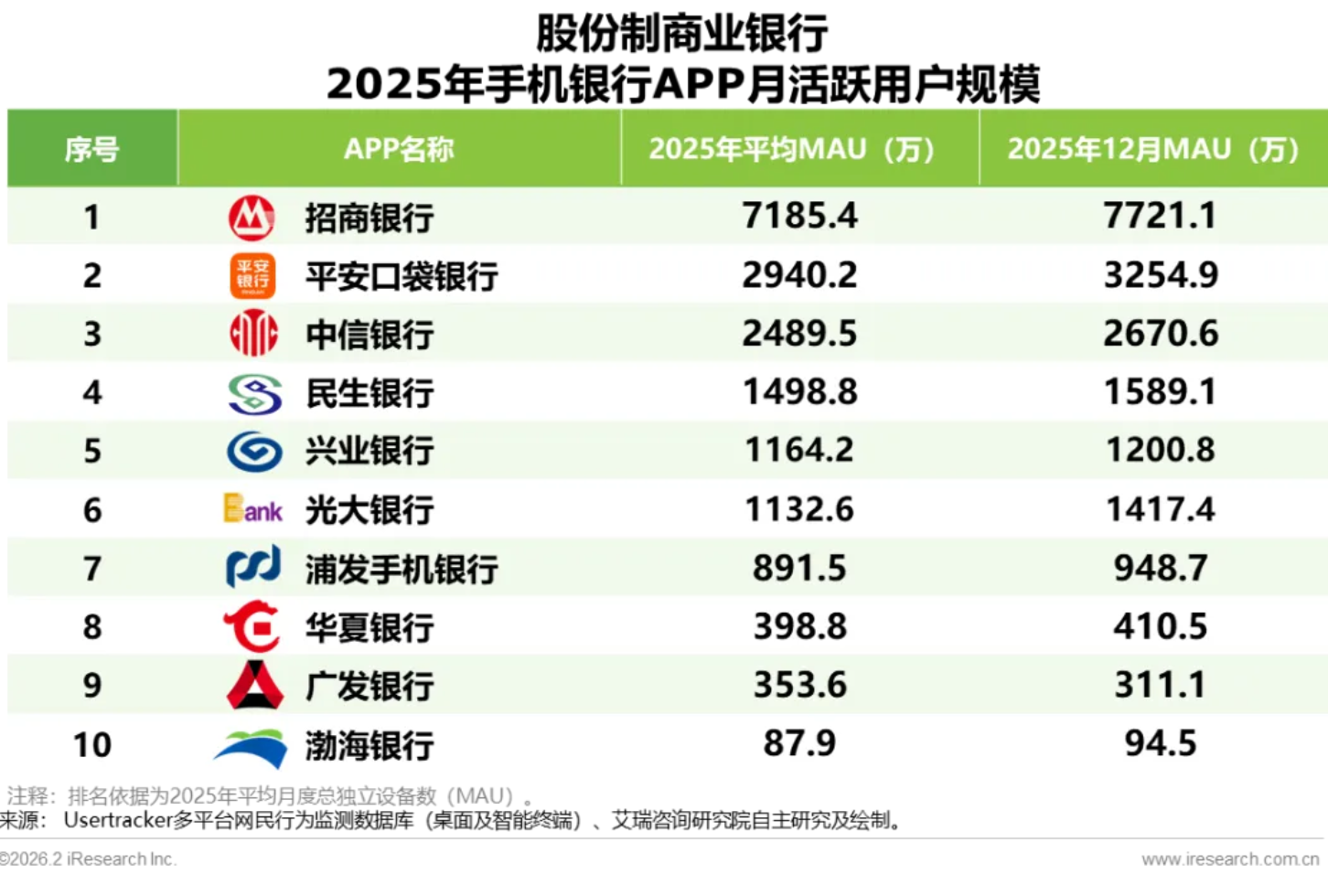
手机银行TOP50再无民营 生态壁垒高筑草根绝迹
Jing Ji Guan Cha Wang· 2026-02-18 05:47
Core Insights - The monthly active users (MAU) of mobile banking apps in China have stabilized between 648 million and 739 million, indicating that user growth has reached a ceiling, marking the end of a decade-long traffic dividend period [2] - User behavior has shifted significantly, with average session duration decreasing from 4.9 minutes in 2023 to approximately 2.7 minutes by mid-2025, reflecting a preference for high-frequency, short-duration, and function-oriented usage [2] - Major state-owned banks have solidified their market dominance, with all six major state-owned banks ranking in the top ten for MAU, led by Agricultural Bank of China with 249 million MAU [2] Industry Dynamics - The core competitive advantage of state-owned banks lies in their "full-scenario integration" capabilities, providing financial services deeply embedded in public services such as government, social security, healthcare, and education [3] - Joint-stock banks are adopting specialized development strategies, with China Merchants Bank leading its peers with 71.85 million MAU, while Ping An Bank and Citic Bank are leveraging AI technology to enhance service processes and maintain user engagement [3] - Local banks are experiencing polarization, with some city commercial banks maintaining MAU above 3 million due to their deep understanding of local markets, while private banks like WeBank and MYbank have fallen out of the top 50 due to challenges in customer acquisition and retention [3] Future Trends - As the industry standard for single-session usage time becomes 3 minutes, banks must rethink their value creation strategies [4] - AI-driven service process optimization, real-time risk control systems, and multi-device collaboration within ecosystems are reshaping the competitive landscape [4] - Key factors for institutional success in the future will include precise user insights, prudent risk management, and robust ecosystem integration capabilities [4]



流量红利枯竭 存量博弈下银行APP被迫断臂求生
Jing Ji Guan Cha Wang· 2026-02-18 05:44
Core Insights - The Chinese mobile banking market is transitioning from "scale expansion" to "value cultivation," indicating a saturation of user growth and the end of the traffic dividend period [2] - Different types of banks are exhibiting varied development trends in this new landscape [2] State-Owned Commercial Banks - The six major state-owned banks dominate the mobile banking market, with Agricultural Bank of China leading with over 250 million monthly active users (MAUs) [2] - The top three banks, including Industrial and Commercial Bank of China and China Construction Bank, have MAUs of nearly 200 million and over 100 million, respectively [2] - All six major banks reported positive month-on-month growth in MAUs, with ICBC leading at a 6.1% growth rate [2] Joint-Stock Commercial Banks - Joint-stock banks are seeking to carve out a niche in the saturated market, with China Merchants Bank leading among them with over 70 million MAUs [3] - Some banks like Everbright Bank and CITIC Bank showed significant month-on-month growth rates of 11.0% and 9.2%, respectively [3] - The performance of joint-stock banks is mixed, with some experiencing negative growth [3] Urban Commercial Banks - Urban commercial banks are growing rapidly, with 17 banks making it to the top 50 list, led by Ningbo Bank with 3.644 million MAUs and a growth rate of 43.9% [3] - The growth is attributed to localized strategies that enhance customer engagement [3] Rural Commercial Banks and Credit Cooperatives - Rural commercial banks and credit cooperatives also performed well, with 17 banks in the top 50, led by Fujian Rural Credit with 781.6 thousand average MAUs [4] - 12 out of these 17 banks reported positive month-on-month growth [4] Private Banks - Private banks are facing significant challenges, with only WeBank making it to the top 50 list in the first half of 2025, experiencing a 27.3% decline in MAUs [4] - The competitive landscape has shifted, making it difficult for online-only private banks to maintain their initial advantages [4] Conclusion - State-owned banks leverage "ecosystem" advantages to solidify their market position, while joint-stock banks focus on "professional" opportunities [5] - Urban commercial banks establish a strong local presence, whereas private banks struggle to survive in the competitive environment [5] - The future of banking will require a focus on creating irreplaceable value for users through technology and insights into user behavior [5]

2.7分钟定生死 手机银行存量厮杀谁在“断臂”,谁在“吃肉”?
Jing Ji Guan Cha Wang· 2026-02-18 04:57
Core Insights - The report by iResearch indicates that the monthly active users (MAU) of mobile banking apps in China have stabilized after fluctuating between 648 million and 739 million, signaling a ceiling in user growth and a shift from acquiring new users to enhancing existing user engagement [2] - User behavior is undergoing a structural reversal, with the effective daily usage time per device dropping from 4.9 minutes in 2023 to around 2.7 minutes by mid-2025, leading to a focus on high-frequency, short-duration, and functional usage [2] - Financial institutions are compelled to streamline operations and focus resources on core transaction scenarios to survive in this competitive landscape, where efficiency and precision are paramount [2] Mobile Banking Market Overview - The top three banks in terms of MAU are Agricultural Bank of China (2.49 billion), Industrial and Commercial Bank of China (1.94 billion), and China Construction Bank (1.09 billion), with all six major state-owned banks ranking in the top ten [3][5][6] - Private banks, represented by WeBank and MYbank, have faced significant setbacks, with many dropping out of the top 50 MAU rankings by 2025 [4] Competitive Landscape - State-owned banks are solidifying their dominance through extensive customer bases and integrated ecosystems, leveraging services embedded in high-frequency life scenarios such as government services and healthcare [7] - Joint-stock commercial banks are adopting a "specialized and precise" survival strategy, with China Merchants Bank leading among them with 71.85 million MAU, focusing on wealth management and intelligent interaction [8][10] - Regional banks are thriving by deeply engaging with local markets, while private banks struggle due to high customer acquisition costs and lack of local ecosystem support [13][14] Future Outlook - The mobile banking market is transitioning from a phase of scale expansion to one of value cultivation, with state-owned banks building moats through ecosystems, joint-stock banks seeking niches through specialization, and regional banks solidifying their local roots [14] - The ability to create irreplaceable value in a limited user engagement environment will be crucial, with technology applications such as AI reshaping service processes and enhancing risk management [15][16]

邮储银行迎首位股份行出身行长,芦苇履新带来新契机
Sou Hu Cai Jing· 2026-02-17 02:29
Core Viewpoint - The appointment of Lu Wei as the new president of Postal Savings Bank marks a significant shift in the leadership dynamics of state-owned banks in China, as he is the first leader to transition directly from a joint-stock bank, breaking the traditional internal promotion or external appointment model [2] Group 1: Appointment Significance - Lu Wei's appointment is a groundbreaking attempt to bridge the talent flow between state-owned banks and joint-stock banks, which has historically faced "invisible barriers" [2] - His career trajectory reflects a strong background in the "CITIC system," having risen through the ranks of CITIC Bank and later serving as chairman of CITIC Trust, showcasing his management capabilities and adaptability [2][3] Group 2: Qualifications and Challenges - Lu Wei's international background and professional qualifications, including a master's degree in accounting from Deakin University and CPA certifications from China, Hong Kong, and Australia, are seen as key factors in his selection, especially as Postal Savings Bank pushes for retail transformation and international expansion [3] - The bank faces challenges such as narrowing interest margins and asset quality pressures, with a non-performing loan ratio of 0.94% as of September 2025, while net profit growth has slowed to 0.98% [3] Group 3: Transformation and Strategy - Postal Savings Bank, known for its "inclusive finance" label, has a vast network of nearly 40,000 outlets, which presents both an advantage and higher operational costs; its asset scale reached 18.61 trillion yuan with an 8.9% year-on-year growth, but revenue growth was only 1.82% [4] - Lu Wei's management team will need to align with his strategic direction, particularly in technology and customer management, raising questions about the potential introduction of market-oriented incentive mechanisms [4] Group 4: Industry Implications - This personnel adjustment signals a diminishing "gatekeeping" mentality in the selection of senior executives at state-owned banks, emphasizing professional competence and cross-institutional experience [5] - Lu Wei's appointment presents both opportunities and challenges for Postal Savings Bank, as he must balance the bank's policy-driven mission with market demands, potentially setting a new paradigm for executive selection in other state-owned banks [5]
黄金跌了价,2026年2月16日,国内黄金新价格、人民币黄金新价格
Sou Hu Cai Jing· 2026-02-16 21:39
Group 1: Gold Market Prices - As of February 16, 2026, the domestic gold market shows a mixed trend with a real-time trading price of 1119 CNY per gram and a basic gold price set at 1125 CNY per gram [1] - The price range for jewelry brand gold products is between 1300-1579 CNY per gram, with major brands like Chow Tai Fook and Luk Fook uniformly priced at 1529 CNY per gram, while Lao Feng Xiang is slightly higher at 1548 CNY per gram [2] - The Shanghai Gold Exchange reports that the AuT D contract price is 1108.50 CNY per gram, down 1.47% from the previous day, and the Au9999 contract is at 1109.00 CNY per gram, with a decline of 1.20% [2] Group 2: Bank Gold Bar Pricing - Major banks are quoting investment gold bars in the range of 1121-1145 CNY per gram, with differences attributed to handling fees and brand premiums [4] - Among state-owned banks, Industrial and Commercial Bank of China is at 1143.43 CNY per gram, and China Construction Bank at 1141.30 CNY per gram, while joint-stock banks are slightly lower [5] - China Gold and Cai Bai Jewelry report prices of 1139 CNY per gram and 1137 CNY per gram respectively, while jewelry brands like Chow Tai Fook and Lao Feng Xiang have gold bar prices reaching 1342-1403 CNY per gram, exceeding bank channel prices [6] Group 3: Investment Case Studies - Investor Xue Di, with a strategy of gradual accumulation since 2023, turned an initial capital of 2.8 million CNY into over 5.6 million CNY by January 2026, emphasizing gold's value preservation [8] - In contrast, investor Shi Yue faced losses after buying at a high of 1200 CNY per gram, leading to an average cost of 1185.73 CNY per gram and a significant weekly loss [8] - Investor Tian Rui missed the opportunity to purchase gold at 553 CNY per gram in 2023, now facing much higher prices, highlighting the importance of timing in investment success [8] Group 4: Pricing Power Shift and Supply Variables - Since 2025, the pricing logic of gold has undergone structural changes, moving from a negative correlation with U.S. Treasury real interest rates to a new model influenced by global debt levels and central bank gold purchases [9] - In 2025, global gold demand reached a record high of 5002 tons, with central bank purchases of 863 tons stabilizing the market, indicating a shift in the pricing system towards a tripartite structure involving Asian demand, North American demand, and central bank purchases [9] - Supply dynamics are also changing, as seen in Ghana, where gold production reached a record 6 million ounces in 2025, with artisanal mining surpassing large commercial mines, indicating a surge in informal supply channels [10] Group 5: Consumer Awareness and Investment Strategies - Consumers are advised to be cautious of "one-price" gold products that may not clearly indicate weight, potentially leading to high per-gram prices upon resale [12] - For genuine investors, transparency is crucial, with institutions like China Construction Bank and Agricultural Bank of China offering gold bars at only a slight premium over market prices, making them preferable for risk-averse investments [12] - The strategic reserve demand from global central banks, alongside U.S. monetary policy expectations and geopolitical risk factors, supports high gold prices, emphasizing the distinction between jewelry and investment-grade gold [12]





中国东方航空20亿元中期票据拟于2月26日付息 利率1.89%
Xin Lang Cai Jing· 2026-02-16 03:38
Core Viewpoint - China Eastern Airlines Corporation Limited has announced the issuance of its first tranche of medium-term notes for 2025, with a total issuance amount of 2 billion yuan [1] Group 1: Bond Details - The bond is referred to as "25东航股MTN001" and has a bond code of 102580807 [1] - The interest rate for this bond is set at 1.89% for the current interest period [1] - The interest payment date is scheduled for February 26, 2026, with provisions for postponement in case of public holidays [1] Group 2: Payment Method - The payment of interest will be managed through the China Central Depository & Clearing Co., Ltd., where the issuer will transfer funds to a designated account [1] - Subsequently, the clearing house will distribute the funds to the bondholders' accounts [1] Group 3: Underwriting Information - The lead underwriter for this bond issuance is CITIC Bank Corporation Limited [1]

最新21家系统重要性银行名单出炉 浙商银行首次上榜
Di Yi Cai Jing· 2026-02-15 00:07
我国系统重要性银行新增一家。 系统重要性银行是指银行中规模较大、地位重要的少数银行。因为其结构和业务复杂、与其他金融 机构关联性强,在金融体系中具有举足轻重的地位,往往对其采取更严格的监管措施,以保障其更加稳 健持续发展,解决"大而不能倒"问题,防范化解金融风险,确保金融稳定和金融安全。 下一步,中国人民银行、国家金融监督管理总局将按照《系统重要性银行附加监管规定(试行)》 要求,发挥好宏观审慎管理与微观审慎监管合力,持续夯实系统重要性银行附加监管,促进系统重要性 银行安全稳健经营和健康发展,更好服务实体经济高质量发展。 (责任编辑:张厚为) 2月13日,2025年我国系统重要性银行名单公布。中国人民银行、国家金融监督管理总局开展了 2025年度我国系统重要性银行评估,认定21家国内系统重要性银行,其中国有商业银行6家、股份制商 业银行10家、城市商业银行5家。 第一财经记者注意到,与此前的名单相比,浙商银行新入选系统重要性银行,表明其系统重要性程 度有所上升。 在此次公布的名单中,按系统重要性得分从低到高分为五组:第一组11家,包括中国民生银行、中 国光大银行、平安银行、华夏银行、宁波银行、江苏银行、北京银 ...
