宇信科技

Search documents
百度分拆昆仑芯上市引发市场!港股大涨,A股正宗概念股一览
Sou Hu Cai Jing· 2026-01-05 04:34
Core Insights - Baidu has submitted a confidential application for the IPO of its AI chip business, Kunlun Chip, on the Hong Kong Stock Exchange, leading to a significant surge in the Hong Kong tech sector and Baidu's stock price [1][3] Group 1: Kunlun Chip's Market Impact - Kunlun Chip has a valuation of 21 billion yuan and is supported by orders in the billion-level range, which has attracted substantial market attention [1] - In 2024, Kunlun Chip's shipment volume reached 69,000 units, outperforming its competitor, Cambricon, by 2.65 times, solidifying its position as a leader in the domestic AI chip market [2] - Morgan Stanley predicts Kunlun Chip's revenue will grow from 1.3 billion yuan in 2026 to 8.3 billion yuan, indicating a sixfold increase and a potential valuation exceeding 80 billion yuan [2] Group 2: Factors Behind Hong Kong Stock Surge - The surge in Hong Kong tech stocks is attributed to multiple favorable factors, including supportive policies from the China Securities Regulatory Commission for spin-off listings [3] - The Hong Kong Stock Exchange has opened a "green channel" for tech companies, facilitating quicker access to the capital market for quality assets [3] - Market sentiment also played a crucial role, with the Hang Seng Index rising by 2.76% and the Hang Seng Tech Index by 4% on the first trading day of 2026, leading to a strong influx of capital [3] Group 3: A-Share Market Opportunities - Companies with official ties to Baidu are identified as potential investment opportunities, including: - Yuxin Technology, which has a business cooperation agreement with Baidu and a stake acquisition [4] - Geling Deep Vision, which has signed a strategic cooperation agreement with Baidu to integrate Kunlun Chip's computing power [5] - BYD is a core partner of Kunlun Chip, holding a stake and providing automotive-related services [6] - Companies in the supply chain for chip manufacturing and testing are also positioned to benefit from Kunlun Chip's expansion [6] Group 4: Investment Guidelines - Investors are advised to focus on companies with clear official announcements and deep business ties to avoid speculative investments [8] - Emphasis should be placed on companies with long-term cooperation, large orders, and equity ties, as these relationships indicate a more sustainable benefit [8] - Companies aligned with national policies supporting AI chip domestic substitution and computing infrastructure construction are recommended for long-term investment [8]



1月4日6家公司获基金调研
Zheng Quan Shi Bao Wang· 2026-01-05 03:21
Group 1 - On January 4, a total of 7 companies were investigated by institutions, with 6 companies being surveyed by funds, highlighting a significant interest in certain firms [1] - Among the companies surveyed, Jingji Zhino (京基智农) attracted the most attention, with 23 funds participating in the investigation, followed by Tianyang Technology (天阳科技) with 21 funds and Yuxin Technology (宇信科技) with 14 funds [1] - The surveyed companies included 3 from the Shenzhen main board and 3 from the ChiNext board, indicating a diverse representation across different market segments [2] Group 2 - The total market capitalization of the surveyed A-share companies included 2 firms with a market value of less than 10 billion yuan, specifically Shanjiji Technology (熵基科技) and Jingji Zhino (京基智农) [3] - In terms of market performance, 5 out of the surveyed stocks increased in value over the past 5 days, with Jingji Zhino leading at a rise of 23.94%, followed by Shanjiji Technology at 13.77% and Jingbeifang (京北方) at 11.09% [3] - Notably, Jingbeifang experienced a net inflow of 216 million yuan in funds over the past 5 days, indicating strong investor interest, while Yuxin Technology and Jingji Zhino also saw significant net inflows of 103 million yuan and 67.98 million yuan, respectively [3]





东吴证券:数字人民币新方案 机制+技术架构双重升级
智通财经网· 2026-01-05 01:34
Core Viewpoint - The upgrade of digital RMB from a "pilot product" to a "core liability and infrastructure" of banks will lead to an "order-driven + long-term penetration" impact on A-shares, rather than a simple thematic trade [1][2]. Group 1: Digital RMB Upgrade - The People's Bank of China will officially launch a new generation of digital RMB measurement framework and management system starting January 1, 2026, transitioning from "cash-type 1.0" to "deposit currency-type 2.0" [2]. - The core of the 2.0 mechanism is the redefinition of liability attributes and the inclusion of a macro framework, where balances in real-name wallets at commercial banks will be treated as "account-based commercial bank liabilities" [3]. Group 2: Financial IT Impact - Financial IT companies are likely to benefit from the need for banks to transform their core systems, accounting, channels, and data governance as the digital RMB infrastructure is implemented [1]. - The digital RMB will enhance the willingness of users to hold and use it by providing interest payments on wallet balances, similar to traditional deposits, thus creating a manageable asset-liability space for banks [3]. Group 3: Technical Architecture - The proposed digital path includes an "account system + currency string + smart contracts," which aims to standardize the wallet system and enhance the resilience of the system while ensuring compatibility with distributed ledger technology (DLT) [4]. - The smart contract ecosystem will facilitate programmable digital payments, reducing misuse risks and compliance costs across various scenarios such as supply chain finance and fiscal subsidies [4]. Group 4: Investment Recommendations - Companies such as Hengsheng Electronics, Jingbeifang, Changliang Technology, and Yuxin Technology are recommended for their potential in payment acceptance and terminal expansion [5]. - Communication operators like China Telecom, China Unicom, and China Mobile are expected to benefit directly from capabilities related to SIM hard wallets and cross-border connections [5].

宇信科技(300674) - 宇信科技:2026年1月4日投资者关系活动记录表
2026-01-05 00:12
Group 1: Digital Currency Development - The "Action Plan" marks a key step in the transition of digital RMB from M0 to M1, addressing the constraints on commercial banks' large-scale use of digital currency [2] - The new regulations remove barriers, allowing commercial banks to innovate more actively within the digital RMB framework [2][4] Group 2: Technological Innovations - The upgrade of digital RMB involves a systematic iteration of its underlying architecture, incorporating blockchain and smart contracts to facilitate large-scale applications [4] - The introduction of interest-bearing features and smart contracts represents a new form of "programmable legal currency," expanding the definition and functionality of money [5] Group 3: Banking Operations Transformation - The integration of digital RMB and smart contracts is expected to transform banking operations, enabling banks to escape homogeneous competition and deeply integrate with various scenarios [6] - Smart contracts can serve as precise economic tools, facilitating efficient fund distribution and enhancing policy execution [6] Group 4: Company Strategy and Market Opportunities - Yuxin Technology has accumulated practical experience in the digital RMB field and views the upgrade as a fusion of traditional Web2 financial systems with a smart contract-driven Web3 ecosystem [7] - The company is transitioning from a system builder to an operational participant, leveraging opportunities in both domestic and international markets [8][10] Group 5: Future Applications and Market Potential - The overseas market for digital RMB presents significant opportunities, particularly in emerging markets like Southeast Asia and Africa, where system construction and operational collaboration are viable [9] - The operational model of digital RMB is evolving towards a collaborative, template-driven approach, enhancing the scope of smart contract applications [12]
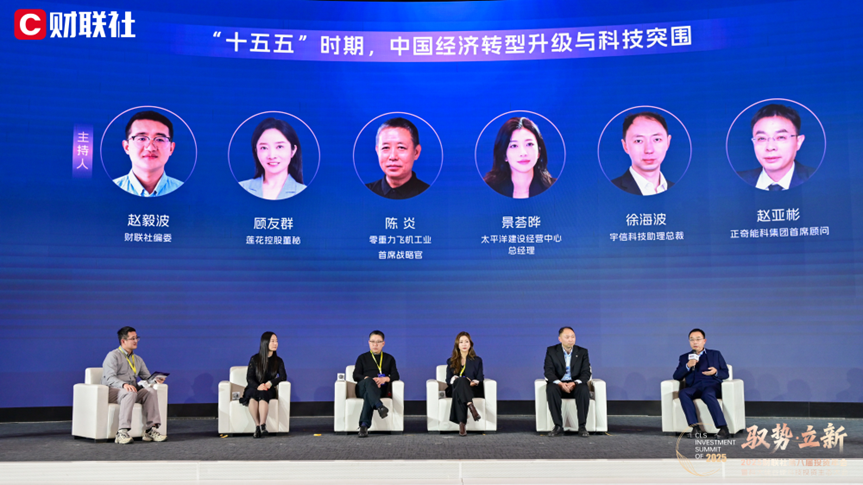
嘉宾热议:“十五五” 时期,中国经济转型升级与科技突围如何协同推进? | 2025财联社投资年会
Xin Lang Cai Jing· 2026-01-04 09:45
Group 1: Economic Transformation and Technological Innovation - The core of China's economic transformation during the "14th Five-Year Plan" period is driven by new productivity, emphasizing the need for technological innovation to overcome development bottlenecks and activate growth momentum [1] - The "2025 Zhitong Finance 8th Investment Annual Conference" focused on the theme of economic transformation and technological breakthroughs, featuring discussions on cross-industry transformation and value investment [1] Group 2: Company Strategies and Innovations - Lianhua Holdings has transitioned from a well-known seasoning brand to the intelligent computing sector, establishing a dual-driven model of "consumption + technology" [3] - The company has launched new products in its seasoning business while also entering the computing rental and AI sectors, achieving nearly 100 million yuan in revenue from its computing rental business by Q3 2025 [3] - Lianhua's strategy includes attracting industry elites and implementing incentive mechanisms to stabilize traditional business while fostering innovation in new sectors [3] Group 3: Industry Challenges and Opportunities - Zero Gravity Aircraft Industry faces challenges in commercializing low-altitude economy due to insufficient airspace resources and infrastructure, with only 512 general airports in China compared to nearly 20,000 in the U.S. [4] - The company advocates for the "green aviation camp" business model to promote low-altitude tourism, utilizing electric new energy aircraft [4] Group 4: Infrastructure and Urban Development - Pacific Construction is evolving from a traditional builder to a city operator, focusing on integrating physical space with cutting-edge industries [5] - The company has initiated projects like a zero-carbon digital economy industrial park in Hebei, showcasing a comprehensive service model from investment to operation [6] Group 5: Financial Innovations and Support for Technology - There is a gap between traditional financial systems and emerging tech companies, as banks typically assess past performance rather than future potential [6] - Banks are adapting by restructuring credit data and incorporating external data to enhance risk control, with digital RMB smart contracts potentially reshaping financial logic [6][7] - The application of digital RMB smart contracts could create a better market environment for hard tech companies and enable precise funding allocation for R&D [7] Group 6: Investment Perspectives - The compatibility of technological originality with industry chain integration is crucial for hard tech survival, with a focus on the ability to transform technology into cost-effective products [8] - The role of the investment institution is to empower rather than take over, fostering trust and collaboration with invested companies and local governments [8]
金融科技行业双周报第二十期:数字人民币重大调整,利好金融IT和三方支付-20260104
GUOTAI HAITONG SECURITIES· 2026-01-04 05:16
数字人民币重大调整,利好金融 IT 和三方支付 [Table_Industry] 综合金融 ——金融科技行业双周报第二十期 | [姓名table_Authors] | 电话 | 邮箱 | 登记编号 | | --- | --- | --- | --- | | 刘欣琦(分析师) | 021-38676647 | liuxinqi@gtht.com | S0880515050001 | | 孙坤(分析师) | 021-38038260 | sunkun@gtht.com | S0880523030001 | 本报告导读: 数字人民币迎利好,允许数币付息和部分准备金制度落地、跨境支付政策落地,利 好金融 IT 和三方支付;部分金融科技行业持续严格监管。 投资要点: 综合金融《数币余额开始付息,供需双向促规模 增长》2026.01.03 综合金融《数币体系升级,规模有望加速增长》 2025.12.29 综合金融《大模型第一股将上市,百融云发布 RaaS 战略》2025.12.22 综合金融《投融资再平衡持续,股权融资逐步回 暖》2025.12.22 股 票 研 究 研 究 报 告 请务必阅读正文之后的免责条款部分 行 ...
百度分拆昆仑芯上市引爆市场!港股大涨,A股正宗概念股一览
Sou Hu Cai Jing· 2026-01-04 01:49
Core Viewpoint - Baidu's announcement of the spin-off of its AI chip subsidiary Kunlun Chip for a Hong Kong IPO has significantly impacted the capital market, leading to a surge in technology stocks in both Hong Kong and A-shares [1][3]. Group 1: Market Reaction - The announcement caused the Hang Seng Technology Index to rise by 4% in a single day, while Baidu's stock price increased by 9.35%, pushing its market capitalization to 386.7 billion HKD [1]. - The overall market sentiment was buoyed by the first trading day of 2026, with the Hang Seng Index rising by 2.76% and trading volume exceeding 140 billion HKD [3]. Group 2: Kunlun Chip's Strength - Kunlun Chip, with a valuation of 21 billion RMB, has secured significant orders, including a major procurement contract from China Mobile worth over 1 billion RMB [2]. - The company is projected to increase its revenue from 1.3 billion RMB in 2024 to 8.3 billion RMB by 2026, representing a growth of 6 times, with a potential valuation exceeding 80 billion RMB [2]. Group 3: A-Share Beneficiaries - Three categories of A-share companies are identified as having official ties to Kunlun Chip: those with deep business cooperation with Baidu, supply chain partners, and companies benefiting from the AI computing power explosion [4]. - Specific companies include: - Yuxin Technology, which has a 5.71% stake from Baidu and a four-year cooperation agreement [5]. - Geling Deep Vision, collaborating with Baidu to integrate Kunlun Chip's computing power [5]. - BYD, a partner in Baidu's Apollo autonomous driving ecosystem and a shareholder in Kunlun Chip [5]. Group 4: Investment Guidelines - Investors are advised to verify the authenticity of company connections through official announcements and focus on companies with deep business ties and substantial orders [6]. - Companies involved in AI chip domestic substitution and computing infrastructure construction are highlighted as having long-term growth potential supported by national policies [6].
数字人民币新方案:机制+技术架构双重升级
Soochow Securities· 2025-12-31 13:00
Investment Rating - The report maintains an "Accumulate" rating for the computer industry, indicating a positive outlook for the sector over the next six months [1]. Core Insights - The People's Bank of China has introduced a new action plan for the digital RMB, transitioning from a "cash-type 1.0" to a "deposit currency-type 2.0" starting January 1, 2026. This upgrade includes a redefinition of liabilities and a new macro framework [3]. - The new digital RMB framework aims to enhance the management and infrastructure of digital currency, improving liquidity management and regulatory efficiency. It introduces a wallet system based on accounts, a "currency string" for value transfer, and a smart contract ecosystem [3]. - The investment implications suggest that the digital RMB upgrade will drive demand for financial IT services, payment acceptance, and telecom operators, with specific companies recommended for investment [3]. Summary by Sections Industry Trends - The report highlights a significant upgrade in the digital RMB, which is expected to enhance its role as a core banking liability and infrastructure, moving beyond pilot products to mainstream adoption [3]. Mechanism and Technical Architecture - The new mechanism emphasizes the redefinition of customer balances in commercial banks as liabilities, with a focus on risk management and compliance. The technical architecture includes an upgraded wallet system and smart contracts to facilitate programmable digital payments [3]. Investment Recommendations - The report suggests focusing on companies like Hengsheng Electronics, Jingbeifang, Changliang Technology, and Yuxin Technology in the financial IT sector. For payment acceptance, companies such as Newland, Lakala, and Hengyin Technology are recommended. Telecom operators like China Telecom, China Unicom, and China Mobile are also highlighted as beneficiaries of the new digital infrastructure [3].
宇信科技徐海波:“智能合约”为数字人民币建设打开想象空间
Zhong Guo Jin Rong Xin Xi Wang· 2025-12-31 04:53
Core Viewpoint - The People's Bank of China has introduced an action plan to strengthen the management and service system of digital RMB, with a full implementation set for January 1, 2026, marking a transition from digital cash to digital deposit currency [1] Group 1: Digital RMB Implementation - The new generation of digital RMB will be fully implemented by January 1, 2026, transitioning to a digital deposit currency era [1] - The digital RMB ecosystem aims to achieve interconnectivity and break down institutional barriers, significantly reducing business performance costs and enhancing fund utilization efficiency [1] Group 2: Smart Contracts and Technological Impact - Smart contract technology, supported by the digital RMB smart contract ecosystem service platform, provides standardized access for payment and clearing [1] - The application of smart contracts in digital currency can serve as an effective tool for government policy implementation, allowing for precise and efficient targeted support [1] - The use of smart contracts in credit can ensure funds are allocated for specific purposes, such as R&D, while blockchain technology enables real-time monitoring of enterprise data, reducing information asymmetry risks [1]
数字人民币系列点评:数字人民币重大变化:从M0到M0
Shenwan Hongyuan Securities· 2025-12-30 14:13
Investment Rating - The industry investment rating is "Overweight" indicating a positive outlook for the digital currency sector compared to the overall market performance [8]. Core Insights - The People's Bank of China has introduced an action plan to enhance the management and service system for digital currency, set to be implemented on January 1, 2026. This plan redefines digital currency from M0 to M1, integrating it into the reserve system and allowing interest payments on digital currency wallet balances [2]. - The action plan emphasizes a hybrid model combining account-based management and blockchain efficiency, highlighting the importance of compliance and regulation [2]. - With the M1 positioning, both individuals and commercial banks are incentivized to adopt and promote digital currency, enhancing its security and convenience compared to traditional electronic payments [2]. - The government is actively promoting cross-border digital currency payments, with initiatives such as the establishment of an international operation center in Shanghai and the launch of a cross-border digital payment platform [2]. - Various local governments are implementing measures to encourage the use of digital currency, such as issuing coupons and integrating it with cultural activities, indicating a strong push towards building a digital currency ecosystem [2]. Summary by Sections Regulatory Developments - The central bank's action plan includes integrating digital currency into the reserve system, allowing banks to pay interest on digital currency wallet balances, thus treating it similarly to deposits [2]. Market Dynamics - The shift to M1 is expected to motivate banks and individuals to engage more with digital currency, enhancing its usability and attractiveness [2]. Government Initiatives - The government is focusing on cross-border payment solutions and has launched several platforms to facilitate digital currency transactions, aiming to reduce transaction times significantly [2]. Related Companies - Companies involved in the digital currency ecosystem include those updating banking IT systems (e.g., Newland, Sifang Jingchuang), promoting payment solutions (e.g., Lakala), and hardware wallet providers (e.g., GDT, Feitian Integrity) [2][3].