Blue Owl

Search documents
美国私募信贷市场,还安全么?
Huafu Securities· 2026-02-12 04:34
Group 1: Private Credit Market Overview - The private credit market in the U.S. has grown to nearly $1.3 trillion, accounting for about 10% of total commercial bank credit as of 2023[3] - Private credit primarily serves small and medium-sized enterprises (SMEs), with non-bank investors like pension funds and insurance companies participating through private credit funds and Business Development Companies (BDCs)[3] - BDCs are required to disclose data regularly, providing a window into the private credit market, with BDCs managing assets that have tripled since 2020[19] Group 2: Credit Quality and Returns - Cash flows for many mid-sized companies are recovering post-rate cuts, but BDC shareholder returns are declining due to lower profitability and mandatory profit distribution requirements[4] - The average dividend coverage ratio for publicly traded BDCs fell from 1.34 in mid-2023 to 1.08 by September 2025, indicating weakened ability to cover dividends[4] - Non-accrual investments in BDCs have increased from 0.8% in 2022 to over 1.2% by Q3 2025, suggesting rising credit risk[4] Group 3: Rising Default Risks - Credit rating agencies report an upward trend in default rates within the private credit market, with "invisible defaults" also on the rise, indicating hidden risks[5] - The software and healthcare sectors are particularly vulnerable, with software companies facing high leverage and potential disruption from AI advancements[5] - Nearly 14% of commercial real estate loans are in negative equity, raising concerns about the stability of this sector[5]
How alternative asset managers are easing software fears
CNBC Television· 2026-02-11 03:19
Some of the biggest names on Wall Street are gathering at Bank of America's global research uh financial services comp uh conference in Miami, including executives of recently battered private credit companies. Leslie Picker joins us with some of the highlights. Leslie, >> hey Mike.Yeah, it's been a busy few weeks for alternative asset managers, uh many of which got caught up in the software selloff due to concerns about exposure among both private equity and private credit. And then over the last few days, ...


Voya Financial (NYSE:VOYA) 2026 Conference Transcript
2026-02-09 14:52
Summary of Voya Financial's Conference Call Company Overview - **Company**: Voya Financial - **Industry**: Life Insurance and Investment Management Key Messages and Financial Performance - **Exceptional Year in 2025**: Voya reported cash generation of $775 million, significantly up from the previous year, and achieved record commercial results in Retirement and Investment Management, with combined assets of $1 trillion in these sectors [2][3] - **Growth Momentum**: The company anticipates continued growth in cash generation into 2026, driven by commercial growth in retirement and investment management, alongside improvements in employee benefits margins [3][4] - **Strong Balance Sheet**: Voya maintains a robust balance sheet and cash-generative businesses, allowing flexibility in capital deployment, including $300 million allocated for share repurchases in the first half of the year [3][4] Retirement Business Highlights - **Record Performance**: The retirement business achieved a margin of close to 40%, exceeding the target range of 35%-39%, with record organic growth of $28 billion in flows, plus an additional $60 billion from the OneAmerica acquisition [6][9] - **Participant Growth**: Voya added nearly 2 million participants, bringing the total to approximately 10 million, indicating strong retention and scale in the retirement sector [6][9] - **Investment in Wealth Management**: Voya is focusing on expanding its wealth management capabilities to serve clients more holistically, leveraging its existing participant base [7][22] OneAmerica Acquisition Insights - **Successful Integration**: Voya exceeded revenue and earnings targets from the OneAmerica acquisition, achieving $200 million in revenue growth and $75 million in earnings, with strong client retention [11][12] - **Market Positioning**: Voya is positioned as a net consolidator in the retirement space, with opportunities for further acquisitions as the industry consolidates [12][13] Wealth Management Strategy - **Established Business**: Voya's wealth management business generates $200 million in existing revenues, representing about 10% of the overall business, with plans to grow this segment by adding advisors and enhancing digital tools [22][23] - **Targeting Mass Affluent**: The focus is on serving the mass affluent market, particularly millennials who lack access to financial advisors, by providing guidance and digital tools for retirement planning [28][29] Employee Benefits and Stop Loss Business - **Claims Environment**: The stop loss business is experiencing increased claims volatility, prompting Voya to adopt a more conservative approach to reserving [50][56] - **Rate Increases**: Voya successfully implemented a 21% rate increase for the January 2025 business and a 24% increase for January 2026, reflecting the broader market trend [53][54] - **Market Demand**: There is a growing demand for stop loss products as employers seek to manage healthcare costs, with RFPs for these products increasing significantly [55][62] Investment Management Performance - **Organic Growth**: Voya's investment management segment has outpaced industry growth, with a focus on expanding relationships in the insurance channel and increasing private and alternative investments [42][44] - **Active ETFs Launch**: The launch of active ETFs is part of Voya's strategy to enhance its investment management offerings and leverage its retirement and wealth management businesses [43][48] Capital Return Strategy - **Consistent Capital Return**: Voya is committed to returning capital to shareholders through share repurchases and dividends, while also pursuing bolt-on acquisitions [73][75] - **High Return on Equity**: The company is achieving a return on equity close to 19%, making it an attractive investment opportunity [73][75] Conclusion - Voya Financial is positioned for continued growth in 2026, driven by strong performance in its retirement and investment management businesses, strategic acquisitions, and a commitment to returning capital to shareholders. The company is actively engaging with younger generations to enhance financial planning and retirement savings, while navigating challenges in the stop loss market.

Blue Owl co-CEO: 'The demise of software is not upon us'
CNBC Television· 2026-02-06 15:48
You know, Mark Twain said, right, the news of my death was an exaggeration. And I think maybe that's the moment we're in around this topic to get down to the brass tax. You know, the the demise of software is, you know, is not upon us, but the disruption is AI is going to disrupt.It's a massively disruptive force for the economy and it's going to disrupt some parts of software, but software is not a monolith. And I think the way it's being treated today, both in stocks, but certainly when we think about cre ...

最终带崩AI叙事的只会是AI自己
虎嗅APP· 2026-02-06 10:18
Core Viewpoint - The capital market is experiencing unexpected downturns, contrary to predictions of a strong 2026 due to anticipated monetary easing and improved geopolitical relations. The primary issue is the "new technology advancements consuming old technology applications" [4]. Market Performance - As of February 5, the North American Technology Software Index has declined by 25% year-to-date [5]. - Major companies within this index, including Palantir, Microsoft, Oracle, Salesforce, and ServiceNow, have seen their stock prices drop by an average of over 30% in the past two months [10]. Company Analysis - Notable companies in the index include Palantir, Microsoft, Oracle, Salesforce, and ServiceNow, all of which have experienced significant stock price declines [9][10]. - Specific stock performance includes: - Palantir: -28.44% over 20 days, -26.93% over 60 days - Microsoft: -18.57% over 20 days, -20.61% over 60 days - Oracle: -29.09% over 20 days, -42.84% over 60 days - Salesforce: -28.61% over 20 days, -20.67% over 60 days - ServiceNow: -31.99% over 20 days, -40.47% over 60 days [11]. Impact of AI on Software Industry - The rise of AI tools is leading to reduced demand for traditional SaaS software, as companies may cut back on subscriptions when employees can enhance efficiency through AI [15]. - The second layer of impact suggests that as AI tools mature, companies might develop their own systems instead of purchasing from traditional vendors, posing a significant threat to existing software companies [16]. Broader Implications - The narrative surrounding AI has shifted from questioning its viability to considering the implications for existing software solutions, raising concerns about the future of traditional software companies [15]. - The private credit industry, heavily invested in software, is facing challenges due to the downturn in software stock prices, with significant exposure reported by firms like Barclays [19].

"软件-PE"死亡循环的中心,美国PE三巨头持续重挫,KKR和Blue Owl电话会承认财务挑战
硬AI· 2026-02-06 06:44
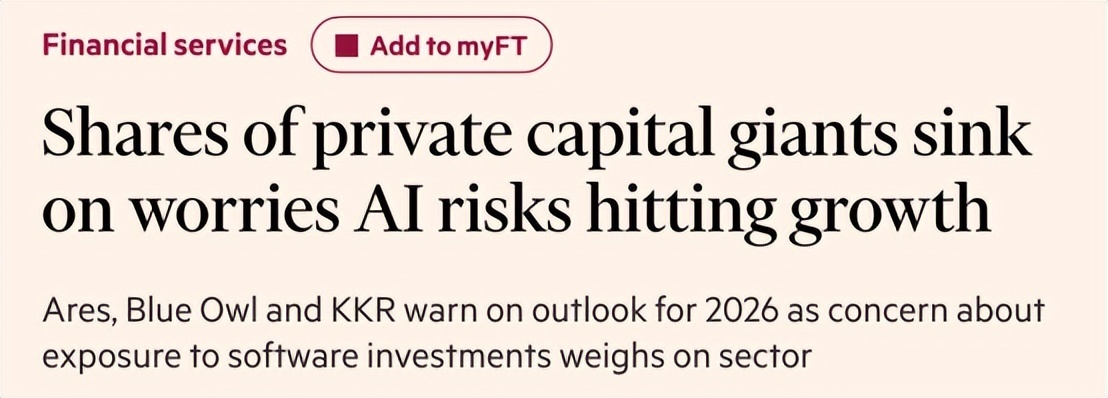
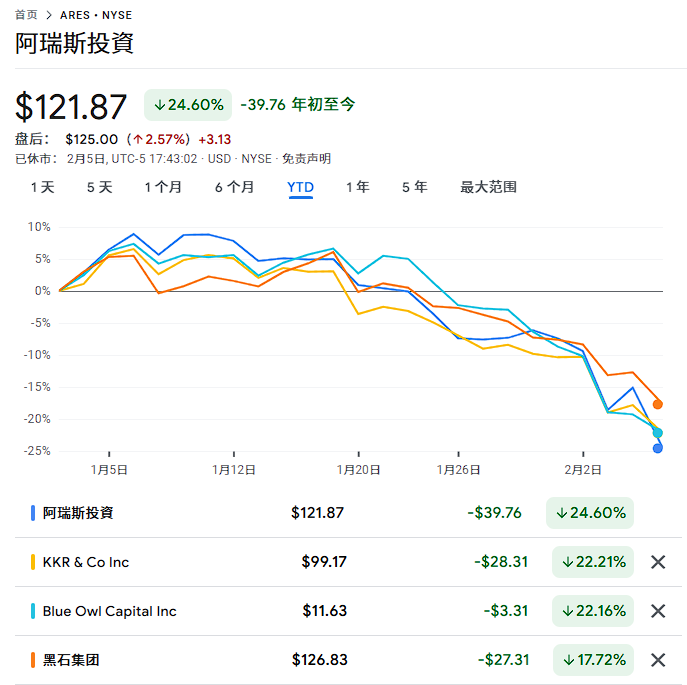
受AI颠覆软件行业的担忧影响,美国私募巨头陷入融资放缓、退出延迟和赎回压力的多重困境。KKR警告推迟资产出售 将影响2026年收益,Blue Owl费用增长预期从20%骤降至"温和"水平。核心原因在于SaaS资产的"类债券"稳定性逻辑崩 溃,不良贷款风险上升。 硬·AI 作者 | 董 静 编辑 | 硬 AI 在AI颠覆软件行业的担忧下,美国私募资本巨头正陷入融资放缓、资产退出延迟和赎回压力上升的多重困 境。过去十年软件资产一直是私募股权投资的核心领域,如今这一基础正在动摇,威胁着行业的增长逻辑 和盈利模式。 2月5日,KKR和Blue Owl在财报电话会议上对2026年财务前景发出警告。KKR首席财务官Robert Lewin 表示,若市场环境恶化,公 司可能推迟今年部分资产出售,这将减少现金流并导致2026年收益下降。 Blue Owl则披露其 信贷基金赎回请求上升,导致公司未能达成长期增长目标 ,预计 2026年费用增长仅 为"温和"水平 ,较2025年约20%的资产和费用增长大幅放缓。 周四,美国PE三巨头股价全线下跌。Ares暴跌超11%至121.87美元,KKR下跌5.5%至99.19美元,Blue ...

AI冲击担忧引发市场动荡 美国私募股权巨头股价下挫
Huan Qiu Wang· 2026-02-06 02:37
事实上,受投资者重新评估行业增长前景影响,今年以来这三家企业及黑石等私募股权同行的股价累计跌幅均已超15%,市场对AI可能淘汰大量软件企业、 削弱私募股权核心资产收益的担忧,成为股价走弱的核心诱因。这种市场动荡也直接影响行业经营节奏,部分机构被迫考虑推迟资产出售,不仅难以兑现丰 厚业绩报酬,还可能因投资者撤资或暂缓新投导致资产增长放缓。 在当日的财报电话会议中,三家巨头分别披露了2026年的业绩承压现状。KKR首席财务官Robert Lewin坦言,若市场环境持续恶化,公司将推迟2026年部分 资产变现计划,这一举措将直接减少当期现金流、拉低收益,不过相关利润将在未来几年逐步兑现,公司对长期前景仍持乐观态度。Blue Owl则受信贷基金 赎回量增加拖累,下调了增长预期,首席财务官Alan Kirshenbaum表示,2026年公司费用增长将趋于"温和",相较于2025年约20%的资产和费用增长率将大 幅放缓,这也意味着公司2029年管理资产超5000亿美元、年度费用相关收益超31亿美元的长期目标推进遇阻。Ares则重点披露了软件业务投资敞口,称其软 件业务占管理的私募信贷资产的9%,同时明确人工智能相关风险并 ...
"软件-PE"死亡循环的中心,美国PE三巨头持续重挫,KKR和Blue Owl电话会承认财务挑战
Hua Er Jie Jian Wen· 2026-02-06 01:03
在AI颠覆软件行业的担忧下,美国私募资本巨头正陷入融资放缓、资产退出延迟和赎回压力上升的多 重困境。过去十年软件资产一直是私募股权投资的核心领域,如今这一基础正在动摇,威胁着行业的增 长逻辑和盈利模式。 2月5日,KKR和Blue Owl在财报电话会议上对2026年财务前景发出警告。KKR首席财务官Robert Lewin 表示,若市场环境恶化,公司可能推迟今年部分资产出售,这将减少现金流并导致2026年收益下降。 Blue Owl则披露其信贷基金赎回请求上升,导致公司未能达成长期增长目标,预计2026年费用增长仅 为"温和"水平,较2025年约20%的资产和费用增长大幅放缓。 周四,美国PE三巨头股价全线下跌。Ares暴跌超11%至121.87美元,KKR下跌5.5%至99.19美元,Blue Owl下跌3.8%至11.65美元。今年以来,这三家公司及包括黑石在内的私募资本同行股价累计跌幅均跌 超15%,投资者正在重新评估其增长前景。 此次抛售潮的核心在于市场逻辑的根本性转变。过去十年中,软件即服务(SaaS)行业凭借稳定的经常 性收入(ARR)成为私募信贷最青睐的资产类别。 然而,随着AI取代代码编写和数 ...
Stocks Slide as Software Selloff Deepens; Bitcoin Falls | The Close 2/5/2026
Youtube· 2026-02-06 00:17
Market Overview - The S&P 500 is down 1% and the NASDAQ 100 is down more than 1% during a rough trading session, indicating a deteriorating market sentiment [1][2] - Bitcoin has experienced a significant decline, dropping about 10% to around $65,000, erasing gains from previous weeks [2][4] Tech Sector Insights - The percentage of NASDAQ 100 stocks below the 100-day moving average has surpassed 50% for the first time since late November, indicating negative momentum in the tech sector [3] - Alphabet reported a 20% surge in revenue last quarter, but this has not alleviated skepticism among tech investors, raising concerns about Amazon's upcoming earnings [6][9] Investment Trends - There is a strong bid into Treasuries, with 10-year Treasury yields decreasing by six to seven basis points, reflecting a flight to safety amid market volatility [2][4] - The current market environment is characterized by a rotation rather than a wholesale selloff, with investors taking profits and becoming more cautious [21][78] Company-Specific Developments - Amazon's earnings report is highly anticipated, with expectations that it will reflect broader trends in the tech sector [9][26] - XPO shares have reached a record high, driven by strong performance in the retail and industrial sectors, indicating a potential recovery in these areas [59][60] Capital Expenditure Outlook - Alphabet has earmarked $182 billion for capital expenditures by 2026, suggesting a focus on long-term growth despite current market challenges [7] - The overall sentiment in the market is shifting towards questioning the return on investments, particularly in the tech sector [8] Consumer Behavior and Market Dynamics - The furniture retail sector, represented by Bob's Discount Furniture, is seeing a successful IPO, raising $331 million, indicating strong consumer demand despite economic uncertainties [27][29] - Tapestry, the parent company of Coach, reported record sales and earnings, highlighting effective brand strategies targeting younger consumers [66][72]

彭博:美国软件业贷款坏账激增,一场“软件-PE”死亡循环正上演
美股IPO· 2026-02-05 04:02
Core Viewpoint - The article discusses a significant credit crisis in the U.S. software industry, driven by concerns over AI disrupting traditional software business models, leading to a surge in non-performing loans and a potential "death spiral" in private credit markets [1][2][4]. Group 1: Credit Crisis in the Software Industry - Over the past four weeks, more than $17.7 billion in tech company loans have fallen into non-performing status, with the total non-performing debt in the tech sector soaring to approximately $46.9 billion, the highest level since October 2022 [2][3]. - The crisis, referred to as the "SaaS apocalypse," is particularly affecting the Software as a Service (SaaS) sector, which is seen as vulnerable due to AI's potential to replace traditional software functions [2][4]. - Notable companies facing difficulties include FinThrive and Perforce Software, both backed by private equity firm Clearlake Capital, indicating a broader trend of distress in the software sector [2][3]. Group 2: Impact on Private Credit Markets - The private credit market is experiencing dual shocks: the collapse of lending logic to software companies and a decline in the attractiveness of private credit itself [5][7]. - Approximately 14% of the leveraged loan market is exposed to the tech sector, with this figure rising to 20% in private credit, highlighting the significant risk to these markets [2][6]. - The appeal of private credit is diminishing as public market yields rise, making the promised "liquidity premium" less attractive, especially in light of increasing default risks [7][8]. Group 3: Formation of a "Death Spiral" - The current market environment is characterized by panic selling, with a lack of signs of stabilization, leading to a dangerous feedback loop where falling software valuations pressure private credit institutions to tighten lending conditions [8]. - As software companies continue to trade at distressed levels, their access to traditional debt markets becomes increasingly difficult, exacerbating their financial challenges [8].