平安银行

Search documents
2025年度A股大数据排行榜
Wind万得· 2025-12-31 22:50
Market Overview - In 2025, the A-share market exhibited a comprehensive upward trend, with major indices showing an average increase of over 10%. The growth was particularly pronounced in growth sectors, with the ChiNext Index, North Exchange 50, and Sci-Tech 50 indices each rising by over 30% [1][3]. - The structural characteristics of the market were evident, with technology and resource sectors leading the performance. The optical module (CPO) index surged by over 180%, while indices for optical chips, copper-clad laminates, optical communications, and optical circuit switches all exceeded 100% growth [1][3]. A-share Index Performance - The ChiNext Index led the gains in 2025 with a cumulative increase of 49.57%. The North Exchange 50 and Sci-Tech 50 indices followed with increases of 38.80% and 35.92%, respectively. Other indices such as the Shenzhen Component Index, Wind All A, and CSI 1000 also saw gains exceeding 20% [3]. A-share Industry Performance - Among the 35 industries classified by Wind, 31 recorded increases in 2025. The non-ferrous metals industry topped the list with a cumulative increase of 92.20%. Hardware equipment and industrial trade sectors also performed well, with increases of 62.39% and 54.65%, respectively. Conversely, the daily consumer retail sector saw a decline of 6.42% [5]. A-share Hot Concepts - The optical module (CPO) index was the strongest performer in 2025, with a cumulative increase of 181.28%. Other notable performers included optical chips (130.78%), copper-clad laminates (129.58%), optical communications (125.58%), and optical circuit switches (112.55%). The rare metals, copper industry, and rare earth indices also showed significant growth, with increases of 119.85%, 103.64%, and 98.97%, respectively [9]. A-share Market Capitalization - By the end of 2025, the total market capitalization of the A-share market reached approximately 118.91 trillion yuan, marking a 26.6% increase from the end of 2024 [15]. - The Shanghai main board had the highest number of listed companies at 1,699, accounting for 31.06% of the total. The Shenzhen main board followed with 1,490 companies (27.24%), while the ChiNext and Sci-Tech boards had 1,393 and 600 companies, representing 25.47% and 10.97%, respectively [13]. Financing and Investment Trends - As of the end of 2025, the A-share margin trading balance was reported at 25.553 billion yuan, reflecting a 5.21% increase from the third quarter and a year-on-year increase of 35.91% [22]. - The top gainers in terms of stock price included Weiwei New Materials, which saw a cumulative increase of 1,820%, followed by Tianpu Co., with a 1,645% increase. Conversely, Shijin Technology led the decline with a 51% drop [24]. IPO Activity - In 2025, the A-share market saw a total of 112 IPOs, representing a 9.8% increase year-on-year. The fourth quarter alone accounted for 36 IPOs, up 9.1% from the previous year [49]. - The total fundraising from IPOs in 2025 reached 130.83 billion yuan, a significant increase of 97.4% year-on-year, with the fourth quarter alone raising 54.86 billion yuan, up 165.0% [51].


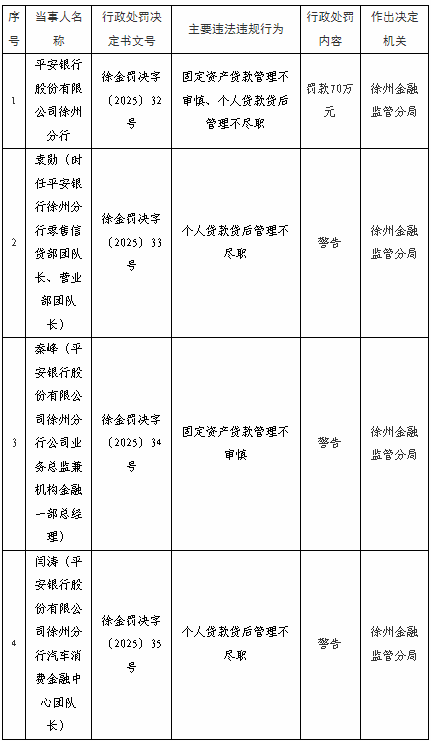
【监管处罚】因固定资产贷款管理不审慎、个贷贷后管理不尽职,平安银行徐州分行被罚款70万元
Xin Lang Cai Jing· 2025-12-31 16:01
2025年12月15日,江苏金融监管局官网发布行政处罚信息公开表,涉及平安银行徐州分行。 行政处罚信息公开表显示,因固定资产贷款管理不审慎、个人贷款贷后管理不尽职的主要违法违规行 为,平安银行徐州分行被徐州金融监管分局处以"罚款70万元"的行政处罚。 与此同时,袁勋(时任平安银行徐州分行零售信贷部团队长、营业部团队长)、秦峰(平安银行徐州分 行公司业务总监兼机构金融一部总经理)、闫涛(平安银行徐州分行汽车消费金融中心团队长)均被徐 州金融监管分局处以"警告"的行政处罚。 行政处罚信息公开表原文: | 序 | 当事人名 | 行政处罚决 | 主要违法违规行为 | 行政处罚 | 作出决定 | | --- | --- | --- | --- | --- | --- | | 司 | 称 | 定书文号 | | 内容 | 机关 | | | 平安银行 股份有限 | 徐金罚决字 | 固定资产贷款管理不 | 罚款70万 | 徐州金融 | | l | 公司徐州 | (2025) 32 ਫੇ | 审慎、个人资款货后 管理不尽职 | 元 | 监管分局 | | | 分行 支勋(时 | | | | | | | 任平安银 | | | | | ...

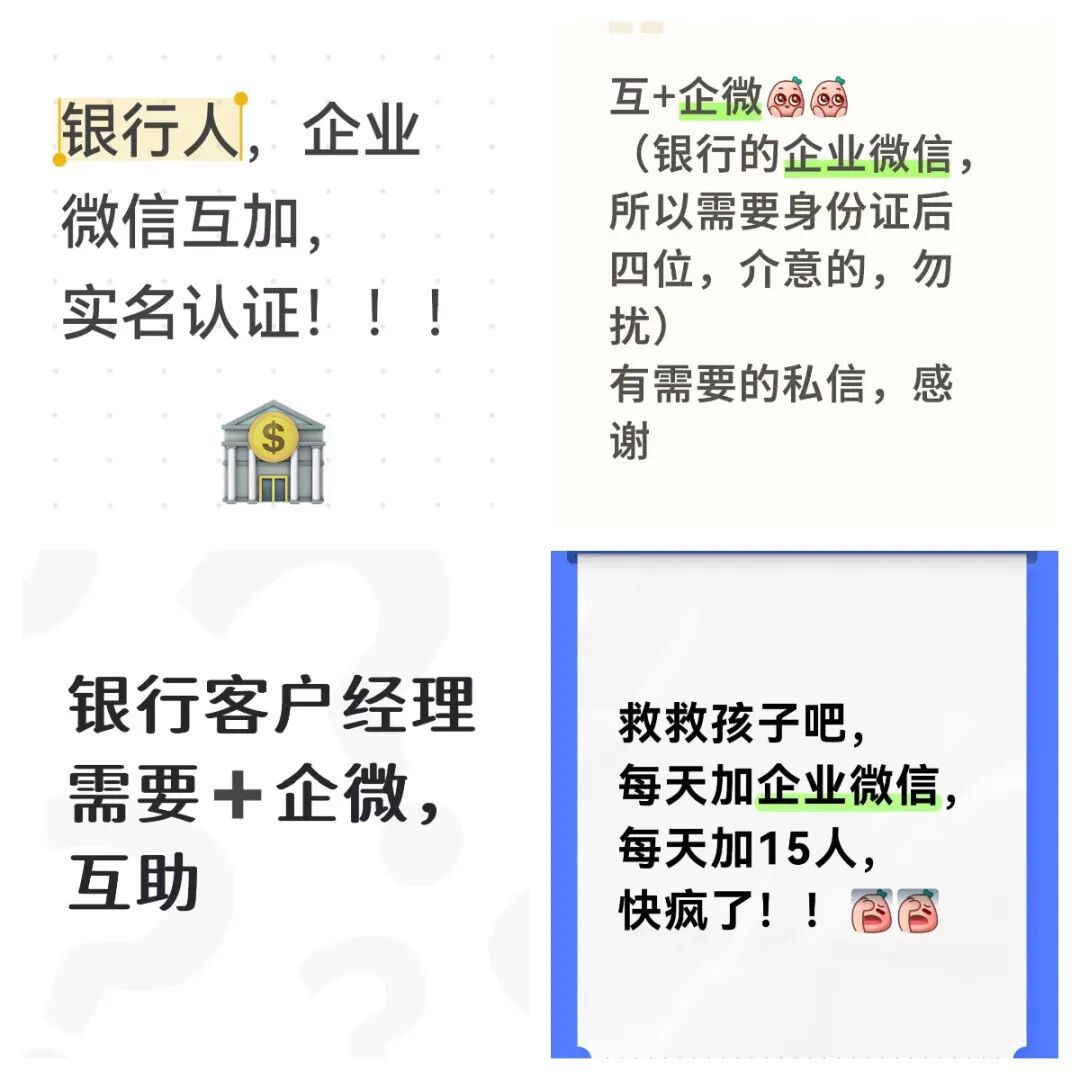
“每天要加十几个,完不成扣钱或加班”!银行员工为企业微信考核伤脑筋,有人去电商买量,还有同行发帖求“互加”
Mei Ri Jing Ji Xin Wen· 2025-12-31 13:40
Core Viewpoint - Banks are increasingly implementing performance assessments based on the addition of clients on enterprise WeChat, reflecting the pressure on retail banking amid declining revenues and profits in the sector [1][17]. Group 1: Performance Assessment and Pressure - Many banks have set specific targets for adding clients on enterprise WeChat, with some requiring customer managers to add up to 100 clients per month, leading to significant pressure on employees [4][6]. - Employees are sharing their enterprise WeChat QR codes on social media to meet these targets, often incentivized by monetary rewards or penalties for failing to meet the requirements [2][5]. - The assessment mechanisms include strict monitoring and penalties, such as deductions from salaries for not meeting the required number of added clients [6][9]. Group 2: Rationale Behind Enterprise WeChat Adoption - The push for enterprise WeChat is partly to prevent "client privatization," ensuring that client relationships remain with the bank rather than individual employees [9][10]. - Banks view enterprise WeChat as a tool for unified client management, allowing for better data collection and analysis of customer behavior and preferences [9][10]. - The financial industry is facing rising customer acquisition costs, making effective client engagement through platforms like enterprise WeChat increasingly important [10][17]. Group 3: Challenges and Misconceptions - There are significant challenges in the implementation of enterprise WeChat, including the perception that the current assessment system is flawed and does not effectively utilize the platform's potential [13][16]. - Many employees express concerns about the quality of interactions with clients, often resorting to generic content that fails to engage customers meaningfully [15][16]. - The focus on quantitative metrics, such as the number of added clients, often overshadows the need for qualitative interactions that drive actual business results [16][17]. Group 4: Retail Banking Performance - Retail banking is experiencing a downturn, with many banks reporting declines in retail revenue and profits compared to the previous year [17][18]. - Specific banks, such as Ping An Bank and Zhejiang Commercial Bank, have seen significant drops in retail revenue, with some experiencing double-digit declines [18]. - Despite some banks reporting growth in retail profits, this is often due to low comparative bases from the previous year, indicating underlying challenges in the retail banking sector [19][20]. Group 5: Success Stories and Future Outlook - Some banks have successfully leveraged enterprise WeChat to enhance customer engagement, with notable increases in client activity and retention rates [20][21]. - For instance, the Industrial and Commercial Bank of China reported significant growth in the number of clients added through enterprise WeChat, leading to improved customer engagement metrics [20][22]. - The ongoing digital transformation in banking emphasizes the need for effective use of platforms like enterprise WeChat to drive profitability and customer satisfaction [10][17].



银行员工为企业微信考核伤脑筋,有人去电商买量,还有同行发帖求“互加”
Mei Ri Jing Ji Xin Wen· 2025-12-31 13:36
Core Viewpoint - Banks are increasingly focusing on the assessment of adding clients via enterprise WeChat as a key performance indicator (KPI) amid challenges in retail banking, leading to a surge in social media posts where employees seek mutual additions to meet their targets [1][22]. Group 1: KPI and Assessment Mechanisms - Many banks have set specific targets for adding enterprise WeChat contacts, with requirements such as 50 contacts per month for some employees, and penalties for not meeting these targets [5][8]. - The assessment includes financial penalties, such as a deduction of 300 yuan for failing to meet monthly targets, and some banks have implemented a ranking system with monetary rewards for top performers [8][12]. - The pressure to meet these KPIs has led to a culture of mutual assistance among bank employees, with many posting their WeChat QR codes on social media to gain more contacts [2][3]. Group 2: Challenges and Pain Points - Employees express frustration over the pressure to add contacts, often feeling compelled to work overtime to meet their targets [17]. - The current assessment system is criticized for focusing solely on frontline employees, neglecting the role of middle management in effectively utilizing enterprise WeChat [18][20]. - There is a concern that the quality of interactions is suffering, as many employees are merely adding contacts to fulfill their quotas rather than engaging meaningfully with clients [19]. Group 3: Industry Context and Performance - The retail banking sector is experiencing significant pressure, with many banks reporting declines in retail revenue and profits compared to the previous year [22][24]. - For instance, several banks, including Postal Savings Bank and Agricultural Bank, have seen retail revenue drop by over 6% year-on-year [23]. - In response to these challenges, banks are leveraging enterprise WeChat as a tool for deeper customer engagement, aiming to enhance client interaction and operational efficiency [25][26].
YiwealthSMI|银行广告怎么拍不招烦?来看平安银行、吉林银行
Di Yi Cai Jing· 2025-12-31 12:13
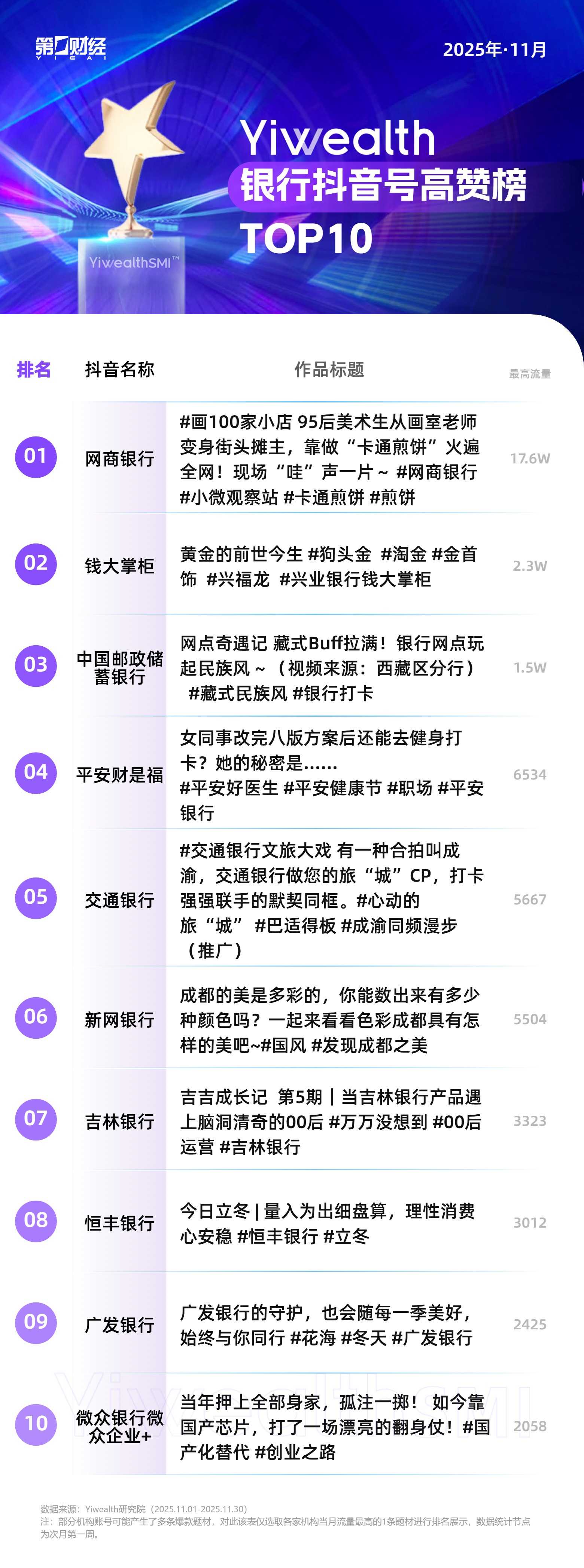
Group 1: Social Media Index Overview - The overall Bank Social Media Index (SMI) for November 2025 showed slight fluctuations, with significant reshuffling at the bottom of the rankings. Notable banks that dropped out include China CITIC Bank, Tianjin Bank, Changsha Bank, and Jiangxi Bank, while banks like Industrial Bank, Chongqing Bank, Zhejiang Commercial Bank, and Zhengzhou Bank entered the rankings [1] - Industrial Bank's ranking has experienced considerable volatility over the past three months, primarily due to the inconsistent update frequency of its Douyin account "Qian Da Zhang Gui," which affected its sub-index and overall SMI [1] Group 2: High Engagement Content - In November's high-engagement content rankings, WeBank's "Drawing 100 Small Shops" continued to dominate, while "Creative Storylines" emerged as a new trend for attracting traffic [2] - Banks like Ping An Bank and Jilin Bank produced highly rated advertisements. Ping An Bank utilized a classic "office worker" theme to highlight its app's "AI Doctor" feature, while Jilin Bank showcased the creative process behind a consumer loan product, effectively integrating product promotion with engaging storytelling [2] - "Scenario-based marketing" became a highlight, with banks transforming their branches into cultural showcases. For instance, China Postal Savings Bank's "Branch Adventure" featured its Tibet branch, breaking stereotypes about bank outlets [2] Group 3: Focus on Gold - Gold remains a key area of interest for users, with Industrial Bank's "The Past and Present of Gold" series gaining significant traction, averaging over 16,000 likes per video across three episodes [3]

全面降息下的“存款搬家”
第一财经· 2025-12-31 10:16
Core Viewpoint - By the end of 2025, the traditional high-interest fixed deposits are becoming scarce, with rates dropping to the "1" range, leading to a significant shift of residents' funds from traditional deposits to diversified assets like wealth management, insurance, and gold. This trend of "deposit migration" is expected to continue into 2026, with further adjustments in the deposit market anticipated [3][11]. Group 1: Interest Rate Cuts and Deposit Market Changes - In 2025, the personal deposit and wealth management markets exhibited significant structural differentiation, with long-term fixed deposit rates entering the "1" range and high-interest products being withdrawn [5]. - Major state-owned banks initiated a wave of interest rate cuts starting May 20, 2025, reducing the interest rates for various deposit types, including a 25 basis point cut for 3-year and 5-year fixed deposits [5][6]. - Smaller banks followed suit, with some reducing rates more aggressively than state-owned banks, leading to a situation where long-term deposit rates fell below those of shorter-term deposits, eroding the traditional appeal of smaller banks as high-interest havens [6][8]. Group 2: Impact on Net Interest Margins and Bank Strategies - The prolonged low macro interest rate environment has led to a narrowing of net interest margins for commercial banks, with the average net interest margin reported at 1.42% as of the third quarter of 2025 [8]. - Many smaller banks have suspended new business for long-term deposits to reduce high-cost funding, thereby enhancing the flexibility of fund utilization [8][9]. - The trend of "deposit migration" is influencing banks' strategies, with state-owned banks focusing on wealth management to offset net interest margin pressures, while smaller banks may adopt differentiated pricing and innovative products to attract deposits [12]. Group 3: Changes in Resident Asset Allocation - Data from the central bank indicates a noticeable slowdown in the growth of residents' fixed deposits, with a shift towards higher-yielding assets such as wealth management products and gold [9]. - By the end of Q3 2025, the total scale of wealth management products reached 32.13 trillion yuan, reflecting a year-on-year growth of 9.42% [11]. - The strategies for attracting deposits are diverging, with local banks relying on promotional tactics while state-owned banks emphasize stable management and cost control [9][11]. Group 4: Outlook for 2026 - Industry insiders predict that the adjustment in the deposit market will deepen in 2026, with the trend of "deposit migration" expected to persist, as residents continue to diversify their savings into wealth management, insurance, and gold [11]. - It is anticipated that the average reduction in retail deposit rates will be around 30 basis points, with a significant increase in non-fixed deposit investments expected to attract an additional 2-4 trillion yuan in 2026 [11][12]. - Banks are encouraged to innovate product designs and enhance service levels to improve the proportion of short-term deposits, while residents are likely to prioritize yield, liquidity, and risk control in their asset allocation decisions [12].

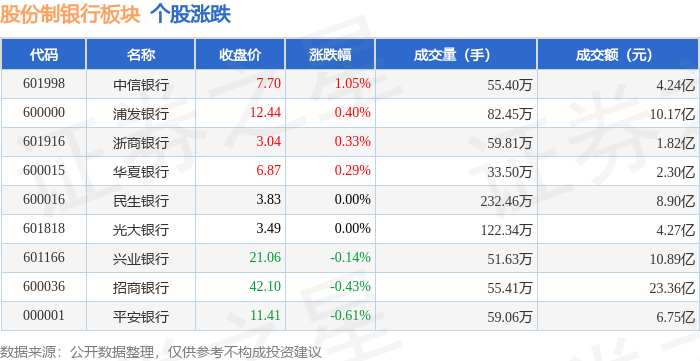
股份制银行板块12月31日跌0.01%,平安银行领跌,主力资金净流入1.77亿元
Zheng Xing Xing Ye Ri Bao· 2025-12-31 09:07
Group 1 - The banking sector experienced a slight decline of 0.01% on December 31, with Ping An Bank leading the drop [1] - The Shanghai Composite Index closed at 3968.84, up 0.09%, while the Shenzhen Component Index closed at 13525.02, down 0.58% [1] - Major banks such as CITIC Bank and Shanghai Pudong Development Bank saw positive price movements, with CITIC Bank increasing by 1.05% to 7.70 and Shanghai Pudong Development Bank rising by 0.40% to 12.44 [1] Group 2 - The net inflow of main funds in the banking sector was 177 million yuan, while retail funds saw a net inflow of 25.68 million yuan [1] - Retail investors showed a mixed response, with significant outflows from major banks like Ping An Bank and Minsheng Bank, while some smaller banks attracted retail inflows [2] - The data indicates that institutional investors favored certain banks, as seen in the net inflow percentages for banks like CITIC Bank and Shanghai Pudong Development Bank [2]



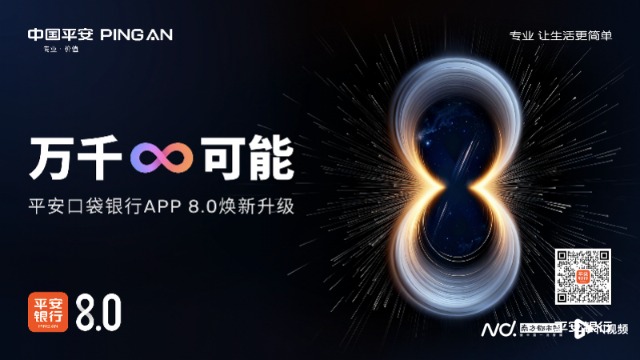
平安口袋银行App 8.0上线 解锁“三省”金融新体验
Nan Fang Du Shi Bao· 2025-12-31 08:18
当金融服务的竞争从产品比拼转向体验角逐,用户对金融工具的期待早已超越基础的存贷、支付功能,而是向着 更便捷、更贴心、更实惠的综合服务体验靠拢。近期,平安口袋银行App 8.0版本正式上线,围绕"省心、省时, 更省钱"打造便捷之省、贴心之省、实惠之省的金融服务场景,多场景、全方位焕新自身产品体验的"万千可能"。 同时,此次升级不仅聚焦用户体验的精细化打磨,更打出"AI技术深度融合"与"集团生态协同联动"的组合拳,推 动金融服务向智能化、生态化方向演进,为银行业的数字化转型勾勒出全新范本。 便捷之省:AI重构服务链路,让金融操作"少走弯路" 在快节奏的生活中,时间成本成为用户衡量服务价值的重要标尺,平安口袋银行App 8.0版本的"便捷之省",正是 瞄准这一痛点,通过AI技术对金融服务链路进行升级、优化。 体现得最为明显的就是操作流程的极致精简,8.0版本将首页功能区icon从19个精简至8个,固定常用功能并减少信 息干扰,让用户无需在繁杂的入口中反复查找,一眼就能定位核心需求。同时基于业务逻辑重组"我的服务"页面 结构,去除非必要营销干扰,使账户查询、资产管理、业务办理等核心操作的路径更短、效率更高。 更具突破 ...
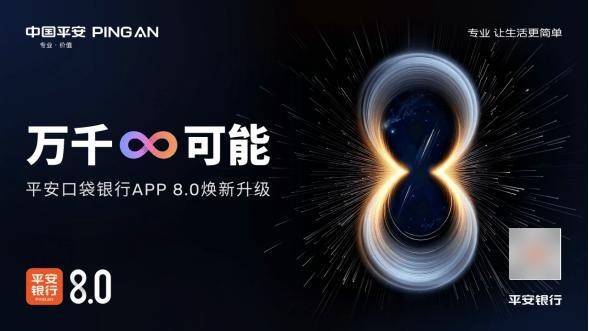
平安口袋银行App 8.0正式上线,打造“省心、省时,省钱”的金融新体验
Sou Hu Cai Jing· 2025-12-31 08:15
在快节奏的生活中,时间成本成为用户衡量服务价值的重要标尺,平安口袋银行App 8.0版本的"便捷之 省",正是瞄准这一痛点,通过AI技术对金融服务链路进行升级、优化。 体现得最为明显的就是操作流程的极致精简,8.0版本将首页功能区icon从19个精简至8个,固定常用功 能并减少信息干扰,让用户无需在繁杂的入口中反复查找,一眼就能定位核心需求。同时基于业务逻辑 重组"我的服务"页面结构,去除非必要营销干扰,使账户查询、资产管理、业务办理等核心操作的路径 更短、效率更高。 更具突破性的是AI服务的场景化落地,新版APP将业务流程组件化,用户可在对话中直接完成转账、查 询、业务办理等操作,无需频繁跳转页面,实现一站式服务闭环。同时支持多模态输入,纯语音模式即 可完成服务全流程,既满足了老年用户等群体的操作习惯,也让碎片化场景下的金融操作更顺畅。 从"人找服务"到"服务找人",AI技术的融入让金融服务摆脱界面束缚,不再局限于固定操作步骤,而是 像日常聊天一样适配不同用户、不同场景的需求,解锁了金融交互的"万千"可能。 当金融服务的竞争从产品比拼转向体验角逐,用户对金融工具的期待早已超越基础的存贷、支付功能, 而是向着 ...
多家国有行公告:余额按0.05%生息,数字人民币告别无息时代
Xin Lang Cai Jing· 2025-12-31 07:03
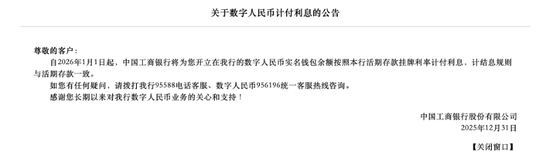
数字人民币将正式告别"无息时代"。 2025年12月31日,工商银行、农业银行、交通银行公告,自2026年1月1日起,为数字人民币实名钱包余 额按照活期存款挂牌利率计付利息,计结息规则与活期存款一致。 工商银行关于数字人民 币计付利息的公告 图/银行官网 农业银行关于数字人民 币计付利息的公告 图/银行官网 交通银行关于数字人民 币计付利息的公告 图/银行官网 交通银行公告亦表示,客户开立在交行的数字人民币实名钱包(包含一类、二类、三类个人钱包和单位 钱包)余额,按照交行公布的活期存款挂牌利率计付利息。如客户开立的数字人民币钱包为四类个人钱 包,则钱包内的余额不计付利息。 此次利息计付政策的落地,源于中国人民银行近期出台的《关于进一步加强数字人民币管理服务体系和 相关金融基础设施建设的行动方案》(以下简称《行动方案》)。中国人民银行党委委员、副行长陆磊 在2025年12月29日公开发文表示,经过十年研发试点,数字人民币将从"数字现金时代"迈入"数字存款 货币"时代。《行动方案》将于2026年1月1日起正式实施,届时新一代数字人民币的计量框架、管理体 系、运行机制与生态体系将同步落地,其中重要的亮点就是,数字人 ...