
鱼跃医疗

Search documents
鱼跃医疗(002223)2024年年报及2025年一季报业绩点评:战略投资加速国际化 看好CGM引领增长
Xin Lang Cai Jing· 2025-07-04 08:38
Core Viewpoint - The company reported a decline in revenue and net profit for 2024, primarily due to high base effects from 2023 and adjustments in the respiratory therapy business, while showing growth in certain segments in Q1 2025 [1][2]. Financial Performance - For 2024, the company achieved revenue of 7.566 billion yuan (-5.09%), net profit attributable to shareholders of 1.806 billion yuan (-24.63%), and operating cash flow of 1.816 billion yuan (-14.61%) [1]. - In Q1 2025, the company reported revenue of 2.436 billion yuan (+9.18%), net profit of 625 million yuan (-5.26%), and operating cash flow of 658 million yuan (+2.64%) [1][2]. Business Segment Analysis - The respiratory therapy segment generated revenue of 2.597 billion yuan, with certain products experiencing declines due to high base effects, while home respiratory devices and nebulizers showed growth [2]. - The blood glucose management and POCT business achieved revenue of 1.03 billion yuan (+40.21%), with significant growth in CGM products [2]. - The home health measurement segment reported revenue of 1.564 billion yuan (-0.41%), with some products declining due to high base effects, while others like electronic blood pressure monitors saw double-digit growth [2]. - The clinical and rehabilitation business generated revenue of 2.093 billion yuan (+0.24%), with good growth trends in acupuncture needles and wheelchairs, but a decline in infection control products due to demand fluctuations [2]. - The emergency business reported revenue of 239 million yuan (+34.05%), with self-developed AED products achieving certification and further technical upgrades [2]. Strategic Initiatives - The company made a strategic investment of $27.21 million in Inogen, acquiring a 9.9% stake, to expand its market presence in Europe and the US, leveraging Inogen's established production bases and market share [3]. - The partnership with Inogen will focus on distribution cooperation for various respiratory products and aims to enhance product exports and collaborative R&D efforts [3]. Dividend Policy - In 2024, the company distributed a total dividend of 802 million yuan, representing 44.40% of net profit attributable to shareholders, reflecting a strong commitment to investor returns and long-term confidence [3]. Investment Outlook - The company is positioned as a leader in home medical devices, focusing on respiratory and oxygen therapy, blood glucose management, and infection control, with an improving product structure and brand advantages [4]. - Forecasts for net profit from 2025 to 2027 are adjusted to 2.341 billion yuan, 2.699 billion yuan, and 3.104 billion yuan, reflecting year-on-year growth of 29.63%, 15.29%, and 15.03% respectively [4].

以新质生产力发展绘就中国式现代化江苏新实践的县域样本
Xin Hua Ri Bao· 2025-07-02 23:56
Core Viewpoint - Jiangsu province is showcasing its development vitality through the "Su Chao" trend, with county-level sectors significantly contributing to nearly half of the province's economic output, emphasizing high-quality development and innovative paths for new productive forces [1] Group 1: Current Landscape of New Productive Forces in Jiangsu Counties - Jiangsu's counties exhibit a spatial pattern of "South Strong, Central Rising, North Advancing," forming a collaborative "geese formation" across the province [2] - The southern region, as an innovation hub, houses over 7,000 enterprises related to new productive forces, with Kunshan, Jiangyin, and Zhangjiagang leading as top counties [2] - Kunshan stands out with over 1,000 enterprises in traditional industry transformation, while Suzhong and Subei regions are also making significant strides in developing new productive forces [2] Group 2: Resilience in Transitioning Old and New Energies - Jiangsu counties are achieving a "multi-level jump" in industrial capability through a dual drive of "renewing traditional energy and laying out new tracks" [3] - Traditional industries are undergoing digital transformation, with notable examples like Changshu's Bosideng integrating AI and big data into textile production [3] - Emerging industries such as new energy vehicles and biomedicine are becoming key development areas, with companies like Yuyue Group leading in the medical device sector [3] Group 3: Collaborative Innovation Ecosystem - Jiangsu counties are breaking through development limitations by building a collaborative innovation ecosystem that attracts innovative resources [4] - The market-oriented operation model of industry-university-research collaboration has shown significant results, with Kunshan's technology spending reaching 10% of public budget expenditures [4] - The establishment of advanced research institutes in collaboration with institutions like the Chinese Academy of Sciences has led to the emergence of leading enterprises in the energy sector [4] Group 4: Institutional Innovation Driving Growth - Institutional innovations are releasing development momentum, with counties like Kunshan focusing on talent acquisition and land resource efficiency [5] - Initiatives such as the "Funiing Filter Material Festival" have successfully created specialized service environments for emerging industries [5] Group 5: Recommendations for Further Development - Strengthening top-level design and coordination for county-level economic integration into the regional development framework is essential [6][7] - Encouraging differentiated development based on regional characteristics and optimizing resource allocation will enhance county-level economic performance [7] - Building a robust innovation ecosystem and enhancing the effectiveness of science and technology-driven initiatives are critical for future growth [8][9][10]
建龙微纳: 广发证券股份有限公司关于洛阳建龙微纳新材料股份有限公司2024年年度报告的信息披露监管问询函回复之核查意见
Zheng Quan Zhi Xing· 2025-07-02 16:36
Core Viewpoint - The company, Luoyang Jianlong Micro-Nano New Materials Co., Ltd., reported a significant decline in revenue for 2024, with total operating income of 779 million yuan, a year-on-year decrease of 20% [1]. Revenue Composition - The main business segments, including gas separation and life health, experienced revenue declines of 16% and 58% respectively, with changes in customer structure noted [1][2]. - The company’s primary products, including medical oxygen molecular sieves and industrial oxygen molecular sieves, generated a total revenue of 615.89 million yuan, down 27.71% year-on-year, primarily due to a 32.13% drop in average selling prices despite a 6.51% increase in sales volume [2][3]. Downstream Demand and Price Changes - The demand for medical oxygen molecular sieves decreased by 54.05% due to inventory adjustments by downstream customers following a peak demand period from 2020 to 2023 [3]. - The price of lithium salt, a key raw material, fell from 538,000 yuan per ton at the beginning of 2023 to approximately 76,300 yuan per ton by the end of 2024, a decline of about 85.82%, which contributed to the reduction in selling prices [3][4]. Comparison with Industry Peers - The revenue trends of comparable companies in the industry showed a similar downward trajectory, with Jianlong Micro-Nano's revenue decline aligning with that of Wanrun Co. and others, while Zhongchumai's revenue increased due to a 68% growth in overseas sales [5][6]. - The differences in revenue growth rates among peers are attributed to variations in product structures, downstream application industries, and raw material dependencies [5][6]. Customer Structure and Sales - The company identified changes in its top five customers across different business segments, noting that three new customers entered the top five for the gas separation segment [9][10]. - The life health segment's major customers, including Yuyue Medical and Kangjuren, reported revenue declines of 22.42% and 32.02% respectively, reflecting a broader market trend of reduced demand [7][9]. Domestic vs. Overseas Revenue - In 2024, domestic sales revenue was 579.74 million yuan, down 27.23%, while overseas sales increased by 13.36% to 199.01 million yuan, driven by growth in animal feed molecular sieve sales [12][13]. - The disparity in revenue trends between domestic and overseas markets is attributed to differences in product structure and pricing strategies, with overseas sales generally yielding higher profit margins [14][16]. Cost Structure and Supplier Relationships - The company reported a 36% decrease in direct material costs, while manufacturing expenses rose by 40%, indicating a shift in cost structure due to raw material price fluctuations [17][18]. - The top five suppliers included new entrants, and the company provided details on procurement amounts and relationships, indicating a strategic shift in supply chain management [22].

建龙微纳: 关于2024年年度报告的信息披露监管问询函的回复公告
Zheng Quan Zhi Xing· 2025-07-02 16:36
Core Viewpoint - The company, Jianlong Micro-Nano, reported a significant decline in revenue for 2024, with total operating income of 779 million yuan, a year-on-year decrease of 20%. The decline is attributed to changes in product and customer structure, particularly in the gas separation and life health business segments, which saw revenue drops of 16% and 58% respectively [1][3]. Revenue Composition - The company's main business segments contributed a total revenue of 678.66 million yuan, accounting for 87.15% of total operating income. The primary products include medical oxygen molecular sieves, industrial oxygen molecular sieves, industrial hydrogen molecular sieves, and adsorption drying molecular sieves, which collectively generated 615.89 million yuan, representing 79.09% of total revenue [2][3]. - The medical oxygen molecular sieve segment experienced a revenue drop of 69.31% compared to 2023, primarily due to a 54.05% decrease in sales volume and a 33.21% decline in average selling price [4][3]. Downstream Demand and Market Trends - The decline in demand for medical oxygen molecular sieves is linked to a post-pandemic inventory adjustment by downstream customers, leading to reduced purchasing activity. The price of lithium salt, a key raw material, fell by approximately 85.82%, further impacting product pricing [3][4]. - The industrial oxygen molecular sieve segment's revenue decline is influenced by reduced capital expenditures in traditional industries such as steel and metallurgy, which saw a 1.7% decrease in crude steel production in 2024 [4][5]. Comparison with Industry Peers - The revenue trends of Jianlong Micro-Nano align with those of comparable companies in the industry, such as Wanrun and Zhongchumai, which also reported declines. However, Zhongchumai's revenue increased due to a 68% growth in overseas sales, contrasting with Jianlong's domestic revenue drop of 27.23% [5][10]. - The differences in revenue performance among peers are attributed to variations in product structure, downstream application industries, and raw material dependencies [5][10]. Customer Structure and Sales Dynamics - The company identified changes in its top five customers across different business segments, noting the presence of new customers and shifts in purchasing behavior. The sales amounts and relationships with these customers were detailed, indicating a need for strategic adjustments in response to market dynamics [10][12]. - The company’s overseas sales reached 199 million yuan, a 13.36% increase year-on-year, while domestic sales fell to 579 million yuan, a decrease of 27.23%. This disparity is attributed to differences in product structure and pricing strategies between domestic and international markets [14][15]. Gross Margin Analysis - The gross margin for overseas sales was 34%, which is 6.91 percentage points higher than that for domestic sales. This difference is due to the company's differentiated pricing strategies based on market characteristics [14][16]. - The competitive landscape in the domestic market is more intense, leading to price sensitivity among customers, which has pressured overall gross margins [16][15]. Audit and Revenue Verification - The company’s external auditor conducted a thorough review of the authenticity of overseas revenue, verifying 69.44% of the reported overseas sales through various documentation and customer confirmations [18][19].
今日共59只个股发生大宗交易,总成交9.79亿元
Di Yi Cai Jing· 2025-07-02 10:06
Summary of Key Points Group 1: Market Overview - On July 2, a total of 59 stocks in the A-share market experienced block trading, with a total transaction value of 979 million yuan [1] - The top three stocks by transaction value were Hongsoft Technology (166 million yuan), Minglida (96.9 million yuan), and Gaweida (52.83 million yuan) [1] Group 2: Pricing Trends - Among the stocks traded, 14 stocks were transacted at par value, 5 at a premium, and 40 at a discount [1] - The stocks with the highest premium rates were Tianyin Holdings (11.86%), Qidi Environment (10.55%), and Guoxuan High-Tech (4.31%) [1] - The stocks with the highest discount rates were Shengwugu (29.43%), Minglida (20.34%), and Heshun Technology (20.07%) [1] Group 3: Institutional Trading Activity - The top stocks by institutional buying were Gaweida (52.83 million yuan), Oujing Technology (26.30 million yuan), and Hualing Steel (25.48 million yuan) [2] - The top stocks by institutional selling were Zhongke Ruankai (48.42 million yuan), Huicheng Vacuum (13.45 million yuan), and Yuyue Medical (11.89 million yuan) [2]
怕死的年轻人,炸出一个“超级单品”
创业邦· 2025-07-01 12:00
Core Viewpoint - The article discusses the rising popularity of continuous glucose monitors (CGMs) among young consumers as a tool for weight management and health monitoring, transforming a medical device into a lifestyle product [4][9][56]. Market Overview - The market for home-use glucose monitors reached a size of 5.67 billion in 2023, accounting for 84.3% of the total market, significantly higher than the medical use segment at 1.06 billion (15.7%) [12]. - The demand for glucose monitors has been increasing, with a notable shift from traditional blood glucose meters to CGMs, which allow for continuous monitoring [18][19]. Consumer Demographics - The primary consumers of glucose monitors include: 1. Diabetic patients who require accurate and economical monitoring solutions [24][25]. 2. Pregnant women who seek comfortable and reliable monitoring options [30][31]. 3. Young individuals without diabetes who are motivated by health concerns and weight management [33][34]. Trends in Health Monitoring - The increasing prevalence of diabetes in China, with the rate rising from 7.53% in 2005 to 13.67% in 2023, has driven the demand for glucose monitors [42]. - The evolution of glucose monitors has made them more user-friendly and affordable, contributing to their widespread adoption [43][51]. Technological Advancements - The introduction of user-friendly features, such as no-coding technology and continuous monitoring capabilities, has improved the usability of glucose monitors [48][49]. - The price of glucose monitors has decreased significantly, with some models available for as low as 97.3, making them accessible to a broader audience [52][53]. Changing Health Perspectives - There is a shift in health management attitudes among young consumers, who prefer proactive health monitoring to prevent potential health issues [55][56]. - Glucose monitors are increasingly viewed as tools for personal health data management, similar to fitness trackers [58].


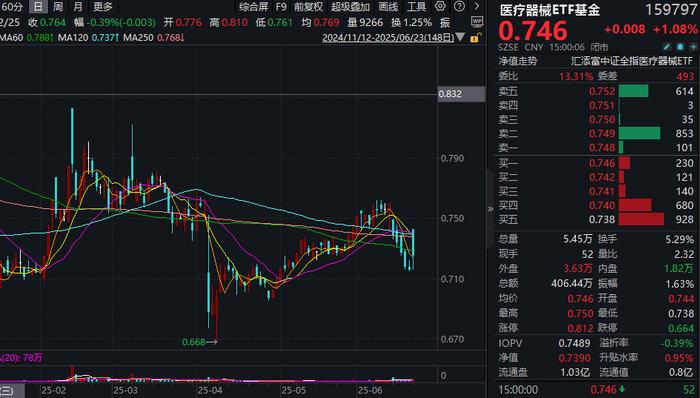
瑞金病理模型全球开源,医疗器械再获政策支持!医疗器械ETF基金(159797)收涨超1%,连续2日净流入!
Xin Lang Cai Jing· 2025-07-01 09:12
Group 1 - The medical device sector is experiencing strong performance, with the medical device ETF (159797) rising by 1.08% and attracting net inflows for the second consecutive day [1][3] - The majority of the constituent stocks of the medical device ETF saw gains, with notable increases such as Hotgen Biotech rising over 11%, and Xiangyu Medical and Xinmai Medical both increasing over 8% [3] - The National Healthcare Security Administration and the National Health Commission issued measures to support the high-quality development of innovative drugs, which includes enhancing the use of medical insurance data for drug research and improving the dynamic adjustment mechanism for the basic medical insurance drug list [3] Group 2 - The release of the RuiPath pathology model by Ruijin Hospital marks a significant advancement in domestic medical AI, transitioning from technical breakthroughs to ecosystem sharing [4] - The measures approved by the National Medical Products Administration aim to optimize the lifecycle regulation to support the innovation of high-end medical devices, including improving special approval processes and enhancing communication mechanisms [5] - The external skeleton robot industry is viewed positively due to recent technological breakthroughs and product innovations, with applications in both medical and industrial sectors expected to grow rapidly [6][7] Group 3 - The medical device ETF (159797) encompasses a wide range of medical equipment and diagnostics, with the top ten weighted stocks accounting for nearly 47% of the fund [7][8] - The top holdings in the medical device ETF include Mindray Medical (14.65%), United Imaging Healthcare (9.44%), and Aimeike (3.95%) among others [8]
中证全指医疗保健设备与服务指数上涨1.02%,前十大权重包含山东药玻等
Sou Hu Cai Jing· 2025-06-30 16:03
Core Viewpoint - The China Securities Index for Healthcare Equipment and Services has shown a slight increase recently, but has experienced declines over the past month, three months, and year-to-date [1]. Group 1: Index Performance - The CSI Healthcare Equipment and Services Index rose by 1.02% to 13,488.91 points with a trading volume of 17.167 billion yuan [1]. - Over the past month, the index has decreased by 0.36%, by 4.69% over the last three months, and by 2.45% year-to-date [1]. Group 2: Index Composition - The index is composed of listed companies in the healthcare sector, reflecting the overall performance of these securities [1]. - The index was established on December 31, 2004, with a base value of 1,000 points [1]. Group 3: Top Holdings - The top ten holdings in the index are as follows: Mindray Medical (9.73%), United Imaging (8.3%), Aier Eye Hospital (7.64%), Aimeike (3.47%), Huatai Medical (3.3%), New Industry (2.93%), Yuyue Medical (2.81%), Lepu Medical (2.38%), Meinian Onehealth (2.11%), and Shandong Pharmaceutical Glass (1.93%) [1]. Group 4: Market Distribution - The index's holdings are primarily listed on the Shenzhen Stock Exchange (60.23%) and the Shanghai Stock Exchange (39.77%) [1]. - All holdings in the index are categorized under the pharmaceutical and healthcare sector, accounting for 100% [1]. Group 5: Index Adjustment and Fund Tracking - The index samples are adjusted biannually, with changes implemented on the next trading day following the second Friday of June and December [2]. - Public funds tracking the healthcare index include various Southern and Tianhong funds, as well as ETFs from multiple financial institutions [2].

6月30日工银医疗保健股票净值增长1.16%,今年来累计上涨14.61%
Sou Hu Cai Jing· 2025-06-30 12:52
Group 1 - The core viewpoint of the news is the performance and holdings of the Industrial and Commercial Bank of China Healthcare Stock Fund, which has shown a recent net value increase and varying returns over different time frames [1] - As of June 30, 2025, the fund's latest net value is 2.6120 yuan, reflecting a growth of 1.16%. The fund has a one-month return of -1.55%, a six-month return of 14.61%, and a year-to-date return of 14.61% [1] - The fund's top ten holdings account for a total of 39.79%, with significant positions in companies such as Heng Rui Pharmaceutical (8.90%), WuXi AppTec (5.12%), and Aier Eye Hospital (4.94%) [1] Group 2 - The Industrial and Commercial Bank of China Healthcare Stock Fund was established on November 18, 2014, and as of March 31, 2025, it has a total scale of 2.724 billion yuan [1] - The fund is managed by Zhao Bei and Ding Yang, both of whom have extensive experience in the healthcare sector and investment management [2]
计算机行业点评报告:蚂蚁集团推出AI医疗C端产品,关注AI+医疗投资机会
CHINA DRAGON SECURITIES· 2025-06-30 09:38
Investment Rating - The report maintains a "Recommended" investment rating for the computer industry [2][9]. Core Viewpoints - Ant Group has launched an AI health application, AQ, aimed at simplifying medical processes and enhancing health management efficiency, connecting over 5,000 hospitals and nearly one million doctors [5][9]. - The AI healthcare sector is rapidly developing, with major players accelerating their investments, addressing traditional healthcare challenges, and promoting the informatization and accessibility of medical services [9]. Summary by Sections Recent Developments - On June 26, 2025, Ant Group officially launched the AI health application AQ, which integrates various health management functions and provides 24/7 medical services [3][5]. Key Features of AQ - AQ includes intelligent consultation, multi-modal interaction, online-to-offline consultation pathways, and collaboration with health device manufacturers to create a personalized health management ecosystem [5][6]. Market Trends - The AI healthcare market in China is expanding, with a projected compound annual growth rate (CAGR) of 11.7% from 2023 to 2028, reaching a total market size of 35.75 billion yuan by 2028 [5][9]. - Companies like Huawei and Tencent are also making significant strides in AI healthcare solutions, indicating a competitive landscape [5][9]. Investment Recommendations - The report suggests focusing on companies with strong technological reserves and rich medical data in the fields of chronic disease management and medical informatization, including Weining Health, Meinian Health, Chuangye Huikang, Dongsoft Group, Rundar Medical, Keda Xunfei, and Jiahe Meikang [9].