长城汽车

Search documents
成交额超3亿元,自由现金流ETF(159201)近9天获得连续资金净流入,合计“吸金”19.33亿元
Sou Hu Cai Jing· 2026-01-29 02:22
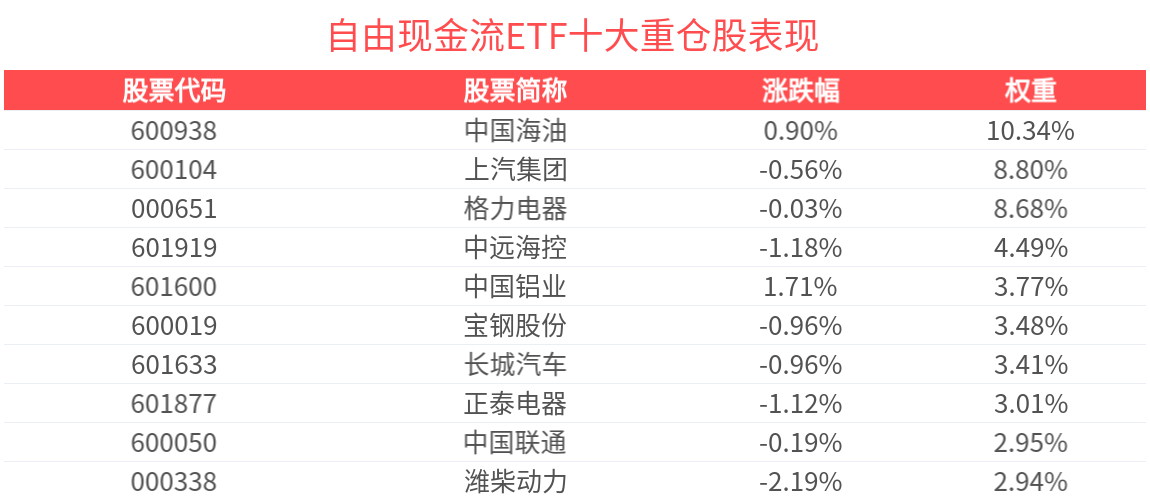
Core Viewpoint - The Guozheng Free Cash Flow Index has shown a slight increase, with notable performance from constituent stocks such as JiBit, JingJin Equipment, and others, indicating a positive trend in free cash flow among listed companies [1] Group 1: Free Cash Flow ETF Performance - The Free Cash Flow ETF (159201) has decreased by 0.67%, with the latest price at 1.34 yuan [1] - The ETF has seen a trading volume of 3.19 billion yuan, with a turnover rate of 2.61% [1] - Over the past week, the ETF has averaged a daily trading volume of 7.21 billion yuan [1] - The ETF has experienced continuous net inflows over the past 9 days, totaling 1.933 billion yuan [1] - The latest share count for the ETF is 9.111 billion, with a total asset size reaching 12.199 billion yuan, marking a record high since its inception [1] - The ETF's net value has increased by 26.18% over the past 6 months [1] - Historical performance shows a maximum monthly return of 7% and a longest consecutive monthly gain of 6 months, with an average monthly return of 3.3% [1] Group 2: Index Composition - The Guozheng Free Cash Flow Index closely tracks the performance of companies with high and stable free cash flow levels [2] - As of December 31, 2025, the top ten weighted stocks in the index include China National Offshore Oil Corporation, SAIC Motor, and Gree Electric Appliances, collectively accounting for 51.95% of the index [2] Group 3: Component Stocks - The top ten component stocks and their respective weightings include: - China National Offshore Oil Corporation: 10.34% - SAIC Motor: 8.80% - Gree Electric Appliances: 8.68% - COSCO Shipping Holdings: 4.49% - China Aluminum: 3.77% - Baosteel: 3.48% - Great Wall Motors: 3.41% - Chint Group: 3.01% - China Unicom: 2.95% - Weichai Power: 2.94% [4]

长城汽车申请屏幕共享状态下的语音控制方法专利,实现可见即可说在共享屏幕状态下能正常使用
Jin Rong Jie· 2026-01-29 01:16
Group 1 - The core point of the article is that Great Wall Motors Co., Ltd. has applied for a patent related to a voice control method and system for screen sharing in vehicles, which aims to enhance user experience by allowing voice commands to be executed while the screen is in a shared state [1] Group 2 - The patent application, titled "Voice Control Method and System under Screen Sharing State, Storage Medium, Vehicle," was published with the number CN121415775A and was filed on October 2025 [1] - The method involves registering keywords in response to user voice commands when the first screen is in a shared state, allowing for voice control commands to be matched and executed accordingly [1] Group 3 - Great Wall Motors was established in 2001 and is located in Baoding City, primarily engaged in the automotive manufacturing industry [1] - The company has a registered capital of approximately 8.56 billion RMB and has invested in 75 enterprises, participated in 2,962 bidding projects, and holds 5,000 trademark and patent records, along with 640 administrative licenses [1]

Navigating 50% tariffs: strategic options for Chinese automakers in Mexico
Yahoo Finance· 2026-01-28 13:21
Group 1: Tariff Changes and Impact - Mexico will raise tariffs on Light Vehicles (LVs) from 20% to 50% starting January 2026, affecting countries without a Free Trade Agreement (FTA) [1] - The most significant impact is expected on Chinese and Indian vehicle manufacturers, as sales of Chinese-made vehicles in Mexico have rapidly increased, accounting for 25.4% of total sales in 2025, up 4.6 percentage points from 2023 [2] - The tariff increase poses a challenge for Chinese OEMs, particularly in the Electric Vehicle (EV) segment, where affordability has been their main competitive advantage [3] Group 2: Affected Companies and Strategies - Indian manufacturers, especially Hyundai, Volkswagen, and Suzuki, will also be impacted by the tariff increase, with Suzuki expected to be more resilient due to its export strategy and recent land acquisition in India [4] - Strategies for OEMs to mitigate tariff impacts include inventory planning and cost absorption, with Geely indicating it will not raise prices to remain competitive [5] - Another strategy involves importing from countries with FTAs, such as Brazil, which allows tariff-free LV imports under certain conditions, despite not having a formal FTA with Mexico [7]
比俄乌冲突时期更差 俄罗斯汽车市场销售额10年来首降
Di Yi Cai Jing· 2026-01-28 12:48
俄乌冲突前(2022年前),欧洲车企主导俄罗斯市场,德系、法系品牌合计占约30%份额,本土车企仅 25%。韩系(20%+)表现优于日系(17%),美系不足10%。俄乌冲突后(2023年起),受制裁影响, 欧美车企大规模退出,本土车企通过接盘外资股份份额跃升至40%,中国品牌也乘势崛起。而自2021年 初开始逐步崭露头角以来,中国品牌的市场份额从最初的5%左右迅速攀升至2023年的超过50%,并在 2024年6月至9月期间突破了60%的大关。中国汽车品牌在短短两三年间完成了对俄罗斯市场的深度渗 透。2024年,俄罗斯是中国汽车出口第一目的地国。不过,2025年开年,俄罗斯市场就整体呈现出低迷 的景象。 俄罗斯对中国汽车出口的政策收紧,导致中国汽车出口销量下降。一名车商在接受记者采访时表示,俄 罗斯市场需求本身有限,叠加关税上涨、贷款利率暴涨,导致消费者购车欲望下降,整体消费低迷,并 非中国车本身不受欢迎。 其中,2024年是一个关键转折点。该年4月1日起,从中国经由中亚国家中转,再运往俄罗斯的车辆需要 补齐各类税费,包括关税、增值税和消费税等。该年10月1日起,进口至俄罗斯的车辆报废税上涨70% 至85%,每年 ...
比俄乌冲突时期更差,俄罗斯汽车市场销售额10年来首降
Di Yi Cai Jing· 2026-01-28 12:36
Group 1 - The core viewpoint is that the Russian automotive market is experiencing a significant decline in sales, with a total market size of 13.8 trillion rubles in 2025, down 7.8% from 2024, marking the first negative growth since 2015 [1] - In 2025, the new car market in Russia is projected to generate 4.6 trillion rubles, a decrease of 18.4% year-on-year, while the used car market is expected to reach 9.2 trillion rubles, down 1.4% [1] - The decline in the Russian automotive market is attributed to high benchmark interest rates increasing loan costs and weak market demand, along with policy changes such as increased vehicle scrappage taxes [1][3] Group 2 - In 2025, new cars will account for 33% of the market's monetary value in Russia, while used cars will represent 67%, highlighting the higher share of used cars in the market [2] - Chinese automotive brands are experiencing a decline in market share in Russia, with sales of new cars dropping to 68.5 million units in 2025, a 25% decrease, resulting in a market share reduction from 58.5% in 2024 to 51.7% [2] Group 3 - Before the Ukraine conflict, European car manufacturers dominated the Russian market, holding about 30% of the market share, while local manufacturers had only 25% [3] - Following the conflict, Western car manufacturers exited the market, allowing local manufacturers to increase their market share to 40%, while Chinese brands surged from around 5% to over 50% by 2023 [3] - In 2024, Russia became the top destination for Chinese automotive exports, but the market showed signs of decline at the beginning of 2025 due to tightening export policies and rising tariffs [3][4] Group 4 - A significant turning point occurred in 2024 when new taxes and increased scrappage fees were implemented, affecting the cost of imported vehicles [4] - The number of Chinese brand showrooms in Russia is expected to decrease significantly, with 643 showrooms closing by 2025, reflecting a cooling market for Chinese vehicles [6] - The competitive landscape for Chinese automotive brands in Russia has intensified, leading to lower profit margins and increased price competition due to market saturation [5][6]


崔东树:2025年1-12月俄罗斯的中国自主车企份额回升到57.2%
智通财经网· 2026-01-28 12:26
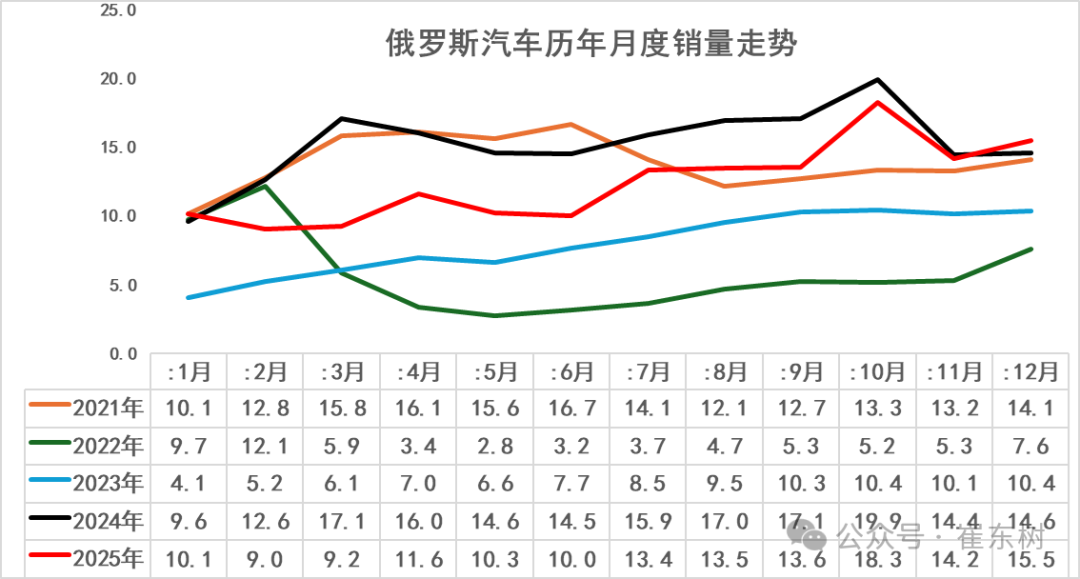
Group 1 - The core viewpoint of the articles indicates that the Russian automotive market is experiencing a complex recovery, with significant fluctuations in sales and a notable increase in the market share of Chinese automotive brands [1][8][14] - In December 2025, Russian automotive sales are projected to reach 150,000 units, reflecting a year-on-year increase of 6%, while the total sales for the year are expected to decline by 19% to 1.49 million units [1][8] - Chinese automotive companies have significantly increased their market share in Russia, reaching 57.2% in December 2025, with a notable recovery from previous lows [1][16] Group 2 - The Russian automotive market has shown volatility, with sales dropping to around 30,000 units during the peak of the Ukraine crisis in 2022, but recovering to approximately 100,000 units per month in 2023 [5][8] - The market is undergoing a transformation due to policy changes, including increased import tariffs and local production incentives, which have reshaped the competitive landscape [6][12] - Chinese automotive companies are adapting to the Russian market by enhancing local production, improving supply chain resilience, and developing products suited for extreme weather conditions [2][12] Group 3 - The sales of Chinese automotive brands in Russia have surged from 157,000 units in 2021 to 1.28 million units in 2024, indicating a strong response to the market gap left by exiting foreign brands [11][14] - The local production strategy has been emphasized, with Chinese companies establishing regional production bases and increasing local parts sourcing to mitigate tariff impacts [2][12] - The overall market dynamics are shifting towards lower-powered models and domestic brands due to the rising costs of imported vehicles and changing consumer preferences [6][12]


创近五年新低 2025年汽车行业销售利润率仅4.1%
经济观察报· 2026-01-28 12:24
Core Viewpoint - The automotive industry is experiencing a significant decline in profitability, with upstream components showing steady growth, while vehicle manufacturing and downstream dealerships face considerable pressure [1][2]. Group 1: Profitability Trends - In 2025, the automotive industry achieved a profit of 461 billion yuan, a year-on-year increase of 0.6%, but the sales profit margin dropped to 4.1%, lower than the average of 5.9% for downstream industrial enterprises [2]. - The profit margin for the automotive industry fell to 4.1% in 2025, marking a five-year low, with December profits plummeting to 20.7 billion yuan, a year-on-year decrease of 57.4% [2][3]. - The overall profit margin for the automotive industry in December 2025 was the lowest in five years, with a significant decline from 4.1% in December 2024 to 1.8% [2]. Group 2: Performance of Different Segments - Among 129 A-share automotive parts companies, 80 reported a year-on-year profit increase, indicating over 60% had both revenue and profit growth [3]. - In the vehicle manufacturing segment, 16 out of 22 A-share car manufacturers were profitable, but major players like BYD and GAC Group saw significant profit declines, with GAC Group's profit dropping by 3691.33% [3]. - The downstream dealership segment is under severe pressure, with only 28% meeting sales targets and a loss rate climbing to 55% [3]. Group 3: Cost Pressures - The overall unit cost for industrial enterprises has increased significantly, with lithium carbonate prices doubling and raw material costs rising for midstream and downstream sectors [3][4]. - The cost of a typical mid-sized smart electric vehicle has increased by 4,000 to 7,000 yuan due to rising prices of lithium, aluminum, and copper, which are difficult for manufacturers to pass on to consumers [4]. - Starting in 2026, a 5% purchase tax on new energy vehicles and changes to subsidy policies will further increase consumer costs, complicating demand and supply dynamics in the automotive market [4]. Group 4: Strategic Responses - Some automotive companies are accelerating collaboration with upstream suppliers to address challenges, as seen in the strategic discussions between China Aluminum Group and China FAW Group [5].


全球化突破!2025年我国汽车出口832万辆,同比增长30%
Hua Xia Shi Bao· 2026-01-28 09:58
Core Insights - In 2025, China's automobile exports reached 8.32 million units, a 30% year-on-year increase, marking a historical high and reflecting the industry's enhanced competitiveness in the global market [2] - The growth in exports is driven by the rise of new energy vehicles (NEVs), which have become a core growth engine, with overseas markets playing a crucial role in the industry's development [2] Export Volume and Structure - Passenger vehicles accounted for over 80% of total exports, while commercial vehicle exports remained stable, with new energy commercial vehicles emerging as a highlight [3] - In December 2025, the monthly export volume reached 990,000 units, a 73% year-on-year increase and a 23% month-on-month increase [3] - NEV exports totaled 3.43 million units, a 70% increase compared to 2024, with pure electric vehicles making up 28% of exports, hybrid vehicles 13%, and traditional fuel vehicles dropping to 43% [3] Price Trends - The average export price of Chinese automobiles in 2025 was $18,200, a 15.7% increase year-on-year, while the average price for NEVs reached $29,800, 83.5% higher than traditional fuel vehicles [3] Market Performance - In Europe, Chinese automakers achieved significant growth, with December 2025 sales reaching 109,864 units, a 127% year-on-year increase, and a market share of 9.5% [5] - For the entire year, sales in Europe reached 810,000 units, a 99% increase, contributing to a 2.3% growth in the European car market [5] Regional Developments - Southeast Asia saw exports of 1.985 million units, a 24.7% increase, while Latin America recorded 1.652 million units, a 36.8% increase [6] - The Middle East market exported 826,000 units, with NEV exports reaching 128,000 units, a 132% increase [6] Industry Ecosystem - The transformation of China's automobile exports from single vehicle exports to a full industry chain ecosystem is evident, with battery companies establishing production bases globally and entering international supply chains [6] - The export of auto parts reached $89.2 billion, with technology suppliers providing smart driving solutions to global automakers [6]
2025年12月皮卡销量5.2万辆,“一超多强”格局继续保持
Bei Jing Shang Bao· 2026-01-28 09:53
Core Viewpoint - The Chinese pickup truck market is experiencing significant growth, with sales and production reaching high levels in 2025, indicating a robust demand for this vehicle segment [1]. Sales Performance - In December 2025, the pickup truck market sold 52,000 units, marking an 8.8% year-on-year increase and reaching a five-year high [1]. - For the entire year of 2025, total pickup truck sales amounted to 589,000 units, reflecting an 11.8% year-on-year growth [1]. Production Performance - December 2025 production of pickup trucks was 48,000 units, which is a 5.2% increase year-on-year and remains at a mid-high level over the past five years [1]. - The total production for the year 2025 reached 575,000 units, showing a 14% year-on-year increase [1]. Market Leaders - Great Wall Motors continues to lead the pickup truck market, demonstrating stable performance both domestically and internationally [1]. - Other strong performers include Changan Automobile, SAIC Maxus, JAC Motors, and Zhengzhou Nissan, benefiting from continued export growth [1]. Domestic Market Dynamics - In the domestic retail market for pickups, key players such as Great Wall Motors, Jiangling Motors, Zhengzhou Nissan, Radar Auto, and Jiangxi Isuzu are performing well, maintaining a competitive landscape characterized by "one strong player and many strong competitors" [1]. New Energy Pickup Trucks - In December 2025, sales of new energy pickups were 6,000 units, representing a 3% year-on-year decline and a 30% month-on-month decline [1]. - Cumulatively, new energy pickup sales for the year reached 73,000 units, showcasing a remarkable 243% growth, significantly outpacing the overall pickup market growth [1].
乘用车板块1月28日跌0.81%,赛力斯领跌,主力资金净流出10.29亿元
Zheng Xing Xing Ye Ri Bao· 2026-01-28 08:58
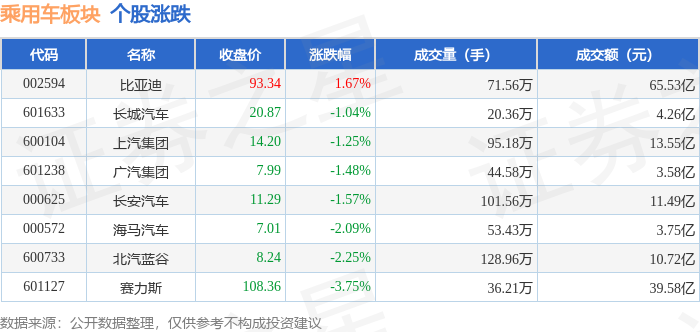
Group 1 - The passenger car sector experienced a decline of 0.81% on January 28, with Seres leading the drop [1] - The Shanghai Composite Index closed at 4151.24, up 0.27%, while the Shenzhen Component Index closed at 14342.9, up 0.09% [1] - BYD's stock price increased by 1.67% to 93.34, while several other major automakers like Great Wall Motors and SAIC Motor saw declines of 1.04% and 1.25% respectively [1] Group 2 - The passenger car sector saw a net outflow of 1.029 billion yuan from institutional investors, while retail investors contributed a net inflow of 762 million yuan [1] - Specific stocks like SAIC Motor and Great Wall Motors experienced significant net outflows from institutional investors, with amounts of -12.24 million yuan and -24.21 million yuan respectively [1] - In contrast, Haima Automobile and BYD saw net inflows from retail investors of 40.35 million yuan and 28.6 million yuan respectively [1]