中科曙光

Search documents
商汤科技进军具身智能 大晓机器人走“开源+生态协同”之路
2 1 Shi Ji Jing Ji Bao Dao· 2025-12-18 23:19
Core Insights - SenseTime's Xiaodao Robot is set to debut by the end of 2025, focusing on ecosystem collaboration within the AI industry chain, unlike its peers [1] - The company emphasizes a human-centered approach to address real-world needs with integrated hardware and software products [1] - The transition to embodied intelligence requires a fundamental paradigm shift in data collection and model training due to a significant data volume gap [1][2] Data and Technology - The ACE embodied research paradigm allows for the collection of tens of millions of hours of data annually, significantly enhancing the value of real data [2] - Current embodied intelligence data is limited to 100,000 hours, while Tesla's FSD V14 achieves a training equivalent to 400 million hours of human driving experience daily [1] - The ACE paradigm utilizes environmental data collection through multi-modal devices, providing comprehensive data support for model training [4] Industry Trends - The global humanoid robot market is projected to reach 6 million units sold by 2035, with a market size exceeding $120 billion, potentially rising to $260 billion in optimistic scenarios [6] - Investment institutions are increasingly focusing on the humanoid robotics sector, anticipating a shift towards mass production and diverse business models [6] Challenges and Solutions - The current data collection methods are costly and inefficient, leading to a lack of general cognitive and adaptive capabilities in robots [4] - The industry consensus is that the true value of robots lies in their ability to solve real-world application challenges rather than their physical form [5] - Key obstacles to large-scale deployment include the need for improved data protection and the replicability of industrial applications [6] Cost Reduction and Future Outlook - Key components like planetary roller screws and six-dimensional torque sensors account for about 40% of total costs, with potential reductions of 70% to 80% as domestic supply chains mature [7] - Breakthroughs in AI chips, battery management, and thermal management are expected to take 5 to 10 years, impacting overall cost structures [7] - As costs decrease, humanoid robots may surpass human labor in investment returns, marking a critical point for large-scale replacement of human workers [7]

商汤科技、大晓机器人与中科曙光达成战略合作;南方航空接入千问,打造“天盾”大模型|数智早参
Mei Ri Jing Ji Xin Wen· 2025-12-18 23:13
Group 1 - Strategic cooperation established between SenseTime, Daxiao Robotics, and Inspur to promote AI infrastructure and embodied intelligence technologies [1] - The collaboration signifies a shift in the AI industry from "digital intelligence" to "physical intelligence," focusing on creating a comprehensive stack of capabilities [1] - The success of this partnership in closing the loop from computing power to execution will be a critical indicator of China's AI industry's practical application capabilities [1] Group 2 - Southern Airlines and Alibaba Cloud launched the "Tian Dun" security model, which integrates multimodal capabilities for flight training, flight alerts, and fault repair [2] - This model represents a significant advancement in applying large model technology to the high-stakes aviation safety sector, transitioning from post-event analysis to real-time alerts and intelligent handling [2] - The reliability, interpretability, and accountability of model decisions will be key issues to address in the industry [2] Group 3 - Google introduced the Gemini 3 Flash AI model, which outperforms its predecessor Gemini 2.5 Pro with a speed increase of approximately three times and lower operational costs [3] - The model balances cutting-edge capabilities, response speed, and commercial costs, addressing market concerns about the high costs of AI application deployment [3] - This development intensifies the trend towards lightweight, high-performance models, compelling competitors to respond in terms of cost-effectiveness [3]



《环球时报》记者探访2025人工智能创新大会:AI下一程,从“单点突围”到“生态共进”
Huan Qiu Wang· 2025-12-18 22:49
Core Insights - Artificial Intelligence (AI) is becoming the core engine driving the development of new productive forces, but traditional scaling methods are no longer sufficient for maintaining rapid iteration in AI technology [1] - The key paths for advancing AI technology and industrial upgrading in China are collaboration and integration [2] Industry Developments - China is promoting "AI+" at the national strategic level, aiming for a comprehensive layout in response to rapid technological advancements [2] - The AI+ model, driven by large models, has permeated nearly all industries within a few years, but faces challenges such as high-end computing power shortages and high application costs [2][3] - The HAIC2025 conference emphasized "open computing" to combine the advantages of various AI industry chain enterprises, moving from isolated technological breakthroughs to collaborative industrial ecosystems [2][3] Technological Innovations - The scaleX supercluster, designed for trillion-parameter models and complex tasks, was showcased at HAIC2025, achieving a 20-fold increase in computing density per cabinet and significantly lowering overall ownership costs [4] - The supercluster supports multiple brands of AI acceleration cards and is compatible with mainstream computing ecosystems [4] Future Directions - The future of AI development is characterized by "two supers," "one openness," and "two integrations," focusing on ultra-node and ultra-density computing, open ecosystems, and the integration of various computing resources [6][7] - AI superclusters are seen as a promising direction, overcoming traditional communication bottlenecks and enhancing computational efficiency [7] Practical Applications - The HAIC2025 conference highlighted numerous successful AI+ applications, including the world's first multimodal language model focused on geographic science, which addresses global change and sustainable development issues [8] - Examples of AI+ applications include the rapid iteration of domestic electric vehicles, supported by AI computing in design and testing, and the "5G+ smart highway" project in Gansu province, which utilizes AI for traffic management [8]


影响市场重大事件:央行加大跨年流动性投放力度 明年初降准预期升温;数据显示 美国投资者今年爆买中国科技ETF
Mei Ri Jing Ji Xin Wen· 2025-12-18 22:37
|2025年12月19日星期五| NO.1 数据显示:美国投资者今年爆买中国科技ETF 12月18日,按管理资产规模计,在美上市最大中国股票ETF——KraneShares中国海外互联网 ETF(KWEB)今年以来已累计吸金23亿美元,有望创下2021年以来最佳年度表现。资产规模排名第四的 景顺中国科技ETF(CQQQ)也录得21亿美元资金流入,有望创下历史最佳年度表现。 NO.2 央行加大跨年流动性投放力度,专家:明年初降准预期升温 央行12月18日在公开市场开展883亿元7天期逆回购操作,利率维持在1.40%,并同步进行1000亿元14天 期逆回购操作。东方金诚首席宏观分析师王青表示,年末临近,央行按惯例在这一时点开启14天期逆回 购,可以有效熨平资金面波动,引导市场流动性处于较为稳定的充裕状态。综合当前经济金融运行态势 及货币政策取向,预计2026年1月央行有可能宣布降准,降准幅度估计为0.5个百分点,向市场注入约1 万亿元的长期流动性。 NO.3 价值预估2700万元,全国首单高光谱卫星数据资产入表落地 12月18日,中科西光航天自主研发的"高光谱遥感卫星应用平台数据"完成资产确权、评估与入表流程, ...
影响市场重大事件:央行加大跨年流动性投放力度,明年初降准预期升温;数据显示,美国投资者今年爆买中国科技ETF
Mei Ri Jing Ji Xin Wen· 2025-12-18 22:27
|2025年12月19日 星期五| NO.1 数据显示:美国投资者今年爆买中国科技ETF 每经记者|杨建 每经编辑|彭水萍 12月18日,按管理资产规模计,在美上市最大中国股票ETF——KraneShares中国海外互联网 ETF(KWEB)今年以来已累计吸金23亿美元,有望创下2021年以来最佳年度表现。资产规模排名第四的 景顺中国科技ETF(CQQQ)也录得21亿美元资金流入,有望创下历史最佳年度表现。 NO.2 央行加大跨年流动性投放力度,专家:明年初降准预期升温 央行12月18日在公开市场开展883亿元7天期逆回购操作,利率维持在1.40%,并同步进行1000亿元14天 期逆回购操作。东方金诚首席宏观分析师王青表示,年末临近,央行按惯例在这一时点开启14天期逆回 购,可以有效熨平资金面波动,引导市场流动性处于较为稳定的充裕状态。综合当前经济金融运行态势 及货币政策取向,预计2026年1月央行有可能宣布降准,降准幅度估计为0.5个百分点,向市场注入约1 万亿元的长期流动性。 NO.5 商汤科技将与大晓机器人、中科曙光共建国产化"算力基础设施+具身智能 "生态 据商汤科技官微12月18日消息,在今日的首届 ...
直击HAIC 2025:开放架构破“墙”而立 国产AI计算生态协同出击
Zheng Quan Ri Bao· 2025-12-18 15:41
Core Insights - The HAIC 2025 conference showcased advancements in AI computing, emphasizing a shift from single product displays to a comprehensive presentation of domestic computing capabilities [1] - The industry is transitioning from a "model-driven" approach to an "engineering-driven" one, focusing on overcoming hardware supply limitations and fostering an open architecture for collaboration [2] Group 1: Hardware Innovations - The scaleX万卡超集群 system, introduced by 中科曙光, features 16 super nodes supporting 10,240 AI accelerator cards, achieving over 5 EFLOPS of total computing power and a 20-fold increase in cabinet computing density [3] - The system's design allows for compatibility with multiple brands of accelerator cards and optimizes over 400 mainstream models, indicating a significant leap in domestic AI computing capabilities [3] Group 2: System-Level Breakthroughs - The focus on system-level architecture is crucial for enhancing domestic computing power, with a reported growth rate exceeding 10 times in the past two years [4] - The evolution from single cabinets to万卡集群 represents a systemic engineering innovation, marking a shift in AI computing competition towards system engineering capabilities and software collaboration [4] Group 3: Open Ecosystem Development - The conference highlighted the importance of "open" and "ecosystem" as key themes, addressing challenges in software layers and the need for affordable, efficient computing for SMEs and research institutions [5][6] - The push for an open architecture aims to unify interfaces and standards, reducing the burden of ecological fragmentation and enhancing collaboration across different technologies [6] Group 4: Strategic Collaborations - The event served as a platform for strategic partnerships among companies like 中科曙光 and 商汤集团, focusing on AI computing system optimization and collaborative innovation in various applications [8] - Initiatives such as the "光耀百城2.0" aim to promote scalable solutions in manufacturing, energy, and research sectors, with a focus on lowering barriers for SMEs [8] Group 5: Future Outlook - Experts predict that 2025 will be a pivotal year for domestic AI computing, transitioning from isolated breakthroughs to systemic outputs, with significant advancements expected in 2026 [9] - The conference illustrated the collective efforts of the Chinese AI computing industry to seek openness and overcome bottlenecks, with the万卡集群 becoming a foundational element for large model training [9]
开悟世界模型3.0开源、超级大脑模组A1落地!具身智能商业化提速
Guo Ji Jin Rong Bao· 2025-12-18 14:41
Core Insights - The article discusses the launch of Kairos 3.0 and the embodiment super brain module A1 by Daxiao Robotics, introducing a human-centric ACE embodiment research paradigm to accelerate the commercialization of robotics [2][8] Group 1: ACE Embodiment Research Paradigm - Daxiao Robotics proposes the ACE embodiment research paradigm to address the significant data gap in the era of embodied intelligence, moving away from the traditional machine-centric approach [8] - The ACE paradigm focuses on human interaction with the physical world, utilizing environmental data collection as a core engine to create a comprehensive technical system [8] - Environmental data collection technology can achieve data collection of tens of millions of hours annually, amplifying the value of real data to the equivalent of hundreds of millions of hours [8] Group 2: Kairos 3.0 Features - Kairos 3.0 can generate long-duration dynamic interactive scene videos, allowing precise control of elements within the scene [9] - The model features capabilities such as one-click generation across different entities, multi-entity generalization, and prediction of numerous evolution paths, creating a high-fidelity, generalizable virtual training environment for embodied intelligence [9] Group 3: Product Platform and Accessibility - The Kairos 3.0 model is integrated into a product platform that includes multi-modal generation capabilities, covering 115 categories of embodied scenarios with 328 tags [9] - The model has been open-sourced to the industry, with APIs available to facilitate the rapid development of lightweight and customized embodied intelligence products [9] Group 4: Super Brain Module A1 - The embodiment super brain module A1 leverages a leading pure visual end-to-end VLA model, enabling robots to adapt to complex and dynamic environments without pre-collected high-precision maps [10] - The module allows robots to autonomously generate robust, safe, and reasonable paths in dynamic settings, achieving true autonomous action [10] - A1 also features cloud interaction capabilities, enabling real-time interpretation of natural language commands and image semantics, allowing robots to execute tasks like obstacle avoidance and following commands accurately [10]
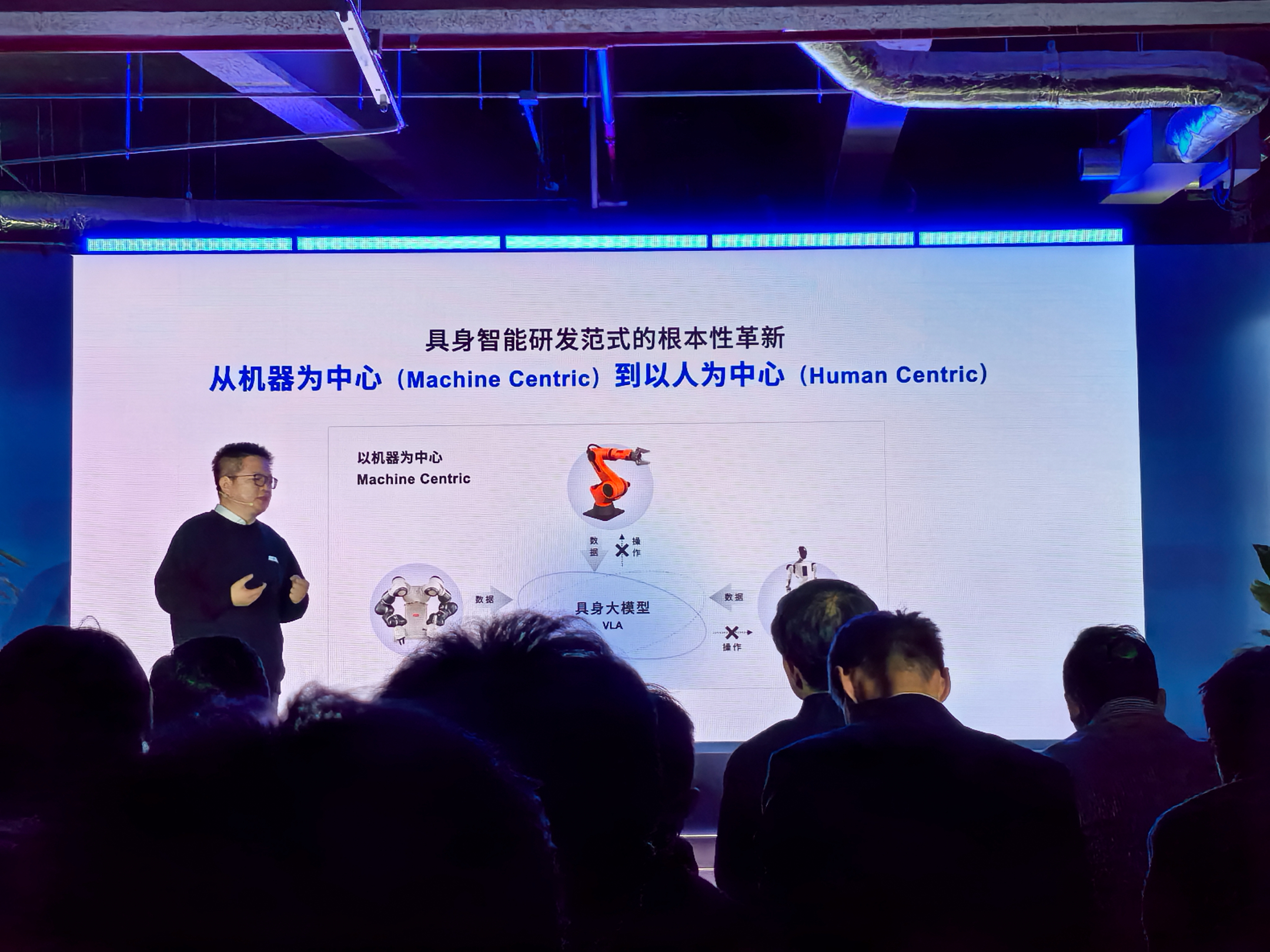
首创ACE具身研发范式 大晓机器人构建具身智能开放新生态
Zheng Quan Shi Bao Wang· 2025-12-18 14:04
Core Insights - The launch of the ACE (Ambient Capture Engine) and the open-source Kairos 3.0 model marks a significant advancement in embodied intelligence, aiming to create a fully autonomous and controllable ecosystem in the industry [1][2] - The focus on "human-centered" ACE development paradigm emphasizes the interaction between humans and the physical world, enabling extensive data collection and enhancing the value of real data [1][2] Group 1 - The ACE paradigm allows for the collection of millions of hours of environmental data, which can scale to over a billion hours of data value through the Kairos 3.0 model [1] - The Kairos 3.0 model is open-sourced for developers, facilitating the rapid emergence of lightweight and customized embodied intelligence products [2] - Strategic partnerships with various companies, including Mu Xi Co., Wallen Technology, and Zhongke Shuguang, have been established to enhance chip performance and adapt the Kairos 3.0 model [2] Group 2 - The launch of the A1 super brain module aims to accelerate the commercialization of robots and enhance the value of the embodied intelligence industry [2] - Collaboration with leading companies in the field of robotics, such as Zhiyuan Robotics and Galaxy General, is focused on creating solutions suitable for various scenarios [2] - The expectation of large-scale deployment of four-legged robots in retail sectors like front warehouses and flash purchase warehouses is anticipated to begin next year [3]
中科曙光12月18日大宗交易成交268.39万元
Zheng Quan Shi Bao Wang· 2025-12-18 13:41
Group 1 - Zhongke Shuguang executed a block trade on December 18, with a transaction volume of 29,300 shares and a transaction amount of 2.6839 million yuan, at a price of 91.60 yuan, representing a premium of 7.92% over the closing price of the day [2][3] - The buyer of the block trade was Yintai Securities Co., Ltd. Suzhou Huashan Road Securities Business Department, while the seller was Guorong Securities Co., Ltd. Dalian Branch [2][3] - In the last three months, Zhongke Shuguang has recorded a total of three block trades, with a cumulative transaction amount of 142 million yuan [2] Group 2 - The latest margin financing balance for Zhongke Shuguang is 9.834 billion yuan, with an increase of 51.6529 million yuan over the past five days, reflecting a growth rate of 0.53% [3] - As of December 18, Zhongke Shuguang's closing price was 84.88 yuan, down 1.28%, with a daily turnover rate of 2.18% and a total transaction amount of 2.728 billion yuan [2] - The stock has seen a net outflow of 302 million yuan in main funds for the day, with a cumulative decline of 5.30% over the past five days and a total net outflow of 2.887 billion yuan [2]
开源+生态协同 商汤的大晓机器人攻坚具身智能痛点
2 1 Shi Ji Jing Ji Bao Dao· 2025-12-18 13:08
Core Insights - SenseTime's Xiaodao Robot emphasizes ecological collaboration within the AI industry chain, focusing on human-centered solutions that address real-world needs [2][3] - The company aims to leverage breakthrough technologies like ACE embodied research paradigm and Enlightenment World Model to scale embodied intelligence commercially [2][3] Data and Technology - The transition to embodied intelligence faces a significant data gap, with current real machine data in the field only amounting to 100,000 hours compared to Tesla's FSD V14 training equivalent to 400 million hours of human driving experience [2] - The ACE paradigm allows for the collection of over 10 million hours of data annually, enhancing the value of real data to achieve a scale of over 100 million hours [3] Industry Trends - The global humanoid robot market is projected to reach 6 million units sold and a market size exceeding $120 billion by 2035, with optimistic scenarios suggesting sales could surpass 10 million units and a market size of $260 billion [11] - The industry consensus is that the true value of robots lies in their ability to solve practical problems in real-world applications rather than their physical form [8] Challenges and Opportunities - The key obstacles to scaling embodied intelligence include high data collection costs and the inefficiency of current data acquisition methods, which are often tied to specific hardware [7] - The cost of critical components, such as planetary roller screws and six-dimensional torque sensors, constitutes about 40% of the total cost, with potential reductions of 70% to 80% as domestic supply chains mature [13][14] Future Outlook - The next two to three years are expected to see significant advancements in industrial applications, particularly in areas like front warehouses and flash purchase warehouses, which could lead to large-scale deployment [13] - Breakthroughs in AI chips, battery technology, and thermal management are anticipated to take 5 to 10 years, impacting the overall cost structure and feasibility of humanoid robots [14]