
广发基金管理有限公司

Search documents
“国家队”斥资超2000亿增持ETF,知名基金经理调仓路径各异
第一财经· 2025-07-23 15:01
Core Viewpoint - The "national team" has significantly increased its investment in ETFs and equity assets, with an estimated total investment exceeding 207 billion yuan in the first half of the year, reflecting a strategic response to market volatility and a focus on structural opportunities [2][3][5]. Group 1: National Team's Investment Actions - In April, amidst increased volatility in the A-share market, the "national team" including Central Huijin and China Reform Holdings began to increase their holdings in ETFs and other equity assets [3]. - Central Huijin Asset Management has become the largest institutional investor in the Huatai-PineBridge CSI 300 ETF, increasing its holdings from 26.62 billion shares at the end of last year to 37.86 billion shares, representing a rise in shareholding ratio from 29.78% to 40.26% [3][4]. - The total estimated investment by the "national team" in ETFs for the first half of the year reached approximately 207.27 billion yuan, with significant contributions from various ETFs [5][6]. Group 2: Fund Managers' Adjustments - In the second quarter, over 57% of active equity funds increased their stock positions, with some funds raising their equity allocation by more than 30% [8]. - Notable fund managers like Zhang Kun have adjusted their portfolios, increasing their holdings in liquor stocks despite a general reduction in the food and beverage sector [9]. - Liu Gesong has focused on increasing allocations to Hong Kong stocks and non-bank financials, with significant investments in companies like Xiaomi and New Oriental Education [9]. Group 3: Sector Focus and Trends - The innovative drug sector has seen increased interest from fund managers, with significant allocations to companies involved in cutting-edge technologies and international collaborations [10]. - Fund managers are optimistic about the potential for domestic innovative drugs to gain international recognition and market share, driven by ongoing clinical trials and partnerships with multinational pharmaceutical companies [10].

“国家队”扫货ETF逾2000亿元,知名基金经理调仓路径各异
Di Yi Cai Jing· 2025-07-23 12:54
Core Viewpoint - The "national team" has significantly increased its investment in ETFs and equity assets, with an estimated total investment exceeding 207 billion yuan in the first half of the year, reflecting a strategic move to stabilize the A-share market amid increased volatility [1][2][4]. Group 1: National Team's Investment Actions - In response to market fluctuations, the central financial institutions, including Central Huijin and China Guoxin, have actively increased their holdings in ETFs and other equity assets since April [2][3]. - Central Huijin Asset Management has become the largest institutional investor in the Huatai-PB CSI 300 ETF, increasing its holdings from 26.62 billion shares at the end of last year to 37.86 billion shares, raising its shareholding ratio from 29.78% to 40.26% [2][3]. - The total investment in ETFs by the national team in the first half of the year reached approximately 207.27 billion yuan, with significant contributions from various ETFs, including Huatai-PB, China Southern, and E Fund [4][3]. Group 2: Fund Managers' Adjustments - In the second quarter, over 57% of active equity funds increased their stock positions, with some funds raising their equity exposure by more than 30% [5][6]. - Notable fund managers, such as Zhang Kun, have adjusted their portfolios by increasing holdings in liquor stocks despite a general market downturn in the food and beverage sector [6][7]. - Liu Gesong has focused on increasing allocations to Hong Kong stocks and non-bank financials, while fund manager Ge Lan has concentrated on innovative pharmaceuticals, reducing exposure to traditional Chinese medicine and medical devices [7][8]. Group 3: Focus on Innovative Pharmaceuticals - The innovative pharmaceutical sector has attracted significant interest from fund managers, with many increasing their stakes in leading companies within this field [8]. - Ge Lan highlighted the ongoing advancements in innovative drug technologies and the increasing collaboration between domestic companies and multinational pharmaceutical firms, indicating a positive outlook for the sector [8].
宏信证券ETF日报-20250723
Hongxin Security· 2025-07-23 09:03
Report Summary 1. Market Overview - The Shanghai Composite Index rose 0.01% to close at 3582.30 points, the Shenzhen Component Index fell 0.37% to close at 11059.04 points, and the ChiNext Index fell 0.01% to close at 2310.67 points. The total trading volume of A-shares in the two markets was 1898.7 billion yuan. The top-performing sectors were non-bank finance (1.29%), beauty care (0.59%), and household appliances (0.58%), while the worst-performing sectors were building materials (-2.27%), national defense and military industry (-1.60%), and machinery and equipment (-1.29%) [2][6]. 2. Stock ETFs - The top trading volume stock ETFs were Huaxia SSE STAR 50 ETF (up 0.47%, premium rate 0.46%), Huatai-PineBridge CSI 300 ETF (down 0.05%, premium rate 0.15%), and Cathay CSI All-Securities Company ETF (up 0.84%, premium rate 0.89%) [3][7]. 3. Bond ETFs - The top trading volume bond ETFs were Fullgoal CSI AAA Science and Technology Innovation Corporate Bond ETF (down 0.10%, premium rate -0.11%), Haitong CSI Short-Term Financing Bond ETF (up 0.00%, premium rate -0.02%), and Penghua CCDC 30-Year Treasury Bond ETF (down 0.18%, premium rate 0.08%) [4][9]. 4. Gold ETFs - Gold AU9999 rose 1.04% and Shanghai Gold rose 0.98%. The top trading volume gold ETFs were HuaAn Gold ETF (up 0.99%, premium rate 0.94%), E Fund Gold ETF (up 0.97%, premium rate 0.89%), and Bosera Gold ETF (up 0.98%, premium rate 0.94%) [12]. 5. Commodity Futures ETFs - The top trading volume commodity futures ETFs were Huaxia Feed Soybean Meal Futures ETF (up 0.35%, premium rate 0.41%), CCB E Fund YiSheng Energy and Chemical Futures ETF (down 1.08%, premium rate -0.18%), and Dacheng Nonferrous Metals Futures ETF (down 0.35%, premium rate -0.23%) [13][14]. 6. Cross-Border ETFs - The previous trading day, the Dow Jones Industrial Average rose 0.40%, the Nasdaq fell 0.39%, the S&P 500 rose 0.06%, and the German DAX fell 1.09%. Today, the Hang Seng Index rose 1.62% and the Hang Seng China Enterprises Index rose 1.82%. The top trading volume cross-border ETFs were E Fund CSI Hong Kong Securities Investment Theme ETF (up 2.89%, premium rate 2.40%), GF CSI Hong Kong Innovative Drugs ETF (down 0.07%, premium rate 0.07%), and Huaxia Hang Seng Internet Technology Industry ETF (up 3.86%, premium rate 3.42%) [15]. 7. Money Market ETFs - The top trading volume money market ETFs were Silver HuaRiLi ETF, HuaBaoTianYi ETF, and CCB TianYi Money Market ETF [17][19].
公募总规模冲到33.73万亿!200亿档主动权益基金经理出现新面孔 | 基金放大镜
Sou Hu Cai Jing· 2025-07-23 02:22
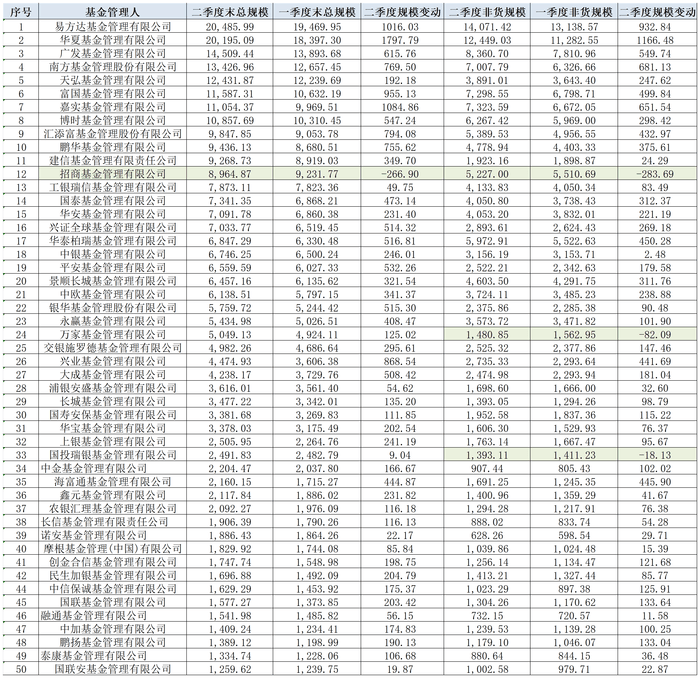
Group 1 - The public fund industry shows new dynamics with a total scale of 33.73 trillion yuan as of the end of Q2, reflecting a 6.69% increase from the previous quarter [1] - The total scale of equity funds reached 4.28 trillion yuan, up 6.17% quarter-on-quarter, while mixed funds decreased by 0.22% to 3.21 trillion yuan [1] - Bond funds increased by 8.55% to 10.92 trillion yuan, and money market funds rose by 6.79% to 14.23 trillion yuan [1] Group 2 - The top ten public funds, including E Fund, Huaxia, and GF Fund, maintained their rankings with slight variations in scale [1][2] - E Fund and Huaxia Fund lead with total scales of 2.05 trillion yuan and 2.02 trillion yuan, respectively, with E Fund increasing by 101.6 billion yuan and Huaxia by 179.8 billion yuan in Q2 [2] - The total scale of GF Fund, Southern Fund, Tianhong Fund, and others also saw increases of over 6% compared to the previous quarter, indicating competitive dynamics among leading public funds [2] Group 3 - Non-monetary scale rankings among public funds showed significant growth, with GF Fund increasing by 549.74 billion yuan, becoming the only fund in the 800 billion yuan tier [5] - Southern, Fortune, and Harvest Funds also saw their non-monetary scales rise to the 700-800 billion yuan range [5] - The rankings of funds in the 10-20 tier are seeking differentiation, with Penghua and Guotai Funds achieving growth rates of 11.26% and 10.34%, respectively [5] Group 4 - Among the "mid-tier funds" ranked 20-40, Xingye and Haifutong Funds reported increases of 441.69 billion yuan and 445.9 billion yuan, reaching 2735.33 billion yuan and 1691.25 billion yuan [6] - Some funds, such as Wanji and Guotou Ruijin, experienced decreases in non-monetary scale [6] - The active equity fund managers with over 20 billion yuan in management scale saw new faces, with some familiar managers experiencing a reduction in managed scale [6][7] Group 5 - As of the end of Q2, the top active equity fund manager is Zhang Kun from E Fund, managing 550.47 billion yuan, despite a decrease of 57.75 billion yuan from the previous quarter [7][8] - Other notable managers like Liu Yanchun and Ge Lan also saw reductions in their managed scales [8] - The net redemption of equity funds reached 1.40268 billion units in Q2, indicating a trend of investors opting to sell for recovery [9]
中央汇金二季度超2000亿增持宽基ETF 稳市决心彰显
Huan Qiu Wang· 2025-07-23 02:06
Group 1 - Central Huijin significantly increased its holdings in core broad-based ETFs such as CSI 300, SSE 50, and CSI 500 during Q2, with total investments amounting to 202.47 billion yuan [1] - The Huatai-PineBridge CSI 300 ETF saw the largest increase, with Central Huijin purchasing 10.874 billion units, amounting to approximately 42.21 billion yuan, raising its shareholding from 29.78% at the end of last year to 40.26% [3] - Central Huijin also made substantial purchases in multiple CSI 1000 ETFs, including 5.655 billion units of Southern CSI 1000 ETF (approximately 13.42 billion yuan) and 3.805 billion units of Huaxia CSI 1000 ETF (approximately 9.07 billion yuan) [3] Group 2 - Additional purchases included 8.183 billion units of Huaxia SSE 50 ETF (approximately 22.22 billion yuan) and 3.366 billion units of Southern CSI 500 ETF (approximately 18.91 billion yuan) [3] - In April, Central Huijin expressed a strong outlook on the development of the Chinese capital market and committed to continue increasing its ETF holdings [3] - The announcement in April also included a clear positioning of "quasi-stabilization fund" and a statement from the central bank regarding support for relending [3]

交投旺盛,科创债 ETF 迎来发展机遇
Yin He Zheng Quan· 2025-07-22 11:47
1. Report Industry Investment Rating No information provided in the content. 2. Core Viewpoints of the Report - In 2025, with policy focus, the "technology board" of the bond market has accelerated its progress. On July 17, the first batch of Sci - tech Bond ETFs were collectively listed. The Sci - tech Bond ETFs have investment value due to factors such as high - quality index components, better performance in bull and bear markets, spread compression potential, and suitability for certain types of investors [1][8][9]. - The Sci - tech Bond ETFs have differences from other mainstream ETFs in terms of sample range, sample rating, and sample remaining term, and the Shanghai AAA Sci - tech Bond Index has the characteristics of high return, low volatility, and low drawdown [4]. - The GF Shanghai AAA Sci - tech Innovation Corporate Bond ETF has features such as low credit risk, stable coupon income, and suitability for both stable - allocation investors and stock - bond portfolio rotation strategies [5]. 3. Summary According to the Catalog 3.1 How to Evaluate the Investment Value of Sci - tech Bond ETFs? 3.1.1 Index Component Structure - Among the 10 Sci - tech Bond ETF products, 6 track the China Securities AAA Sci - tech Bond Index, 3 track the Shanghai AAA Sci - tech Bond Index, and 1 tracks the Shenzhen AAA Sci - tech Bond Index. The Shanghai AAA Sci - tech Bond Index has better sample subject qualifications, a relatively larger sample size, and uses physical redemption [11]. - The industry distributions of the China Securities AAA Sci - tech Bond Index, Shanghai AAA Sci - tech Bond Index, and Shenzhen AAA Sci - tech Bond Index are similar and highly concentrated. The top four industries of the first two are industry, public utilities, energy, and materials, accounting for 90% of the total scale [13]. 3.1.2 Policy Attributes: Better Returns in Bull Markets and More Resilience in Bear Markets - Since 2025, in bear markets, the yield of sci - tech bonds has increased 3BP less than that of medium - term notes and short - term financing bills; in bull markets, it has decreased 6BP more. The policy attributes of sci - tech bonds provide strong support for their performance in bull - bear cycles [2][18]. 3.1.3 Allocation Demand: Room for Spread Compression - Currently, the 10 - year Treasury yield has been fluctuating narrowly in the range of 1.63% - 1.73% for over 2 months. The 3 - year and 5 - year AAA - rated sci - tech bonds still have an excess spread of 29BP and 5BP compared to medium - term notes of the same term and rating, and their yield levels are still attractive [2][22]. 3.1.4 High Correlation between Sci - tech Bond Index and Dividend Index: Suitable for Conservative Allocation - Oriented Investors - The Shanghai AAA Sci - tech Bond Index has a strong positive correlation with the Shanghai Dividend Index, with a correlation coefficient of 0.56. Sci - tech Bond ETFs are more suitable for conservative allocation - oriented investors and those who prefer stable high - coupon income [3][25]. 3.2 Comparison between Sci - tech Bond ETFs and Other ETFs 3.2.1 Comparison of Indexes Tracked by Mainstream ETFs - Sci - tech Bond ETFs, as a new listing category, differ from other mainstream ETFs in sample range, sample rating, and sample remaining term. For example, the ChinaBond 7 - 10 - year Policy Financial Bond Index and the Shanghai 10 - year Treasury Bond (Net) Index have no restrictions on sample ratings, while the Shanghai Market - Making Corporate Bond Index and the Shanghai AAA Sci - tech Bond Index require high - credit - rated bonds [30][31]. 3.2.2 The Index Tracked by Sci - tech Bond ETFs Has High Return, Low Volatility, and Low Drawdown - The Shanghai AAA Sci - tech Bond Index has the highest annualized return (5.41%), relatively low annualized volatility (1.02%), and relatively low maximum drawdown (- 1.42%) among the four indexes [38][39]. 3.3 Introduction to Sci - tech Bond ETF Products 3.3.1 Product Information of GF Sci - tech Bond ETF - The GF Shanghai AAA Sci - tech Innovation Corporate Bond ETF (fund code: 511120.SH) is a contract - type open - ended index fund tracking the Shanghai AAA Sci - tech Bond Index. As of July 17, 2025, its liquid scale is 5.172 billion yuan [5][43]. 3.3.2 Trading Mechanism: On - exchange Trading with "T + 0" Real - time Trading for Convenient Operation - The ETF supports on - exchange continuous trading, has no subscription and redemption limits, and allows "T + 0" real - time trading. It also has a cash dividend mechanism, providing flexibility and predictable cash flow for investors [46][47]. 3.3.3 The Index Tracked by the ETF Has Medium - to - Short Duration, High Credit Rating, High Industry Concentration, and Many Leading Enterprises - The Shanghai AAA Sci - tech Bond Index has a medium - to - short duration, with bonds with a maturity of less than 5 years accounting for 80% of the total scale and a weighted average duration of 4.40 years. The component bonds are mainly of high - credit rating, and the top four industries account for over 90% of the total scale [48][50][51]. 3.3.4 Good Liquidity and Low Correlation with Stocks Make It Suitable for Stock - Bond Rotation Strategies - The ETF is suitable for stable - allocation investors and stock - bond portfolio rotation strategies due to its low credit risk, stable coupon income, anti - drawdown ability, low correlation with the Shanghai Composite Index, and good secondary - market liquidity [5][55].
交投旺盛,科创债ETF迎来发展机遇
Yin He Zheng Quan· 2025-07-22 11:32
1. Report Industry Investment Rating No industry investment rating is provided in the report. 2. Core Viewpoints of the Report - In 2025, driven by policy focus, the "science - technology board" of the bond market has accelerated its progress. On July 17, the first batch of Science - Innovation Bond ETFs were listed collectively. These ETFs have investment value due to factors such as high - quality index components, better performance in bull and bear markets, potential for spread compression, and suitability for certain types of investors [1][8][9]. - Science - Innovation Bond ETFs have differences from other mainstream ETFs in terms of sample scope, sample rating, and sample remaining maturity. The tracking index of Science - Innovation Bond ETFs has the characteristics of high return, low volatility, and low drawdown [4][30]. - The Guangfa Shanghai Stock Exchange AAA Science - Innovation Corporate Bond ETF has features such as low credit risk, stable coupon income, and suitability for both conservative allocation investors and stock - bond rotation strategies [5][55]. 3. Summary According to the Directory 3.1 How to Evaluate the Investment Value of Science - Innovation Bond ETFs? 3.1.1 Index Component Structure - Among the 10 Science - Innovation Bond ETF products, 6 track the CSI AAA Science - Innovation Bond Index, 3 track the Shanghai AAA Science - Innovation Bond Index, and 1 tracks the Shenzhen AAA Science - Innovation Bond Index. The Shanghai AAA Science - Innovation Bond Index has advantages such as better sample subject quality, relatively larger sample size, and physical redemption [11]. - The industry distributions of the CSI AAA, Shanghai AAA, and Shenzhen AAA Science - Innovation Bond Indexes are similar with high concentration. The top four industries of the first two are industry, public utilities, energy, and materials, accounting for 90% of the total scale; for the Shenzhen AAA index, they are industry, materials, public utilities, and information technology, accounting for 85% of the total scale [13]. 3.1.2 Policy Attributes: Better Returns in Bull Markets and More Resilience in Bear Markets - Since 2025, Science - Innovation Bonds have shown more resilience in bear markets (yield up 3BP less than medium - term notes and short - term commercial paper) and better return elasticity in bull markets (yield down 6BP more than medium - term notes and short - term commercial paper). Their policy attributes support their performance in bull - bear cycles [2][18]. 3.1.3 Allocation Demand: Room for Spread Compression - Currently, the 10 - year Treasury yield has been fluctuating in the range of 1.63% - 1.73% for over two months. The 3 - year and 5 - year AAA - rated Science - Innovation Bonds still have an excess spread of 29BP and 5BP respectively compared with medium - term notes of the same term and rating, indicating attractive yield levels [2][22]. 3.1.4 High Correlation between Science - Innovation Bond Index and Dividend Index, Suitable for Conservative Allocation Investors - The Shanghai AAA Science - Innovation Bond Index has a strong positive correlation (correlation coefficient of 0.56) with the Shanghai Dividend Index, and a low correlation (correlation coefficient of 0.16) with the Shanghai Composite Index. Science - Innovation Bond ETFs are suitable for conservative allocation investors and those who prefer stable high - coupon income [25][28]. 3.2 Comparison between Science - Innovation Bond ETFs and Other ETFs 3.2.1 Comparison of Indexes Tracked by Mainstream ETFs - Science - Innovation Bond ETFs, as a new category, differ from other mainstream bond ETFs (such as Policy - Financial Bond ETFs, Treasury Bond ETFs, and Credit Bond ETFs) in sample scope, sample rating, and sample remaining maturity. For example, the Shanghai AAA Science - Innovation Bond Index requires high - credit - rated bonds and has no restriction on the remaining maturity [30][31]. 3.2.2 The Index Tracked by Science - Innovation Bond ETFs has High Return, Low Volatility, and Low Drawdown - From 2023 to July 2025, the Shanghai AAA Science - Innovation Bond Index had the highest annualized return (5.41%) among the four compared indexes, relatively low annualized volatility (1.02%), and relatively low maximum drawdown (- 1.42%) [38][39]. 3.3 Introduction to Science - Innovation Bond ETF Products 3.3.1 Product Information of Guangfa Science - Innovation Bond ETF - The Guangfa Shanghai Stock Exchange AAA Science - Innovation Corporate Bond ETF (fund code: 511120.SH) is a contract - type open - ended index fund tracking the Shanghai AAA Science - Innovation Bond Index. As of July 17, 2025, its floating scale was 5.172 billion yuan [5][43]. 3.3.2 Trading Mechanism: On - exchange Trading with "T + 0" Real - time Trading for Convenient Operation - The ETF supports on - exchange continuous trading without subscription and redemption limits and "T + 0" real - time trading, which improves capital turnover efficiency and provides flexible trading space. The cash - dividend mechanism provides investors with a predictable cash source [47]. 3.3.3 The Index Tracked by the ETF has Medium - to - Short Duration, High Credit Rating, High Industry Concentration, and Many Leading Enterprises - The Shanghai AAA Science - Innovation Bond Index has a medium - to - short duration (bonds with a maturity of less than 5 years account for 80% of the total scale, and the weighted average duration is 4.40 years), high - credit - rated components (bonds with an implied rating above AAA - account for nearly 70% of the total scale), and high industry concentration with leading enterprises in the top four industries accounting for over 90% of the total scale [48][50][51]. 3.3.4 Good Liquidity and Low Correlation with Stocks Make it Suitable for Stock - Bond Rotation Strategies - The Guangfa Shanghai Stock Exchange AAA Science - Innovation Corporate Bond ETF is suitable for conservative allocation investors. Its low correlation with the Shanghai Composite Index and good secondary - market liquidity support stock - bond rotation strategies, enabling risk control during stock market downturns and efficient asset switching [55].
重磅揭晓!基金公司二季末规模排行出炉(附全排名)
华尔街见闻· 2025-07-22 11:13
Core Viewpoint - The public fund industry in China has experienced significant growth in the first half of 2025, with a notable increase in the scale of public funds and a competitive environment among fund companies [2][30]. Group 1: Top Fund Companies - As of June 30, 2025, the top ten public fund companies by non-monetary scale are: E Fund, Huaxia Fund, GF Fund, Fortune Fund, Harvest Fund, Southern Fund, Bosera Fund, Hua Tai-PB Fund, Huitianfu Fund, and China Merchants Fund [2][7]. - The top two companies, E Fund and Huaxia Fund, have surpassed 1.4 trillion yuan and 1.2 trillion yuan in non-monetary fund scale, respectively, indicating strong market leadership [8][10]. - The third to sixth ranked companies, including GF Fund and Fortune Fund, have all seen growth rates exceeding 8.4%, highlighting a competitive atmosphere within the industry [8][10]. Group 2: Second Tier Companies - The second tier of fund companies, ranked 11th to 20th, includes Penghua Fund, Invesco Great Wall, ICBC Credit Suisse, Guotai Fund, and others, with notable growth in their scales [12][15]. - Guotai Fund has risen to 14th place, driven by the growth of index funds, while Penghua Fund is approaching the 500 billion yuan mark and is expected to challenge for a top ten position soon [13][15]. - Xingsheng Global Fund has also shown double-digit growth, primarily due to increases in bond and index funds [14][15]. Group 3: Middle Tier Competition - The competition among the middle tier fund companies (ranked 21st to 30th) is intensifying, with significant movements in rankings [17][20]. - Xinyi Fund has moved up from 23rd to 21st place with a remarkable growth rate of 20%, while Haifutong Fund has jumped from 33rd to 28th with a 34% increase [18][19]. - Dachen Fund has also seen a 10.14% increase, moving from 24th to 23rd place, indicating a dynamic competitive landscape [20]. Group 4: Emerging Fund Companies - The rankings from 31st to 40th include Huabao Fund, Dongzheng Asset Management, and others, with some companies like Dongzheng Asset Management and Minsheng Jia Yin achieving notable upward movements [22][24]. - The latest rankings show that several companies have successfully risen by two positions, attributed to effective team adjustments and focused product strategies [24][25]. - The number of public fund companies with non-monetary scales exceeding 100 billion yuan has increased to 49, up from 45 in the previous quarter, indicating a growing trend in the industry [29].

中央汇金大手笔增持宽基ETF
Zhong Guo Zheng Quan Bao· 2025-07-21 20:16
Central Huijin's Role in the Market - Central Huijin has played a significant role as a "stabilizer" in the capital market by increasing its holdings in major ETFs, with an estimated increase of over 200 billion yuan in Q2 [1][2][3] - The company has emphasized its commitment to maintaining market stability and will continue to act decisively when necessary [1][3] ETF Holdings and Increases - In Q2, Central Huijin Asset Management increased its holdings in various ETFs, including 84.29 million shares of E Fund CSI 300 ETF and 92.88 million shares of Huaxia CSI 300 ETF, among others [2][3] - The total scale of Central Huijin's holdings in the ten major ETFs rose from over 360 billion yuan at the end of last year to over 580 billion yuan in the first half of this year [3] Market Response and Confidence - Following external disturbances that affected the A-share market, Central Huijin and other state-owned entities announced their intention to increase ETF holdings, which significantly boosted market confidence [3][4] - On April 8, a record net inflow of nearly 100 billion yuan was observed in several ETFs, indicating strong market support [4] Asset Management Adjustments - Central Huijin has shown signs of portfolio adjustments in its asset management plans, with significant holdings in various ETFs [5][6] - The company has been actively managing its investments, including reducing holdings in certain ETFs while increasing others [5][6]
广发基金旗下广发道琼斯石油指数人民币C二季度末规模4.52*亿元,环比减少8.61%
Jin Rong Jie· 2025-07-18 10:38
数据显示,该基金近3个月收益率10.13%,近一年收益率-11.02%,成立以来收益率为117.83%。其股票 持仓前十分别为:康菲石油、EOG能源、Phillips 66、马拉松原油、EQT能源、瓦莱罗能源、Expand Energy Corp、Diamondback Energy Inc、赫斯、戴文能源,前十持仓占比合计63.77%。 截至2025年6月30日,广发基金旗下广发道琼斯石油指数人民币C(004243)期末净资产4.52亿元,比上 期减少8.61%,该基金经理为姚曦。 简历显示,姚曦先生:商科硕士,中国,曾先后任广发期货有限公司发展研究中心研究员、广发基金管理有 限公司指数投资部研究员。现任广发港股通恒生综合中型股指数证券投资基金(LOF)基金经理(自2021年 11月17日起任职)、广发中证主要消费交易型开放式指数证券投资基金基金经理(自2022年10月19日起任 职)、广发中证全指原材料交易型开放式指数证券投资基金基金经理(自2022年11月15日起任职)、广发中 证全指能源交易型开放式指数证券投资基金基金经理(自2022年11月15日起任职)、广发道琼斯美国石油 开发与生产指数证券投资基 ...