
韵达股份

Search documents
【读财报】快递行业2025年中报:营收普遍增长 快递业务“量增价减”
Xin Hua Cai Jing· 2025-09-11 23:12
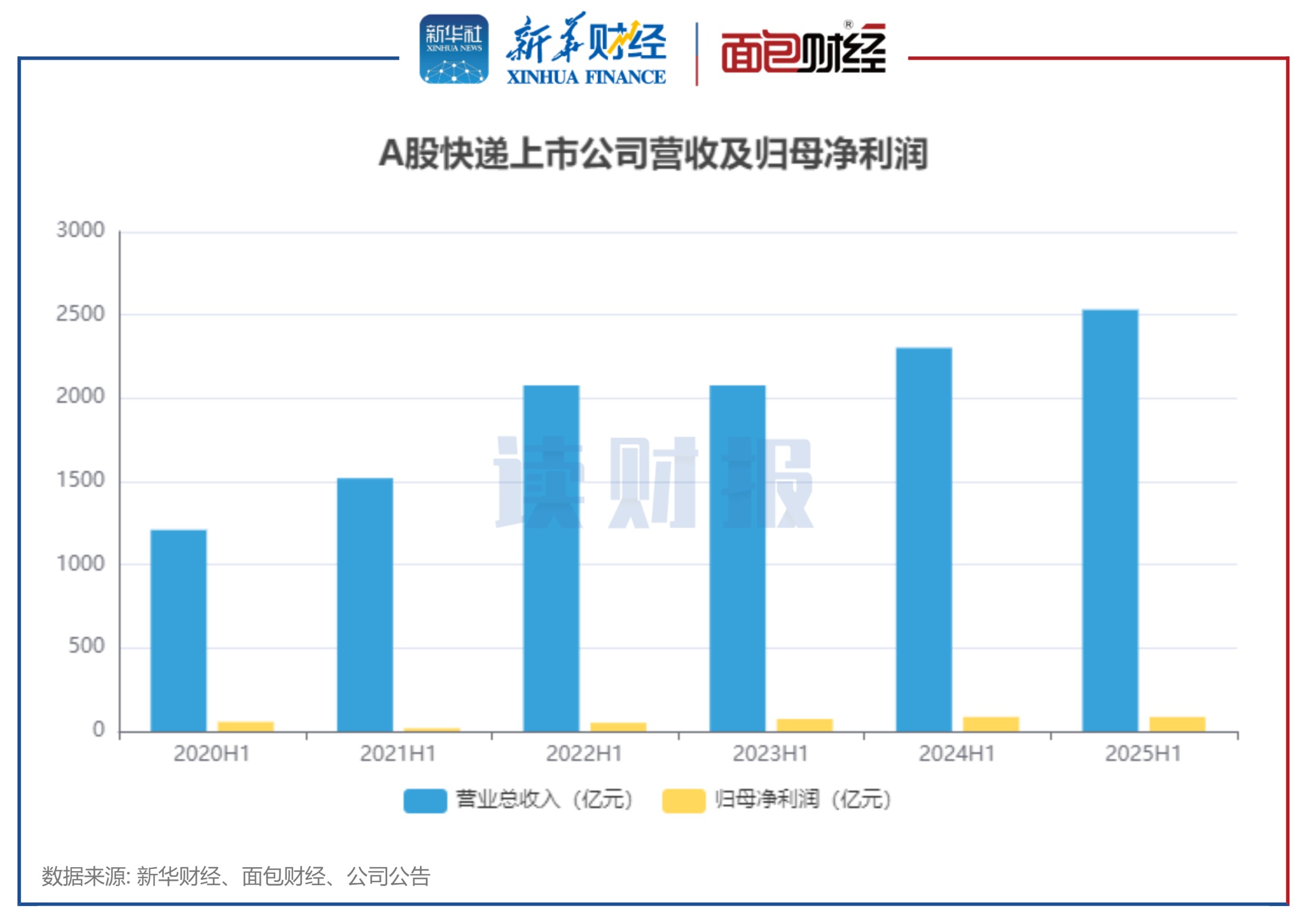
Core Insights - The express delivery sector in A-shares shows a mixed performance in revenue and net profit for the first half of 2025, with total revenue reaching 253.15 billion yuan, a year-on-year increase of 9.95%, while net profit slightly decreased by 0.03% to 8.60 billion yuan [1][2]. Revenue Performance - In H1 2025, SF Express led the revenue rankings with 146.86 billion yuan, followed by YTO Express with 35.88 billion yuan and Shentong Express with 25.03 billion yuan [5][6]. - Shentong Express exhibited the fastest revenue growth at 16.02% year-on-year, while Debon Express and YTO Express grew by 11.43% and 10.19%, respectively [5][12]. Net Profit Analysis - SF Express and YTO Express achieved net profits of 5.74 billion yuan and 1.83 billion yuan, respectively, while the other three companies reported net profits below 600 million yuan, with Debon Express experiencing a significant decline of 84.34% [8][9]. - SF Express and Shentong Express saw net profit increases of 19.37% and 3.73%, while YTO Express, Yunda Express, and Debon Express reported declines [8][9]. Market Trends - The express delivery industry is experiencing a "volume increase, price decrease" trend, with total express business volume reaching 95.64 billion pieces, a 19.3% increase year-on-year, but the average price per piece dropped by 8% to 7.5 yuan [9][12]. - In H1 2025, YTO Express led in business volume with 14.86 billion pieces, followed by Yunda Express and Shentong Express with 12.73 billion and 12.35 billion pieces, respectively [9][11]. Single Ticket Revenue - The single ticket revenue for major companies has shown a downward trend, with SF Express reporting a decline of 12.43% to 13.67 yuan in June compared to January, and YTO Express declining by 10.64% to 2.10 yuan [9][13].



快递进村 门口收件
Si Chuan Ri Bao· 2025-09-11 22:11
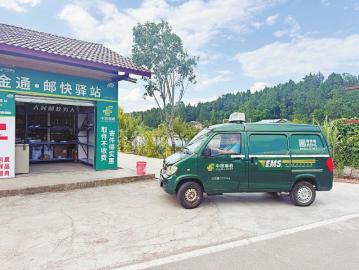
Core Viewpoint - The establishment of village-level logistics service stations by China Post in Nanchong, Sichuan, has significantly improved the delivery of packages to rural areas, facilitating cooperation with private express companies to enhance service efficiency and coverage [3]. Group 1: Logistics Service Stations - China Post has created the first batch of village-level logistics service stations in Nanchong, which has enabled unified delivery of packages from various express companies to rural areas [3]. - The Datan Village logistics service station has delivered nearly 10,000 packages in one year, covering over 10,000 people across three administrative villages and one construction site [3]. - As of August this year, 43 standardized logistics service stations have been established across 26 administrative towns in Yingshan County [3]. Group 2: Collaboration with Express Companies - China Post collaborates with private express companies to address the challenges of delivering packages to remote villages, leveraging its extensive delivery network [3]. - The partnership allows for the separate sorting of packages that are difficult to deliver, with China Post handling the final delivery to rural areas [3]. - The cooperation has led to a significant increase in package volume, with the number of packages received at the service station rising from less than 100 to 879 in one year [3]. Group 3: Cost Efficiency and Revenue Generation - The cost for villagers to receive packages through the service station is lower than traditional storage fees, eliminating the need for additional charges [3]. - The logistics service stations also provide a source of income for local businesses, with the owner of a small shop reporting earnings of 400 to 500 yuan per month from package services [3]. - To alleviate delivery pressure, China Post has coordinated with local passenger transport services to utilize excess capacity for package delivery [3].
指数再创年内新高!电商物流发展活力十足
Xin Hua She· 2025-09-11 09:45
Core Insights - The e-commerce logistics index in China reached a new high of 112.3 points in August, reflecting a 0.3 point increase from the previous month, indicating robust growth in e-commerce consumption and logistics operations [1][2] - The total business volume index for e-commerce logistics also hit a new high at 131.4 points, up by 0.5 points from July, showcasing the increasing demand in the sector [1][2] E-commerce Logistics Performance - The rural e-commerce logistics business volume index rose to 131.7 points in August, marking a 0.2 point increase, demonstrating sustained growth in rural e-commerce consumption [3][4] - The eastern and western regions of China saw their rural e-commerce logistics indices increase by 0.4 and 0.9 points respectively, with most regions exceeding the national average [4] Demand and Supply Dynamics - The e-commerce logistics index has shown a continuous upward trend for six consecutive months, driven by increased consumer demand and a stable supply recovery [4] - In August, the overall e-commerce sales and promotional activities significantly increased compared to July, with seasonal factors such as the back-to-school season and autumn clothing launches contributing to the demand surge [4] - The logistics sector is leveraging advanced technologies like AI, big data, and cloud computing to enhance service quality, resulting in a 0.5 point decrease in cost index for three consecutive months [4] Future Outlook - The upcoming "Golden September and Silver October" consumption peak, along with the back-to-school season, is expected to maintain a steady upward trend in e-commerce logistics demand in September [5]
服贸会供应链及交通运输服务专题展展示智慧交通等成果
Zhong Guo Xin Wen Wang· 2025-09-11 05:55
Core Viewpoint - The 2025 China International Service Trade Fair (CIFTIS) will showcase the latest technologies and achievements in smart public transportation and logistics services under the theme "People Enjoy Their Travel, Goods Flow Smoothly" [1] Group 1: Exhibition Highlights - The supply chain and transportation service exhibition will feature the "Beijing Plan" for urban traffic governance and global supply chain innovation practices, with participation from leading companies such as COSCO Shipping, China Foreign Trade, and others [2] - High-quality and well-structured exhibitors include top 500 companies and industry leaders like SF Express, Meituan, and Beijing Subway, showcasing global first launches in digital transportation and green low-carbon technologies [2] - The debut of "first set" technologies, such as automatic ticketing machines and smart passenger flow control systems, will enhance the exhibition's appeal [2] Group 2: Smart Public Transportation Zone - The smart public transportation zone, featuring companies like Beijing Subway and Beijing Public Transport, focuses on technological innovation and green transformation [3] - Beijing Subway emphasizes "smart operation" and showcases initiatives to enhance service efficiency and passenger experience, transitioning from "efficient transportation" to "quality service" [3] - The Municipal Card Company presents innovations in digital payment and service extension, including the "Linglongtong PLUS" NFC smart transportation card [3] Group 3: Smart Logistics Zone - The smart logistics zone gathers companies like COSCO Shipping, China Post, and SF Express to display cutting-edge technologies such as drones and automated sorting [4] - China Post showcases a comprehensive solution integrating "smart logistics + e-commerce + finance," featuring automated sorting systems and cross-border bonded warehouses [4] - SF Express introduces its self-developed intelligent supply chain system, covering core logistics scenarios with global leading design and implementation capabilities [4] Group 4: Multi-Modal Transport and Innovation - YTO Express leverages a multi-modal transport system to establish the "Oriental Tian Di Port" in Jiaxing as a global air logistics hub [5] - Yunda demonstrates AI assistants and digital management tools to enhance the efficiency of unmanned delivery services [5]
深化“快递进村”“快递进厂”,韵达差异化战略破局内卷
Tai Mei Ti A P P· 2025-09-11 03:19
Core Insights - The express delivery industry is facing a "volume increase and price decrease" dilemma, with a projected 19.3% year-on-year growth in business volume for the first half of 2025, while competitive pricing pressures continue to rise [2] - Yunda's differentiated strategy focuses on "express delivery into villages" and "express delivery into factories," which is seen as a key initiative for supporting national rural revitalization and upgrading the manufacturing supply chain [2][8] Group 1: Express Delivery into Villages - Yunda aims to activate rural economic growth by implementing a "network sinking + customized services" dual approach, facilitating the last mile for consumer goods and the first mile for agricultural products [2] - As of the first half of 2025, Yunda's service network covers all 31 provinces, with over 99.8% coverage in county-level areas, and has added more than 1,300 township outlets [3] - Customized solutions for rural specialty industries include optimized packaging and logistics for local products, such as a cold chain logistics system in Sichuan that significantly extends the shelf life of mushrooms [5] Group 2: Express Delivery into Factories - Yunda is transforming from a mere "transport service provider" to a "supply chain partner" by leveraging technology and focusing on industry-specific needs, thus creating a new ecosystem for manufacturing logistics [6] - The company has established 468 package collection warehouses to enhance efficiency through automation, with significant improvements in daily collection volumes in manufacturing hubs [6][7] - Yunda's tailored services for different industries, such as specialized packaging for fragile items, have led to a reduction in damage rates and improved logistics efficiency [8] Group 3: Future Outlook - Yunda's strategies of "express delivery into villages" and "express delivery into factories" allow it to avoid homogeneous price wars while capitalizing on policy benefits related to rural revitalization and industrial integration [8] - The company plans to strengthen its core competitiveness through the continued operation of package collection and grid warehouses, as well as the implementation of technologies like "Yunda Intelligent Body" and "unmanned delivery" [8]

物流板块9月10日涨0.46%,申通快递领涨,主力资金净流入144.45万元
Zheng Xing Xing Ye Ri Bao· 2025-09-10 08:30
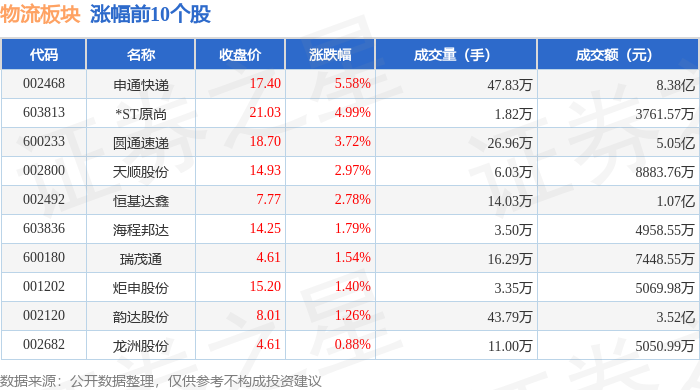
Market Overview - On September 10, the logistics sector rose by 0.46% compared to the previous trading day, with Shentong Express leading the gains [1] - The Shanghai Composite Index closed at 3812.22, up 0.13%, while the Shenzhen Component Index closed at 12557.68, up 0.38% [1] Individual Stock Performance - Shentong Express (002468) closed at 17.40, with a gain of 5.58% and a trading volume of 478,300 shares, amounting to a transaction value of 838 million [1] - Other notable performers included: - ST Yuanshang (603813) at 21.03, up 4.99% [1] - YTO Express (600233) at 18.70, up 3.72% [1] - Tiens Holdings (002800) at 14.93, up 2.97% [1] - Hengkai Daxin (002492) at 7.77, up 2.78% [1] Fund Flow Analysis - The logistics sector saw a net inflow of 1.4445 million in main funds, while retail funds experienced a net outflow of 68.1491 million [2] - Retail investors contributed a net inflow of 66.7047 million [2] Detailed Fund Flow for Key Stocks - Shentong Express had a main fund net inflow of 79.7019 million, with retail funds showing a net outflow of 44.4659 million [3] - YTO Express recorded a main fund net inflow of 46.6307 million, with retail funds experiencing a net outflow of 33.2871 million [3] - Yunda Express (002120) had a main fund net inflow of 31.6127 million, while retail funds saw a net outflow of 28.9086 million [3]
浙商证券:快递提价风起全国 盈利修复空间广阔
智通财经网· 2025-09-10 07:48
Core Viewpoint - The logistics industry is experiencing a price increase trend since July and August, with approximately 80% of the national market share in provinces that have announced price hikes, indicating a potential recovery in performance for franchisees and listed companies [1][3][4]. Group 1: Price Adjustment Trends - Starting from August 4, Guangdong initiated collective price hikes, with the price for a 0.1kg special item rising to over 1.4 yuan per ticket, aiming to stabilize market shares [2]. - By August 11, Zhejiang and Jiangsu began adjusting prices, with increases of 0.3 yuan per ticket in Zhejiang and 0.4 yuan in Jiangsu, contributing to 16.9% and 7.9% of the national express delivery volume respectively [2]. - On August 20, Fujian issued price increase notices, setting a minimum price of 1.5 yuan for packages under 0.3kg, with a total volume of 32.6 billion items in the first half of 2025, accounting for 3.4% of the national total [2]. Group 2: Regional Price Adjustments - By September 4, regions including Beijing-Tianjin-Hebei and Henan began to follow suit with price increases, with Henan raising all outbound express prices by 0.2 yuan per ticket [3]. - The Hebei and Henan provinces are significant players in the express delivery market, contributing 6.0% and 5.7% to the national volume respectively [3]. - Shandong's YTO Express updated its pricing parameters, automatically increasing all outbound express prices by 0.2 yuan, reflecting the importance of price adjustments in the northern e-commerce market [3]. Group 3: Industry Outlook and Performance Recovery - The ongoing price adjustments are seen as a response to cost pressures and a step towards establishing a long-term mechanism against "involution" in the industry [3]. - Based on the price increase trend, the industry is expected to continue raising prices, leading to potential performance recovery for franchisees and listed companies as the peak season in September approaches [4]. - According to estimates, a price increase of 0.1 yuan could lead to an increase in net profit per ticket for listed companies, with varying price elasticity among major players like Zhongtong, YTO, and Shentong [4]. Group 4: Investment Recommendations - In the context of the "anti-involution" policy, despite the overall pressure on the express delivery sector in the first half of 2025, there is optimism for performance recovery in the short term due to price stabilization and improved competitive dynamics [5]. - Companies such as Jitu Express, Shentong Express, YTO Express, and Zhongtong Express are recommended for investment, with expectations of performance recovery driven by price adjustments and market share growth [5].

快递反内卷:反内卷保障良性竞争,监管力度决定持续性
2025-09-09 14:53
Summary of the Express Delivery Industry Conference Call Industry Overview - The express delivery industry has undergone significant changes, transitioning from a "Spring and Autumn" phase (2017-2019) characterized by high growth and light asset models to a "Warring States" phase (2020 onwards) marked by heavy asset investments and price wars [3][10]. Key Points and Arguments - **Revenue Decline Factors**: The decline in single ticket revenue is attributed to three main factors: cost-driven efficiencies, rational competition, and irrational price wars. The past five years have seen revenue declines primarily driven by cost factors such as scale effects and automation upgrades [1][4][20]. - **Impact of New Entrants**: The entry of Jitu in 2020 triggered irrational price wars, leading to a decline in industry performance and valuations, putting pressure on networks and couriers [1][8]. - **Regulatory Actions**: Local governments, such as in Yiwu, have implemented measures to raise minimum delivery prices to curb irrational competition, which has stabilized the network and improved valuations for lower-ranked companies [1][9]. - **Market Recovery**: Following the anti-involution actions in 2021, leading companies regained market share, and single ticket revenue increased, significantly restoring profitability [10][11]. - **Future Price Competition**: The industry is expected to enter another price competition phase in the second half of 2024, with intensified price wars anticipated post-Chinese New Year in 2025 [1][12]. Important but Overlooked Content - **Regulatory Influence**: The effectiveness of the anti-involution measures heavily relies on regulatory strength, which has shown to alleviate competitive pressures in the short term and promote healthy competition in the long term [2][16]. - **Profitability Elasticity**: Future profitability in the express delivery sector will depend on the sustainability of price increases and regulatory actions. Current net profits for major companies are low, indicating a need for effective price adjustments to enhance profitability [17][21]. - **Long-term Implications**: The current anti-involution measures are expected to foster a healthy competitive environment, leading to industry consolidation and the rise of leading companies, ultimately benefiting consumers and investors alike [22]. Conclusion - The express delivery industry is at a critical juncture, with regulatory measures playing a pivotal role in shaping its future. The focus on sustainable pricing and profitability recovery presents significant investment opportunities in the sector, particularly for leading companies poised for growth in a more stable competitive landscape [19][22].

中国快递 “反内卷” 更新-大范围涨价,后续如何-China ExpressAnti-Involution Update #5 - Widespread Price Hikes, What's Next
2025-09-09 02:40
Summary of Key Points from the Conference Call Industry Overview - The conference call focuses on the **China Express** industry, particularly discussing the **"anti-involution"** initiatives and recent price hikes affecting the parcel delivery sector in China [1][2]. Recent Developments - **Price Hikes**: Approximately **70%** of the industry parcel volume has been affected by recent price hikes, with successful implementation expected to sustain and potentially expand coverage [9]. - Price increases in **Guangdong, Zhejiang, and Fujian** regions range from **Rmb0.1 to Rmb0.4** per parcel since August. - Regions including **Hunan, Hubei, Jiangxi, Henan, Hebei, Beijing, and Tianjin** have seen hikes of **Rmb0.2 to Rmb0.4** per parcel since September, with further increases planned in Hubei and Jiangxi effective from October. - Discussions for price hikes are ongoing in **Shandong and Jiangsu** [9]. Market Dynamics - **Market Share Lock-Up Period**: The lock-up period for market share has been extended in several regions, including Guangdong, Zhejiang, and Fujian. Most regions have a lock-up period following price hikes, except for Hunan and Hubei [9]. - The current lock-up period is shorter in regions outside Guangdong, which has a lock-up from **August 5 to September 20**, but may be extended further [9]. Industry Volume Growth - **Volume Growth Deceleration**: Both **ZTO** and **YTO** have reported a deceleration in industry volume growth as of August [5]. Future Catalysts - Potential catalysts for further price hikes include: 1. The trend of industry volume growth post-price hikes, which may influence local regulators' decisions on executing further price increases. 2. Market share dynamics once the lock-up periods conclude [9]. Analyst Insights - Analysts from **Morgan Stanley** are closely monitoring these developments, indicating a cautious but optimistic outlook on the industry dynamics and pricing strategies [6][7]. Important Considerations - The report emphasizes the importance of understanding the regulatory environment and market dynamics that could impact pricing strategies and overall industry performance [7][9]. This summary encapsulates the critical insights and developments discussed in the conference call regarding the China Express industry and its pricing strategies.
广州召开邮政快递业“扫黄打非”线索核查推进会
Guang Zhou Ri Bao· 2025-09-08 01:56
Core Insights - The meeting in Guangzhou focused on the "sweep away pornography and illegal publications" initiative within the postal and express delivery industry, analyzing the current situation and planning future tasks [1] Group 1: Current Situation and Analysis - The Guangzhou Postal Administration reported on the progress of the "sweep away pornography and illegal publications" initiative in the postal and express delivery sector this year [1] - The "sweep away pornography and illegal publications" office summarized the distribution and handling processes of related clues in the postal and express delivery sector [1] - Participants identified issues such as insufficient identification capabilities, lax implementation of regulations, and inadequate customer supervision [1] Group 2: Proposed Measures and Key Focus Areas - The meeting emphasized three key areas for improvement: enhancing the ability to identify illegal publications, strictly enforcing real-name delivery and package inspection systems, and strengthening the review and dynamic supervision of agreement clients [1] - The goal is to establish a robust risk prevention mechanism from the source, solidify responsibilities throughout the delivery process, and effectively close management loopholes [1]