工商银行

Search documents
工行河南省分行以金融“活水”赋能豫企“出海”
Huan Qiu Wang· 2026-02-09 03:02
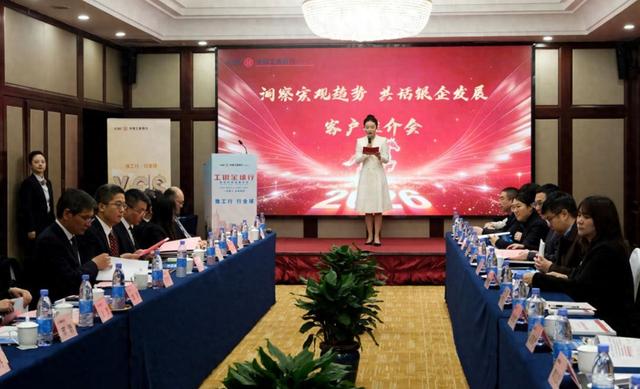
Group 1 - The core viewpoint of the article emphasizes the role of the Industrial and Commercial Bank of China (ICBC) in promoting high-quality foreign trade development and facilitating cross-border financial cooperation for private enterprises in Henan province [1][3]. - ICBC has established branches in 49 countries and regions globally, serving as a RMB clearing bank in 12 countries, thus creating a 24-hour uninterrupted financial service network [3]. - By the end of 2025, ICBC aims to serve nearly 4,000 foreign trade enterprises, process international settlements amounting to 39.1 billion USD, and support financing for foreign trade enterprises totaling 27 billion CNY [3]. Group 2 - The recent promotional event signifies progress in enhancing cooperation between banks and enterprises, with ICBC focusing on optimizing cross-border financial services and translating policy benefits into tangible outcomes for enterprise development [4]. - The event featured discussions on macroeconomic analysis, RMB exchange rate trends, and the application prospects of digital RMB in cross-border trade, providing valuable insights for enterprises facing challenges in international operations [3][4].


金融地产ETF国投瑞银(159933)开盘跌0.66%
Xin Lang Cai Jing· 2026-02-09 01:37
金融地产ETF国投瑞银(159933)业绩比较基准为沪深300金融地产指数,管理人为国投瑞银基金管理 有限公司,基金经理为赵建、钱瀚,成立(2013-09-17)以来回报为201.43%,近一个月回报 为-6.36%。 2月9日,金融地产ETF国投瑞银(159933)开盘跌0.66%,报2.989元。金融地产ETF国投瑞银 (159933)重仓股方面,中国平安开盘涨0.82%,招商银行涨0.00%,兴业银行涨0.00%,东方财富涨 0.66%,中信证券涨0.50%,工商银行跌0.14%,国泰海通涨1.00%,农业银行跌0.60%,交通银行跌 0.15%,浦发银行跌0.10%。 来源:新浪基金∞工作室 声明:市场有风险,投资需谨慎。本文基于第三方数据库自动发布,不代表新浪财经观点,任何在本文 出现的信息均只作为参考,不构成个人投资建议。如有出入请以实际公告为准。如有疑问,请联系 biz@staff.sina.com.cn。 ...
银行业对外开放新格局: 支持中国企业全球布局的金融力量
Jin Rong Shi Bao· 2026-02-09 01:28
Core Viewpoint - The Central Financial Work Conference emphasizes the importance of advancing high-level financial openness in China, aiming to enhance the competitiveness and influence of the Shanghai International Financial Center while better serving the real economy [1]. Group 1: Institutional Opening - Institutional opening is the core of high-level financial openness, focusing on aligning domestic financial regulations and market rules with international best practices to create a stable and transparent business environment [2]. - The recent upgrade of the free trade account system in the Shanghai Free Trade Zone is seen as a significant step towards high-level financial openness, allowing pilot enterprises to conduct more flexible cross-border payments [2]. - The achievements of institutional opening are reflected in the enhanced service capabilities and international competitiveness of Chinese banks, enabling them to provide tangible cross-border financial conveniences to enterprises [2]. Group 2: Cross-Border Service Capabilities - Chinese banks' global service networks and comprehensive capabilities are key indicators of the effectiveness of institutional opening, providing one-stop services for enterprises to connect with international capital markets [3]. - The steady rise of the renminbi's international status injects core momentum into the opening system, as it has become the primary settlement currency for China's external payments and ranks among the top three trade financing and payment currencies globally [3]. Group 3: Financial Infrastructure for Global Operations - The banking sector is transitioning from traditional settlement and financing services to becoming comprehensive service partners that cover the entire cycle of investment, financing, risk management, and treasury management for enterprises going global [6]. - A notable case is the successful syndicate loan of 3.78 billion yuan provided by the Bank of China for Zijin Mining's acquisition of a gold mine in Ghana, showcasing how banks can support enterprises in managing cross-border transaction risks [6]. Group 4: Risk Management and Compliance - The Chinese financial regulatory authorities are pushing for a transformation in anti-money laundering efforts from mere compliance to proactive risk prevention, requiring banks to enhance their risk management capabilities [13]. - The establishment of a global risk monitoring and early warning system is essential for banks to manage various risks, including country and geopolitical risks, as they expand their international operations [17]. Group 5: Future Outlook - The future of China's banking sector will focus on deepening institutional opening and actively participating in international financial governance, with an emphasis on aligning with high-standard international rules [19]. - Banks are encouraged to transform from passive fund providers to active industry collaborators, embedding cross-border financial services into the global supply chains of emerging industries [20]. - Building a diverse, transparent, and risk-controlled open financial ecosystem is crucial for enhancing the international competitiveness of Chinese banks and supporting the implementation of national strategies [22].

震荡市显韧性,黄金增强策略理财产品近3月收益仍领先
2 1 Shi Ji Jing Ji Bao Dao· 2026-02-09 01:15
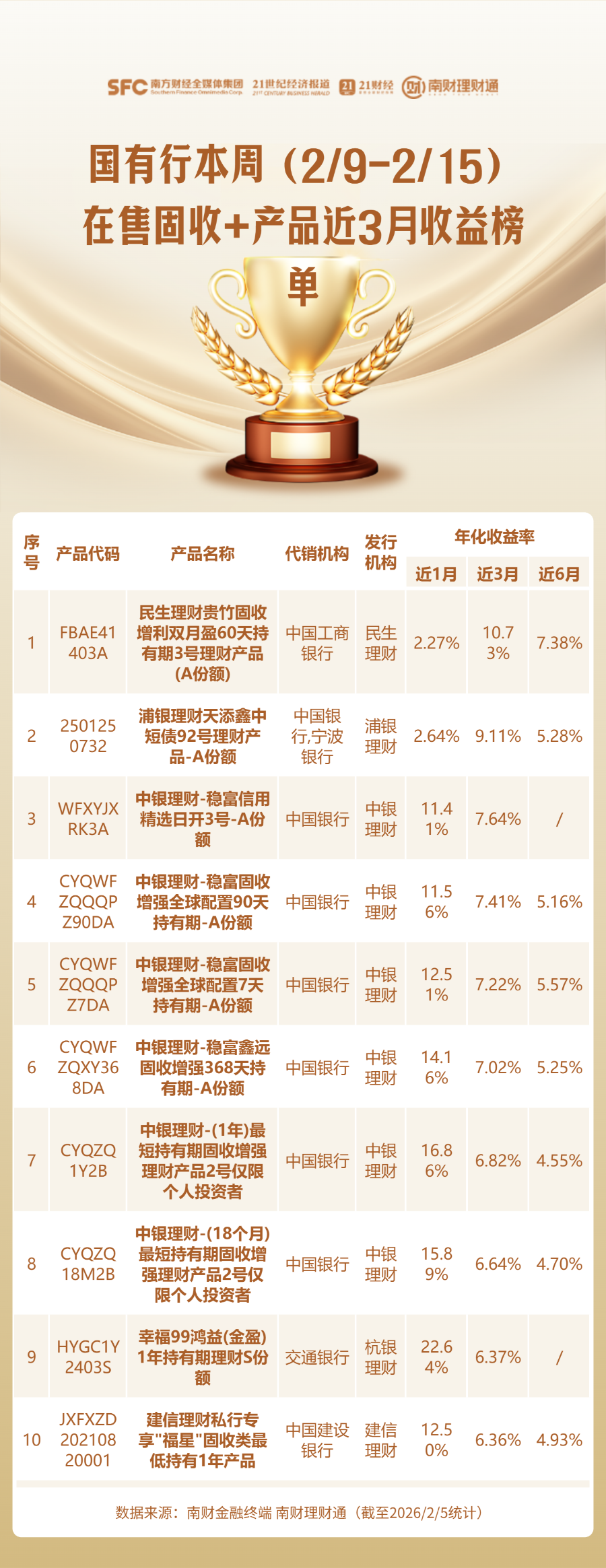
Core Insights - The report focuses on fixed income + products issued by wealth management companies, highlighting superior performing products available for investors through distribution channels [1] - A ranking of products is provided based on their annualized performance over the last month, three months, and six months, with a particular emphasis on the three-month annualized yield to reflect their performance amid recent market fluctuations [1] Distribution Channels - The report includes a list of 28 distribution institutions, which consist of major banks such as Industrial and Commercial Bank of China, Bank of China, Agricultural Bank of China, and others [1] Product Performance - The ranking showcases various products with their respective annualized yields, indicating the performance metrics over different time frames, such as 2.64% for one month and 9.11% for three months for a specific product [5] - The data is sourced from the South Finance Financial Terminal, with statistics as of February 5, 2026, providing a snapshot of the current market offerings [5][10]




收益率碾压现金产品!这份“闲钱理财”榜单透露了哪些机会?
2 1 Shi Ji Jing Ji Bao Dao· 2026-02-09 01:15
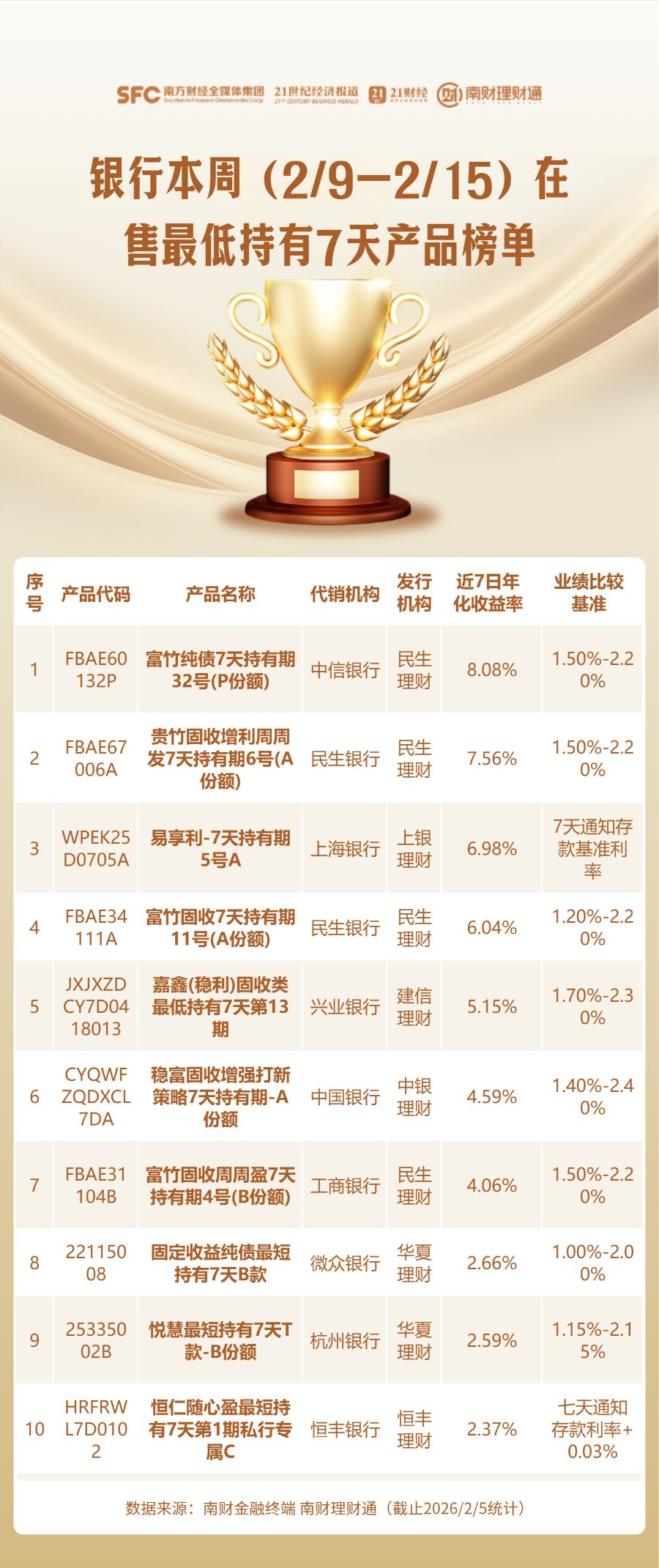
Core Insights - The article focuses on the performance of minimum holding period RMB public offering products, ranking them based on annualized returns for holding periods of 7, 14, 30, and 60 days [1] Group 1: 7-Day Holding Period Products - The top-performing product is from Minsheng Bank with an annualized return of 7.56% [5] - Other notable products include a 6.98% return from Shanghai Bank and a 6.04% return from Minsheng Bank [5] Group 2: 14-Day Holding Period Products - The leading product is from Minsheng Bank with a return of 7.39% [8] - China Bank follows with a return of 4.44% [8] Group 3: 30-Day Holding Period Products - The highest return is 18.14% from Hangzhou Bank [12] - Other significant returns include 12.34% from Minsheng Bank and 9.72% from Minsheng Bank [12][13] Group 4: 60-Day Holding Period Products - The top product is from China Bank with a return of 9.33% [15] - Other products include 5.95% from Shanghai Bank and 5.54% from Huaxia Bank [15][16]
跨境流动性跟踪20260208:贸易回流比率再度回正,服务逆差大幅收窄
GF SECURITIES· 2026-02-09 01:11
Investment Rating - The industry rating is "Buy" [4] Core Views - The trade return ratio has turned positive again, and the service trade deficit has significantly narrowed [16][18] - The cross-border capital flow is expected to gradually return, positively impacting domestic liquidity [5][19] - The service trade deficit for December 2025 was 966 billion CNY, a year-on-year decrease of 466 billion CNY, with a full-year deficit of 13,760 billion CNY, down 2,544 billion CNY, approximately 16% [18] Summary by Sections 1. Current Observation - The State Administration of Foreign Exchange (SAFE) released data on China's international balance of payments for December 2025, indicating a potential impact on the central bank's willingness to settle foreign exchange [16] - The trade return ratio is at a historical high, with a monthly unconverted trade net outflow of 447 billion CNY, a year-on-year increase of 1,392 billion CNY [17] 2. Arbitrage Trading Returns - The arbitrage trading return rate for 10Y US Treasury bonds in CNY has dropped significantly to -1.77%, indicating a shift in cross-border capital dynamics [17] 3. Service Trade Deficit - The service trade deficit has narrowed significantly, with major contributions from improved policies for foreign visitors, reduced international shipping costs, and enhanced competitiveness in high-tech services [18] 4. Cross-Border Liquidity Outlook - Despite the recent appointment of Kevin Warsh as the next Federal Reserve Chair, the trend of cross-border capital return is expected to continue, influenced by the Fed's monetary policy stance [19][21] - The short-term liquidity in the US remains tight, with limited space for balance sheet reduction, while long-term prospects depend on economic performance [20][21]

智通港股通持股解析|2月9日
智通财经网· 2026-02-09 00:31
Group 1 - The top three companies by Hong Kong Stock Connect holding ratio are China Telecom (00728) at 71.46%, Green Power Environmental (01330) at 68.82%, and Haotian International Construction Investment (01341) at 68.17% [1] - The latest holding ratio rankings for the top 20 companies show significant ownership levels, with China Telecom leading at 99.18 billion shares [1] - The recent five trading days saw Tencent Holdings (00700) increase its holding by 51.95 billion, Southbound Hang Seng Technology (03033) by 17.79 billion, and Xiaomi Group-W (01810) by 15.84 billion [1] Group 2 - The top three companies with the largest decrease in holdings over the last five trading days are Yingfu Fund (02800) with a decrease of 35.48 billion, SMIC (00981) with a decrease of 23.60 billion, and Zhaojin Mining Industry (01818) with a decrease of 6.58 billion [3] - Other notable companies in the reduction list include Huahong Semiconductor (01347) with a decrease of 6.56 billion and CSPC Pharmaceutical Group (01093) with a decrease of 5.59 billion [3] - The data reflects significant trading activity and shifts in investor sentiment within the Hong Kong stock market [2]



中小银行改革提质加速462家退出市场 差异化整合路径构建多层次金融格局
Chang Jiang Shang Bao· 2026-02-08 23:38
Group 1: Core Insights - 2025 is a pivotal year for the reform of small and medium-sized banks in China, marked by structural adjustments such as the reform of provincial rural credit cooperatives and the integration of village banks, indicating a shift from scale expansion to quality and efficiency improvement [1][2] - A total of 462 banks are expected to exit the market in 2025, with village banks accounting for 291 of these, representing approximately 63% of the total [4][5] - The establishment of new provincial rural commercial banks or joint banks is set to reach 7 by the end of 2025, with 13 provinces already completing the reform of provincial rural credit cooperatives [2][3] Group 2: Provincial Reforms - The Xinjiang Rural Commercial Bank, with an asset scale of 760 billion yuan, marks a significant breakthrough in the reform of provincial rural credit cooperatives, becoming the first unified legal entity rural commercial bank in the northwest region [2][3] - The reform has led to two main models: the unified legal entity rural commercial bank model and the provincial rural commercial joint bank model, with the former being more comprehensive in its reform [2][3] Group 3: Village Bank Integration - The "village to branch" model has become the mainstream path for the integration of village banks, allowing for comprehensive management, risk control, and business integration [5][6] - State-owned banks have played a significant role in the integration process, with major acquisitions and transformations of village banks into branches, enhancing governance structures and service methods while maintaining their focus on supporting agriculture and small enterprises [4][6]


中国黄金,宣布调整
Sou Hu Cai Jing· 2026-02-08 23:21
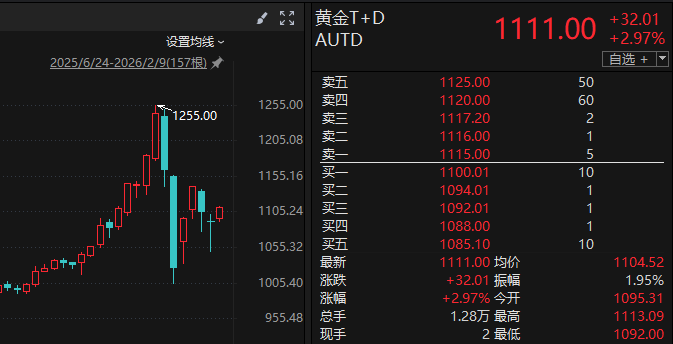
Core Viewpoint - The recent volatility in precious metal prices has prompted China Gold to adjust its gold repurchase business rules to enhance risk management and operational efficiency in response to market uncertainties [1][3]. Group 1: Market Conditions - Precious metal prices have shown significant fluctuations, with gold T+D prices recently at 1111 RMB per gram, up by 32.01 RMB (2.97%) from the previous trading day, but down 11.47% from a recent high of 1255 RMB per gram [2]. - The Shanghai gold futures market also reflects this volatility, with the latest price at 1114.5 RMB per gram, down 11.46% from a recent peak of 1258.72 RMB per gram [2]. Group 2: Business Adjustments - China Gold's adjustment to its repurchase rules includes limiting transactions to trading days to align with market pricing mechanisms, thereby avoiding pricing disputes and operational risks [1][3]. - The company aims to control its risk exposure during periods of price volatility, as acquiring physical gold without market price references could lead to significant losses [1][3]. - The new rules will implement limit management on repurchase transactions starting February 7, 2026, including daily repurchase limits and appointment systems, with adjustments based on market conditions [3]. Group 3: Industry Insights - Experts suggest that the adjustment is a necessary measure to stabilize the market and protect investor interests amid increasing price volatility and a lack of risk awareness among investors [3]. - Other major gold retailers are also adjusting their repurchase policies, indicating a broader industry trend towards enhanced risk management practices [7]. - The current trading sentiment in the precious metals market has shifted from risk aversion to speculation, exacerbating trading risks, particularly as stock market optimism grows [7].

金价真的一夜变天!2月7日最新报价,全国价差最高差430元克?
Sou Hu Cai Jing· 2026-02-08 23:04
Core Viewpoint - The significant price disparity in the gold market, with differences reaching up to 430 yuan per gram, raises questions about the true value of gold purchases and whether they represent an investment or merely an expensive consumer experience [3][4]. Market Dynamics - On February 7, the Shanghai Gold Exchange's gold T+D contract closed at approximately 1111 yuan per gram, reflecting a nearly 3% increase, while international gold prices surged to 4962 USD per ounce, indicating substantial market volatility [6]. - The basic gold price serves as an initial anchor point, but the actual prices consumers encounter in retail settings differ significantly due to various factors [8]. Pricing Structures - Investment gold bars sold by banks, such as those from China Construction Bank and Industrial and Commercial Bank, were priced around 1079.60 yuan and 1106.64 yuan per gram, respectively, showing a price difference of nearly 30 yuan between banks [9]. - Retail prices at high-end jewelry stores like Chow Tai Fook and Lao Feng Xiang reached as high as 1508 yuan per gram, which is over 420 yuan more than the bank prices, primarily reflecting brand premiums and additional costs [11][15]. Brand and Channel Costs - The additional costs in brand jewelry stores include brand premiums, high channel costs, and luxurious shopping experiences, which contribute to the overall price of gold jewelry [13][14]. - The Shenzhen Shui Bei wholesale market offers a more economical alternative, with prices around 1247 yuan per gram plus minimal processing fees, resulting in total costs that remain significantly lower than those at branded stores [14][15]. Recovery and Realization - Regardless of the purchase price, when consumers attempt to sell their gold, it is valued based on the raw gold price, typically around 1070 yuan per gram, negating any brand or craftsmanship premiums [15].