沪金主连

Search documents
每日商品期市纵览-20260324
Dong Ya Qi Huo· 2026-03-24 10:42
1. Report Industry Investment Rating No relevant content provided. 2. Core Views of the Report - The overall market is affected by geopolitical situations, Fed policies, and supply - demand fundamentals. Different sectors show various trends, with some in short - term adjustment, some in long - term upward potential, and others in high - level volatility or decline. [1][2][3] 3. Summary by Categories Financial Futures - **Stock Index**: There may be a technical rebound due to the easing signal of the Middle - East situation, but the sustainability is weak. In the medium - to - long - term, there is no trend turning point, and it is mainly in short - term adjustment. [2] - **Treasury Bonds**: The funds are stable, and purchases by banks and insurance institutions provide support. Yields rise, and after the rise, there is value for layout. It shows a short - term rebound following the fluctuation of risky assets. [2] Shipping (Container Shipping to Europe) - The SCFIS European line index continues to rise due to the game between geopolitical sentiment and off - season fundamentals. The market is in high - level wide - range oscillation, with near - month contracts affected by news and far - month contracts pricing long - term conflict expectations. [3] Non - ferrous Metals - **Platinum and Palladium**: The Fed's delayed rate - cut rhythm and Middle - East easing expectations put pressure on prices. Weak - dollar logic and South African supply disturbances support prices. It is in short - term weak - side oscillation and has medium - to - long - term upward potential. [4] - **Gold and Silver**: Trump's easing remarks cause a V - shaped reversal. Geopolitical conflicts and interest - rate hike expectations are the core trading logics. It lacks short - term upward drivers and maintains low - level oscillation. [5] - **Copper**: The expectation of US - Iran easing drives a rebound. Domestic social inventory decreases significantly, and downstream purchasing supports prices. The probability of a sharp rise is small, and attention should be paid to volume - price matching and upper pressure levels. [5] - **Aluminum**: The cooling of the Fed's rate - cut expectation and lack of new Middle - East production - cut news lead to weak - side oscillation. Supply shortages may cause price increases, and overseas fundamentals provide some resistance to decline. [6] - **Alumina**: Domestic production capacity decreases, and the oversupply situation narrows. Overseas, geopolitical impacts and rising shipping costs bring a balance between cost support and supply pressure, with prices in oscillation. [6] - **Cast Aluminum Alloy**: It follows the trend of Shanghai Aluminum, and has strong lower - side support due to raw material shortages and tax - refund policies. [7] - **Zinc**: Supply - side pressure is released, and demand is delayed with high inventory. Zinc prices face upward pressure and remain weak. [8] - **Nickel and Stainless Steel**: The Fed's hawkish stance and US - Iran conflicts suppress prices. Uncertainty in sulfur supply and slow quota approval in Indonesia affect the industry. Stainless - steel price decline is limited, and demand release rhythm needs attention. [8] - **Tin**: Supply has a buffer, and demand starts to resume. Inventory is high, but the spot market shows warming. It is in weak - side oscillation with no obvious bullish turning point. [9] - **Lithium Carbonate**: Supply is loose, and demand is mainly for rigid needs. The market is jointly led by supply - demand fundamentals and capital sentiment, with prices in oscillation. [9] - **Industrial Silicon and Polysilicon**: The industry is in a supply - demand double - weak situation. Global energy transformation is an irreversible trend, and it is at the bottom of the production - capacity cycle. [10][11] - **Lead**: Supply - side pressure is obvious, and demand recovers slowly. Lead prices are expected to oscillate and gradually stop falling. [11] Black Metals - **Rebar and Hot - Rolled Coil**: Rising oil prices drive up coking coal, and tight iron - ore inventory and rising freight provide cost support. High inventory and high warehouse receipts limit the upward space, and the short - term rebound height is limited. [12] - **Iron Ore**: The market is a mix of long and short factors. It shows a "near - strong, far - weak" feature, with prices supported by cost and tight spot supply but suppressed by medium - to - long - term demand and supply increase expectations. [13] - **Coking Coal and Coke**: The rise is driven by expectations, but the fundamentals are insufficient. Domestic production increases, and inventory is close to the same - period level. The price increase may trigger delivery risks. [14] - **Ferrosilicon and Ferromanganese**: Manganese - ore prices are firm, and the lower - side cost support for ferroalloys is gradually strengthening. Attention should be paid to the impact of hurricanes on mining areas. [14] Energy and Chemicals - **Crude Oil**: Trump's easing signal causes a sharp drop in oil prices, but the conflict may still escalate. Geopolitical progress is the only core driver, and short - term volatility increases. [15] - **Fuel Oil**: Low - sulfur fuel oil is dragged by weak downstream demand, and high - sulfur fuel oil is slightly supported. The market's strength eases, and the price decline space is limited. [15] - **Asphalt**: Geopolitical disturbances lead to short - term price increases in crude oil, which is the core factor overriding asphalt's own fundamentals. [16][17] - **Pure Benzene - Styrene**: Fluctuations in crude oil due to US - Iran news cause large - scale adjustments in chemicals. Short - term oscillation is on the strong side, and attention should be paid to the duration of the Strait closure and supply reduction. [17] - **LPG**: Futures prices rise due to capital, showing an internal - strong, external - weak and futures - strong, spot - weak pattern. It is expected to return to fundamentals and oscillate at a high level, with a risk of回调. [18] - **Methanol**: Geopolitical games are the core logic. Supply - interruption concerns push up prices. The pricing logic changes, and port inventory decreases. The inter - month spread follows the US - Iran situation. [18] - **PP and Propylene**: Supply - side refinery maintenance and open export windows support the supply - demand situation. Geopolitical easing will reduce risk premiums, but supply reduction provides support. [19] - **Plastic**: Middle - East conflicts lead to supply reduction. Downstream resistance to high prices and demand feedback are obvious. The price has toughness, and short - term volatility increases. [20] - **Rubber**: Geopolitical news causes large fluctuations in synthetic rubber and small fluctuations in natural rubber. Cost support is strengthened, and inventory is reduced. Medium - to - long - term supply - demand supports valuation. [20] - **Soda Ash**: Supply pressure is high, and demand is stable but weak. Inventory is better than expected. The price increase space is limited, and the downward space depends on inventory accumulation. [21] - **Glass**: Cold - repair expectations continue, and medium - level inventory is a risk. Supply return expectations and high inventory limit the price increase, and demand needs verification. [22] - **Caustic Soda**: Supply pressure eases due to domestic and overseas device disturbances. Demand improves, but inventory is relatively high. Futures prices oscillate. [23][24] Agricultural Products - **Hogs**: The supply - demand situation is loose, with high supply and weak demand. Futures prices are under pressure and lack upward drivers. [25] - **Oilseeds**: The delay of Sino - US negotiations and short - term supply factors affect the market. The medium - term large - supply logic remains unchanged, and the price difference between soybean and rapeseed meal is being repaired. [25] - **Oils**: Crude - oil price changes are the main factor affecting the oil market. Attention should be paid to the progress of bio - fuel policies in Indonesia and the US. [26] - **Cotton**: Geopolitical conflicts and increased supply lead to a decline in Zhengzhou cotton, but low downstream inventory and good consumption provide support. Attention should be paid to US cotton exports. [26] - **Sugar**: The expected reduction in Brazilian sugar production and geopolitical tensions affect the market. The supply - demand situation is stable, and prices oscillate. [27] - **Eggs**: Supply shortages in some areas and cost support lead to a rebound in futures prices. The supply - demand situation remains unchanged, and the upward space is limited. [27] - **Red Dates**: The market focus is on demand, and downstream sales are weak. Prices are under pressure and may oscillate at a low level. [27]
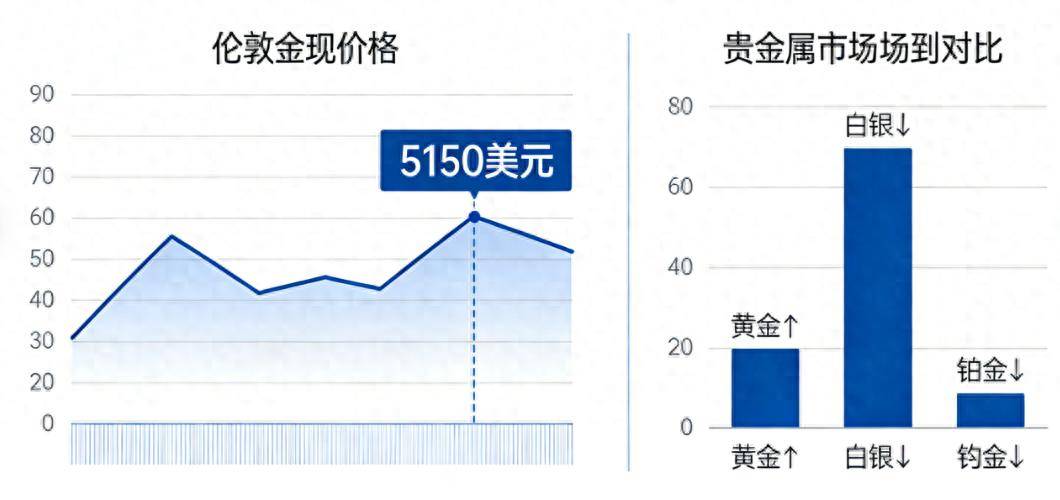
高位震荡!2月23日伦敦金现站稳5150美元,贵金属市场涨跌互现
Sou Hu Cai Jing· 2026-02-23 13:07
Group 1 - The global precious metals market is experiencing high volatility with gold prices stabilizing above $5,150 per ounce and silver showing slight corrections, influenced by Federal Reserve policy signals and geopolitical risks [1][3] - As of February 23, gold was reported at $5,152.02 per ounce, down $12.61, with a daily high of $5,164.63, while silver was at $86.797 per ounce, down $0.196, with a peak increase of 2.22% during the day [3] - The domestic physical gold market shows a clear divergence, with major retailers like Chow Tai Fook and Chow Sang Sang maintaining gold prices at 1,560.0 CNY per gram, while other retailers like Chow Sang Sang and King Fook experienced price declines [4] Group 2 - The futures market is underperforming compared to the spot market, with significant declines in futures prices attributed to strong signals from the Federal Reserve indicating no interest rate cuts in the short term, leading to profit-taking in precious metal futures [3][5] - The price of gold T+D in the domestic market was reported at 1,108.5 CNY per gram, down 16.55 CNY, while silver T+D was at 19,270 CNY per kilogram, down 649 CNY, reflecting a downward trend [3] - Experts indicate that the core logic behind the high volatility in the precious metals market is the interplay between risk aversion and Federal Reserve policies [5]

STARTRADER外汇:美联储降息预期升温 金银价格同步走高
Sou Hu Cai Jing· 2026-02-14 05:38
Group 1 - The core viewpoint of the articles is that the significant drop in U.S. inflation, as indicated by the January CPI data, has led to heightened expectations for a Federal Reserve interest rate cut, which in turn has positively impacted the global precious metals market [1][3]. - The January CPI data showed a year-on-year increase of 2.4%, lower than the market expectation of 2.5%, marking a decrease of 0.3 percentage points from December 2025's 2.7%, and the lowest inflation rate in recent times [3]. - Following the CPI release, the probability of a Federal Reserve rate cut in June surged from 49.9% to 83%, with the expected rate cut for the year adjusted to approximately 63 basis points, equivalent to 2.5 standard cuts [3]. Group 2 - The rise in gold and silver prices is logically linked to the increased expectations of a rate cut, as lower interest rates reduce the opportunity cost of holding non-yielding assets like gold and silver [4]. - As of February 14, gold was priced at $5040.56 per ounce, up $121.6 (2.47%), while silver was at $77.146 per ounce, up $2.01 (2.68%), reflecting a significant increase in both markets [4]. - The domestic gold and silver markets showed a correlated trend, with some variations in performance; while certain products experienced slight pullbacks, others maintained high prices, indicating a balanced market response to the rate cut expectations [4]. Group 3 - The precious metals market has experienced increased volatility, with instances of sharp price fluctuations, highlighting the market's sensitivity to Federal Reserve policy signals [5]. - Various institutions have differing forecasts for gold and silver prices; some remain bullish, anticipating further price increases post-rate cut, while others caution against potential corrections due to interest rate reversals and profit-taking [5]. - Additional factors influencing gold and silver prices include central banks' continuous accumulation of gold over the past 15 months and rising industrial demand for silver, particularly in the photovoltaic sector, which is contributing to a widening supply-demand gap [5].

2026开年开门红藏隐忧?美联储博弈+存款搬家,6类核心资产走向已定
Sou Hu Cai Jing· 2026-02-10 02:24
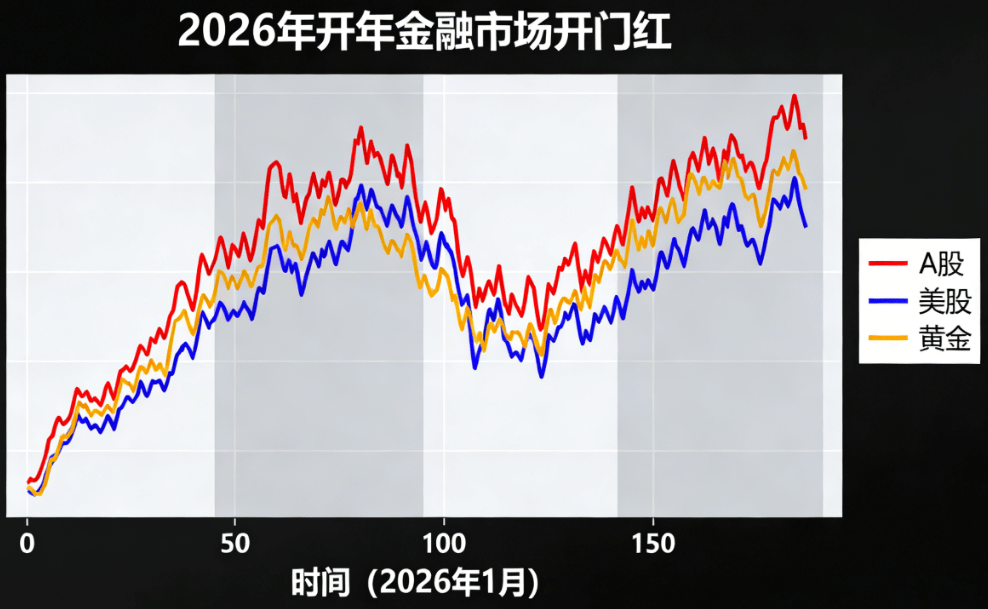
Group 1 - The global financial market has started 2026 with a strong performance, with A-shares rising over 3% and the Dow Jones Industrial Average reaching a high of 49,000 points [1][3] - Gold prices have surged, with London gold reaching $5,042.11 per ounce and domestic gold prices exceeding 1,500 yuan per gram, reflecting both safe-haven and value appreciation attributes [1][3] - The "deposit migration" trend in China is driving liquidity, with approximately 75 trillion yuan of household time deposits maturing in 2026, significantly higher than market expectations [3][4] Group 2 - The ongoing conflict between Trump and the Federal Reserve raises concerns about the independence of monetary policy, with a criminal investigation into Fed Chair Powell adding to market uncertainty [4][6] - The rise of "shadow banking" is amplifying liquidity risks in the global market, as funds flow into this sector seeking higher returns amid traditional bank credit contraction [6][9] - The outlook for six core assets is influenced by three main variables: uncertainty in Federal Reserve policy, risks from shadow banking, and the structured nature of deposit migration [9][10] Group 3 - Gold is expected to maintain a long-term bullish trend, driven by a shift in the pricing anchor from interest-bearing assets to physical currency, despite short-term price volatility [9] - The U.S. dollar is anticipated to exhibit a "weak trend with high volatility" due to uncertainties surrounding Federal Reserve policy and the conflict between the White House and the Fed [9] - The domestic bond market is likely to benefit from low-risk fund inflows due to deposit migration, while the U.S. bond market faces increased yield volatility amid Fed policy uncertainties [9]
中国黄金,宣布调整
Sou Hu Cai Jing· 2026-02-08 23:21
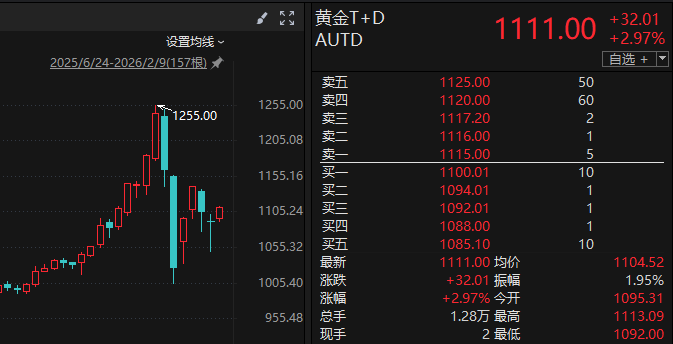
Core Viewpoint - The recent volatility in precious metal prices has prompted China Gold to adjust its gold repurchase business rules to enhance risk management and operational efficiency in response to market uncertainties [1][3]. Group 1: Market Conditions - Precious metal prices have shown significant fluctuations, with gold T+D prices recently at 1111 RMB per gram, up by 32.01 RMB (2.97%) from the previous trading day, but down 11.47% from a recent high of 1255 RMB per gram [2]. - The Shanghai gold futures market also reflects this volatility, with the latest price at 1114.5 RMB per gram, down 11.46% from a recent peak of 1258.72 RMB per gram [2]. Group 2: Business Adjustments - China Gold's adjustment to its repurchase rules includes limiting transactions to trading days to align with market pricing mechanisms, thereby avoiding pricing disputes and operational risks [1][3]. - The company aims to control its risk exposure during periods of price volatility, as acquiring physical gold without market price references could lead to significant losses [1][3]. - The new rules will implement limit management on repurchase transactions starting February 7, 2026, including daily repurchase limits and appointment systems, with adjustments based on market conditions [3]. Group 3: Industry Insights - Experts suggest that the adjustment is a necessary measure to stabilize the market and protect investor interests amid increasing price volatility and a lack of risk awareness among investors [3]. - Other major gold retailers are also adjusting their repurchase policies, indicating a broader industry trend towards enhanced risk management practices [7]. - The current trading sentiment in the precious metals market has shifted from risk aversion to speculation, exacerbating trading risks, particularly as stock market optimism grows [7].

黄金,恐慌性抛盘;沪银逼近跌停,多空大战开启!
Sou Hu Cai Jing· 2026-02-02 02:08
Core Viewpoint - The recent irrational surge in gold and silver prices has led to a significant market correction, which is seen as a necessary cleansing of speculative funds and a cooling of the overheated market [1][3]. Group 1: Market Analysis - The market is expected to experience volatility with both bullish and bearish movements throughout early February, indicating a back-and-forth trading environment [3]. - The recent sharp decline in gold and silver prices is viewed as a buying opportunity for low-leverage or non-leverage products, with specific price levels provided for reference [3][5]. - Key support and resistance levels for international gold are identified, with short-term support at $4700 and resistance at $4880-90, while for silver, support is at $74-75 and resistance at $88-90 [5]. Group 2: Investor Behavior - Various types of investors are highlighted, including those who trade frequently without understanding market dynamics, those who wait too long to enter the market, and those who trade against the trend, all of whom face significant risks [8][10][13]. - The importance of timely profit-taking is emphasized, as many investors fail to secure gains during bullish trends, leading to losses when the market reverses [13][16]. - The company has consistently advised investors to adopt a bullish stance on gold and silver, but has recently shifted to caution due to heightened risks, recommending profit-taking on long positions [16].

国内期货21日收盘多数上涨,碳酸锂主连上涨7.26%
Jin Rong Jie· 2026-01-21 08:30
Group 1 - The domestic futures market closed mostly higher on January 21, with lithium carbonate futures leading the gains, rising by 7.26% [1] - Other notable gainers included tin futures up 5.79%, gold futures up 3.69%, and butadiene rubber futures up 3.43% [2] - The trading volume for lithium carbonate futures reached 1.958 billion yuan, while tin futures had a trading volume of 1.3374 billion yuan [2] Group 2 - The leading decliners included glass futures, which fell by 2.35%, followed by caustic soda futures down 2.02% and coking coal futures down 1.83% [1] - The trading volume for glass futures was 949.3 million yuan, while caustic soda futures had a trading volume of 471.1 million yuan [2] - Other declining commodities included polysilicon futures down 1.59% and white sugar futures down 1.38% [2]
炒期货绕不开新浪财经?老司机揭秘3个碾压级优势
Xin Lang Cai Jing· 2025-12-11 09:42
Core Viewpoint - The article highlights the advantages of using Sina Finance's app for gold trading, emphasizing its integration of various market data and real-time insights, which enhances trading efficiency and decision-making. Group 1: Market Data Integration - The app consolidates data for London gold, New York COMEX gold, Shanghai gold futures, and gold ETFs on a single page, with a data delay of under 10 seconds, making it three times faster than bank apps [1][3] - It provides automatic alerts for key indicators like the US dollar index and US Treasury yields, helping users avoid potential market downturns [1][3] Group 2: Insightful Information Delivery - The app delivers timely insights, such as non-farm payroll data, with actionable advice on market support levels, enhancing trading strategies [2][4] - It summarizes extensive reports into concise, actionable points, saving users time and improving their understanding of market trends [2][4] Group 3: Comprehensive Service Offering - The app facilitates a seamless experience for both financial and physical gold transactions, allowing users to open accounts and trade without switching platforms [5] - It provides real-time pricing for retail gold and compares buyback offers across 32 cities, ensuring users get the best deals [5] - The app's features cater to both short-term traders and long-term investors, making it a versatile tool for gold trading [5]

现货黄金逼近4000美元,有品牌金饰价格4天跌近50元
Sou Hu Cai Jing· 2025-11-18 08:03
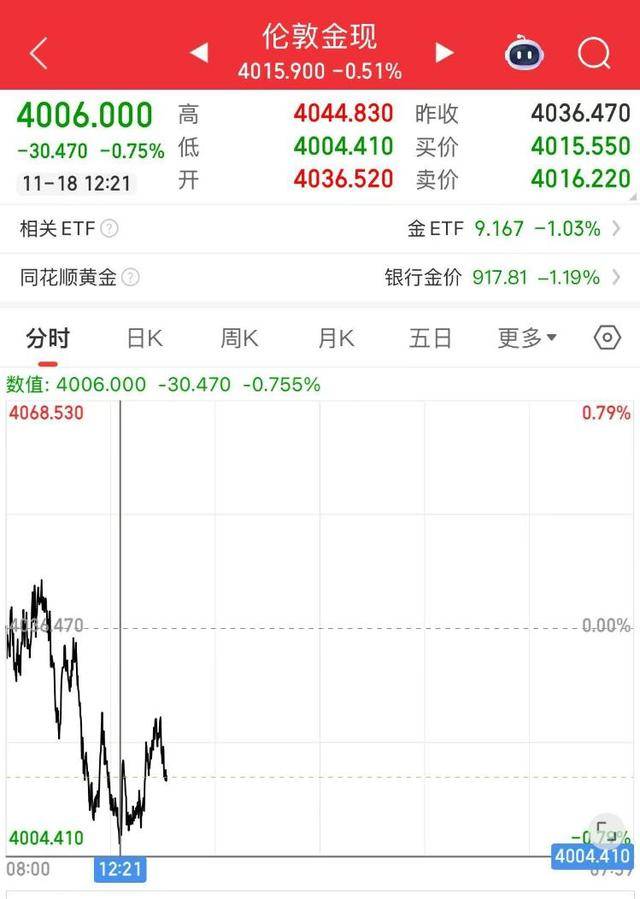
Core Insights - International gold and silver prices experienced a significant drop, with spot gold nearing the $4000 mark and London spot silver falling below $50 per ounce [1][6] - Domestic gold jewelry prices have also been adjusted downward, marking a four-day consecutive decline since the 14th [4] Price Movements - As of the latest report, London gold is down 0.55% at $4014.40 per ounce, while Shanghai gold has decreased by 1.23% to 919.42 yuan per gram, and New York gold has fallen by 1.42% to $4016.5 per ounce [1] - Major domestic brands have reported the following prices: Chow Sang Sang at 1289 yuan per gram (down 16 yuan), Chow Tai Fook at 1288 yuan per gram (down 17 yuan), Lao Miao at 1276 yuan per gram (down 13 yuan from the previous day and down 49 yuan from the high of 1325 yuan), and Lao Feng Xiang at 1285 yuan per gram (down 8 yuan from the previous day and down 40 yuan from the high of 1325 yuan) [4] Market Sentiment - The market sentiment is cautious due to diminishing expectations for a Federal Reserve interest rate cut, contributing to a three-day decline in gold and silver prices [6] - Weak physical demand for gold in the Asian market has further exacerbated the price drop, with the market reacting to inconsistent signals from the Federal Reserve [6] - Technical analysis indicates that gold prices are facing resistance at previous highs, entering a phase of high-level fluctuations, with market participants closely monitoring economic data for indications of Federal Reserve policy direction [6]
午后,市场突变
Shang Hai Zheng Quan Bao· 2025-10-13 06:15
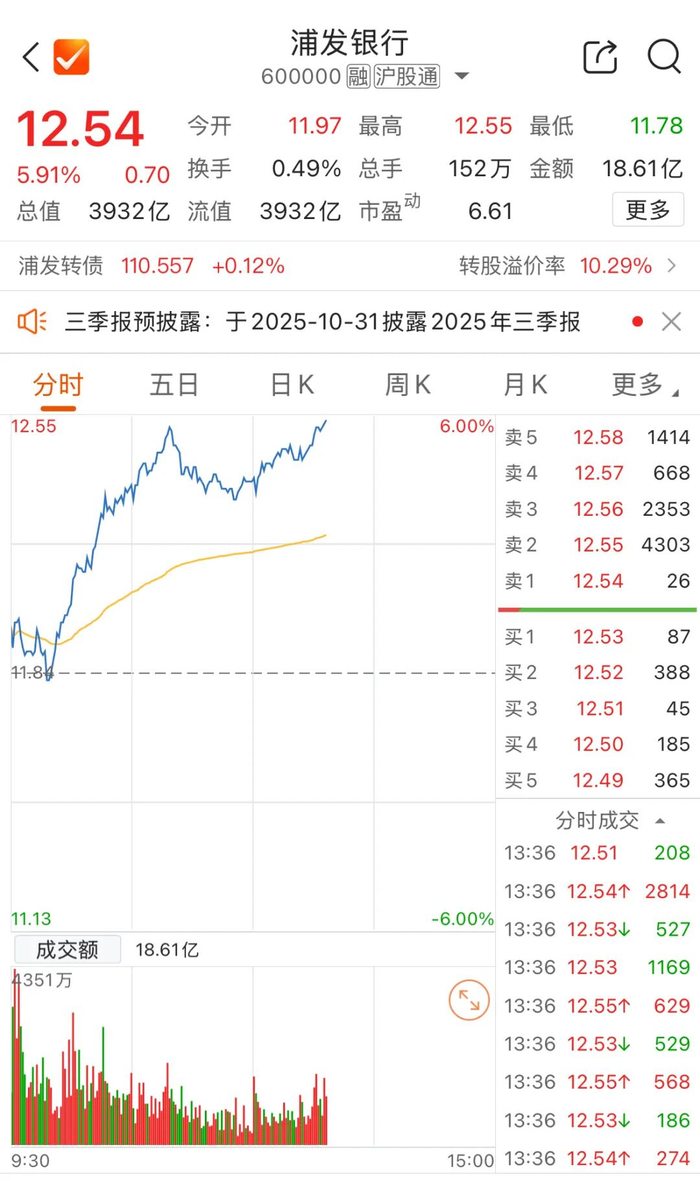
Group 1: Banking Sector Performance - The banking sector showed strong performance in the afternoon, with notable increases in shares of Shanghai Pudong Development Bank (SPDB) and Nanjing Bank, both rising over 5% [1] - SPDB announced that Dongfang Asset increased its stake in the bank through the secondary market by purchasing common shares and convertible bonds [1] Group 2: Stock Market Data - SPDB's stock opened at 12.55, with a high of 12.54 and a low of 11.78, achieving a trading volume of 1.52 million shares and a total transaction value of 1.861 billion [2] - Nanjing Bank's stock opened at 11.35, reaching a high of 11.36 and a low of 10.79, with a trading volume of 776,000 shares and a total transaction value of 859 million [3] Group 3: Port and Shipping Sector - The port and shipping sector experienced localized fluctuations, with Nanjing Port hitting the daily limit up [5] - Other companies in the sector, such as Lianyungang and China National Offshore Oil Corporation, also saw significant price increases [5] Group 4: Gold Market Activity - Spot gold prices surged, breaking through $4,070 per ounce, leading to a rebound in Hong Kong gold stocks, with companies like Chifeng Jilong Gold and Zijin Mining rising over 6% [8] - Gold futures also showed significant gains, with Shanghai gold rising by 2% to 927.66 yuan per gram [11] Group 5: Market Indices - As of the latest update, major indices showed a narrowing decline, with the Shanghai Composite Index at 3,874.24 points, down 0.58%, and the Shenzhen Component Index at 13,119.42 points, down 1.77% [16]