
成都银行

Search documents
湘财证券晨会纪要-20250917
Xiangcai Securities· 2025-09-17 02:01
Banking Industry - The total loan growth has weakened, but the structure of corporate loans has improved. In August, the total social financing growth rate decreased by 0.2 percentage points to 8.8%, marking the first decline this year. Financial institution loan growth and medium to long-term loan growth both fell by 0.1 percentage points, with growth rates of 6.8% and 6.4% respectively [3][4] - Government bond financing has lessened its support for social financing. In August, new social financing amounted to 2.57 trillion yuan, a year-on-year decrease of 463 billion yuan, primarily due to government bond financing and loan drag. Government bond financing decreased by 251.9 billion yuan year-on-year [3][4] - The demand for resident loans is weak. In August, new RMB loans from financial institutions totaled 590 billion yuan, a year-on-year decrease of 310 billion yuan. Both long-term and short-term resident loans weakened [4][5] - Corporate loan growth has weakened, but the structure has improved. In August, new corporate loans totaled 590 billion yuan, a year-on-year decrease of 250 billion yuan, mainly due to a reduction in bill financing [5][6] - Investment suggestions indicate that with the implementation of fiscal interest subsidy policies and accelerated infrastructure investment, bank credit demand and structure are expected to improve. The report maintains an "overweight" rating for the banking sector, recommending specific banks for investment [6] Electronic Industry - Alibaba released Qwen3-Next, enhancing both performance and efficiency. The market performance of the AI industry index rose by 5.70% last week [8][9] - The valuation of the AI industry index shows a PE ratio of 56.60X and a PB ratio of 7.48X, indicating a significant increase compared to previous values [8][9] - The breakthrough of Qwen3-Next lies in achieving a balance between large parameter capacity, low activation overhead, and long context processing, which is expected to lower training and inference costs [10] - Investment suggestions highlight the ongoing recovery in consumer electronics and the high demand for AI infrastructure, recommending specific companies in the AI infrastructure and end-side SOC sectors [11] Medical Services Industry - The overall performance of the medical services industry has shown significant improvement, with a notable recovery in revenue and profit margins in the pharmaceutical manufacturing sector [13][14] - Private medical services are under short-term pressure, while CXO performance continues to improve, particularly in the eye care sector [15][16] - The IVD sector faces challenges due to medical insurance cost control and centralized procurement, but high-growth areas are still worth monitoring [18] Chemical Industry - Tian Nai Technology is a leading company in carbon nanotube production, with a focus on applications in lithium batteries and conductive materials [20][21] - The demand for carbon nanotubes is expected to grow significantly due to advancements in fast-charging and solid-state battery technologies, with a projected compound annual growth rate of 26.7% from 2024 to 2030 [24][26] - The company is expected to achieve net profits of 341 million yuan, 550 million yuan, and 762 million yuan from 2025 to 2027, respectively, and is rated as "overweight" [26][28]
3.4万亿不良贷款待处置,银行不良贷款处置手段详解
数说者· 2025-09-16 23:52
Core Viewpoint - The overall non-performing loan (NPL) ratio of Chinese commercial banks is on a downward trend, reaching 1.50% by the end of 2024 and 1.49% by mid-2025, down from 1.96% in September 2020, indicating stable asset quality in the banking sector [2][3]. Summary by Sections Non-Performing Loan Ratio and Balance - The non-performing loan balance of commercial banks is increasing despite the declining NPL ratio, reaching 3.28 trillion yuan by the end of 2024 and 3.43 trillion yuan by mid-2025, compared to only 0.84 trillion yuan at the end of 2014 [3]. NPL Disposal Methods - Commercial banks are employing various methods to dispose of non-performing loans, including write-offs, asset securitization, and collections. For instance, in 2024, China Merchants Bank disposed of 62.902 billion yuan of NPLs, with 30.401 billion yuan through write-offs, 22.569 billion yuan through asset securitization, and 7.599 billion yuan through collections [6]. Write-Offs - Write-offs are a method where banks remove recognized bad debts from their balance sheets, thus lowering the NPL ratio without affecting current profits if provisions are sufficient. In 2024, write-offs accounted for 48% of all NPL disposals at China Merchants Bank [12]. Collections - Collections involve recovering loans from borrowers, which can occur even after loans have been written off. This process can be conducted internally by the bank or outsourced to collection agencies, utilizing various methods such as phone calls, in-person visits, or legal actions [13]. Debt-for-Asset Swaps - Debt-for-asset swaps occur when borrowers repay loans with non-cash assets like property or stocks. While this reduces NPLs, it introduces risks related to the subsequent sale of these assets, which may not yield expected cash returns [14]. NPL Transfers - NPL transfers involve selling bad loans at a discount to specialized institutions that manage distressed assets. This method allows banks to offload management costs and potentially recover more funds through experienced asset managers [16]. Restructuring - Restructuring is a process where banks modify loan terms for borrowers facing temporary difficulties, aiming to restore their repayment capacity. However, this method does not immediately reduce NPLs and may not be effective if borrowers do not recover financially [18][19]. Securitization - Securitization of NPLs is viewed as a financing method rather than an effective disposal strategy, with further discussion warranted on its implications [20].


多家银行股东及高管密集增持
Zheng Quan Ri Bao Wang· 2025-09-16 12:25
Core Insights - Recent actions by shareholders and executives of listed banks to increase their holdings indicate a strong confidence in the banking sector's future performance [1][3] - Institutional investors, including insurance and trust companies, are actively investing in bank stocks, highlighting the sector's investment value [1][4] Group 1: Shareholder and Executive Actions - Multiple listed banks have disclosed announcements of share buybacks by shareholders and executives, with significant amounts being committed [2][3] - For instance, Qilu Bank announced a plan for its executives to buy back shares worth at least 3.5 million yuan, while Nanjing Bank's major shareholder increased its stake from 12.56% to 13.02% through a purchase of 56.78 million shares [2] - This trend of increasing shareholdings reflects confidence in the banks' long-term investment value and future growth prospects [3] Group 2: Institutional Investment Trends - Insurance and trust companies have shown a notable increase in their investments in bank stocks, indicating a strong preference for long-term holdings in this sector [4] - Major insurance firms, such as Ping An Life, have actively increased their stakes in banks, focusing on both A-shares and H-shares, which demonstrates a robust commitment to the banking sector [4] - As of June, 18 trust companies were among the top ten shareholders in 25 A-share listed companies, with a total investment value of 59.21 billion yuan, many of which were bank stocks [4] Group 3: Market Outlook and Valuation - Analysts maintain an optimistic outlook for bank stocks, suggesting that there is still room for valuation recovery and highlighting their long-term investment appeal [5] - The banking sector has experienced a phase of adjustment, and the overall performance in the mid-year reports has been positive, with expectations for a rebound in return on equity (ROE) [5] - Factors such as the low interest rate environment and the ongoing shift of household deposits to equity markets are expected to support the demand for bank stocks, enhancing their appeal as a stable income source [5]





银行股屡获增持,9月以来6家上市银行发布增持公告
Cai Jing Wang· 2025-09-16 10:46
Group 1 - Qilu Bank announced a voluntary share buyback plan by its directors, supervisors, and senior management, with a total investment of no less than RMB 3.5 million, scheduled from September 16, 2025, to December 31, 2025, reflecting confidence in the bank's long-term investment value [1] - In September, six listed banks have announced share buyback plans or progress, indicating a trend of major shareholders and executives favoring bank stocks for their long-term investment potential [1] - Suzhou Bank's executives plan to buy back at least RMB 4.2 million worth of shares, citing confidence in the bank's future development [1] Group 2 - Huaxia Bank's share buyback plan was completed with a total of 4.2293 million shares purchased for approximately RMB 31.9 million [2] - Qingdao Bank's major shareholder plans to increase their stake to between 19.00% and 19.99%, intending to buy between 233 million and 291 million shares, based on the long-term investment value of the bank's stock [2] - Share buyback plans from Chengdu Bank and Everbright Bank have progressed, with total investments exceeding RMB 130 million [2] Group 3 - The steady progress of multiple banks' share buyback plans reflects shareholders' optimism about the banks' future development, which is expected to benefit the valuation of the banking sector [3] - The long-term logic of systemic valuation recovery for bank stocks remains unchanged, supported by improved operating conditions and sustained appeal to long-term capital [3] - Factors such as low interest rates and policy incentives are likely to bring stable incremental funds to the banking sector, enhancing the sustainability of valuation recovery [3]
航宇科技:关于为控股子公司提供担保的公告
Zheng Quan Ri Bao Zhi Sheng· 2025-09-15 13:10
Core Points - Aerospace Technology announced a fixed asset loan approval of 90 million yuan from Chengdu Bank for its subsidiary Chengdu Chenghangfa General Power Equipment Co., Ltd. to fund new project construction [1] - The loan has a term of 8 years, with the company providing a joint liability guarantee for the loan and its wholly-owned subsidiary Sichuan Delan Aerospace Technology Development Co., Ltd. offering land mortgage collateral [1] - The guarantee period for the loan is three years from the expiration of the debt performance period under the contract, and no guarantee fees will be charged by the company [1]

城商行板块9月15日跌0.85%,西安银行领跌,主力资金净流出7.97亿元
Zheng Xing Xing Ye Ri Bao· 2025-09-15 08:43
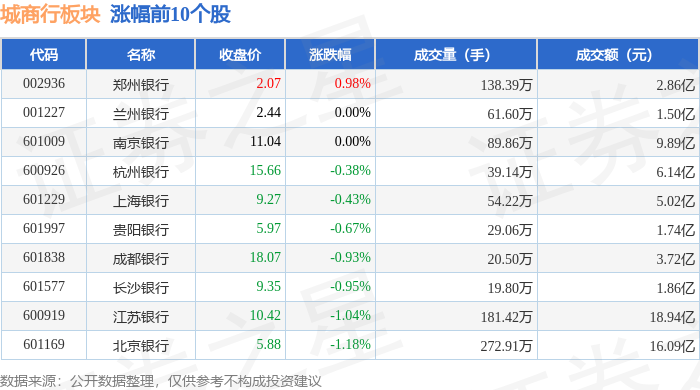
Market Overview - On September 15, the city commercial bank sector declined by 0.85% compared to the previous trading day, with Xi'an Bank leading the decline [1] - The Shanghai Composite Index closed at 3860.5, down 0.26%, while the Shenzhen Component Index closed at 13005.77, up 0.63% [1] Individual Bank Performance - Zhengzhou Bank closed at 2.07, up 0.98% with a trading volume of 1.38 million shares and a transaction value of 286 million yuan [1] - Xi'an Bank closed at 4.19, down 1.87% with a trading volume of 438,000 shares and a transaction value of 184 million yuan [2] - The highest decline was observed in Chengdu Bank, which closed at 18.07, down 0.93% [1] Capital Flow Analysis - The city commercial bank sector experienced a net outflow of 797 million yuan from institutional investors, while retail investors saw a net inflow of 348 million yuan [2] - The main capital inflow and outflow for individual banks varied, with Hangzhou Bank seeing a net inflow of 61.64 million yuan from institutional investors [3] - Conversely, Suzhou Bank experienced a net outflow of 11.76 million yuan from institutional investors [3]



2025年A股中报业绩分析及行业景气展望:实体盈利缓增,新质亮点突出
Ping An Securities· 2025-09-15 07:32
Overall Performance - A-share listed companies reported a 2.4% year-on-year profit growth in Q2 2025, with market sentiment remaining optimistic[4] - The cumulative net profit growth rates for all A-shares and non-financial A-shares were 2.4% and 1.0%, respectively, showing a decline of 1.2 percentage points and 3.5 percentage points compared to Q1 2025[9] - Non-financial A-shares' overseas business revenue grew by 3.9%, contributing 15.3% to total revenue[9] Sector Analysis - The Sci-Tech Innovation Board showed a significant profit recovery with a net profit growth rate of 38.0% in Q2 2025, contrasting with a decline of 14.3% in the same period for the ChiNext Board[12] - Large-cap stocks demonstrated relative resilience, with the cumulative net profit growth rates for the CSI 500, CSI 800, and CSI 300 at 6.9%, 2.8%, and 2.4%, respectively[12] - AI technology continues to lead high prosperity, with the TMT sector maintaining strong growth, particularly in AI computing hardware[15] Consumer Trends - High-end new energy vehicles and innovative pharmaceuticals showed improved market conditions, with the automotive sector experiencing unexpected domestic sales growth[4] - The food and beverage sector saw a mixed performance, with liquor industry profits stabilizing while beverage and snack segments remained high in demand[4] Market Outlook - The equity market is expected to continue high-level fluctuations, with recommendations to focus on sectors with upward trends in industrial prosperity and superior performance[4] - Key sectors to watch include technology growth (AI, semiconductors, innovative pharmaceuticals), advanced manufacturing (new energy, automotive), and traditional cyclical sectors benefiting from price increases[4] Risk Factors - Potential risks include macroeconomic fluctuations, lower-than-expected profit growth for listed companies, and unexpected disturbances from overseas policies and geopolitical tensions[4]
中国银行业:2025 年宏观、金融与房地产调研要点-China Banks_ Takeaways from 2025 macro, financial and property tour
2025-09-15 01:49
Summary of Key Points from the Conference Call Industry Overview - **Industry**: Chinese Banking Sector - **Date of Conference**: September 3-5, 2025 - **Location**: Hangzhou and Beijing Core Insights 1. **Economic Support and Government Policies**: The Chinese government has prioritized economic support through various policies since September 2024, including rate cuts and consumption stimuli, leading to a recovering capital market and alleviation of local government financing vehicle (LGFV) debt issues [2][3][4] 2. **GDP Growth Outlook**: Despite recent weakening economic data, experts believe China is on track to meet its approximately 5% GDP growth target for 2025, aided by a favorable base effect in the second half of the year. However, 2026 presents heightened risks [3][12] 3. **Monetary and Fiscal Policies**: Further policy rate cuts are deemed unlikely for the remainder of 2025, with a preference for targeted fiscal subsidies. The potential introduction of a consumption tax reform in 2025 is also noted [3][4][12] 4. **Inflation and Economic Structure**: Weak inflation persists, attributed to structural issues and overcapacity in the investment-driven growth model, particularly in manufacturing. Experts emphasize the need for long-term structural reforms [11][13] 5. **Capital Market Recovery**: The capital market is showing signs of recovery, supported by easing US-China tensions and improved global liquidity. The upward momentum is expected to continue [15] Banking Sector Insights 1. **Net Interest Margin (NIM) Outlook**: Banks are less negative about NIM outlooks, with many indicating that NIM is near its bottom and may stabilize soon. However, loan demand remains lackluster, particularly from non-government corporates and retail sectors [5][24] 2. **Dividend Preferences**: In light of macroeconomic uncertainties, banks with higher dividend yields, such as ICBC, CCB, CITIC, and regional banks like BOCD and BOHZ, are preferred [5][24] 3. **Individual Bank Performance**: - **ICBC**: Expects improved earnings in H2 2025, driven by fee income growth and trading gains, despite a slight decline in NIM [25] - **CCB**: Anticipates NIM stabilization, with potential downward pressure from previous LPR cuts [26] - **BOC**: Expects NIM to bottom out and aims to prioritize wealth management and consumer finance [27] - **CITIC**: Predicts stable NIM and improvement in retail asset quality by early next year [28] - **SPDB**: Noted revenue and NPAT growth in H1, with a focus on technology finance and inclusive finance [30] Additional Considerations 1. **Consumption Trends**: Retail consumer goods sales growth has slowed, with services consumption becoming increasingly significant, accounting for approximately 46% of total consumption in 2024. Policies to boost consumption are expected to be emphasized [16][17] 2. **Property Market Dynamics**: The residential property market remains weak, but there is high demand for quality homes. Experts express skepticism about new property policies due to limited room for easing [22][18] 3. **Tariff and Trade Outlook**: Tariffs are expected to remain stable, with potential RMB appreciation driven by trade dynamics. The relationship between China and the US is characterized as tight, with full decoupling seen as unlikely [19][22] Conclusion The conference highlighted a cautious yet optimistic outlook for the Chinese banking sector, with a focus on stabilizing NIMs, improving asset quality, and navigating macroeconomic challenges. The emphasis on structural reforms and consumption growth indicates a strategic shift in policy direction moving forward.




湾财周报 人物 罗永浩VS西贝贾国龙:预制菜之争
Nan Fang Du Shi Bao· 2025-09-14 13:24
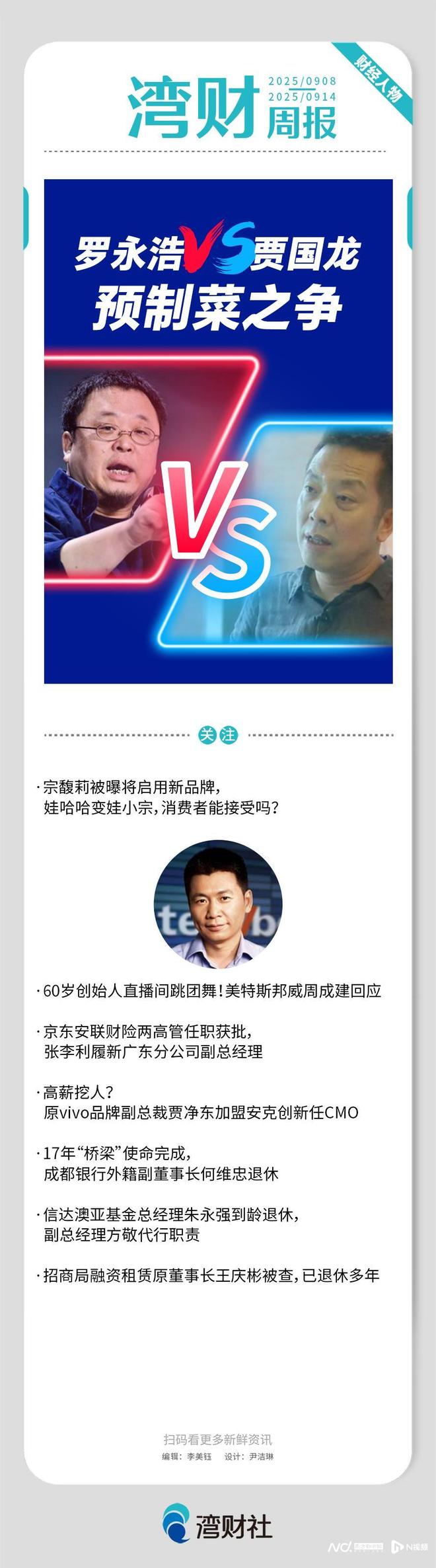
Group 1 - The dispute between Luo Yonghao and Xibei regarding the use of pre-prepared dishes continues, with Luo accusing Xibei of playing word games about their food preparation methods [4] - Xibei's revenue dropped significantly, with daily sales decreasing by 1 million yuan on September 10 and 11, and an expected drop of 2 to 3 million yuan on September 12, marking the largest external crisis in the company's history [5] - Xibei publicly refuted Luo's claims, asserting that the dishes he consumed were not pre-prepared [4][5] Group 2 - Wahaha, under the leadership of Zong Fuli, plans to rebrand as "Wah Xiaozong" starting from the 2026 sales year, aiming to maintain compliance with brand usage [6] - The announcement of the rebranding has sparked strong consumer backlash, with many expressing their inability to accept the name change due to emotional ties to the original brand [7] Group 3 - Meisibangwei's founder, Zhou Chengjian, gained attention for dancing in a live stream, which attracted over 200,000 viewers, highlighting the company's strategy to engage with consumers in a fun manner [8] - Anker Innovations has appointed former Vivo executive Jia Jingdong as CMO, which is expected to enhance the company's brand strength and market strategy [9] Group 4 - Ho Wai Choong, the foreign vice chairman of Chengdu Bank, has retired after 17 years, coinciding with significant share purchases by state-owned platforms, indicating a new phase in the bank's collaboration with strategic investors [10] - Xinda Australia Fund's general manager Zhu Yongqiang is retiring, with deputy general manager Fang Jing taking over, amidst concerns about the stability of the company's governance following frequent executive changes [11] Group 5 - Wang Qingbin, the former chairman of China Merchants Jinling Leasing, is under investigation for serious violations of discipline and law, as announced by the Central Commission for Discipline Inspection [12][13]
8月金融数据点评:存款非银化延续,贷款投放或“价在量先”
KAIYUAN SECURITIES· 2025-09-14 08:06
Investment Rating - The industry investment rating is "Overweight" (maintained) [1] Core Viewpoints - The report indicates that the financial management scale is expected to benefit, and there may be changes in investment fund preferences due to new regulations on fund sales [3] - The trend of deposit non-bankization continues, with loan issuance potentially prioritizing price over volume [4] - The report highlights a decrease in both corporate and personal loans in August, with a notable decline in short-term and medium-to-long-term loans [5][6] Summary by Sections Financial Data - In August, M1 and M2 year-on-year growth rates were 6.00% (up 0.4 percentage points month-on-month) and 8.80% (unchanged month-on-month), respectively [4] - The total social financing (社融) increased by 2.57 trillion yuan in August, a year-on-year decrease of 463 billion yuan, with a stock growth rate of 8.8% (down 0.2 percentage points month-on-month) [4] - The new RMB loans amounted to 590 billion yuan in August, a year-on-year decrease of 310 billion yuan [5] Loan Analysis - Corporate loans showed a decline, with medium-to-long-term loans decreasing by 20 billion yuan year-on-year, while short-term loans increased by 70 billion yuan, marking the first positive growth in five years for corporate short-term loans [6] - Residential loans also decreased, with medium-to-long-term loans adding only 20 billion yuan, a year-on-year decrease of 100 billion yuan [6] Investment Recommendations - The report anticipates a recovery in credit rhythm in September, with potential short-term loan growth for enterprises [7] - Recommended bank stocks include Agricultural Bank of China, China Merchants Bank, CITIC Bank, Industrial Bank, Beijing Bank, Jiangsu Bank, Hangzhou Bank, Chengdu Bank, and Chongqing Rural Commercial Bank [7]