
石药集团

Search documents
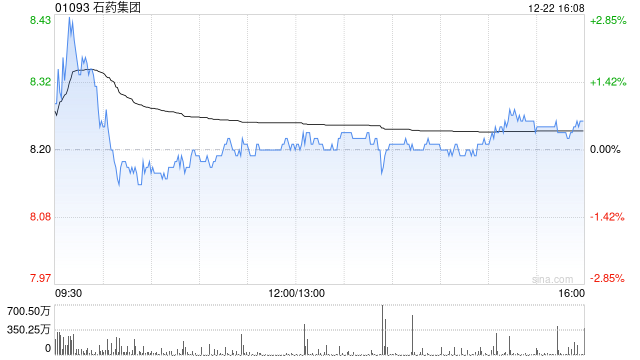
石药集团获主席兼执行董事蔡东晨增持1345.4万股 每股作价约8.2港元
Xin Lang Cai Jing· 2025-12-22 23:48
责任编辑:卢昱君 热点栏目 自选股 数据中心 行情中心 资金流向 模拟交易 客户端 热点栏目 自选股 数据中心 行情中心 资金流向 模拟交易 客户端 香港联交所最新资料显示,12月22日,主席兼执行董事蔡东晨增持石药集团(01093)1345.4万股,每 股作价8.1957港元,总金额约为1.1亿港元。增持后最新持股数目约为29.1亿股,最新持股比例为 25.26%。 香港联交所最新资料显示,12月22日,主席兼执行董事蔡东晨增持石药集团(01093)1345.4万股,每 股作价8.1957港元,总金额约为1.1亿港元。增持后最新持股数目约为29.1亿股,最新持股比例为 25.26%。 责任编辑:卢昱君 ...

智通港股通资金流向统计(T+2)|12月23日
智通财经网· 2025-12-22 23:32
Group 1 - Xiaomi Group-W (01810) had a net inflow of 904 million, representing a 17.60% increase in net inflow [1][2] - Meituan-W (03690) experienced a net inflow of 476 million, with a net inflow ratio of 20.69% [1][2] - Changfei Optical Fiber Cable (06869) saw a net inflow of 356 million, corresponding to a 12.70% increase [1][2] Group 2 - The top three stocks with the highest net outflow were: - Yingfu Fund (02800) with a net outflow of -1.42 billion, a decrease of -14.05% [1][2] - China Mobile (00941) with a net outflow of -1.295 billion, reflecting a -49.14% decrease [1][2] - Innovent Biologics (01801) with a net outflow of -271 million, a -32.88% decrease [1][2] Group 3 - The top three stocks with the highest net inflow ratio were: - Southern Hang Seng Index ETF (03037) with a net inflow ratio of 84.61% [1][2] - ICBC Southern China (03167) with a net inflow ratio of 75.00% [1][2] - Midea Real Estate (03990) with a net inflow ratio of 65.00% [1][2] Group 4 - The top three stocks with the highest net outflow ratio were: - Wan Guo Gold Group-Old (02979) with a net outflow ratio of -100.00% [1][3] - New Idea Network Group (01686) with a net outflow ratio of -71.51% [1][3] - Ruian Real Estate (00272) with a net outflow ratio of -71.45% [1][3]


【医药生物】AI医疗激活“医药险”全链路闭环,建议关注相关投资机会——医药生物行业跨市场周报(20251221)(吴佳青)
光大证券研究· 2025-12-22 23:05
Market Overview - Last week, the A-share pharmaceutical and biotechnology index fell by 0.14%, underperforming the CSI 300 index by 0.14 percentage points, while outperforming the ChiNext index by 1.39 percentage points, ranking 22nd among 31 sub-industries [4] - The Hong Kong Hang Seng Healthcare Index also declined by 1.77%, outperforming the Hang Seng Index by 0.19 percentage points [4] R&D Progress - Last week, SSGJ-608 NDA application from 3SBio was newly undertaken; the 24-valent pneumococcal polysaccharide conjugate vaccine from CanSino and SYH2069 from CSPC were also newly undertaken for clinical application [5] - Hengrui Medicine's 9531 is in Phase III clinical trials; HRS-7249 is in Phase II clinical trials; and CanSino's CM383 is in Phase I clinical trials [5] Investment Insights - The recent rebranding of Ant Group's AI health application "AQ" to "Antifufu" has led to a surge in downloads, reaching the top 3 in the Apple App Store and surpassing 15 million monthly active users, making it the leading AI health management app in China [6] - Antifufu integrates over 500 national-level academicians and renowned doctors into its "AI avatar" service, transforming scarce expert resources into 24/7 accessible services [6] - This product iteration shifts the traditional low-frequency medical visits into high-frequency health management, creating a digital closed loop from consultation, medication purchase to insurance claims, thus enhancing the "medical + pharmaceutical + insurance" integration [6] Future Investment Strategy - With the changing macroeconomic and policy landscape, future investments in the pharmaceutical sector should increasingly focus on the intrinsic clinical value of pharmaceuticals, addressing clinical needs of patients [7] - Both domestic medical insurance policies and global expansion strategies are placing higher premiums on clinical value [7]

石药集团(01093.HK)获执行董事兼主席蔡东晨增持1345.4万股
Ge Long Hui· 2025-12-22 22:43
增持后,蔡东晨最新持股数目为2,910,198,670股,持股比例由25.14%上升至25.26%。 格隆汇12月23日丨根据联交所最新权益披露资料显示,2025年12月22日,石药集团(01093.HK)获执行董事兼主席蔡东晨在场内以每股均价8.1957港元增持 1345.4万股,涉资约1.10亿港元。 | 股份代號: | 01093 | | --- | --- | | 上市法國名稱: | 石藥集國有限公司 | | 日期 (日 / 月 / 年): | 23/11/2025 - 23/12/20 | | 表格序號 | 大股東/董事/最高行政人員名稱 作出披露的 買入 / 費出或涉及的股 每股的平均價 | | | | 持有權益的股份數目 佔已發行的 有關事件的出 | | | --- | --- | --- | --- | --- | --- | --- | | | 份數目 | 三次 | | | (請參閱上述*註解)有投票權股 (日 / 月 / 年 | | | | | | | | 份自分比 | | | DA20251222E00266 | 啓東晨 | 1101(L) | 13,454,000(L | HKD 8. ...

医药生物行业周报(12月第3周):病理业务发展进入快车道-20251222
Century Securities· 2025-12-22 14:46
Investment Rating - The report does not explicitly state an investment rating for the industry [2]. Core Insights - The pathology business is entering a fast track with the National Healthcare Security Administration issuing guidelines for pricing projects in pathology services, focusing on biopsy sampling, sample processing, and digitalization of pathology data, which is expected to enhance the application of AI in the field [3][11]. - The influenza activity has peaked across the board, with reported cases in southern provinces at 9.7%, down from 11.2% the previous week, but higher than the same period in previous years [3][11]. Market Weekly Review - The pharmaceutical and biotechnology sector fell by 0.14% from December 15 to December 19, outperforming the Wind All A index (-0.15%) and the CSI 300 index (-0.28%). The rebound was weak, with segments like pharmaceutical distribution (5.59%), offline pharmacies (4.69%), and hospitals (4.15%) leading gains, while chemical preparations (-2.1%), vaccines (-0.87%), and medical R&D outsourcing (-0.87%) lagged [3][8]. - Notable stock performances included Huaren Health (55.9%), Luyuan Pharmaceutical (36.8%), and Shuyupingmin (35.7%) with significant gains, while *ST Changyao (-24%), Yipinhong (-23.7%), and Rejing Biology (-16.5%) faced substantial declines [3][11]. Industry News and Key Company Announcements - The National Healthcare Security Administration's guidelines for pathology services are expected to drive high-quality development in the sector and create new scenarios for AI-assisted technology applications [11]. - Significant collaborations and approvals were reported, including Shanghai Jinmante's partnership with Jiangsu Kangning Jerey for a breakthrough therapy designation from the FDA for JSKN003, and Novo Nordisk's submission of a marketing application for CagriSema, which showed a weight loss of 22.7% over 68 weeks in clinical trials [12][13]. - Fosun Pharma's subsidiary received FDA approval to initiate a Phase I clinical trial for HLX18, a biosimilar to Nivolumab, targeting various cancers [13][14].
港股通成交活跃股追踪 石药集团近一个月首次上榜
Zheng Quan Shi Bao Wang· 2025-12-22 14:13
Core Insights - On December 22, 2023, CSPC Pharmaceutical Group made its first appearance on the Hong Kong Stock Connect active trading list in nearly a month [2][3] - The total trading volume of active stocks on the Hong Kong Stock Connect reached HKD 315.99 billion, accounting for 35.82% of the day's total trading amount, with a net buying amount of HKD 17.47 billion [2] - Alibaba-W led the trading volume with HKD 63.20 billion, followed by SMIC and Xiaomi Group-W with HKD 56.70 billion and HKD 40.84 billion, respectively [2] Trading Activity Summary - CSPC Pharmaceutical Group had a trading volume of HKD 5.84 billion on December 22, with a net buying amount of HKD 0.16 billion, and the stock closed up by 0.61% [2][3] - The most frequently listed stocks in the past month include Alibaba-W and Tencent Holdings, each appearing 21 times, indicating strong interest from Hong Kong Stock Connect funds [2] - The trading data for other notable stocks includes Tencent Holdings at HKD 38.08 billion, SMIC at HKD 56.70 billion, and Xiaomi Group-W at HKD 40.84 billion, all showing significant trading activity [2]


港股通(深)净买入39.49亿港元



Zheng Quan Shi Bao Wang· 2025-12-22 13:53
Group 1 - The Hang Seng Index rose by 0.43% on December 22, closing at 25,801.77 points, with a net inflow of HKD 3.125 billion through the southbound trading channel [1] - The total trading volume for the southbound trading on December 22 was HKD 88.223 billion, with a net buy of HKD 3.125 billion [1] - In the Shanghai-Hong Kong Stock Connect, the trading volume was HKD 54.526 billion with a net sell of HKD 0.824 billion, while the Shenzhen-Hong Kong Stock Connect had a trading volume of HKD 33.697 billion with a net buy of HKD 3.949 billion [1] Group 2 - Among the most actively traded stocks in the Shanghai-Hong Kong Stock Connect, Alibaba-W had the highest trading amount of HKD 4.274 billion, followed by SMIC and Xiaomi Group with HKD 3.472 billion and HKD 2.623 billion respectively [2] - In terms of net buy amounts, Tencent Holdings had the highest net buy of HKD 0.427 billion, while Alibaba-W had the largest net sell of HKD 1.081 billion [2] - In the Shenzhen-Hong Kong Stock Connect, SMIC led with a trading amount of HKD 2.198 billion, followed by Alibaba-W and Tencent Holdings with HKD 2.046 billion and HKD 1.461 billion respectively [2]

港股通12月22日成交活跃股名单
Zheng Quan Shi Bao Wang· 2025-12-22 13:53
Summary of Key Points Core Viewpoint - The Hang Seng Index rose by 0.43% on December 22, with southbound capital transactions totaling HKD 882.23 billion, resulting in a net inflow of HKD 31.25 billion [1]. Group 1: Southbound Capital Transactions - Total southbound capital transactions amounted to HKD 882.23 billion, with buy transactions at HKD 456.74 billion and sell transactions at HKD 425.49 billion, leading to a net buy of HKD 31.25 billion [1]. - The Hong Kong Stock Connect (Shenzhen) recorded a total transaction amount of HKD 336.97 billion, with net buying of HKD 39.49 billion [1]. - The Hong Kong Stock Connect (Shanghai) had a total transaction amount of HKD 545.26 billion, resulting in a net sell of HKD 8.24 billion [1]. Group 2: Active Stocks - Alibaba-W had the highest transaction amount among southbound stocks at HKD 63.20 billion, followed by SMIC at HKD 56.70 billion and Xiaomi Group-W at HKD 40.84 billion [1]. - SMIC led in net buying with HKD 7.31 billion, with a closing price increase of 5.92%, while Xiaomi Group-W had a net buy of HKD 6.87 billion [1]. - Tencent Holdings saw a net buy of HKD 5.97 billion, while China Mobile experienced the largest net sell of HKD 5.79 billion, closing down by 0.24% [1]. Group 3: Continuous Net Buying - Three stocks have seen continuous net buying for over three days, with Xiaomi Group-W leading at 17 days, followed by Tencent Holdings at 5 days and Yangtze Optical Fibre and Cable at 4 days [2]. - The total net buying amount for Xiaomi Group-W reached HKD 155.58 billion, while Tencent Holdings had a net buy of HKD 24.77 billion [2].
百利天恒朱义:原始创新打造超级爆品,执掌全球话语权
2 1 Shi Ji Jing Ji Bao Dao· 2025-12-22 13:08
Core Insights - The oncology sector remains a hotbed for pharmaceutical innovation, with antibody-drug conjugates (ADCs) emerging as one of the most promising areas due to their dual advantages of precise targeting and potent cytotoxicity [1][2] - Chinese biotech companies have established themselves as key players in the global ADC innovation landscape, holding over 50% of the new drug pipeline in this category [1][2] - A significant strategic partnership between BaiLi TianHeng and Bristol-Myers Squibb (BMS) has set a record for the highest total transaction value for a single ADC asset, further intensifying industry innovation [1][2] Industry Trends - The ADC sector has become one of the fastest-growing segments in the global pharmaceutical industry, with projections estimating the market to reach $115.1 billion by 2032, and China's ADC market expected to reach 66.2 billion yuan by 2030 [2] - In the first eight months of 2025, ADC drugs accounted for 14 transactions, making it one of the hottest outbound technology sectors for Chinese companies [1][2] - Companies are expanding their focus beyond established targets like HER2 and TROP2 to explore "blue ocean" targets such as CDH6, CDH17, and DLL3, aiming for broader treatment windows and improved competitive landscapes [1][2] Strategic Collaborations - The partnership between BaiLi TianHeng and BMS is characterized by a unique model of "self-researched core assets + global rights collaboration" and "co-development + co-commercialization," which is relatively rare globally [4][5] - The collaboration is expected to face challenges related to team size and division of labor, prompting BaiLi TianHeng to expand its team and build a robust organizational structure [4][5] - The deal with BMS, valued at up to $8.4 billion, has revitalized the pharmaceutical market during a period referred to as a "capital winter" [2][3] Market Dynamics - Despite the growing trend of business development (BD) transactions, licensing out remains the mainstream model for domestic biotech companies, allowing them to focus on early-stage innovation while outsourcing later-stage development [6] - The increasing number of BD transactions reflects the rising competitiveness and value of Chinese pharmaceutical assets on a global scale, although concerns about undervaluation persist [7][8] - The need to create "super blockbuster" products is seen as essential for overcoming the challenges of being undervalued in the global market [7][8] Future Outlook - The competition in the ADC+IO (immune-oncology) space is intensifying, with both multinational and domestic companies racing to develop innovative therapies [8][9] - BaiLi TianHeng aims to leverage the cash flow from its partnership with BMS to enhance its R&D capabilities and build a comprehensive commercialization framework [9][10] - The company plans to address four core capability gaps essential for achieving global competitiveness: global R&D capabilities, clinical development capabilities, supply chain capabilities, and commercialization capabilities [10][11] Conclusion - The ADC sector's growth signifies a shift in China's pharmaceutical innovation from a follower to a leader, with a focus on original innovation and global capabilities as the pathway for domestic biotech companies to establish themselves as industry leaders [12]
石药二代掌舵,锁定创新驱动下的转型突围
Guo Ji Jin Rong Bao· 2025-12-22 12:17
Core Viewpoint - Recently, Shiyao Group (01093HK) has made significant announcements, including its subsidiary XinNuoWei (300765) submitting an IPO application to the Hong Kong Stock Exchange and the appointment of Cai Lei as CEO, indicating a strategic shift towards innovation and R&D investment during a challenging performance period [1][2] Group 1: Management Changes - Cai Lei, the son of the chairman Cai Dongchen, has been appointed as CEO, which is seen as a positive signal for the company's transformation strategy due to his familiarity with the company [1][3] - The management restructuring is part of a broader transition from a generic drug giant to an innovation-driven pharmaceutical company, with a focus on R&D and international expansion [2][5] Group 2: R&D Investment - Shiyao Group has significantly increased its R&D investment, reaching 5.7 billion yuan in 2024, maintaining double-digit growth for several years [5] - The company has 15 clinical-stage drugs in development, with 9 being ADC drugs, and has secured over $1.2 billion in international collaborations [4][6] Group 3: Financial Performance - For the first three quarters, Shiyao Group reported revenues of 19.891 billion yuan, a year-on-year decrease of 12.32%, and a net profit of 3.511 billion yuan, down 7.06%, primarily due to drug procurement and price adjustments [8] - Despite the revenue decline, R&D expenses reached 4.185 billion yuan, a year-on-year increase of 7.9%, accounting for 27.1% of the revenue from the core pharmaceutical business [8] Group 4: Strategic Initiatives - The company is focusing on business integration and resource synergy, particularly with the restructuring of ST Jingfeng (Jingfeng Pharmaceutical), where it invested 526 million yuan to gain control [7] - The integration aims to leverage Jingfeng's capabilities in cardiovascular, orthopedic, and anti-tumor plant drugs to enhance market share and product upgrades [7]