平安银行

Search documents
银行年末加码汽车消费金融
Jing Ji Wang· 2025-12-25 02:12
Core Viewpoint - Banks are intensifying support for automotive consumer finance to stimulate the automotive market and align with national consumption policies, utilizing various loan schemes to meet consumer needs [1][4]. Group 1: Bank Initiatives - Multiple banks are launching targeted year-end purchase incentives, such as Ping An Bank's "minimum 0% interest" campaign with loan amounts ranging from 30,000 to 5 million yuan, and Postal Savings Bank's financial plan offering up to 4,500 yuan in subsidies for specific new models [2][3]. - Credit card installment plans are becoming a key focus for banks in automotive consumer finance, with ICBC offering up to 60 months of financing at minimum 0% interest for specific models purchased with their credit card [2]. Group 2: Customer Experience Enhancements - Some banks are upgrading automotive benefits for credit card holders to enhance customer experience, such as Industrial Bank's "monthly rewards" program for cardholders, allowing them to save up to 1,800 yuan annually [3]. Group 3: Industry Trends - The increase in automotive consumer finance by banks is a response to policy directives and a proactive measure to address slowing retail credit growth and the scarcity of quality assets [4]. - Experts predict a shift towards refined operations in automotive consumer finance, moving away from high-interest models to compliance-based, demand-driven service models, with a focus on electric vehicles and used car transactions [4][5].



12月24日信用债异常成交跟踪
SINOLINK SECURITIES· 2025-12-25 01:15
1. Report Industry Investment Rating No relevant content provided. 2. Core Viewpoints - According to Wind data, among the bonds traded at a discount, "24 Chengtong Holdings MTN010B" had a relatively large deviation in valuation price; among the bonds with rising net prices, "Jingzi K10" led in terms of valuation price deviation; among the Tier 2 and perpetual bonds with rising net prices, "25 Ping An Bank Perpetual Bond 01BC" showed a relatively large deviation in valuation price; among the commercial financial bonds with rising net prices, "25 Zhangjiagang Rural Commercial Science and Technology Innovation Bond 01" ranked high in terms of valuation price deviation; among the bonds with a trading yield higher than 5%, transportation bonds were at the forefront [2]. - The changes in credit bond valuation yields are mainly distributed in the [-5,5] range. The trading terms of non - financial credit bonds are mainly between 2 and 3 years, with the highest proportion of discount - traded varieties within 0.5 years; the trading terms of Tier 2 and perpetual bonds are mainly between 4 and 5 years, with the highest proportion of discount - traded varieties between 1 and 3 years. By industry, the bonds in the light manufacturing industry had the largest average deviation in valuation price [2]. 3. Summary by Relevant Catalogs 3.1 Discounted Bond Trading Tracking - The report tracked the trading of significantly discounted bonds, listing the remaining term, valuation price deviation, valuation net price, valuation yield deviation, valuation yield, previous - day valuation yield, implied rating, subject rating, industry, and trading volume of various bonds such as "24 Chengtong Holdings MTN010B" [4]. 3.2 Tracking of Bonds with Rising Net Prices - It tracked the trading of bonds with significant positive deviations in net prices. Bonds like "Jingzi K10" had a valuation price deviation of 0.21%, and the report also provided details on other bonds including remaining term, valuation price deviation, etc. [5]. - For Tier 2 and perpetual bonds with rising net prices, "25 Ping An Bank Perpetual Bond 01BC" and others were listed, with a valuation price deviation of about 0.03% for many of them [6]. 3.3 Commercial Financial Bond Trading Tracking - The trading of commercial financial bonds was tracked, such as "25 Zhangjiagang Rural Commercial Science and Technology Innovation Bond 01", with information on remaining term, valuation price deviation, etc. provided [9]. 3.4 Tracking of Bonds with a Trading Yield Higher than 5% - Bonds like "24 Ruimao 02" with a trading yield higher than 5% were tracked, and the report presented details such as remaining term, valuation price deviation, and trading volume [10]. 3.5 Distribution of Credit Bond Trading Valuation Deviations on the Day - The distribution of changes in credit bond valuation yields on the day was mainly in the [-10,-5), [-5,0), (0,5], (5,10] intervals, along with the number of bonds and trading volume [13]. 3.6 Distribution of Trading Terms of Non - Financial Credit Bonds on the Day - The trading terms of non - financial credit bonds (including urban investment and industrial bonds) on the day were mainly between 2 and 3 years, with corresponding trading volumes [15]. 3.7 Distribution of Trading Terms of Tier 2 and Perpetual Bonds on the Day - The trading terms of Tier 2 and perpetual bonds on the day were mainly between 4 and 5 years, with relevant trading volume data [18]. 3.8 Discounted Trading Ratio and Trading Volume of Non - Financial Credit Bonds by Industry - The average valuation price deviation and trading volume of non - financial credit bonds in various industries were presented, with the light manufacturing industry having the largest average valuation price deviation [20].
三年减少1亿张,联名信用卡批量退场?
Chang Sha Wan Bao· 2025-12-24 23:43
Core Insights - The credit card industry in China is undergoing a significant transformation, moving away from rapid expansion and towards a focus on cost reduction and efficiency optimization [1][4][7] Group 1: Industry Trends - The total number of credit cards in China has decreased to 707 million as of the end of Q3 2025, marking a reduction of nearly 100 million cards over the past three years [1][4] - Major banks are halting the issuance of co-branded credit cards, with significant cuts announced by institutions such as Postal Savings Bank, Bank of Communications, and China Merchants Bank [2][4] - The shift from co-branded credit cards reflects a broader industry trend from a scale-driven model to a value-driven approach, as banks seek to optimize their product offerings and focus on active users [4][6] Group 2: Structural Adjustments - Banks are restructuring their credit card operations, with a clear trend towards reducing physical branches and integrating credit card services into broader retail banking operations [5][6] - The closure of credit card centers and the consolidation of apps indicate a strategic move to streamline operations and enhance decision-making efficiency [6][7] - The reduction in credit card loan balances is attributed to multiple factors, including slow consumer recovery, competition from online financial platforms, and efforts to clean up inactive accounts [7]
今天黄金多少钱一克?12月24日黄金价格跌了价
Sou Hu Cai Jing· 2025-12-24 19:39
Price Discrepancies - The price of gold varies significantly among different retailers, with 周大福 pricing at 1368 yuan per gram and 中国黄金 at 1262 yuan per gram, indicating a substantial price difference for the same product [1] - Other retailers also show varied pricing, with 菜百 at 1342 yuan, 宝庆银楼 at 1329 yuan, and 太阳金店 at 1179 yuan per gram, highlighting the competitive pricing landscape in the gold retail market [1] Brand Value and Cost Structure - The high prices at established brands like 周大福 can be attributed to factors such as high rental costs in prime locations and additional processing fees for complex jewelry designs [2] - 中国黄金's strategy involves eliminating unnecessary marketing expenses, appealing to consumers who prioritize purchasing pure gold over brand prestige [2] Consumer Preferences - Consumers face a choice between brand prestige, design appeal, and budget when purchasing gold jewelry, with some willing to pay a premium for well-known brands while others focus on the purity of the gold [4] - The price difference of over 100 yuan between 周大福 and 中国黄金 could allow consumers to purchase additional gold, reflecting the dual role of gold as both a decorative item and a form of currency [4]




平安广州交投广河高速公路封闭式基础设施证券投资基金关于二〇二五年十一月主要运营数据的公告
Shang Hai Zheng Quan Bao· 2025-12-24 18:15
登录新浪财经APP 搜索【信披】查看更多考评等级 公告送出日期:2025年12月25日 一、公募REITs基本信息 ■ 二、2025年11月主要运营数据 本基金以获取基础设施项目收费等稳定现金流为主要目的,通过积极主动运营管理基础设施项目,力求 提升基础设施项目的运营收益水平,实现基础设施项目现金流长期稳健增长。 1、日均收费车流量计算方法:当月总收费车流量/当月自然天数; 2、收费车流量口径说明:均为自然车流(veh)口径; 3、以上为广东省联网收费清分结算机构提供的当期清分数据,未经审计,最终以经审计后的数据为 准。 以上披露内容已经过本项目运营管理实施机构广州高速运营管理有限公司确认。 三、其他说明事项 投资者可登陆平安基金管理有限公司网站fund.pingan.com或拨打客户服务电话:400-800-4800进行相关 咨询。 截至目前,本基金投资运作正常,无应披露而未披露的重大信息,基金管理人将严格按照法律法规及基 金合同的规定进行投资运作,履行信息披露义务。 基金管理人承诺以诚实信用、勤勉尽责的原则管理和运用基金资产,但不保证基金一定盈利,也不保证 最低收益。基金的过往业绩及其净值高低并不预示其未 ...
银行年末加码汽车消费金融 低息让利与服务升级齐发力
Zheng Quan Ri Bao· 2025-12-24 15:49
Core Insights - Banks are intensifying support for automotive consumer finance to stimulate the car market and align with national consumption policies, utilizing low-interest loans, substantial subsidies, and high credit limits to meet consumer demand [1][4] Group 1: Banking Strategies - Multiple banks are launching targeted year-end car purchase promotions, such as Ping An Bank's "lowest 0% interest" campaign with loan amounts ranging from 30,000 to 5 million yuan, and Postal Savings Bank's financial plan offering up to 4,500 yuan in subsidies with interest rates between 0% and 6% [2] - Credit card installment plans are becoming a key focus for banks in automotive consumer finance, with Industrial and Commercial Bank of China offering up to 60 months of 0% interest for specific vehicle purchases [2][3] Group 2: Customer Experience Enhancements - Some banks are upgrading automotive service benefits for credit card holders, such as Industrial Bank's "monthly rewards" program, allowing customers to choose from various benefits like charging or fuel discounts [3] Group 3: Industry Trends - The increase in automotive consumer finance by banks is a response to policy directives aimed at boosting consumption and addressing the slowdown in retail credit growth, with a focus on high-quality asset allocation [4] - Experts predict a shift towards refined operations in automotive consumer finance, moving away from high-commission models to compliance-based, demand-driven service models, with an emphasis on digitalization and customer experience [4][5]
年末银行零售信贷竞技:经营贷低至2.35% 消费贷优惠来袭
2 1 Shi Ji Jing Ji Bao Dao· 2025-12-24 14:49
Core Insights - The current competition in business loan interest rates has intensified, with banks offering rates as low as 2.35% for secured loans and around 3% for unsecured loans, creating a favorable environment for small and micro enterprises [1][2][3] - The demand for housing loans is weak, leading banks to target small business owners with property and business licenses as a new market opportunity [1][4] - Financial institutions are also focusing on consumer loans, with various promotional activities and competitive interest rates to stimulate consumption during the upcoming holiday season [4][5] Business Loan Market - Major state-owned banks are offering business loan rates around 3%, with competitive rates for qualified clients, particularly for secured loans which can be as low as 2.5% [2][3] - Different banks are emphasizing various aspects of their business loan products, but the common theme is "low rates and high limits," with some banks offering loans up to 20 million yuan [1][2] - The competitive landscape is driven by policy guidance, market competition, and the need for banks to find new lending channels as traditional mortgage loans decline [3][7] Consumer Loan Market - Consumer loans are becoming a competitive arena for financial institutions, with government initiatives encouraging banks to boost consumer lending through fiscal subsidies and promotional campaigns [4][7] - Interest rates for consumer loans from major banks generally range from 3.3% to 4.5%, with some banks offering lower rates for high-quality clients [5][6] - Financial institutions are implementing various promotional activities to attract consumers, including rewards for referrals and special offers for new customers [6][7] Future Outlook - Experts suggest that while interest rates may not drop significantly in the short term, they are likely to remain stable at low levels due to ongoing policy support for financial institutions to benefit the real economy [3][7] - The competitive nature of the market may lead to further innovations in loan products and marketing strategies, but banks must adhere to regulatory guidelines to avoid risks associated with low-interest rates [7]
消费贷重回3字头,经营贷掀起抢客大战
21世纪经济报道· 2025-12-24 14:23
Group 1 - The core viewpoint of the article highlights the competitive landscape of business loans, with interest rates dropping to around 2.35% for secured loans, making them attractive for small business owners with real estate assets [2][4][5] - The demand for housing loans is weak, leading banks to target small business owners as a new market for credit, especially as the year-end consumption peak approaches [2][4] - Various banks are offering business loans with low interest rates and high limits, with some institutions providing flexible repayment options to cater to different business needs [4][5] Group 2 - The article notes that the current favorable rates for business loans are a result of policy guidance, market competition, and industry transformation, as banks seek new lending channels amid a shrinking mortgage market [6] - Experts predict that while interest rates may not drop significantly in the short term, they are likely to remain stable at low levels due to ongoing regulatory encouragement for banks to support small businesses [6] - The competition among banks, particularly between state-owned and joint-stock banks, has intensified, leading to a "rate-cutting" trend to attract quality clients [6] Group 3 - In addition to business loans, consumer loans are also becoming a competitive area for financial institutions, with banks responding to government initiatives aimed at boosting consumption [8][10] - Consumer loan rates are generally above 3%, with major banks offering rates between 3.3% and 4.5%, depending on the borrower's creditworthiness [7][8] - Financial institutions are actively promoting consumer loans through various incentives and marketing strategies, aiming to stimulate consumer spending during peak seasons [9][10]

年末银行零售信贷竞技:经营贷低至2.35%,消费贷优惠来袭
2 1 Shi Ji Jing Ji Bao Dao· 2025-12-24 14:10
Core Viewpoint - The competition among banks for operating loan rates has intensified, with rates as low as 2.35% being offered, driven by a combination of policy guidance, market competition, and the need for banks to support small and micro enterprises [1][3]. Group 1: Operating Loan Rates - Current operating loan rates are competitive, with banks offering rates around 2.5% for secured loans and approximately 3% for unsecured loans, with potential for further negotiation based on client creditworthiness [1][2]. - A notable case is a small business owner who secured a loan at around 3% linked to the LPR, highlighting the favorable lending environment compared to previous years [1]. - Different banks are focusing on various aspects of their operating loan products, but the common themes are "low rates and high limits" [1]. Group 2: Bank Strategies and Offerings - Major state-owned banks are maintaining stable operating loan rates around 3%, with some offering rates as low as 2.5% for qualified clients [2]. - Banks are enhancing customer engagement through promotional activities, such as referral rewards for existing clients who bring in new customers [2]. - Flexibility in loan eligibility criteria is evident, with banks like Ping An Bank requiring only two years of company establishment and a certain level of account turnover [2]. Group 3: Market Dynamics and Future Outlook - The current favorable operating loan rates are attributed to a combination of shrinking traditional mortgage assets and regulatory encouragement for banks to support small businesses [3]. - Experts predict limited room for significant rate decreases in the short term, with rates likely to stabilize at low levels due to ongoing regulatory support for financial institutions to benefit the real economy [3]. - Concerns about excessively low rates potentially leading to risks such as fund arbitrage are noted, indicating that banks need to maintain a balance in their pricing strategies [3]. Group 4: Consumer Loan Market - Consumer loans are also becoming a competitive area for financial institutions, with rates generally above 3%, and efforts to stimulate consumption through various financial products [4][5]. - Major state-owned banks are offering consumer loan rates in the range of 3.3% to 4.5%, with some flexibility based on individual credit profiles [5]. - Financial institutions are actively promoting consumer loans, especially in anticipation of peak consumption periods, with various incentives and promotional campaigns being launched [6][7].


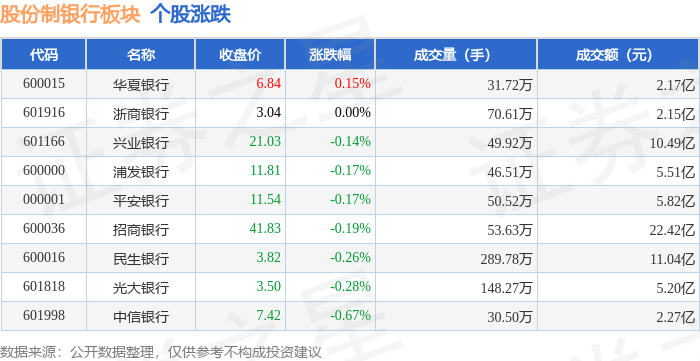
股份制银行板块12月24日跌0.22%,中信银行领跌,主力资金净流出2.53亿元
Zheng Xing Xing Ye Ri Bao· 2025-12-24 09:10
证券之星消息,12月24日股份制银行板块较上一交易日下跌0.22%,中信银行领跌。当日上证指数报收 于3940.95,上涨0.53%。深证成指报收于13486.42,上涨0.88%。股份制银行板块个股涨跌见下表: | 代码 | 名称 | 收盘价 | 涨跌幅 | 成交量(手) | 成交额(元) | | --- | --- | --- | --- | --- | --- | | 600015 | 华夏银行 | 6.84 | 0.15% | 31.72万 | 2.17亿 | | 601916 | 浙商银行 | 3.04 | 0.00% | 70.61万 | 2.15亿 | | 601166 | 兴业银行 | 21.03 | -0.14% | 49.92万 | 10.49 乙 | | 600000 | 浦发银行 | 11.81 | -0.17% | - 46.51万 | 5.51亿 | | 000001 | 平安银行 | 11.54 | -0.17% | 50.52万 | 5.82亿 | | 600036 | 招商银行 | 41.83 | -0.19% | 53.63万 | 22.42 乙 | | 600016 | ...