千禾味业

Search documents
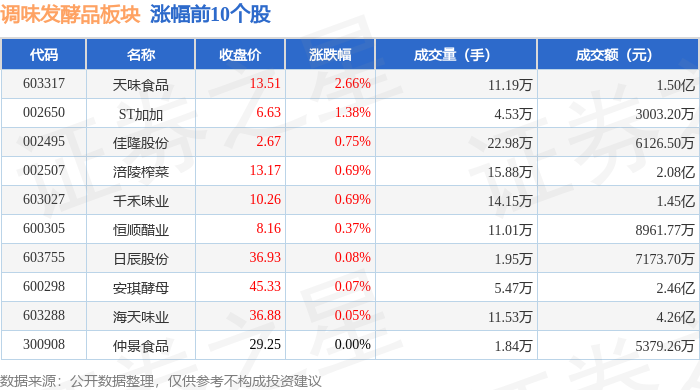
调味发酵品板块1月20日涨0.11%,天味食品领涨,主力资金净流出4702.35万元
Zheng Xing Xing Ye Ri Bao· 2026-01-20 08:51
Group 1 - The seasoning and fermentation sector saw a slight increase of 0.11% on January 20, with Tianwei Food leading the gains [1] - The Shanghai Composite Index closed at 4113.65, down 0.01%, while the Shenzhen Component Index closed at 14155.63, down 0.97% [1] - Key stocks in the seasoning and fermentation sector showed varied performance, with Tianwei Food closing at 13.51, up 2.66%, and other notable stocks like ST Jiajia and Jialong Co. also experiencing gains [1] Group 2 - The sector experienced a net outflow of 47.02 million yuan from institutional investors, while retail investors saw a net inflow of 41.85 million yuan [2] - The individual stock performance indicated that Hai Tian Wei Ye had a significant net outflow of 35.27 million yuan from institutional investors, while retail investors contributed a net inflow of 30.45 million yuan [3] - Other stocks like Jialong Co. and ST Jiajia had mixed net inflows and outflows from different investor categories, reflecting varied investor sentiment within the sector [3]


食品饮料行业:月聚焦:如何布局零食“春季躁动”?
GF SECURITIES· 2026-01-20 06:14
Group 1 - The report highlights the "Spring Excitement" in the snack sector, indicating a historical high relative win rate of 70% for the food and beverage sector in the 40 days leading up to the Spring Festival [7][16] - The report emphasizes that the "Spring Excitement" is not solely dependent on the annual beta of the food and beverage sector, as structural opportunities still exist despite a long-term adjustment period since 2021 [7][16] - Key catalysts for the upcoming Spring Festival include concentrated demand for gifts and gatherings, which leads to more planned channel stocking, creating a positive feedback loop of expectations and validations [7][16][28] Group 2 - In December, the food and beverage sector underperformed the market by 7.5 percentage points, with a decline of 5.2%, ranking last among 31 primary industries [7][61] - The report notes a divergence in performance among sub-sectors, with snacks and soft drinks showing gains while liquor and beer experienced declines [7][61][64] - The absolute and relative valuations of the food and beverage sector are at their lowest since 2010, indicating potential investment opportunities [7][61][64] Group 3 - The report tracks the recovery of consumer confidence, with a 0.9% year-on-year increase in retail sales in December, showing improvement from the previous month [7][63] - It highlights that the liquor sector is facing weak demand and declining prices, with the price adjustments for premium liquor nearing levels seen between 2011 and 2015 [7][63][64] - The report identifies structural differentiation in costs, with some packaging materials and agricultural products experiencing price increases [7][63][64] Group 4 - Investment recommendations include a focus on liquor stocks that have undergone a four-year adjustment period, with potential for a "valuation + performance" double bottom [7][64] - For consumer goods, the report anticipates a moderate increase in industry prices in 2026, with specific recommendations for companies like Anjuke Foods, Qianhe Flavor, and Eastroc Beverage [7][64] - The report suggests that the upcoming Spring Festival will provide a favorable environment for growth narratives, particularly in the restaurant supply chain and certain chain formats [7][64]






如何看2025年12月消费数据
2026-01-20 01:50
Summary of Key Points from Conference Call Records Industry Overview - **Consumer Sector Performance**: In December 2025, the overall retail sales growth was 0.9% year-on-year, with a full-year growth of 3.7%. Online retail grew by 5.2% for the year, while offline retail showed slower growth [2][3]. Key Insights and Arguments - **Retail Categories**: - Supermarket retail sales increased by 4.3% year-on-year, while department stores only saw a 0.1% increase [3]. - Essential goods performed well, with grain and oil food growth at 3.9%. In the discretionary category, cosmetics grew by 8.8%, and gold and jewelry increased by 5.9% due to a rise in gold prices [3][4]. - Communication equipment maintained a growth rate of over 20%, while home appliances declined by 19% due to tightening subsidies [3][4]. - **Automotive Sector**: - The total retail sales for automobiles reached 548.2 billion, down 5% year-on-year. Passenger car sales fell by 8.8%, but new energy vehicle wholesale sales grew by 3.3% [11]. - **Textile and Apparel**: - The textile and apparel sector saw a 0.6% year-on-year retail growth in December, but a decline in month-on-month performance due to weather and the delayed Spring Festival [13][14]. - **Alcohol Industry**: - The retail sales of the liquor industry decreased by 2.9% year-on-year in December, with a price index decline of 0.19%. The industry is currently in a phase of active inventory reduction [16][17]. - **Consumer Expectations**: - Due to the late Spring Festival and expectations of rising gold prices, consumer demand is anticipated to recover in January and February 2026 [5]. Additional Important Insights - **Investment Recommendations**: - In the beauty and personal care sector, companies like Shiseido and domestic brands such as Maogeping are recommended. For the gold and jewelry sector, brands with strong store expansion logic are highlighted [6][10]. - In the automotive sector, companies like JAC Motors and Geely are recommended, focusing on high-end and luxury markets [12]. - For the textile and apparel sector, brands like Li Ning and Fuanna are suggested, with a focus on companies that can support their market value through dividends [15]. - **Household Appliances**: - The household appliance sector is experiencing a downturn, with significant declines in sales across various categories. However, leading companies like Midea and Haier are expected to maintain slight growth due to low inventory levels [21][22][24]. - **Light Industry**: - The light industry saw a decline in furniture sales by 2.2% year-on-year, with exports down by 9.8%. However, some companies are expected to see revenue and profit recovery in 2026 [26][27]. Conclusion The consumer sector is facing mixed performance across various categories, with essential goods showing resilience while discretionary spending is under pressure. Investment opportunities exist in specific brands and sectors that are positioned to benefit from changing consumer behaviors and market dynamics.
月聚焦:如何布局零食“春季躁动”?
GF SECURITIES· 2026-01-20 01:07
Group 1 - The core view of the report emphasizes the high relative success rate of the food and beverage sector during the pre-Spring Festival period, with a historical success rate of 70% in the last ten years [7][16] - The report identifies structural opportunities within the food and beverage sector despite a long-term adjustment phase since 2021, highlighting the importance of seasonal demand and planned channel stocking [7][16] - The report suggests three strategic approaches for investment in the snack sector during the "spring excitement" period, focusing on companies with clean chips, strong growth themes, and clear growth drivers [7][49] Group 2 - In December, the food and beverage sector underperformed the market, with a decline of 5.2%, lagging behind the CSI 300 index by 7.5 percentage points, ranking last among 31 primary industries [7][61] - The report notes a divergence in performance among sub-sectors, with snacks and soft drinks showing gains while liquor and beer sectors faced declines [7][61] - The report highlights that the absolute and relative valuations of the food and beverage sector are at their lowest levels since 2010, indicating potential investment opportunities [7][61][64] Group 3 - The report tracks the recovery of consumer confidence, with a December retail sales growth of 0.9%, showing improvement from the previous month [7][63] - It notes that the liquor sector is experiencing weak demand and price adjustments, particularly for high-end products like Moutai, which is nearing historical price levels [7][63] - The report indicates that the cost structure is showing divergence, with some packaging materials and agricultural products experiencing price increases [7][63][64] Group 4 - Investment recommendations include a focus on liquor stocks that have undergone a four-year adjustment period, with potential for valuation and performance recovery [7][64] - For consumer goods, the report anticipates a moderate increase in industry prices in 2026, highlighting opportunities in new products and channels [7][64] - Specific stock recommendations include Luzhou Laojiao, Shanxi Fenjiu, and various consumer goods companies such as Anjuke Foods and Dongpeng Beverage [7][64]


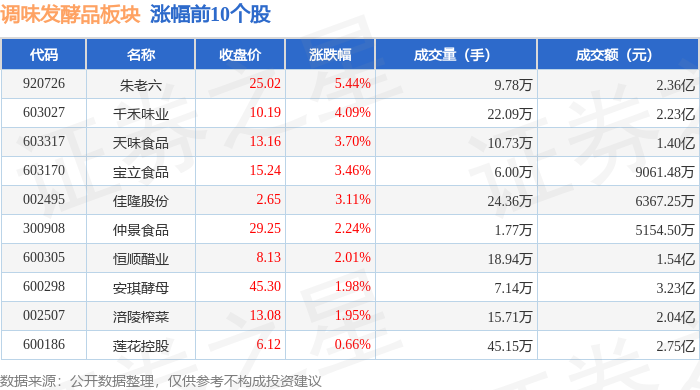
调味发酵品板块1月19日涨0.41%,朱老六领涨,主力资金净流出6624.48万元
Zheng Xing Xing Ye Ri Bao· 2026-01-19 08:52
Market Overview - The seasoning and fermentation sector increased by 0.41% on January 19, with Zhu Laoliu leading the gains [1] - The Shanghai Composite Index closed at 4114.0, up 0.29%, while the Shenzhen Component Index closed at 14294.05, up 0.09% [1] Stock Performance - Zhu Laoliu (code: 920726) closed at 25.02, up 5.44% with a trading volume of 97,800 shares and a transaction value of 236 million [1] - Qianhe Flavor (code: 603027) closed at 10.19, up 4.09% with a trading volume of 220,900 shares and a transaction value of 223 million [1] - Tianwei Food (code: 603317) closed at 13.16, up 3.70% with a trading volume of 107,300 shares and a transaction value of 140 million [1] - Other notable stocks include Baoli Food (code: 603170) up 3.46%, Jialong Co. (code: 002495) up 3.11%, and Zhongjing Food (code: 300908) up 2.24% [1] Capital Flow - The seasoning and fermentation sector experienced a net outflow of 66.24 million from institutional investors, while retail investors saw a net inflow of 21.38 million [2] - The sector's overall capital flow indicates a mixed sentiment among different investor types [2] Individual Stock Capital Flow - Zhu Laoliu had a net outflow of 23.53 million from institutional investors, with a retail net inflow of 1.83 million [3] - Hai Tian Flavor (code: 603288) saw a net inflow of 16.67 million from institutional investors but a net outflow of 24.60 million from retail investors [3] - Hengshun Vinegar (code: 600305) had a net inflow of 12.32 million from institutional investors, while retail investors experienced a net outflow of 13.99 million [3]


AI赋能下的消费品投资机遇
2026-01-19 02:29
Summary of Key Points from Conference Call Records Industry and Company Overview - The conference call discusses investment opportunities in the consumer goods sector, particularly focusing on AI applications, AR technology, smart glasses, and AI education [1][2] - Companies mentioned include Yiyuan Yichuang, Quark, Tianli International Holdings, Huatu Shanding, Fenbi, Kevin Education, Focus Technology, Xiaogoods City, and Qingmu Technology [1][2][3][4] Core Insights and Arguments AI and AR Applications - The development of AR technology is expected to significantly impact traffic distribution and marketing channels, with companies like Yiyuan Yichuang already making strides in this area [2] - Smart glasses are becoming more affordable, priced around 1,000 yuan, and are anticipated to replace traditional glasses, with domestic companies like Quark showing strong performance [2] - AI education is addressing challenges in personalized learning and scalability, with companies like Tianli International Holdings and Huatu Shanding rapidly expanding their offerings [2] E-commerce Transformation - AI tools are transforming the e-commerce landscape through functionalities like image and video generation and cross-border translation, with companies like Focus Technology excelling in B2B platforms [3] Food and Beverage Sector - The food and beverage industry is showing signs of recovery, with companies like Anji Food, Baoli Food, and Qianhe Flavor Industry seeing stock price increases. A rising CPI is expected to further strengthen this trend [4] - The liquor sector is projected to accelerate its recovery starting Q3 2025, with companies like Moutai benefiting from price elasticity [4] Market Competition Changes - The public servant exam training and gold jewelry sectors are experiencing improved competitive dynamics, with online and offline integration reshaping the public exam training ecosystem [5] - The tourism industry is also expected to see increased demand, supported by favorable policies and anti-monopoly investigations benefiting upstream resources [5] Additional Important Insights Investment Recommendations - Investors are advised to focus on undervalued companies, particularly those significantly below their fair value, such as Action Education and Jiangsu Guotai [6] - The cultural tourism and retail sectors are anticipated to undergo significant transformations, presenting investment opportunities [6] Cotton Industry Trends - The cotton industry is witnessing a stabilization in prices, with Brazil expected to reduce production in 2025-2026, alleviating inventory pressures. Companies like Bailong Dongfang, with significant overseas capacity, are recommended for investment [7] Agricultural Sector Developments - AI technology is being applied in pig farming to reduce costs, with a slight increase in pork prices noted [8][9] Light Industry and Home Appliances - The light industry is seeing advancements in AI applications, particularly in smart glasses and toys, with companies like Mingyue Lens and Konnate expected to perform well [10][11] - The home appliance sector is closely tied to AI, with companies like Midea making significant progress in robotics, although competition is intense [14][15] Small Appliance Sector Strategies - Small appliance companies are encouraged to innovate their marketing strategies to adapt to the current market environment, with firms like Xiaoxiong and Xinbao actively expanding their operations [16]
食品饮料行业:春节走访:河南、上海市场跟踪
GF SECURITIES· 2026-01-18 10:06
Core Insights - The report maintains a "Buy" rating for the food and beverage industry, consistent with previous ratings, indicating a positive outlook for the sector [4] - The report highlights the cautious inventory management in the liquor market, particularly in Henan, with the upcoming Spring Festival sales performance still uncertain [17][19] - The demand for frozen food in Henan is showing signs of improvement as preparations for the Spring Festival begin, with increased confidence among distributors [22] - In Shanghai, the "锅圈" (Guoquan) stores are undergoing significant renovations, leading to a notable increase in daily sales post-renovation [25][27] Weekly Focus: Henan & Shanghai Market Tracking - **Henan Liquor Market**: Inventory levels are low, and major brands like Moutai are seeing stable pricing, with the Spring Festival sales performance yet to be observed [17][19] - **Henan Food Supply Market**: Distributors are beginning to stock up for the Spring Festival, with a slight uptick in demand noted [22] - **Shanghai Guoquan Store Renovations**: The store renovations have led to a significant increase in daily sales, with new product categories contributing to revenue growth [25][27] Food and Beverage Sector Overview - The food and beverage sector experienced a decline of 2.1% in the week of January 12-16, underperforming compared to the CSI 300 index [29] - The valuation of the food and beverage sector stands at a PE-TTM of 21.2X, with the white liquor sector at 18.3X, indicating a relative valuation compared to the broader market [43][46] Recent Key Announcements & News - The report includes updates on major companies like Qianwei Culinary and Sanquan Foods, highlighting their strategic adjustments and product innovations aimed at enhancing competitiveness [23][24] - The report notes that the industry is moving away from price wars towards a focus on product innovation and quality assurance [24] Investment Recommendations - The report recommends key liquor brands such as Luzhou Laojiao, Shanxi Fenjiu, and Moutai, as well as consumer goods companies like Anjuke Foods and Tianwei Foods, indicating potential investment opportunities [8][12]




颐海国际(01579):颐海国际跟踪报告:关联方企稳,2B、海外延续较快成长
GUOTAI HAITONG SECURITIES· 2026-01-17 11:20
Investment Rating - The investment rating for the company is "Accumulate" [2][6]. Core Insights - The report highlights the return of the founder of Haidilao, which is expected to stabilize the related party business and continue rapid growth in the third-party business [3]. - The company anticipates that the related party business will recover in the second half of 2025, driven by improvements in Haidilao's operations and pricing adjustments [10]. - The overseas and B2B businesses are projected to drive the third-party business's growth, with overseas revenue expected to reach 266 million RMB in the first half of 2025, reflecting a year-on-year increase of 34.43% [10]. Financial Summary - Total revenue is projected to grow from 6,147.57 million RMB in 2023 to 8,118.23 million RMB by 2027, with a compound annual growth rate (CAGR) of approximately 8.99% [4]. - Net profit is expected to decrease from 852.70 million RMB in 2023 to 739.43 million RMB in 2024, before recovering to 962.06 million RMB by 2027 [4]. - The company’s price-to-earnings (PE) ratio is projected to decrease from 13.04 in 2023 to 14.60 in 2027, indicating a potential increase in valuation [4]. Business Performance - The related party business is expected to stabilize, with a low profit margin of around 13% in the first half of 2025, suggesting limited room for further decline [10]. - The overseas business is anticipated to maintain rapid growth, supported by the ramp-up of production capacity in Thailand and enhanced local supply chain capabilities [10]. - The B2B segment is expected to continue its rapid growth due to brand and cost advantages, as well as the establishment of a professional B2B team [10].
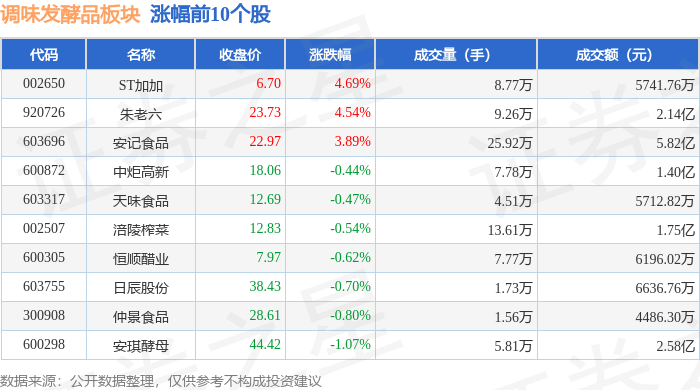
调味发酵品板块1月16日跌1.29%,佳隆股份领跌,主力资金净流出2.54亿元
Zheng Xing Xing Ye Ri Bao· 2026-01-16 08:56
Market Overview - The seasoning and fermentation sector experienced a decline of 1.29% on January 16, with Jialong Co., Ltd. leading the drop [1] - The Shanghai Composite Index closed at 4101.91, down 0.26%, while the Shenzhen Component Index closed at 14281.08, down 0.18% [1] Stock Performance - Notable gainers in the seasoning and fermentation sector included: - ST Jiajia (002650) with a closing price of 6.70, up 4.69% on a trading volume of 87,700 shares and a transaction value of 57.42 million yuan [1] - Zhu Laoliu (920726) closed at 23.73, up 4.54% with a trading volume of 92,600 shares and a transaction value of 214 million yuan [1] - Anji Food (603696) closed at 22.97, up 3.89% with a trading volume of 259,200 shares and a transaction value of 582 million yuan [1] - Decliners included: - Jialong Co., Ltd. (002495) closed at 2.57, down 2.65% with a trading volume of 296,900 shares and a transaction value exceeding 76.84 million yuan [2] - Lianhua Holdings (600186) closed at 6.08, down 2.41% with a trading volume of 726,100 shares and a transaction value of 444 million yuan [2] - Hai Tian Flavoring (603288) closed at 36.99, down 1.60% with a trading volume of 181,500 shares and a transaction value of 674 million yuan [2] Capital Flow - The seasoning and fermentation sector saw a net outflow of 254 million yuan from institutional investors, while retail investors contributed a net inflow of 158 million yuan [2] - The capital flow for specific stocks showed: - Zhu Laoliu (920726) had a net inflow of 15.38 million yuan from institutional investors [3] - ST Jiajia (002650) experienced a net outflow of 8.58 million yuan from institutional investors [3] - Anji Yeast (600298) had a net inflow of 6.59 million yuan from institutional investors [3]

广发证券:供需重构 餐供行业拐点渐显
Zhi Tong Cai Jing· 2026-01-16 07:25
Core Viewpoint - The restaurant supply industry is undergoing a structural transformation, shifting from "passive supporters" to "active drivers" as companies adapt to a more cautious capital expenditure environment and a less aggressive price competition landscape [1][2]. Supply Side - The peak of capital expenditure has passed, revealing opportunities for structural adjustment within the restaurant supply industry. The industry continues to grow driven by the expansion of the restaurant sector, increased chain rates, and high growth in food delivery services. However, the past few years of downturn in the downstream restaurant sector and supply surplus have accelerated industry consolidation. Leading companies are moving away from past extensive capacity expansion and distribution strategies towards efficient service for large clients and refined operations for smaller clients, focusing on quality growth through product innovation and customization [2]. Demand Side - Historical analysis shows that when the Consumer Price Index (CPI) transitions from negative to positive or enters an upward phase, market expectations for consumer recovery often lead to capital flowing into cyclical sectors like the restaurant supply chain. The CPI is expected to turn positive in October 2025, indicating a mild recovery in consumer demand, which creates a favorable macro environment for the restaurant supply sector. The performance of leading companies has shown improvement since Q3 2025, suggesting that while the industry has not entered a high-growth phase, it has passed its worst stage and is currently stabilizing, with potential for both performance and valuation recovery [3]. Valuation - The restaurant supply sector's valuation has fallen to historically low levels, and the sector remains underweight, providing a high margin of safety and emotional recovery potential. Key segments include: 1. Frozen baking: The industry is expected to maintain rapid growth with a CAGR of 22.1% from 2020 to 2025. Leading company Lihigh Foods (300973) is benefiting from new product launches and channel expansion, with significant growth potential in its frozen baking business and cream business due to domestic substitution acceleration [4]. 2. Frozen food: The price competition has significantly weakened, with leading company Anjui establishing a clear advantage over competitors in management, channels, and capacity. The company is expected to enjoy dual benefits from industry growth and market share increase due to a rich pipeline of new products in 2025 [4]. 3. Compound seasoning: The current penetration rate in China is only 25.4%, compared to over 50% in mature markets like Europe, the U.S., and Japan, indicating substantial growth potential. The long-term development of leading companies in Western-style compound seasoning, such as Baoli Foods (603170) and Chinese-style compound seasoning companies like Tianwei Foods (603317) and Richen Co. (603755) is promising [4]. Investment Recommendations - The sector is currently in a phase of low valuation and institutional holdings, with demand stabilizing and improving policy conditions. Capital expenditures have significantly decreased, and the competitive landscape is shifting from price wars to a more rational framework. Leading companies are actively pursuing new products and channels (membership supermarkets/new retail), mergers and acquisitions, and R&D initiatives, providing high certainty and elasticity. It is recommended to focus on large-cap stocks for allocation and small-cap stocks for elasticity, with particular attention to the performance improvements of Anjui Foods (603345), Lihigh Foods (300973), and Qianhe Flavor (603027), as well as the growth elasticity from new channels and category expansions of Tianwei Foods (603317), Guoquan (02517), and Qianwei Yangchu (001215) [5].