强生

Search documents
城记|锚定“全球新” 上海浦东加快构建世界级医疗器械产业集群
Xin Hua Cai Jing· 2025-11-21 10:34
Core Insights - The Chinese medical device industry has entered a golden period of innovation, with more Chinese companies appearing in the global TOP 100 rankings and showing upward trends in their positions [2][4] - The overall market size of China's medical device industry is projected to reach 1.35 trillion yuan in 2024, making it the second-largest market globally [3] Group 1: Industry Growth and Innovation - Leading Chinese companies like Mindray, Weigao, and United Imaging have made significant strides, with 12 domestic firms entering the global TOP 100 list, and Mindray ranking 25th, up two spots from the previous year [4] - Over 50% of Mindray's profits now come from overseas markets, indicating a successful transition from a follower to a leader in specific segments [4] - The industry is experiencing a shift from imitation to innovation, driven by intense competition and the need for differentiation [4][5] Group 2: Collaborative Ecosystem - The collaboration between industry, hospitals, and research institutions is crucial for transforming innovative ideas into market-ready products [5] - The establishment of the Shanghai Clinical Innovation Transformation Research Institute exemplifies efforts to streamline the process from clinical needs to product development [5][6] Group 3: Regulatory and Institutional Innovations - The regulatory framework is evolving to support innovation, with a focus on adapting to new technologies like brain-computer interfaces and surgical robots [6] - Shanghai's Pudong New Area is leading in medical device regulatory reforms, aiming to transition from domestic replacement to global innovation standards [6][8] Group 4: Regional Development and Internationalization - Pudong has a solid medical device industry foundation, with over 500 R&D and manufacturing companies, accounting for 25% of the city's total [7] - The region has approved 38 innovative medical devices, representing about 10% of the national total, including several global firsts [7] - Pudong is also a hub for international collaboration, with over 200 foreign medical device companies and more than 60 local firms successfully entering international markets [7][8] Group 5: Future Plans and Strategic Initiatives - Pudong has launched a development plan for high-end medical devices from 2025 to 2027, focusing on innovation, park clustering, and ecosystem enhancement [8][9] - The area aims to become a global center for innovative medical devices and a preferred location for scientific entrepreneurship and regulatory reforms [9]


2025医药行业合规与信用建设大会即将在京启幕
Yang Guang Wang· 2025-11-19 07:56
Core Viewpoint - The "2025 Pharmaceutical Industry Compliance and Credit Construction Conference" aims to establish a compliance credit ecosystem across the entire pharmaceutical industry chain, focusing on sustainable development and supporting the Healthy China strategy [1][2]. Group 1: Conference Overview - The conference will take place from November 29 to 30 in Beijing, organized by the All-China Federation of Industry and Commerce Pharmaceutical Industry Chamber [1]. - The core theme of the conference is "Compliance and Credit, Safeguarding Long-term Development" [1]. Group 2: Key Participants and Mechanisms - A new three-dimensional dialogue mechanism involving "medical institutions, chambers of commerce, and pharmaceutical companies" will be introduced to promote compliance consensus [2]. - Leaders from major companies such as Yangtze River Pharmaceutical Group, Hengrui Medicine, and Merck China will engage in high-level discussions with clinical institution leaders [2]. - The Compliance and Credit Working Committee of the All-China Federation of Industry and Commerce Pharmaceutical Industry Chamber has been established, and an action plan for industry self-regulation will be released [2]. Group 3: Solutions and Innovations - Leading global institutions will present cutting-edge solutions to empower corporate transformation during the conference [3]. - Top law firms and consulting teams will provide insights on compliance essentials and share practical tools for financial and tax compliance [3]. - AI and big data applications will be showcased to enhance compliance in academic promotion [3]. Group 4: Significant Announcements - The conference will unveil two major group standards in the compliance field and launch a compliance credit information sharing platform [4]. - A report on "Safety Risk Prevention for Chinese Pharmaceutical Enterprises Going Global" will be released to support internationalization efforts [4]. Group 5: Focus on High-Quality Development - The conference will explore the coexistence of compliance and innovation, with discussions involving top medical institution managers and pharmaceutical company compliance officers [5]. - Experts will discuss the integration of real-world value assessment in medical insurance and the drive for new productive forces in academic promotion [5].
第五套重启后,首单“人工心”械企核心医疗冲刺科创板IPO
Hua Er Jie Jian Wen· 2025-11-17 12:48
Core Viewpoint - The resumption of the fifth set of IPO standards on the Sci-Tech Innovation Board has led to significant developments for innovative medical device companies, with Shenzhen Core Medical Technology Co., Ltd. being the first to have its IPO application accepted under these new standards, focusing on artificial hearts [1][2]. Company Overview - Core Medical specializes in artificial hearts, reporting a revenue of 94 million yuan in 2024, which represents a growth of over 400% year-on-year, despite a net loss of 132 million yuan during the same period [1]. - The revenue surge is attributed to the successful market launch of its magnetic levitation implantable left ventricular assist device, Corheart® 6, which has generated substantial income [1][4]. Product Details - Corheart® 6 is the first commercially available third-generation magnetic levitation artificial heart, recognized for being the smallest and lightest of its kind globally, weighing only 0.8 kg, which is nearly 50% lighter than its competitor, Abbott's HeartMate 3 [3][4]. - The production cost of Corheart® 6 is approximately 70,000 yuan per unit, with a selling price of 247,200 yuan, resulting in a gross margin close to 70% [9]. Market Challenges - The high price of Corheart® 6, along with the overall surgical costs reaching up to 700,000 yuan, limits the affordability for many patients in China, posing a challenge for its commercialization [1][9]. - Core Medical faces competition not only from Abbott but also from domestic companies like Tongxin Medical and Aerospace Taiheart, which have already launched their products [6][11]. International Expansion - To expand its market, Core Medical aims to penetrate overseas markets, particularly the U.S., where it has yet to initiate clinical trials for Corheart® 6, although it has received approvals in Colombia and Ukraine [6][7]. - The company has other products, such as DuoCor® 2 and CorVad® 4.0/6.0, which are expected to gain approval in the U.S. by 2030, indicating a longer timeline for revenue realization [7]. Industry Landscape - The global heart failure market is projected to grow, with the number of heart failure patients expected to rise from 62.98 million in 2024 to 71.51 million by 2033, presenting a significant opportunity for artificial heart technologies [11]. - However, the emergence of alternative therapies, such as minimally invasive atrial shunt devices, poses additional competition for artificial heart products [11].
靖因药业IPO:32项重大专利未获授权 靠非经常损益扭亏只是昙花一现 ?
Xin Lang Zheng Quan· 2025-11-14 05:38
Core Viewpoint - Sirius Therapeutics has submitted its listing application to the Hong Kong Stock Exchange, with a valuation of approximately $253 million after its Series B funding round in April 2025, backed by prominent investors [1][2]. Group 1: Company Overview - Sirius Therapeutics was established in 2021 and focuses on developing siRNA therapies [1]. - The company is co-founded by top healthcare investment firms OrbiMed Entities and Creacion Ventures, holding over 40% of shares, with Tencent's investment arm holding 8.14% and Hancan Capital holding over 13% [1]. - The company reported a net loss of 309 million yuan and 342 million yuan for 2023 and 2024, respectively, totaling 651 million yuan in losses [3]. Group 2: Financial Performance - In the first half of 2025, Sirius Therapeutics achieved a net profit of 34.46 million yuan, marking its first profitable period, primarily driven by non-recurring income [3][4]. - The company generated 144 million yuan in other income, a significant increase from 4.51 million yuan in the same period last year, largely due to a strategic partnership with CRISPR Therapeutics [3][4]. Group 3: Product Pipeline and Challenges - The core product, SRSD107, is in Phase II clinical trials for venous thromboembolism, while two key products, SRSD216 and SRSD384, are also in various stages of development [5][6]. - The company faces significant competition in the FXI/FXIa inhibitor space, with several competitors already in Phase III trials, including drugs from Novartis, Bayer, and Johnson & Johnson [7][8]. - Sirius Therapeutics has 65 patents and applications, but only one has been granted, with 32 critical patents pending, posing potential risks in a competitive biopharmaceutical landscape [9].

未来3年医药行业的4大投资机遇
青侨阳光投资交流· 2025-11-13 07:59
Core Viewpoint - The pharmaceutical sector has experienced significant fluctuations, with a prolonged downturn from 2021 to 2024, followed by a substantial recovery in 2025. The Hang Seng Medical Index has doubled from its lowest point but still has room to grow compared to previous highs, while the A-share medical index remains significantly below its historical peak [1][2]. Group 1: Investment Opportunities in the Pharmaceutical Sector - The current market sentiment towards the pharmaceutical sector is cautious, with a need to reassess the understanding of the industry and future prospects [2]. - Four major investment opportunities in the pharmaceutical sector over the next three years have been identified, which may influence future fund allocation strategies [2]. Group 2: Domestic High-Value Consumables - Domestic high-value consumables, particularly in the context of "innovation + going global," show strong growth potential, although market consensus is still lacking [3][9]. - The market capitalization of domestic high-value consumables companies is significantly lower than their international counterparts, indicating substantial growth potential [5][9]. - The characteristics of high-value consumables align well with China's manufacturing strengths, suggesting that the emergence of world-class companies in this sector is likely [9][10]. Group 3: U.S. Biotech Sector - The U.S. biotech sector is experiencing a second upward cycle driven by various intracellular biological technologies achieving clinical validation [14]. - The rise of domestic innovative drugs has created competitive pressure on U.S. biotech firms, but it also opens opportunities for collaboration and integration [14][15]. - The market for intracellular technologies is expected to grow, with significant investment opportunities in U.S. biotech companies [16][19]. Group 4: Domestic Innovative Drugs - The domestic innovative drug sector is entering a golden window of opportunity following deep medical reforms, with strong growth potential anticipated in the coming years [23][24]. - The growth trajectory of domestic innovative drugs mirrors that of the U.S. market in the 1980s, suggesting a potential for a prolonged high-growth cycle [25][27]. - The competitive landscape for domestic innovative drugs is evolving, with a focus on maintaining product quality and performance to succeed in a mature global market [27][29]. Group 5: Overall Pharmaceutical Industry Trends - The overall growth rate of the pharmaceutical industry is expected to accelerate marginally over the next three years, improving the industry’s overall outlook [29][30]. - The anticipated recovery in industry revenue and profit margins is driven by the maturation of previously loss-making innovative drug companies and a reduction in competitive pressures [30][35]. - Despite the positive outlook, the market has yet to fully recognize the potential for recovery, as evidenced by low valuation levels compared to historical averages [33].

未来3年医药行业的4大投资机遇
雪球· 2025-11-13 07:57
Core Viewpoint - The pharmaceutical sector has experienced significant fluctuations, with a notable recovery expected in the coming years, particularly in the context of the Chinese market and its potential for innovation and growth [3][4]. Group 1: Current Market Analysis - As of October 2025, the Hang Seng Medical Index is at 4048 points, reflecting a 100% increase from its lowest point but still has room to grow compared to its previous high of 8396 points [3]. - The A-share pharmaceutical index stands at 9488 points, only reaching 25% of its previous high of 16906 points, indicating a slower recovery compared to Hong Kong stocks [3]. - The overall valuation of covered pharmaceutical stocks has stabilized around historical averages, but a recent market pullback has raised questions about future performance [3][4]. Group 2: Investment Opportunities - The domestic high-value consumables market shows strong potential for growth, particularly in the context of "innovation + going global," although market consensus on this potential is still lacking [4][10]. - The market capitalization of leading domestic biotech companies is approaching that of their international counterparts, indicating a significant growth opportunity in the high-value consumables sector [4][10]. - The disparity in market capitalization between U.S. and Chinese high-value consumables companies raises questions about the potential for Chinese firms to achieve similar valuations [6][10]. Group 3: Future Growth Drivers - The high-value consumables sector is characterized by a strong innovation pipeline, with many products in the regulatory approval process, suggesting continued growth in this area [9][10]. - The potential for significant unmet medical needs in areas such as heart valve treatments and neuromodulation therapies presents further opportunities for innovation and market expansion [9][10]. - The increasing competitiveness of domestic high-value consumables firms in international markets is expected to drive growth, with several products nearing market entry in Europe and the U.S. [11][13]. Group 4: Biotech Sector Insights - The U.S. biotech sector is poised for a second upward cycle driven by various innovative technologies, particularly in cell-based therapies [15][16]. - The siRNA technology has shown promise in clinical applications, with a historical trajectory that suggests a potential for significant market recovery and growth [17][20]. - Gene editing technologies are gaining traction as they offer the potential for permanent solutions to diseases, which could reshape treatment paradigms in the future [22][23]. Group 5: Domestic Innovation and Market Trends - The domestic innovative drug sector is entering a critical phase, with the potential for substantial growth driven by ongoing reforms and market expansion [23][25]. - The historical context of U.S. pharmaceutical growth during the 1980s suggests that China may experience a similar trajectory, with the current phase representing only the first half of a longer growth cycle [25][26]. - The increasing focus on high-quality, innovative products in the Chinese market is expected to enhance competitiveness and drive future growth [28][30]. Group 6: Overall Industry Outlook - The pharmaceutical industry is anticipated to see a recovery in total revenue growth, with projections suggesting a return to a stable growth rate of 6%-9% over the next three years [32][34]. - The potential for improved profit margins is linked to the maturation of previously unprofitable innovative drug companies and a reduction in competitive pressures [32][34]. - Despite current low valuations, the pharmaceutical sector's long-term growth prospects remain strong, making it an attractive investment opportunity [34].

强生周敏涛:不再只靠自己创新 正全面融入中国创新生态
Jing Ji Guan Cha Wang· 2025-11-11 10:58
Core Insights - The surgical robot market is highly competitive but not saturated, with significant growth potential in China [2] - Johnson & Johnson is accelerating its investment in the surgical robot sector in China, particularly through partnerships with local companies [2][7] - The Haishan I, developed by Chinese company RuLong Surgical, is a notable product showcased by Johnson & Johnson, representing a strategic collaboration [2][3] Market Dynamics - The surgical robot market is characterized by intense competition, with Intuitive Surgical's Da Vinci system holding a dominant market share of 53.8% as of Q2 2025 [3] - RuLong Surgical's Haishan I is the first modular surgical robot in China, offering flexibility and lower production costs compared to traditional integrated systems [3][4] - Johnson & Johnson's entry into the surgical robot market has been relatively late, but the company has made several acquisitions and is optimistic about future growth [4][5] Product Development - Johnson & Johnson currently has one approved surgical robot in China, the MONARCH, while aiming for a target installation of 500 units for the Haishan I within five years [4][5] - The Haishan I has received approvals for multiple surgical applications, unlike many competitors that require separate approvals for each application [3][4] Pricing and Cost Structure - The high cost of surgical robots has historically limited their adoption, with prices for leading models exceeding 20 million yuan [5][6] - Johnson & Johnson is focused on optimizing technology and supply chains to reduce costs and improve competitiveness in the market [6] Collaboration and Commercialization - Johnson & Johnson has engaged in several collaborations with local medical device companies to enhance commercialization efforts [7] - The company is also exploring international markets for its products, contingent on confirming quality and supply chain stability [8] Market Opportunities - The aging population in China presents a significant opportunity for the medical device market, driving demand for surgical interventions [8] - Johnson & Johnson showcased over 1,000 products at the China International Import Expo, indicating a strong commitment to integrating into China's innovation ecosystem [8]

艾滋病(HIV):关注长效制剂、多重耐药和功能性治愈三大方向
Changjiang Securities· 2025-11-11 06:10
Investment Rating - The report maintains a "Positive" investment rating for the HIV sector [14] Core Insights - The HIV/AIDS sector has significant unmet clinical needs despite advancements in antiretroviral therapy (ART), which has transformed HIV from a fatal disease to a manageable chronic condition. Key areas of focus include long-acting formulations, multi-drug resistance (MDR), and functional cures [4][11][44] Summary by Sections Disease Burden and Unmet Needs - As of the end of 2022, there were approximately 39 million people living with HIV/AIDS globally, with over 1 million new cases annually. In China, over 50,000 new cases are reported each year, with 1.39 million living with HIV as of mid-2025 [9][23] New Drug Development Directions - The report identifies three main directions for new drug development in the HIV field: 1. Long-acting formulations to improve patient adherence and reduce side effects [11][45] 2. Addressing multi-drug resistance, with only three FDA-approved drugs specifically for MDR [11][57] 3. Exploring functional cures, which aim to maintain undetectable viral loads after stopping ART [11][62] Long-Acting Formulations - Long-acting antiretroviral drugs, such as Cabenuva, have shown significant market potential, with projected sales reaching $1.294 billion in 2024. These formulations aim to reduce the burden of daily medication [11][49] Multi-Drug Resistance - The prevalence of multi-drug resistant HIV is increasing, particularly among newly treated patients. The report highlights the need for more effective treatment options as current approved drugs are limited [11][56] Functional Cure Strategies - Functional cure strategies are being explored, including methods to activate and eliminate latent HIV reservoirs. Various approaches such as "Shock and Kill" and immune therapies are under investigation [62][63] UB-421 Development - UB-421, a humanized CD4 monoclonal antibody, is positioned as a leading candidate in China for treating multi-drug resistant HIV and achieving functional cures. It is currently in Phase III clinical trials [12][67]
何氏眼科与强生眼力健签署战略合作协议 共建老视诊疗手术亚太卓越中心
Zheng Quan Shi Bao Wang· 2025-11-10 02:17
Core Viewpoint - The strategic cooperation agreement between He Eye Hospital and Johnson & Johnson Vision Care aims to enhance cataract diagnosis and treatment technologies, dry eye services, and talent development in the ophthalmology field [1][2]. Group 1: Strategic Cooperation - He Eye Hospital and Johnson & Johnson Vision Care will collaborate on advancing clinical applications of new ophthalmic technologies and products, focusing on cataract treatment, advanced medical equipment promotion, presbyopia development, and clinical skill enhancement for young and mid-career doctors [1]. - The partnership will accelerate the introduction of innovative ophthalmic products and technologies in the Chinese market, including the Smart Preloaded Intraocular Lens, Catalys 7.0 femtosecond laser treatment machine, Veritas ultrasound emulsification device, and Elita femtosecond laser corneal refractive surgery equipment [1]. Group 2: Goals and Vision - The collaboration is expected to drive the Chinese refractive cataract surgery into a new era of intelligence, providing patients with a globally advanced treatment experience and contributing to the long-term development of eye health under the "Healthy China" strategy [2]. - The partnership will leverage Johnson & Johnson Vision Care's global perspective, innovation capabilities, and talent development experience to promote cutting-edge ophthalmic technologies, high-end equipment, and personalized services widely in China [2].
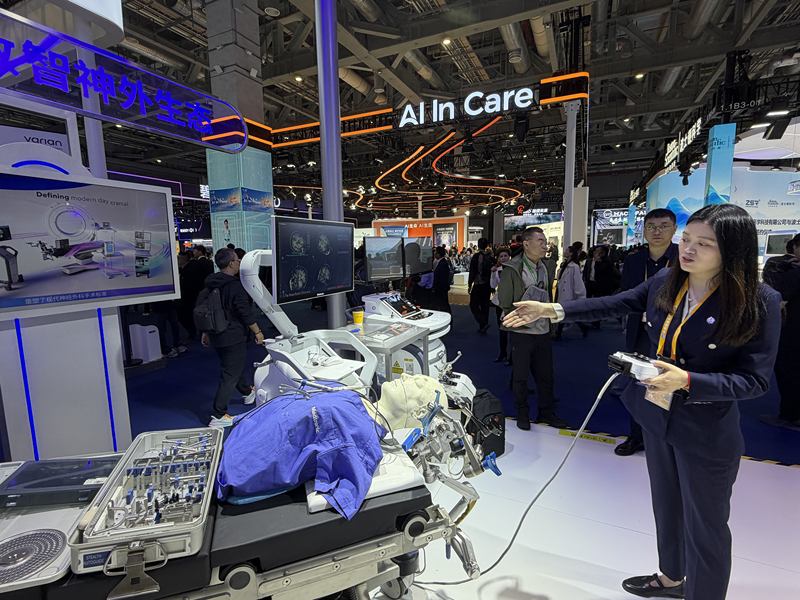
进博观察:AI与脑机接口齐飞,“最卷展区”上演未来照进现实
Xin Jing Bao· 2025-11-08 06:55
Core Insights - The integration of AI in the medical and pharmaceutical sectors is becoming increasingly prominent, with numerous innovative products showcased at the China International Import Expo, highlighting AI's role in drug development, clinical efficiency, and decision-making [1][2][6]. Group 1: AI Empowerment in Medical Research and Drug Development - The Chinese government has implemented policies to promote AI in the pharmaceutical industry, emphasizing the use of new information technologies in drug research [2]. - Major multinational companies like Roche, AstraZeneca, Johnson & Johnson, and Siemens Healthineers are collaborating with AI firms to advance various projects [2][3]. - Roche's AI-driven solutions, such as the "MDT Intelligent Body" and "Little Roche Smart Star," aim to enhance clinical practice efficiency and support the entire research process, having already assisted over 4,000 doctors in completing more than 600 research projects [3]. Group 2: AI in Medical Devices and Diagnostics - The introduction of AI-powered medical devices is transforming traditional healthcare practices, with companies like Medtronic showcasing their AiBLE smart ecosystem that integrates surgical robots and imaging systems [6]. - Siemens Healthineers presented its AI-driven innovations, including a prostate cancer diagnostic software that enhances detection accuracy and reduces misdiagnosis risks [7]. - Boston Scientific debuted several AI-enabled cardiac health innovations, including the FDA-approved HeartLogic heart failure monitoring system, which can predict heart failure risks [7]. Group 3: Brain-Computer Interface Technology - Brain-computer interface (BCI) technology is emerging as a revolutionary treatment paradigm, enabling patients with severe disabilities to control devices through thought [11][12]. - Siemens Healthineers introduced a comprehensive BCI solution that covers preoperative planning, intraoperative navigation, and postoperative evaluation, facilitating the clinical application of BCI technology [12]. - Medtronic showcased a rechargeable, perceptive closed-loop brain stimulator that offers personalized treatment for conditions like Parkinson's disease, enhancing patient care [12].