
龙芯中科

Search documents
上证科创板芯片设计主题指数下跌0.49%,前十大权重包含睿创微纳等
Jin Rong Jie· 2025-07-07 14:54
Group 1 - The A-share market's three major indices closed mixed, with the Shanghai Stock Exchange Sci-Tech Innovation Board Chip Design Theme Index down by 0.49% to 1260.19 points, with a trading volume of 12.655 billion yuan [1] - The Shanghai Stock Exchange Sci-Tech Innovation Board Chip Design Theme Index has increased by 0.48% over the past month, decreased by 2.11% over the past three months, and has risen by 8.91% year-to-date [1] - The index reflects the overall performance of listed companies in the chip design sector on the Sci-Tech Innovation Board, with a base date of December 31, 2019, set at 1000.0 points [1] Group 2 - The top ten weighted companies in the index include Haiguang Information (10.26%), Lanke Technology (9.83%), and Cambricon (9.07%), among others [1] - The index's holdings are entirely composed of companies listed on the Shanghai Stock Exchange, with a 100% allocation [1] - The index's holdings are exclusively in the information technology sector, also with a 100% allocation [1] Group 3 - The index sample is adjusted every six months, with adjustments implemented on the next trading day following the second Friday of June and December [2] - Weight factors are adjusted in accordance with the regular sample adjustments, which occur at the same time [2] - Special circumstances may lead to temporary adjustments to the index, such as delisting or corporate actions like mergers and acquisitions [2]

185亿,国产CPU龙头要上市了
3 6 Ke· 2025-07-07 10:16
Core Viewpoint - The domestic CPU chip market is experiencing significant activity, with Shanghai Zhaoxin Integrated Circuit Co., Ltd. preparing for an IPO on the Sci-Tech Innovation Board, aiming to raise 4.169 billion yuan for new processor development and R&D projects [1][2]. Group 1: Company Overview - Zhaoxin Integrated was established in 2013 and is headquartered in Shanghai, with Shanghai United Investment holding a 50.07% stake [4]. - The company focuses on x86 architecture, which is crucial for compatibility with mainstream software ecosystems, positioning it favorably in the domestic CPU market [4][7]. - Zhaoxin has developed several microarchitecture generations, achieving significant domestic performance milestones, such as the KX-6000 series processor reaching a frequency of 3.0GHz [8]. Group 2: Financial Performance - Zhaoxin's revenue projections show a compound annual growth rate (CAGR) of 61.71%, with expected revenues of 3.4 billion yuan in 2022, 5.55 billion yuan in 2023, and 8.89 billion yuan in 2024 [1]. - Despite revenue growth, the company has reported net losses of 7.27 billion yuan, 6.76 billion yuan, and 9.51 billion yuan for the years 2022 to 2024, totaling approximately 23.54 billion yuan in losses [1][18]. - R&D expenses have been substantial, reaching 289.5% of revenue in 2022, and totaling 2.785 billion yuan over three years [16]. Group 3: Market Position and Competition - Zhaoxin's valuation is estimated at 18.5 billion yuan, significantly lower than competitors like Haiguang Information and Longxin Zhongke, which have market values of 328.4 billion yuan and 53.489 billion yuan, respectively [2]. - The x86 server market in China is projected to grow, with shipments expected to reach 4.47 million units by 2027, indicating a growing opportunity for Zhaoxin [14]. - The company faces intense competition from both domestic and international players, including Intel and AMD, who dominate over 90% of the global market share [15]. Group 4: Client Base and Revenue Sources - Zhaoxin's primary clients include major manufacturers like Lenovo, contributing significantly to its revenue, with the top five clients accounting for over 96% of total sales in recent years [12][13]. - The "Kaixian" series of processors, aimed at desktop and embedded devices, accounted for 86.32% of revenue in 2024, highlighting its importance to the company's growth [9]. Group 5: Industry Trends and Future Outlook - The recent policy changes in China, including the introduction of the "1+6" policy measures, aim to support tech companies like Zhaoxin, potentially easing the path for IPOs and funding [20]. - The ongoing push for domestic chip development aligns with national strategies, creating a favorable environment for companies like Zhaoxin to thrive [20].

中关村综保区保税研发政策为仪器企业降本增效注入强劲动力
仪器信息网· 2025-07-07 07:36
Core Viewpoint - The Beijing Zhongguancun Comprehensive Bonded Zone, as the first in the country to focus on R&D innovation, offers significant advantages in cost savings, convenience, and time efficiency for enterprises, particularly in the instrument industry, through its bonded R&D policies and comprehensive service support [1][2]. Group 1: Advantages for Instrument Enterprises - Cost Savings: Instrument enterprises can benefit from substantial financial incentives, including exemption from import duties (average rate of 7%) on equipment used for R&D. For instance, a liquid chromatography instrument costing 1 million yuan incurs 4.03 million yuan in taxes outside the zone, while within the zone, the tax cost is zero, leading to an average reduction of over 30% in R&D costs [3]. - Convenience: The zone has introduced policies such as exemption from medical device certification, significantly reducing the qualification barriers for enterprises. A one-stop service hall integrates resources from customs, taxation, and commerce, streamlining the approval process and allowing R&D teams to focus on innovation [4]. - Time Efficiency: The zone has improved customs clearance efficiency by over 50%, allowing for rapid declaration processes. Enterprises can complete tax exemption declarations in as little as 10 working days, providing a competitive edge in the market [5]. Group 2: Comprehensive Support for R&D - Infrastructure: The buildings in the Zhongguancun Comprehensive Bonded Zone are designed to meet the high demands of large precision instrument installations, with superior conditions compared to standard office buildings. The zone facilitates simultaneous environmental assessments and registration for new enterprises, saving time and costs [6]. - Service Support: The zone plans to establish public warehouses for bonded storage and special inspection platforms for sensitive items, enhancing the overall service environment for instrument R&D. This comprehensive support allows enterprises to focus on their core business [8]. Group 3: Diverse Beneficiaries - Instrument Equipment Enterprises: These enterprises can significantly lower R&D costs and enhance product competitiveness through bonded R&D policies. They can also showcase high-end foreign equipment and technologies within the zone, creating a comprehensive business loop of R&D, display, and transaction [9]. - "Two Ends Outside" Enterprises: Companies engaged in both import and export can leverage the zone's tax advantages and efficient customs processes to shorten capital turnover cycles and enhance international competitiveness [10]. - Foreign Investment Enterprises: The zone provides policy breakthroughs for foreign investment in restricted sectors, facilitating the establishment of R&D centers in China and promoting the integration of international advanced technologies into the domestic instrument industry [11].

摩尔线程20250706
2025-07-07 00:51
Summary of the Conference Call for Moores Threads Company Overview - Moores Threads focuses on GPU-related products, established in 2020, targeting AI, digital twin, and scientific computing applications [3][4] Product Lines - The product lines cover three main areas: AI intelligent computing, graphics acceleration, and smart SoC [2] - Key products include: - AI computing products: training/inference cards, super node servers, and cross-edge computing clusters [4] - Graphics rendering products: S3,000 series graphics cards for industrial design and digital twin applications [4] - Smart SoC products: A140 computing box and E300 module for AI PC edge applications [5] Financial Performance - Projected revenue for 2024 is 438 million RMB, a year-on-year increase of approximately 2.5 times [2][10] - AI intelligent computing business contributes 77.63% of total revenue, with expectations to achieve profitability by 2027 [2][11] - Average gross margin for 2024 is 70.71%, with AI intelligent computing business gross margin exceeding 70% and desktop graphics cards at 18.99% [14] Sales and Market Presence - In 2024, the company sold three clusters and 2,058 graphics cards, with average prices of 6.113 million RMB for clusters and 60,000 RMB for computing cards [12] - 99.5% of revenue comes from the domestic market, with a direct sales model accounting for 41% and a distribution model for 59% [13] Supply Chain and Inventory - Following entry into the US Entity List in October 2023, the supply chain shifted from wafer production to raw material procurement, with inventory increasing from 275 million RMB to 647 million RMB [15] - Prepayments rose from 76 million RMB to 567 million RMB, indicating preparation for future growth [15] Research and Development - Cumulative R&D expenses exceeded 3.6 billion RMB from 2020 to 2024, significantly higher than revenue in 2024 [16] - The workforce has seen limited growth, with 1,126 employees by the end of 2024, but R&D personnel constitute over 78% of the total [18] Management Team - The management team primarily consists of former Nvidia executives, including CEO Zhang Jianzhong, who previously held senior positions at Nvidia [8] Competitive Landscape - The company’s Musa architecture competes with Nvidia's CUDA and AMD's CDNA, providing a unified GPU acceleration framework [6] - The latest chip series, Pinghu, achieves FP32 computing power of 32 TFlops, about half of Nvidia's H100, and has overcome challenges in high-efficiency interconnects [7] Industry Insights - The domestic chip industry is expected to recover in Q4 2024, despite current pressures from US restrictions on Southeast Asian AI chip imports [21] - Recommended companies for investment include Haiguang, Cambrian, and Longxin Zhongke, which are positioned to benefit from domestic computing center projects [22] Risks - Key risks include uncertainties from US-China relations, underperformance of fundamentals, and intensified market competition [26]
10大产业41类“卡脖子”技术国产替代全景图
材料汇· 2025-07-06 13:22
Core Viewpoint - The article emphasizes the urgency of domestic substitution for "choke point" technologies in various industries due to escalating Sino-US trade tensions and the need for self-sufficiency in critical sectors [2][3]. Group 1: Research Framework & Key Industries - A comprehensive research framework is established, focusing on ten key industries: electronics, computers, communications, pharmaceuticals, medical, automotive, machinery, military, metals, and chemicals [3]. - The framework combines top-down and bottom-up approaches to assess the current state, challenges, and prospects of domestic substitution in these industries [3]. Group 2: Key Areas of Domestic Substitution - The report identifies 41 categories of critical technologies for domestic substitution across the ten industries, highlighting the importance of these areas for attracting investment [2][3]. - The analysis categorizes the difficulty of domestic substitution into five levels, ranging from extremely difficult to easy, based on factors such as market share and technological barriers [8][11]. Group 3: Electronics Industry - The semiconductor sector is highlighted as a key area for domestic substitution, with a focus on storage chips, CPUs, and GPUs, where current domestic market shares are below 5% [11][14]. - The article notes that the government is expected to increase support for key technologies in the semiconductor industry, particularly in overcoming manufacturing and equipment limitations [14][15]. Group 4: Computer Industry - The article discusses the development of a self-controlled IT ecosystem driven by policies aimed at enhancing domestic capabilities in hardware and software [19][20]. - The industrial software market is identified as a significant area for growth, with domestic companies gradually making inroads in CAD, EDA, and other software segments [20][21]. Group 5: Communication Industry - The communication equipment sector has seen significant domestic market penetration, with leading companies like Huawei and ZTE holding substantial global market shares [26][28]. - The report emphasizes the potential for domestic substitution in core communication chips, particularly in the FPGA market, which is currently dominated by foreign firms [27][31]. Group 6: Pharmaceutical and Medical Industries - The scientific instruments sector is highlighted for its low domestic substitution rates, with significant opportunities for growth driven by supportive policies [33][34]. - The article points out the challenges in the production of borosilicate glass for pharmaceuticals, indicating a need for technological advancements to reduce reliance on imports [38][40].
半导体行业周报:“大而美”法案落地,半导体在美建厂税惠力度升级-20250706
Xiangcai Securities· 2025-07-06 11:53
Investment Rating - The industry maintains a "Buy" rating [7][5][33] Core Viewpoints - The "Big and Beautiful" Act in the US increases tax credits for semiconductor manufacturers building new factories from 25% to 35%, which is expected to significantly lower expansion costs and encourage companies like TSMC, Intel, and Micron to accelerate their projects in the US [3][11][21] - The Philadelphia Semiconductor Index has shown a continued upward trend, supported by strong capital expenditures and positive long-term technology demand expectations, with a year-to-date increase of 12.46% as of July 3, 2025 [4][15] - The demand for AI-related hardware is expected to rise due to the proliferation of AI large models and devices like AI smart glasses and AI smartphones, driving steady growth in the market for high-performance Ethernet switches, advanced storage products, GPUs, and edge computing chips [5][33] Summary by Sections Industry Investment Rating - The report maintains a "Buy" rating for the semiconductor industry, suggesting a positive outlook for the sector [7][5][33] Market Overview - The semiconductor industry index experienced a decline of 1.18% from June 30 to July 4, 2025, while the broader market indices showed gains [10][13] - The semiconductor equipment sector led the performance among sub-sectors, while other sectors recorded declines [14] Key Legislative Developments - The "Big and Beautiful" Act was signed into law, which is expected to stimulate high-end manufacturing in the US and increase import tariffs on semiconductor manufacturing equipment and high-end chips [11][22] Company Recommendations - The report recommends focusing on companies such as Zhaoyi Innovation, Lanke Technology, Juchen Co., Shenkong Co., and Longxin Zhongke, which are expected to benefit from the ongoing trends in the semiconductor market [5][33]
雷神科技举办信创旗舰新品发布会,共擎信创国产化未来
Cai Fu Zai Xian· 2025-07-03 04:44
Core Insights - The event held on July 2, 2025, in Qingdao focused on the development trends of the domestic innovation industry, discussing product technology breakthroughs and industry ecosystem construction [1] - Key leaders from various sectors, including government and industry representatives, attended the event, highlighting the collaborative effort in promoting the domestic innovation industry [3] Group 1: Industry Development - Qingdao is building an innovation-driven industrial development framework, showcasing core enterprises in the industry chain, with Raytheon Technology as a pioneer in high-performance computing [3] - The city aims to accelerate the construction of an innovative industrial system, emphasizing technology innovation as a driver for industrial innovation [3] Group 2: Company Strategy - Raytheon Technology is committed to becoming a new domestic brand driven by both "e-sports and domestic innovation," aiming to open a second growth curve [4] - The company has established a product matrix focusing on domestic innovation servers, storage, workstations, and desktop terminals, widely adopted across key sectors such as finance, education, and healthcare [6] Group 3: Business Growth - Raytheon Technology's domestic innovation business is projected to achieve an average annual revenue growth rate of 76.8% from 2022 to 2024, with a year-on-year growth rate of 62% in the first half of 2025 [7] - The company aims to establish a "double hundred plan" targeting 100 top agents and 100 industry-leading users, fostering a collaborative ecosystem [7] Group 4: Product Launch - The company launched 19 new products, including laptops, servers, and desktops, featuring advanced specifications such as the flagship product BoYue G46, which has a 14.51% increase in main frequency [8] - The new products are designed to meet diverse user needs, emphasizing performance, portability, and privacy protection [8] Group 5: Collaborative Initiatives - Raytheon Technology initiated the "Double Hundred Plan Empowerment Ceremony" with seven ecological partners, aiming to deepen collaboration for high-quality development in the domestic innovation industry [10] - The company envisions a collaborative ecosystem that promotes technological autonomy and industry prosperity [12]
最高单日获得6.79亿元净流入,科创芯片ETF(588200)连续3天“吸金”14.22亿元
Xin Lang Cai Jing· 2025-07-03 03:06
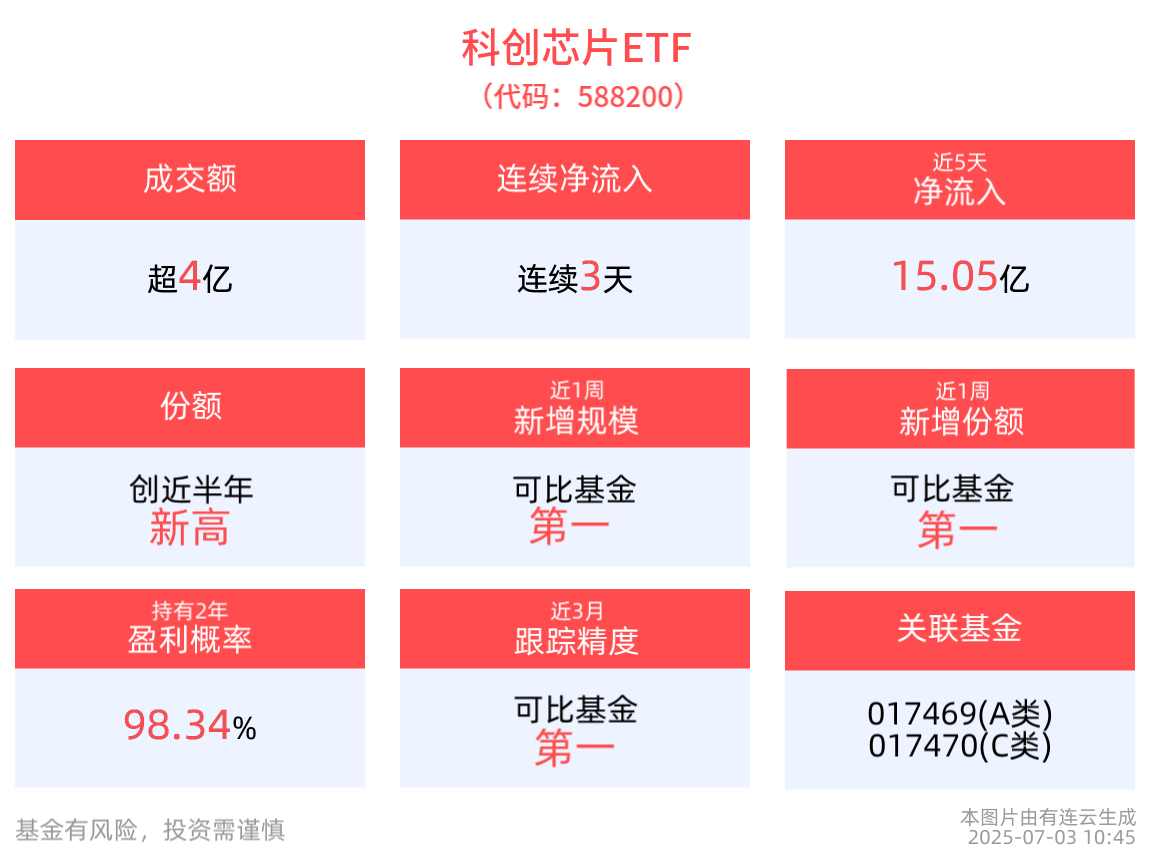
Group 1: ETF Performance - The Sci-Tech Chip ETF has a turnover rate of 1.63% and a transaction volume of 460 million yuan, ranking first among comparable funds over the past year with an average daily transaction of 2.325 billion yuan [1] - The ETF's scale increased by 1.126 billion yuan in the past week, also ranking first among comparable funds, with the latest share count reaching 18.658 billion, a six-month high [1] - The ETF has seen continuous net inflows over the past three days, with a maximum single-day net inflow of 679 million yuan, totaling 1.422 billion yuan [1] Group 2: Leverage and Returns - Leveraged funds are actively investing, with a net purchase of 61.371 million yuan in financing on the previous trading day and a latest financing balance of 1.532 billion yuan [1] - The ETF's net value has increased by 64.87% over the past year, ranking first among comparable funds, and it is positioned in the top 2.07% among 2,897 index stock funds [1] - Since its inception, the ETF has achieved a maximum single-month return of 25.18%, with the longest consecutive monthly gains of four months and an average monthly return of 8.40%, resulting in a total annual profit percentage of 100% [1] Group 3: Semiconductor Industry Outlook - The global semiconductor manufacturing industry is expected to maintain a compound annual growth rate of 7% from the end of 2024 to 2028, reaching a historical high capacity of 11.1 million wafers per month [2] - Investment opportunities are suggested in semiconductor self-sufficiency, AI computing power construction, and terminal innovation, particularly due to intensified US-China tech tensions accelerating domestic semiconductor replacement [2] - As of June 30, 2025, the top ten weighted stocks in the Sci-Tech Chip Index include SMIC, Haiguang Information, and Cambrian, collectively accounting for 57.76% of the index [2] Group 4: Stock Performance - The top ten stocks by weight in the Sci-Tech Chip Index show varied performance, with SMIC at 10.08% weight and a slight increase of 0.17%, while other stocks like Chipone and Huahai Qingshi experienced declines [4] - Investors without stock accounts can access domestic chip investment opportunities through the Sci-Tech Chip ETF linked fund (017470) [4]
国产GPU,还有多少硬骨头要啃?
Hu Xiu· 2025-07-02 00:46
Core Viewpoint - The recent IPO applications of domestic GPU companies, Moore Threads and Muxi Integrated Circuit, have reignited discussions about the challenges and potential of the domestic GPU industry, particularly regarding the high costs and the need for substantial investment to achieve profitability [1][3][4][5]. Group 1: IPO Developments - Both Moore Threads and Muxi Integrated Circuit have had their IPO applications accepted by the Shanghai Stock Exchange, marking a significant step for the domestic GPU sector [1][3]. - Muxi plans to raise 3.9 billion yuan, while Moore Threads aims to raise 8 billion yuan through their IPOs [4][5]. Group 2: Financial Performance - Muxi's projected net losses from 2022 to 2024 are 777 million yuan, 871 million yuan, and 1.4 billion yuan, with R&D expenditures of 647.8 million yuan, 699 million yuan, and 900 million yuan respectively [4]. - Moore Threads anticipates net losses of 1.84 billion yuan, 1.673 billion yuan, and 1.492 billion yuan over the same period, with R&D costs of 1.116 billion yuan, 1.334 billion yuan, and 1.359 billion yuan [5]. - Despite the losses, both companies are seeing revenue growth, with Muxi's revenue projected to reach 743 million yuan by 2024, and Moore Threads expecting 438 million yuan in the same year [7][9]. Group 3: Market Dynamics - The domestic GPU market is characterized by high competition, with various players adopting different strategies, including those aligned with NVIDIA and AMD technologies [12][14]. - The GPU industry is heavily reliant on R&D investments, with companies needing to continue funding their development efforts to remain competitive [21][22]. Group 4: Future Prospects - The AI sector is identified as a significant growth area for GPUs, with the market for AI chips in China projected to grow substantially, indicating a promising future for domestic GPU manufacturers [25][26]. - The competitive landscape is expected to undergo consolidation, as many players vie for market share, suggesting that mergers and acquisitions may become more common [26][27].
诚通基金等8家机构调研龙芯中科最新产品
Shang Hai Zheng Quan Bao· 2025-07-01 14:28
Group 1 - The core viewpoint of the news is that Longxin Zhongke has successfully developed and launched new products, including the Longxin 3C6000 server series and the 2K3000 industrial control/terminal chip, showcasing significant advancements in performance and technology [1][2] - Longxin Zhongke's new products are positioned to compete with mainstream market offerings, with the 3C6000 series achieving performance levels comparable to Intel's third-generation Xeon scalable architecture server chips [1] - The company emphasizes its commitment to building an independent ecosystem outside of the X86 and ARM architectures, focusing on self-reliance in chip development, production, and software ecosystem [2] Group 2 - The "Three Swordsmen" of Longxin's R&D transformation have been fully commercialized, indicating a successful transition from development to market readiness [1] - Longxin's GPGPU technology aims to integrate graphics and AI processing into a single core, targeting inference applications and emphasizing continuous performance improvement and software ecosystem enhancement [2] - The cost-performance ratio of Longxin's new products is reported to be over three times that of the previous generation, enhancing its competitiveness in the open market [2]
