软银集团

Search documents
新浪财经早餐:商务部回应美将对中国半导体加征301关税,白银LOF套利者可能还有超2个跌停丨2025年12月26日
Xin Lang Zheng Quan· 2025-12-26 06:22
Group 1 - The Chinese Ministry of Commerce firmly opposes the U.S. decision to impose 301 tariffs on certain Chinese semiconductor products, stating that it does not recognize the conclusions of the U.S. investigation and has lodged serious representations through the China-U.S. economic and trade consultation mechanism [3] - The Ministry of Commerce also emphasized its commitment to maintaining global supply chain stability and facilitating compliant trade, responding to questions about potential relaxation of export restrictions on rare earth magnets to the U.S. [4] - The Ministry of Commerce commented on TikTok's establishment of a joint venture in the U.S., highlighting the importance of cooperation and mutual respect in resolving issues related to the platform's operations [6][7] Group 2 - The Chinese defense ministry criticized a U.S. Pentagon report that allegedly attempts to sow discord between China and India, asserting that such claims distort China's defense policy and serve as an excuse for U.S. military hegemony [5] - The Chinese defense ministry reiterated its stance on Taiwan, emphasizing that the Taiwan issue is a matter of internal affairs and that the military is prepared to take necessary measures if provoked by separatist forces [8] Group 3 - The A-share market continues to rise, with the Shanghai Composite Index recording seven consecutive days of gains, driven by sectors such as commercial aerospace and satellite navigation [11] - The offshore RMB exchange rate has returned to the "6" level against the U.S. dollar for the first time in 15 months, with expectations of a moderate appreciation in the future [10] - The People's Bank of China has continued to inject liquidity into the market through medium-term lending facilities (MLF), with net injections exceeding 1 trillion yuan for the year [14] Group 4 - Xiaomi launched its new product, the Xiaomi 17 Ultra, with a price increase of 500 yuan, although the founder Lei Jun did not attend the launch event [15] - There are rumors regarding a potential acquisition of Shui Jing Fang by Jian Nan Chun, but both companies have denied any knowledge of such discussions [16] - JD.com announced its year-end bonus plan, with employees in upgraded departments potentially receiving bonuses up to 25 times their monthly salary based on performance ratings [18][19]


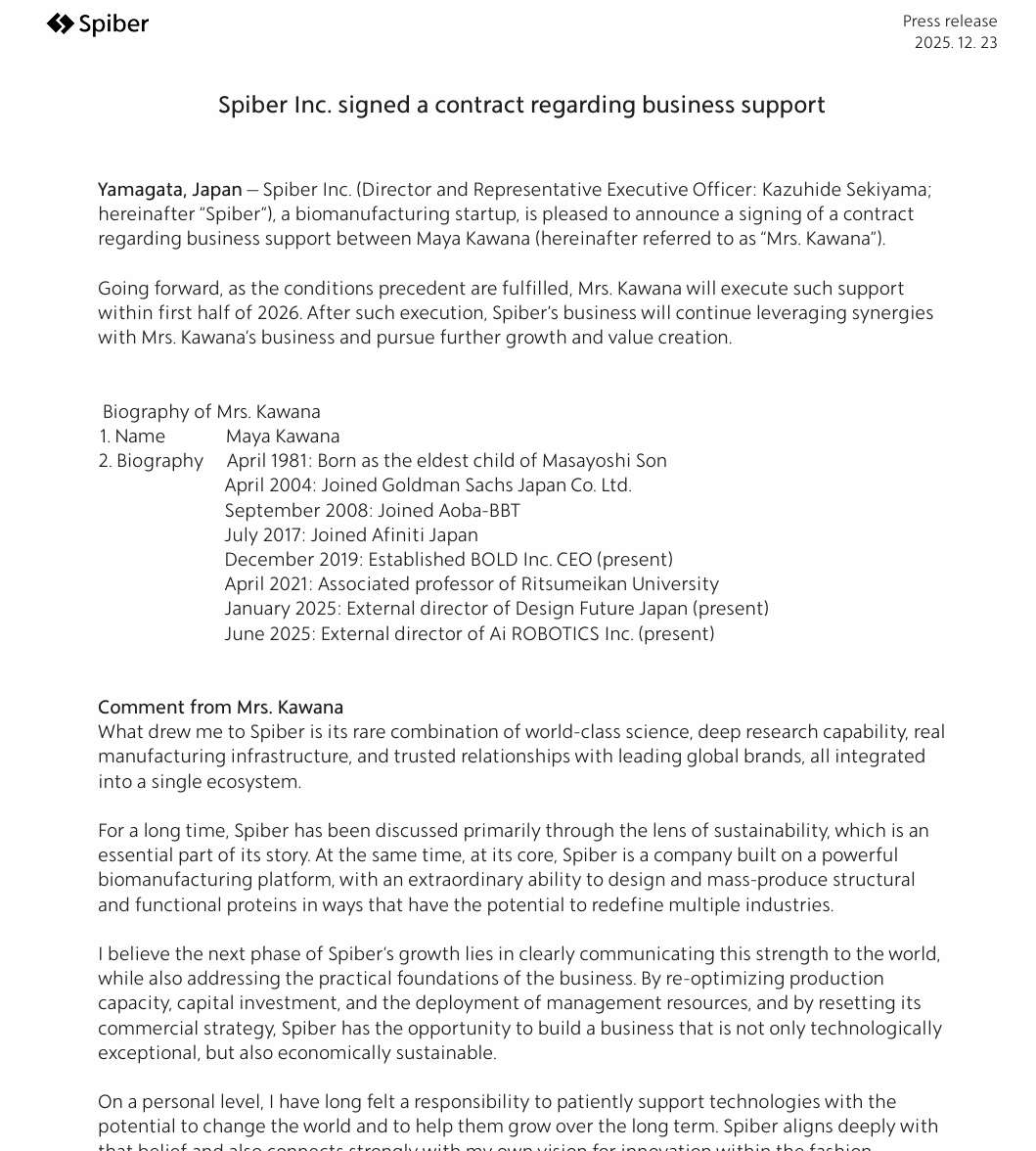
川名麻耶承认:我就是孙正义女儿
Mei Ri Jing Ji Xin Wen· 2025-12-26 05:49
孙正义女儿自曝身份。 在公告中,川名麻耶简介赫然写着:1981年4月,作为孙正义长女出生。其他经历包括:2004年加入高盛日本,2008年加入青羽BBT,2017年加入Afiniti 日本分公司,2019年12月创立BOLD株式会社(BOLD Inc.),担任首席执行官;2025年先后担任Design Future Japan和Ai ROBOTICS的外部董事。 川名麻耶强调,她选择公开个人背景,旨在明确表明她与Spiber的合作基于长期视角,而非受首次公开募股(IPO)或企业并购(M&A)等短期资本收益 驱动。这使她能够全身心投入,助力Spiber成长为全球生物创业领域的领军企业,并为实现这一目标做出深思熟虑、及时有效的决策。 近日,日本科技独角兽公司Spiber发布的一份公告显示,软银集团董事长孙正义的女儿亮相其中。 根据Spiber发布的公告,其已与川名麻耶(Maya Kawana)签署业务支持相关协议。待协议生效前提条件满足后,川名麻耶将于2026年上半年开展相关支 持工作。相关支持实施后,Spiber将继续借助与川名女士业务的协同效应,追求进一步的发展与价值创造。 在孙正义本人年近7旬的背景下,这份 ...
“不再是机器人大国”,日本错过了什么?
Xin Lang Cai Jing· 2025-12-26 04:40
Group 1 - The core viewpoint of the article is that Japan has fallen behind in the humanoid robot sector, which is now dominated by AI-driven innovations from the US and China [1][2][5] - Japan was once a leader in humanoid robotics, having developed significant technologies since the 1960s, but has not adapted to the AI-first approach that is now prevalent [4][5] - The article highlights that Japanese robots are often perceived as industrial automation devices rather than humanoid robots, which limits their development and application in everyday scenarios [2][5] Group 2 - Japanese companies are still strong in manufacturing precision components for robots, but they struggle with integrating AI and advanced control systems, which are essential for creating intelligent humanoid robots [5][7] - The article notes that Japan's strict regulations and limited application scenarios hinder the practical deployment and iteration of robotic technologies, particularly in areas like autonomous driving and elder care [6][8] - There is a growing recognition among Japanese firms that collaboration with Chinese technology companies may be necessary to regain competitiveness in the AI and robotics sectors [8] Group 3 - A new collaborative organization, the Kyoto Humanoid Robot Association, has been formed by several Japanese companies to accelerate the development and production of humanoid robots by 2027 [7] - Despite Japan's advanced capabilities in certain robotic components, the overall integration of these components into complete intelligent systems remains a challenge [7][8] - The article concludes that Japan may increasingly take on a role as a follower or investor in the global AI and robotics landscape, rather than as an independent innovator [8]

日本组团搞存储,旨在干掉HBM
半导体行业观察· 2025-12-26 01:57
Core Viewpoint - Fujitsu is joining a project led by SoftBank to develop next-generation memory for artificial intelligence and supercomputers, aiming to revitalize Japan's memory production technology and position its companies among the world's top memory manufacturers [1][2]. Group 1: Project Overview - The newly established Saimemory company will coordinate the project, focusing on developing high-performance memory to replace current high-bandwidth memory (HBM) achieved through stacked DRAM chips [1]. - The project plans to invest 8 billion yen (approximately 51.2 million USD) to complete prototype development by the fiscal year 2027 and aims to establish a mass production system by the fiscal year 2029 [1]. - SoftBank will inject 3 billion yen into Saimemory before the fiscal year 2027, while Fujitsu and RIKEN will jointly invest about 1 billion yen [1]. Group 2: Technical Aspects - Saimemory aims to produce memory with a capacity two to three times that of HBM, with power consumption only half that of HBM, while maintaining similar or lower pricing [2]. - The project will utilize semiconductor technology jointly developed by Intel and the University of Tokyo, with production and prototyping in collaboration with Nikkon and Taiwan's Powerchip Semiconductor Manufacturing Corporation [2]. - Intel will provide underlying stacking technology, which allows for vertical stacking of chips, increasing the number of memory chips per device and reducing data transmission distances [2]. Group 3: Market Context - The demand for computing power in Japan is expected to grow over 300% by 2030 compared to 2020, driven by the rise of generative AI [2]. - Japan's semiconductor self-sufficiency is low, leading to risks of supply instability and price increases, with South Korean companies holding about 90% of the global HBM market share [2]. - The emergence of artificial intelligence is changing the industry landscape, with SoftBank building its own large data centers and Fujitsu developing CPUs for data centers and communication infrastructure, targeting practical applications by 2027 [3].

全球大公司要闻 | 水井坊澄清:“某酒企拟收购”传闻不属实
Wind万得· 2025-12-26 00:31
Group 1 - Water Well Square clarified that media reports about a potential acquisition by another liquor company are untrue [2] - Samsung Electronics plans to launch an application processor with its own GPU by 2027, marking a significant step in building an end-to-end AI ecosystem [2] - Tianqi Lithium has adjusted its product pricing system, effective January 1, 2026, shifting from SMM prices to prices based on Mysteel battery-grade lithium salt or the main contract price of lithium carbonate futures [2] - Xiaomi announced the price for its Xiaomi 17 Ultra starting at 6,999 yuan, which is an increase of 500 yuan compared to the previous Ultra model [2] Group 2 - Unisoc's subsidiary plans to invest 300 million yuan with partners to establish a new company focused on automotive domain control chips, with an asset valuation increase of 3,723.15% [4] - Zhongwei Co. signed a strategic cooperation framework agreement with Xinwanda for solid-state batteries [4] - Banachian plans to acquire 100% of Zhonglian Century's shares through a combination of stock issuance and cash payment, aiming to enhance its marketing business [4] - Tian Tie Technology reported that its controlling shareholder is under criminal detention, but this matter is unrelated to the company's operations [4] Group 3 - Yundong Technology completed a Pre-IPO financing round of several hundred million yuan, led by the National AI Industry Fund [5] - Sifang Precision submitted an IPO prospectus for a Hong Kong listing, reporting revenues of 664 million yuan in 2022 and projected revenues of 740 million yuan in 2024 [5] - Shiyuan Co. also submitted an IPO prospectus for a Hong Kong listing, with revenues of 20.99 billion yuan in 2022 and projected revenues of 22.40 billion yuan in 2024 [5] Group 4 - First Quantum Minerals agreed to sell its Cobre Las Cruces copper mine in Spain for up to $190 million, with the transaction expected to close in the first half of 2026 [8] - Super Copper's Cordillera Cobre project received approval from the Chilean National Mining Agency, securing 26 mining concessions [8] Group 5 - SoftBank is leading a new AI memory development project with Fujitsu, aiming to create next-generation memory products for AI and supercomputers [10] - LG Electronics will showcase its home robot LG CLOiD at CES 2026, integrating AI and automation features [10] - Mitsubishi Heavy Industries is maintaining a stable partnership with Fuan Co. in the gas turbine sector [10] Group 6 - Mercedes-Benz is accelerating its localization strategy in China, focusing on electrification and smart technology, with over 14 billion yuan planned for investment in 2024 [12] - Volkswagen Group is adjusting its core management at FAW-Volkswagen, with plans for a dual-line strategy for large SUVs by 2026 [12] - Audi plans to launch a pure electric sports car based on the SSP Sport architecture, targeting the high-end electric sports car market [12] - Shimadzu has reached a final agreement to acquire Glass HoldCo s.r.o. for approximately $678 million [12] - Deutsche Bahn signed a framework agreement with BYD for 200 electric buses, promoting green transformation in public transport [12]

财经早报:商务部回应美将对中国半导体加征301关税,白银LOF套利者可能还有超2个跌停丨2025年12月26日
Xin Lang Zheng Quan· 2025-12-25 23:41
Group 1 - The Ministry of Commerce firmly opposes the U.S. decision to impose 301 tariffs on certain Chinese semiconductor products, stating that it has lodged a serious representation through the China-U.S. economic and trade consultation mechanism [2] - The Ministry of Commerce emphasizes its commitment to maintaining global supply chain security and facilitating compliant trade, responding to inquiries about potential relaxation of export restrictions on rare earth magnets to the U.S. [3] - The Ministry of Commerce comments on TikTok's establishment of a joint venture in the U.S., highlighting the importance of reaching a solution that aligns with Chinese laws and regulations [5][6] Group 2 - The Chinese Ministry of Defense criticizes a U.S. Pentagon report that allegedly seeks to sow discord between China and India, asserting that such claims distort China's defense policy [4] - The Chinese government expresses its desire for a fair and transparent business environment for Chinese companies operating in the U.S., urging the U.S. to fulfill its commitments [6] - The People's Bank of China continues to inject liquidity into the market through Medium-term Lending Facility (MLF) operations, with a net injection exceeding 1 trillion yuan for the year [14] Group 3 - The A-share market shows a strong performance with the Shanghai Composite Index recording seven consecutive days of gains, driven by sectors such as commercial aerospace and satellite navigation [10] - The offshore renminbi exchange rate against the U.S. dollar has returned to the "6" level for the first time in 15 months, with expectations of a moderate appreciation in the future [9] - The silver LOF fund experiences a significant drop in premium rates, falling from 68.19% to 45.45%, indicating a shift in market sentiment [11][12]
财经观察:“不再是机器人大国”,日本错过了什么?
Huan Qiu Shi Bao· 2025-12-25 22:48
Core Viewpoint - Japan is falling behind in the humanoid robot sector, which is now dominated by AI-driven technologies led by companies in the US and China [1][2][5]. Group 1: Current State of Humanoid Robotics in Japan - Japan was once a leader in humanoid robotics, having developed early models like WABOT-1 and ASIMO, but has not capitalized on AI advancements [4][5]. - Japanese robots are often perceived as industrial automation tools rather than humanoid robots, limiting their application in service sectors [2][5]. - The current humanoid robots in Japan, such as GROOVE X's LOVOT and MIXI's Romi, lack advanced AI capabilities compared to their Chinese counterparts [3][4]. Group 2: Challenges Facing Japan - Japan's reliance on industrial robots has hindered its transition to AI-driven humanoid robotics, missing early opportunities in the AI robot market [5][6]. - The conservative approach to software and AI ecosystems in Japan has resulted in a significant lag behind the more open and rapid developments in the US and China [6][7]. - Strict regulations and limited application scenarios in Japan restrict the practical deployment and iteration of robotic technologies, particularly in areas like autonomous driving [7][8]. Group 3: Future Prospects - Japanese companies are forming collaborations, such as the Kyoto Humanoid Robot Association, aiming to produce humanoid robots by 2026 [8][9]. - Despite Japan's advanced manufacturing capabilities for robot components, it struggles to integrate these into complete intelligent systems due to a lack of robust IT and AI infrastructure [8][9]. - Japan may increasingly adopt a role as a follower or investor in the global AI and robotics landscape, rather than a leader, due to political and economic dependencies on China and the US [9][10].
川名麻耶承认:我就是孙正义女儿!
Mei Ri Jing Ji Xin Wen· 2025-12-25 16:27
Group 1 - Spiber, a Japanese tech unicorn, announced a business support agreement with Maya Kawana, daughter of SoftBank Group Chairman Masayoshi Son, set to take effect in the first half of 2026 [1][3] - Maya Kawana has a notable background, including positions at Goldman Sachs Japan, Afiniti Japan, and founding BOLD Inc., emphasizing her commitment to Spiber's long-term growth rather than short-term capital gains [3][5] - The announcement provides rare insight into potential successors within SoftBank, as Masayoshi Son approaches his 70s and has previously kept family matters private [5][7] Group 2 - Masayoshi Son, born in 1957, founded SoftBank in 1981 after returning to Japan with 100 million yen from selling a multilingual translation machine [7] - Despite Maya Kawana's impressive resume, she currently holds no position within SoftBank, leaving her potential as a successor uncertain [5][7] - In 2022, Masayoshi Son announced his withdrawal from daily operations at SoftBank to focus on artificial intelligence [7]
AI浪潮转向硬科技 专家:2026年大概率成为AI手机元年
Mei Ri Jing Ji Xin Wen· 2025-12-25 14:57
Core Insights - In 2025, DeepSeek emerged, significantly lowering the application cost and threshold of AI technology, leading to a boom in vertical applications and a shift in industry competition from single model comparisons to full-stack ecosystem battles [1] - The AI landscape is transitioning from a dominance of OpenAI to a multi-polar competition, with applications expanding from software to intelligent hardware [1][2] - The "Hundred Mirrors War" in AI hardware is intensifying, with major tech companies investing heavily in AI glasses and smartphones, marking a significant shift in human-computer interaction [6] Group 1: AI Application Market Dynamics - The introduction of DeepSeek in February 2025 has drastically reduced AI inference costs, spurring growth in vertical applications such as AI in health, education, and office settings, leading to a reshuffling of the AI application market [2] - User data shows a concentration effect, with DeepSeek achieving an average monthly download of 34.72 million and ByteDance's Doubao at 31.44 million, dominating the general AI assistant market [2] - Vertical scenarios are becoming crucial for AI applications, evolving from language Q&A and content generation to multi-task intelligent agents across various industries [2][3] Group 2: Hardware Developments and Market Trends - McKinsey predicts a surge in vertical AI intelligent agents by 2025, with over 70% of AI value potential expected to come from these applications [3] - The global smart glasses market saw a shipment of 4.065 million units in the first half of 2025, a 64.2% year-on-year increase, with China accounting for 26.6% of the market share [6] - The global smart glasses market is projected to reach $42 billion by 2030 and $117 billion by 2040, despite facing challenges in technology maturity and privacy compliance [6] Group 3: Future Growth Areas - Key growth points in the AI field for 2026 include large models with continuous learning capabilities, real-time interactive 3D models, and seamless intelligent agents that integrate tools, data, and workflows [4] - The AI smartphone market is expected to see a shipment of 147 million units in China in 2026, a 31.6% year-on-year growth, capturing 53% of the overall market [8] - The "Doubao phone" model is gaining attention, with a focus on a multi-to-multi intelligent connection ecosystem, avoiding a zero-sum game in the internet ecosystem [9]
孙正义长女亮相!合作牵手日本独角兽公司
Zheng Quan Shi Bao Wang· 2025-12-25 11:23
一篇公告透露出软银集团的潜在接班人。 日本科技独角兽公司Spiber发布的一份公告显示,软银集团董事长孙正义的女儿亮相其中。 根据Spiber发布的公告,其已与川名麻耶(Maya Kawana)签署业务支持相关协议。待协议生效前提条件满足后,川名麻耶将于2026年上半年开展相关 支持工作。相关支持实施后,Spiber将继续借助与川名女士业务的协同效应,追求进一步的发展与价值创造。 在公告中,川名麻耶简介赫然写着:1981年4月,作为孙正义长女出生。其他经历报2004年加入高盛日本,2008年加入青羽BBT,2017年加入Afiniti日 本分公司,2019年12月:创立BOLD株式会社(BOLD Inc.),担任首席执行官;2025年先后担任Design Future Japan和Ai ROBOTICS的外部董事。 川名麻耶强调,她选择公开个人背景,旨在明确表明她与Spiber的合作基于长期视角,而非受首次公开募股(IPO)或企业并购(M&A)等短期资本收 益驱动。这使她能够全身心投入,助力Spiber成长为全球生物创业领域的领军企业,并为实现这一目标做出深思熟虑、及时有效的决策。 川名麻耶表示,吸引她关注S ...