
上美股份

Search documents
彩妆品牌合伙人离职、超八成收入来自韩束,上美股份如何解决结构难题?
凤凰网财经· 2026-01-20 12:44
Core Viewpoint - The recent departure of Gu Mai, a key partner of NAN beauty under Shangmei Co., has raised concerns about the company's reliance on a single brand and its overall business strategy in the beauty industry [3][4]. Group 1: Management Changes - Gu Mai, previously with Estee Lauder and LVMH, joined Shangmei in 2025 as a partner for NAN beauty, which was launched in September 2025 [3][4]. - The departure of Gu Mai highlights the challenges Shangmei faces in diversifying its brand portfolio and improving its performance in the competitive beauty market [3][4]. Group 2: Revenue Dependence - Over 80% of Shangmei's revenue comes from the Han Shu brand, which generated 33.44 billion yuan in the first half of 2025, marking a 14.3% increase from the previous year [6]. - Other brands under Shangmei, such as newpage, Yiyezi, and Hongse Xiaoxiang, contributed significantly less, with revenues of 3.97 billion yuan, 0.89 billion yuan, and 1.59 billion yuan respectively [6]. Group 3: Channel Strategy - Shangmei's online sales account for over 90% of its revenue, with a significant portion coming from Douyin, indicating a high sensitivity to platform traffic and a relatively weak risk management capability [3][6]. - The company's marketing expenses remain high, with sales and distribution costs at 56.9% of total revenue in the first half of 2025, slightly down from 57.6% in the previous year [8]. Group 4: Market Position and Future Outlook - The beauty industry has seen success with brands linked to celebrity makeup artists, but Shangmei's NAN beauty has not yet shown significant growth in follower numbers on platforms like Xiaohongshu [5][6]. - Experts suggest that while there are opportunities in the Tmall channel, Shangmei's main brands are nearing saturation on Douyin, and the success of its second growth curve remains uncertain [9].


批零社服行业:12月社零同比+0.9%,重视服务消费板块春节机会
GF SECURITIES· 2026-01-20 12:08
Investment Rating - The industry investment rating is "Buy" [3] Core Insights - In December 2025, the year-on-year growth of social retail sales was 0.9%, with a total of 4.5 trillion yuan, indicating a decline of 0.4 percentage points compared to November 2025. Excluding automobiles, the total was 4.0 trillion yuan, growing by 1.7% year-on-year [5] - The report emphasizes the importance of service consumption sectors for the upcoming Spring Festival opportunities [5] - The report suggests a shift in retail industry logic from "adjusting input" to "adjusting output," with a focus on improving same-store sales and customer flow, which will enhance profit elasticity as the share of high-margin private brands increases [5] Summary by Sections Retail Sector Performance - In December 2025, retail sales of goods reached 3.9 trillion yuan, growing by 0.7% year-on-year, while catering revenue was 0.6 trillion yuan, with a year-on-year growth of 2.2% [5] - The growth rates for various categories in December included: - Grain and oil food retail sales grew by 3.9% - Beverage retail sales grew by 1.7% - Tobacco and alcohol retail sales declined by 2.9% [5] - In the optional consumer goods category, cosmetics and gold and silver jewelry retail sales grew by 8.8% and 5.9%, respectively [5] E-commerce Insights - The e-commerce penetration rate slightly decreased, with online retail sales of physical goods reaching 13.1 trillion yuan in 2025, a year-on-year increase of 5.2%. The penetration rate was 26.1%, a decrease of 0.7 percentage points year-on-year [5] - For the year, the growth rates for e-commerce categories were: food (14.5%), clothing (1.9%), and daily necessities (4.1%) [5] Investment Recommendations - Retail: Focus on companies like Bubugao, Huijia Times, Yonghui Supermarket, and Chongqing Department Store [5] - Cosmetics: Prefer high-end brand assets and consider low-positioned stocks like Maogeping and Yixian E-commerce [5] - Jewelry: Anticipate strong sales during the traditional gold sales peak in Q1, with recommendations for Laopu Gold and Mankalon [5] - Tourism: Focus on winter sports themes and the Spring Festival market, with recommendations for Changbai Mountain and Huangshan Tourism [5] - Education: Highlight opportunities in undervalued vocational education stocks like China Oriental Education and Action Education [5]


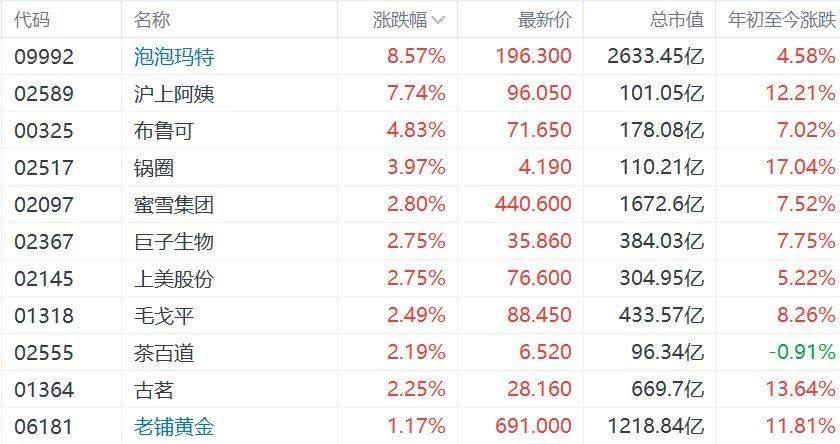
港股新消费概念集体走强,泡泡玛特涨超8%,沪上阿姨涨超7%,布鲁可涨超4%,锅圈涨近4%,蜜雪集团、古茗涨2%
Ge Long Hui· 2026-01-20 03:11
Core Viewpoint - Pop Mart has conducted its first share buyback in nearly two years, leading to a significant increase in its stock price and positively impacting the Hong Kong market for new consumer stocks [1] Group 1: Company Performance - Pop Mart's stock price rose over 8%, leading the market, while other companies like Hu Shang Ayi and Blok also saw increases of over 7% and 4% respectively [1] - The company repurchased 1.4 million shares at prices ranging from HKD 177.7 to HKD 181.2, totaling over HKD 250 million, marking its first buyback in nearly two years [2] - Morgan Stanley noted that the buyback is expected to attract more investors, particularly those looking for stock price catalysts, and highlighted Pop Mart's strong growth and clear driving factors [3] Group 2: Financial Outlook - Morgan Stanley projects that Pop Mart's net profit will reach RMB 12.6 billion by 2025, supported by a net cash position of RMB 20 billion at the end of last year, indicating ample financial resources for shareholder returns [3] - The collaboration with Honor to launch the "trendy toy phone" and the release of the Honor 500 Pro Molly 20th Anniversary Limited Edition at a price of RMB 4,499, with a promotional price of RMB 3,999, is expected to further enhance brand visibility and sales [2]

港股新消费概念集体走强,泡泡玛特涨超8%,布鲁可涨超4%
Jin Rong Jie· 2026-01-20 02:50
Group 1 - The core viewpoint of the article highlights that Pop Mart has initiated its first share buyback in two years, which has led to a significant increase in its stock price, boosting the performance of new consumer stocks in the Hong Kong market [1] Group 2 - As of now, Pop Mart's stock has surged over 8%, leading the market [1] - Other companies in the new consumer sector have also seen gains, with Hu Shang A Yi up over 7%, Blokus up over 4%, Guoquan up nearly 4%, and several others including Mixue Group, Shangmei Shares, Maolongping, Cha Baidao, and Guming all rising over 2% [1]
新消费概念集体走强,泡泡玛特涨超8%,布鲁可涨超4%
Ge Long Hui· 2026-01-20 02:44
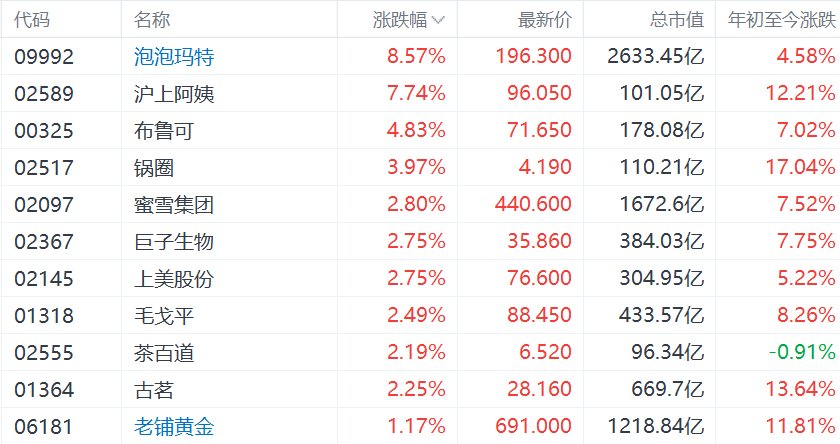
Group 1 - The core viewpoint of the article highlights that Pop Mart has conducted its first share buyback in nearly two years, leading to a significant increase in its stock price and positively impacting the Hong Kong stock market for new consumer stocks [1] - Pop Mart repurchased 1.4 million shares at a price range of HKD 177.7 to HKD 181.2, totaling over HKD 250 million, marking the company's first buyback in two years [1] - The collaboration between Pop Mart and Honor resulted in the launch of the "潮玩手机" (Trendy Toy Phone), specifically the Honor 500 Pro Molly 20th Anniversary Limited Edition, priced at RMB 4,499, with a net price of RMB 3,999 after subsidies [1] Group 2 - Morgan Stanley noted that Pop Mart's share buyback is expected to attract more investor attention, particularly from those looking for stock price catalysts, and emphasized the company's strong growth and clear driving factors [1] - The firm projects that Pop Mart's net profit will reach RMB 12.6 billion by 2025, and the company had RMB 20 billion in net cash at the end of last year, indicating ample financial resources to provide returns to shareholders [1] - As of the latest data, Pop Mart's stock price increased by 8.57%, leading the market, with a total market capitalization of HKD 2,633.45 million and a year-to-date increase of 4.58% [2]
港股异动丨新消费概念集体走强,泡泡玛特涨超8%,布鲁可涨超4%
Ge Long Hui· 2026-01-20 02:37
Group 1 - The core viewpoint of the news is that Pop Mart has conducted its first share buyback in nearly two years, leading to a significant increase in its stock price and positively impacting the Hong Kong market for new consumer stocks [1] - Pop Mart repurchased 1.4 million shares at a price range of HKD 177.7 to HKD 181.2, totaling over HKD 250 million, marking the company's first buyback in two years [1] - The collaboration between Pop Mart and Honor to launch the "Trendy Toy Phone" has been announced, with the limited edition Honor 500 Pro Molly priced at RMB 4,499, and a promotional price of RMB 3,999 [1] Group 2 - Morgan Stanley noted that Pop Mart's share buyback is expected to attract more investor attention, particularly from those looking for stock price catalysts [1] - The firm highlighted that Pop Mart is experiencing strong growth with clear driving factors and a solid long-term outlook, projecting a net profit of RMB 12.6 billion by 2025 [1] - As of the end of last year, Pop Mart had RMB 20 billion in net cash, indicating ample financial resources to provide returns to shareholders [1]
国补高基数下12月社零同增0.9%
HTSC· 2026-01-20 02:02
Investment Rating - The report maintains a "Buy" rating for the consumer discretionary sector, highlighting structural investment opportunities [5][10]. Core Insights - The report indicates that in December, the total retail sales of consumer goods increased by 0.9% year-on-year to 4.5 trillion yuan, with a month-on-month decline of 0.4 percentage points, primarily due to high base effects from durable goods like automobiles and home appliances [7][9]. - The report emphasizes the importance of the new round of trade-in policies for 2026, which focus on core home appliance categories and expand into new categories like smart glasses and products for the elderly, supporting demand in these segments [7]. - The report suggests that consumer sentiment remains strong, particularly in sectors like emotional consumption, technology consumption, and undervalued high-dividend stocks, recommending a focus on domestic brands and global brand expansion [10]. Summary by Sections Retail Sales Performance - In December, retail sales of food and beverages grew by 2.2% and 0.7% respectively, with urban and rural retail sales increasing by 0.7% and 1.7% year-on-year [8]. - Online retail sales of physical goods in December increased by 0.8% year-on-year, with a total annual growth of 5.2%, accounting for 26.1% of total retail sales [8]. Consumer Categories - The report notes a structural differentiation in consumer categories, with home appliances, building materials, and furniture experiencing declines of 18.7%, 11.8%, and 2.2% respectively due to high base effects and trade-in policy impacts [9]. - Conversely, communication equipment saw a significant increase of 20.9% year-on-year, while emotional and self-care products like sports and entertainment goods and cosmetics grew by 9.0% and 8.8% respectively [9]. Investment Recommendations - The report identifies four main investment themes: 1. Rise of domestic brands and global brand expansion, recommending companies like Pop Mart, Shangmei, and Anta Sports [10]. 2. Technology consumption empowered by AI, recommending companies like Midea Group and Haier Smart Home [10]. 3. Emotional consumption, recommending companies like Gu Ming and Yum China [10]. 4. Undervalued high-dividend blue-chip leaders, recommending companies like Li Ning and Shenzhou International [10]. Company-Specific Insights - For Smoore International (6969 HK), the report forecasts a revenue of 10.21 billion yuan for Q1-3 2025, with a year-on-year growth of 21.8%, and maintains a "Buy" rating with a target price of 27.00 HKD [48]. - For Juzhibio (2367 HK), the report highlights the approval of a new collagen product, projecting significant sales potential and maintaining a "Buy" rating with a target price of 85.00 HKD [49]. - For Pop Mart (9992 HK), the report notes a revenue increase of 245-250% in Q3 2025, driven by strong performance in both domestic and international markets, maintaining a "Buy" rating with an updated target price of 410 HKD [51].



如何看2025年12月消费数据
2026-01-20 01:50
Summary of Key Points from Conference Call Records Industry Overview - **Consumer Sector Performance**: In December 2025, the overall retail sales growth was 0.9% year-on-year, with a full-year growth of 3.7%. Online retail grew by 5.2% for the year, while offline retail showed slower growth [2][3]. Key Insights and Arguments - **Retail Categories**: - Supermarket retail sales increased by 4.3% year-on-year, while department stores only saw a 0.1% increase [3]. - Essential goods performed well, with grain and oil food growth at 3.9%. In the discretionary category, cosmetics grew by 8.8%, and gold and jewelry increased by 5.9% due to a rise in gold prices [3][4]. - Communication equipment maintained a growth rate of over 20%, while home appliances declined by 19% due to tightening subsidies [3][4]. - **Automotive Sector**: - The total retail sales for automobiles reached 548.2 billion, down 5% year-on-year. Passenger car sales fell by 8.8%, but new energy vehicle wholesale sales grew by 3.3% [11]. - **Textile and Apparel**: - The textile and apparel sector saw a 0.6% year-on-year retail growth in December, but a decline in month-on-month performance due to weather and the delayed Spring Festival [13][14]. - **Alcohol Industry**: - The retail sales of the liquor industry decreased by 2.9% year-on-year in December, with a price index decline of 0.19%. The industry is currently in a phase of active inventory reduction [16][17]. - **Consumer Expectations**: - Due to the late Spring Festival and expectations of rising gold prices, consumer demand is anticipated to recover in January and February 2026 [5]. Additional Important Insights - **Investment Recommendations**: - In the beauty and personal care sector, companies like Shiseido and domestic brands such as Maogeping are recommended. For the gold and jewelry sector, brands with strong store expansion logic are highlighted [6][10]. - In the automotive sector, companies like JAC Motors and Geely are recommended, focusing on high-end and luxury markets [12]. - For the textile and apparel sector, brands like Li Ning and Fuanna are suggested, with a focus on companies that can support their market value through dividends [15]. - **Household Appliances**: - The household appliance sector is experiencing a downturn, with significant declines in sales across various categories. However, leading companies like Midea and Haier are expected to maintain slight growth due to low inventory levels [21][22][24]. - **Light Industry**: - The light industry saw a decline in furniture sales by 2.2% year-on-year, with exports down by 9.8%. However, some companies are expected to see revenue and profit recovery in 2026 [26][27]. Conclusion The consumer sector is facing mixed performance across various categories, with essential goods showing resilience while discretionary spending is under pressure. Investment opportunities exist in specific brands and sectors that are positioned to benefit from changing consumer behaviors and market dynamics.
彩妆品牌合伙人离职、超八成收入来自韩束 上美股份如何解决结构难题?
Zhong Guo Jing Ying Bao· 2026-01-20 00:19
Core Viewpoint - The recent departure of Gu Mai, a partner of NAN beauty under Shangmei Co., has raised concerns about the company's reliance on a single brand and its overall business strategy in the beauty industry [1][2]. Group 1: Company Overview - Shangmei Co. has a diverse portfolio of brands, including skincare and maternal and infant products, but over 80% of its revenue still comes from the Han Shu brand [1][4]. - As of the first half of 2025, Han Shu generated revenue of 33.44 billion yuan, accounting for 81.4% of the total revenue, with a year-on-year increase of 14.3% [4][6]. - Other brands under Shangmei, such as newpage, Yiyezi, and Hongse Xiaoxiang, contributed significantly less, with revenues of 3.97 billion yuan, 0.89 billion yuan, and 1.59 billion yuan, respectively [4]. Group 2: Market Position and Challenges - The company has a strong presence on Douyin, with over 90% of its revenue coming from online channels, primarily from Douyin, indicating a high sensitivity to platform traffic [1][5]. - The departure of Gu Mai, who had expertise in the Tmall channel, highlights a gap in Shangmei's strategy, as the brand has struggled to gain traction on Tmall despite its strong performance on Douyin [2][5]. - The brand NAN beauty, launched in September 2025, has not shown significant growth in its follower count on platforms like Xiaohongshu, indicating challenges in brand performance [2]. Group 3: Financial and Operational Insights - Shangmei's marketing expenses remain high, with sales and distribution costs accounting for 56.9% of total revenue in the first half of 2025, although this is a slight decrease from 57.6% in the previous year [6]. - The company has been exploring new growth avenues, but the success of these initiatives remains uncertain [7]. - The recent controversy surrounding Han Shu's products, which were found to contain questionable ingredients, has negatively impacted the company's stock price, which fell from 85.3 HKD to 57 HKD before recovering slightly to 73.95 HKD [6].
如何看2025年12月消费数据?
Changjiang Securities· 2026-01-19 14:31
Investment Rating - The report does not explicitly state an investment rating for the industry, but it provides insights into various sectors and companies with potential investment opportunities. Core Insights - In December, the total retail sales of consumer goods reached 45,136 billion yuan, a year-on-year increase of 0.9%. Excluding automobiles, retail sales amounted to 39,654 billion yuan, growing by 1.7%. For 2025, total retail sales are projected to reach 501,202 billion yuan, representing a 3.7% increase from the previous year, with non-automobile retail sales expected to grow by 4.4% to 451,413 billion yuan [4][7]. Retail Sector - The retail sector shows stable growth, with offline sales demonstrating resilience. In December, the retail sales of goods increased by 0.7% year-on-year, while dining revenue grew by 2.2%. Online retail sales of physical goods for the year increased by 5.2%, accounting for 26.1% of total retail sales [17][18]. Food and Beverage Sector - The food and beverage sector faced challenges in December, with dining revenue growing by only 2.2% year-on-year. The report suggests that the sector may see a rebound as previous restrictions on alcohol consumption ease [19][20]. Automotive Sector - The automotive sector experienced a decline in December, with total retail sales of automobiles at 548.2 billion yuan, down 5.0% year-on-year. However, the export of passenger vehicles saw significant growth, with a 50.4% increase in December [24][25]. Apparel and Textile Sector - The apparel and textile sector saw a slowdown in retail growth, with sales increasing by only 0.6% year-on-year in December. The report indicates that the sector is expected to recover in 2026 as inventory levels stabilize [28][29]. Home Appliances Sector - The home appliances sector faced a decline in December, with retail sales down 18.7% year-on-year. The report highlights that the sector's performance is affected by high base effects and the withdrawal of government subsidies [38][39]. Investment Recommendations - The report recommends focusing on companies with strong growth potential in various sectors, including beauty and personal care, gold and jewelry, and consumer electronics. Specific companies highlighted include 毛戈平, 上美股份, and 美的集团 [18][45].