
华宝

Search documents
2025年收益率18.95%!“能攻善守”的标普A股红利ETF华宝(562060)标的指数12月月报出炉!
Xin Lang Cai Jing· 2026-01-07 11:48
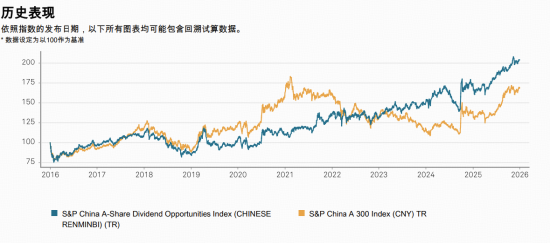
Core Insights - The S&P China A-Share Dividend Opportunity Index has shown a total return of 18.95% year-to-date, with a one-month return of 1.59% and a three-month return of 7.18% [2][14] - The index's annual performance for 2025 is projected at 18.95%, following a trend of positive returns in previous years [3][15] - The index's historical price-to-earnings ratio is 11.75, with an expected ratio of 11.07, indicating a stable valuation environment [4][16] Performance Summary - The total return for the S&P China A-Share Dividend Opportunity Index is 28,306.3 points, with a one-month return of 1.59% and a three-year annualized return of 16.03% [2][14] - The benchmark index, S&P China A 300 Index, has a total return of 22.95% year-to-date, outperforming the dividend opportunity index in the same period [2][14] - The net total return for the benchmark index is 22.62%, indicating strong performance relative to historical averages [2][14] Annual Performance - The annual total returns for the S&P China A-Share Dividend Opportunity Index from 2021 to 2025 are as follows: 23.12% (2021), -3.59% (2022), 14.21% (2023), 14.98% (2024), and 18.95% (2025) [3][15] - The benchmark index has shown more volatility, with a high of 37.28% in 2019 and a low of -19.33% in 2022 [3][15] Valuation Metrics - The historical price-to-earnings ratio stands at 11.75, with a dividend yield of 4.76%, suggesting attractive income potential for investors [4][16] - The market-to-sales ratio is 1.03, indicating a reasonable valuation compared to sales [4][16] Index Composition - The S&P China A-Share Dividend Opportunity Index consists of 100 constituent stocks, with an average market capitalization of CNY 126,639.92 million [6][17] - The largest constituent stock accounts for 2.7% of the index, while the top ten stocks collectively represent 16.3% [6][17] Top Constituents - The top ten constituents include companies from various sectors, such as textiles, electrical equipment, and machinery, indicating a diversified index [7][18] - Notable companies include 002083.SZ (Jiangsu Guotai International Group), 688516.SH (Aotewei), and 601717.SH (Zhongchuangzhiling) [7][18] Industry Distribution - The index is diversified across multiple industries, reflecting a balanced exposure to different sectors of the Chinese economy [19]

中国规模最大ETF更名
财联社· 2026-01-07 11:36
Group 1 - The largest ETF in China, managed by Huatai-PB, is officially renamed to "Huatai-PB CSI 300 ETF" effective January 12, with a current size of 439.4 billion yuan, making it the largest stock ETF in the market [1] - The renaming is in response to the revised fund business guidelines issued by the Shanghai and Shenzhen Stock Exchanges in November 2025, which require all existing ETFs to complete the standardized name adjustment by March 31, 2026 [1] - Several fund companies, including E Fund, Fullgoal, and Huabao, have recently announced the renaming of their ETFs, accelerating the process of standardizing existing product identifiers, with new names following the format of "core investment target + ETF + manager" [1]

24只ETF公告上市,最高仓位75.70%
Zheng Quan Shi Bao Wang· 2026-01-06 02:42
Group 1 - The core point of the news is the announcement of the listing of the Guotai CSI Hong Kong Stock Connect Internet ETF, which will be listed on January 9, 2026, with a trading share of 279 million [1] - The fund's establishment date is December 30, 2025, and as of December 31, 2025, the fund's asset allocation includes 4.95% in bank deposits and settlement reserves, and 4.80% in stock investments, indicating it is still in the accumulation phase [1] - In the past month, 24 stock ETFs have announced their listings, with an average position of only 28.08%, while the highest position is held by the Industrial Bank's Sci-Tech Innovation and Entrepreneurship Artificial Intelligence ETF at 75.70% [1] Group 2 - The average fundraising for newly announced ETFs in the past month is 439 million shares, with the largest being E Fund's CSI Sci-Tech Innovation and Entrepreneurship Artificial Intelligence ETF at 1.336 billion shares [2] - Institutional investors hold an average of 18.16% of the shares, with the highest proportions in the Huabao CSI Hong Kong Stock Connect Automotive Industry Theme ETF at 64.43% and the Jiao Yin CSI Selected Hong Kong and Shanghai Technology 50 ETF at 48.92% [2] - A detailed table lists various ETFs, their establishment dates, fundraising scales, and asset allocation percentages, highlighting the low positions of some funds, such as the China Merchants Shanghai Composite Enhanced Strategy ETF at 0.00% [2][3]
史诗级“开门红”,这些ETF刷屏了!
Xin Lang Cai Jing· 2026-01-06 01:23
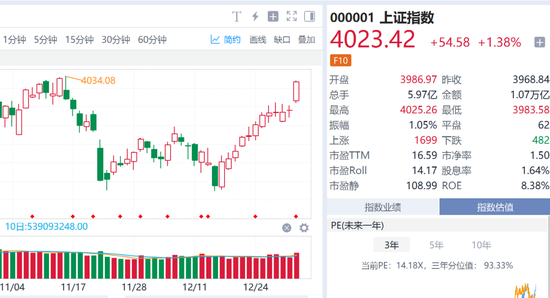
Core Viewpoint - The Chinese stock market has experienced a significant rally, with the Shanghai Composite Index achieving a record twelve consecutive days of gains, surpassing the 4000-point mark for the first time in 33 years since 1993, indicating a strong market sentiment and potential for a cross-year rally [1][27]. Group 1: Market Performance - The total trading volume in the two markets surged to 2.55 trillion yuan, with over 4100 stocks rising, reflecting heightened market enthusiasm and capital inflow [3][27]. - Goldman Sachs has released a report predicting that the Chinese stock market will rise by 15%-20% annually in 2026 and 2027, recommending an overweight position in Chinese stocks [3][27]. Group 2: ETF Performance - Hong Kong ETFs have seen substantial gains, particularly in the innovative drug, internet, and chip sectors, which have been the main drivers of the market's upward movement [4][28]. - The top-performing Hong Kong ETFs include the Hong Kong Innovative Drug ETF (520880) with a 5.4% increase, the Hong Kong Internet ETF (513770) with a 4.4% increase, and the Hong Kong Information Technology ETF (159131) with a 3.6% increase [4][29]. Group 3: Sector Highlights - The innovative drug sector is boosted by the implementation of a new national medical insurance drug list and a commercial health insurance list for innovative drugs starting January 1, 2026, which is expected to enhance industry confidence [6][30]. - In the internet sector, Baidu's Kunlun Chip has submitted a listing application to the Hong Kong Stock Exchange, raising expectations for its parent company's asset value [6][30]. - The chip sector is experiencing a rally due to a significant increase in global memory chip prices and the acceptance of Changxin Storage's IPO application on the Sci-Tech Innovation Board, with leading stocks like Hua Hong Semiconductor and SMIC showing strong performance [6][31]. Group 4: ETF Trends in 2025 - The top-performing ETFs in 2025 include the Entrepreneurial Board Artificial Intelligence ETF (159363) with a 105% increase, and the Nonferrous Metals ETF (159876) with over a 92% increase, indicating strong growth in technology and materials sectors [7][32]. - Other notable sectors include technology, electronics, and chemicals, which have also shown impressive performance, attracting significant investor interest [7][33]. Group 5: Fund Inflows - The top three ETFs by net inflow are the Broker ETF (512000) with 159.3 million yuan, the Hong Kong Internet ETF (513770) with 91.7 million yuan, and the Financial Technology ETF (159851) with 49.7 million yuan, highlighting investor preference for these sectors [9][35].
这类产品,指数增强效果大分化!
Zhong Guo Ji Jin Bao· 2026-01-05 13:37
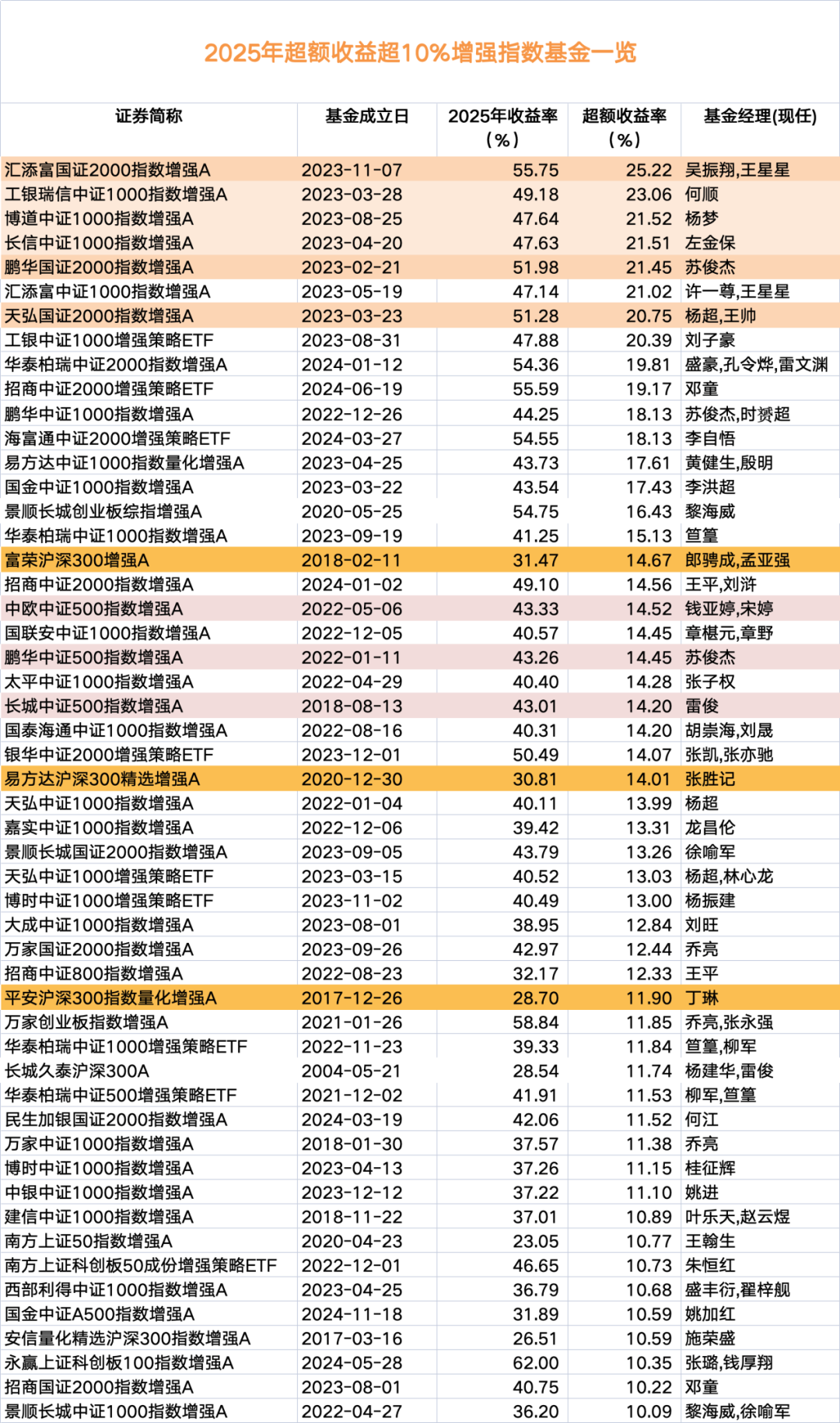
Core Insights - In 2025, enhanced index funds showed significant performance differentiation, with an average net value growth rate exceeding 32% and over 80% achieving positive excess returns [1][2] - The trend towards diversified and refined enhancement strategies is expected to continue, with a focus on achieving stable performance against benchmarks [1][10] Performance Highlights - As of the end of 2025, 291 enhanced index funds had an average net value growth rate of 32.51% and an average excess return of 5.35%, with nearly 80% achieving positive excess returns [2][3] - Small-cap and technology-focused enhanced index products performed particularly well, with notable funds like Dongcai Zhongzheng Nonferrous Metals Enhanced Index and Huabao Zhongzheng Rare Metals Theme achieving returns of 91.50% and 88.55% respectively [2][3] Fund Performance Analysis - 52 enhanced index funds achieved excess returns exceeding 10%, with the highest being Huitye National Index 2000 Enhanced Fund at 25.22% [3][4] - Performance varied significantly among funds tracking the same broad index, with some funds underperforming by nearly 33 percentage points [7][8] Market Trends and Strategies - The performance of enhanced index products was influenced by market conditions, with small-cap stocks showing higher volatility and effective pricing, benefiting quantitative models [8][9] - The application of multi-factor quantitative enhancement strategies was key to achieving excess returns, considering various factors such as fundamentals and technical indicators [9][12] Future Outlook - The trend towards diversification and refinement in enhancement strategies is expected to continue, with AI integration in investment processes anticipated to deepen [10][11] - Enhanced index products will need to adapt to different market conditions and investor needs, focusing on long-term stable excess returns and effective risk modeling [12]
4只公告上市ETF仓位超60%
Zheng Quan Shi Bao Wang· 2026-01-05 03:24
Core Viewpoint - Three stock ETFs have recently announced their listing, with varying stock positions indicating different investment strategies and market conditions [1] Group 1: ETF Stock Positions - The stock position of the Invesco Hang Seng Biotechnology ETF is 15.90%, while the XQHS300 Quality ETF has a stock position of 62.01%, and the E Fund Shanghai Stock Exchange Sci-Tech Innovation Board Chip ETF has a stock position of 5.37% [1] - In the past month, 23 stock ETFs have announced their listings, with an average stock position of only 29.09%. The highest stock position is held by the Industrial Bank Sci-Tech Innovation Entrepreneurship Artificial Intelligence ETF at 75.70% [1] Group 2: Fundraising and Shareholder Structure - The average number of shares raised by the recently listed ETFs is 4.46 million, with the largest being the E Fund CSI Sci-Tech Innovation Entrepreneurship Artificial Intelligence ETF at 13.36 million shares [2] - Institutional investors hold an average of 18.62% of the shares, with the highest proportions in the Hua Bao CSI Hong Kong Stock Connect Automotive Industry Theme ETF (64.43%), the Jiao Yin CSI Selected Hong Kong and Shanghai Technology 50 ETF (48.92%), and the Guangfa CSI A50 ETF (45.22%) [2] Group 3: ETF Listing Details - The listing details of several ETFs include the establishment date, fundraising scale, and stock positions, with notable examples being the E Fund Shanghai Stock Exchange Sci-Tech Innovation Board Chip ETF with a stock position of 5.37% and the Invesco Hang Seng Biotechnology ETF with a stock position of 15.90% [3]
头部公募集体“换马甲”,百余只ETF掀起更名潮
Huan Qiu Wang· 2026-01-04 03:49
Core Viewpoint - The ETF market is undergoing a significant renaming trend as major public fund companies respond to regulatory requirements, marking a shift towards brand recognition and systematic competition in the industry [1][4]. Group 1: Unified Naming and Brand Recognition - On December 30, 2025, E Fund announced a change in the names of 45 ETFs, becoming the first company to complete the adjustment of all its ETFs, adopting a standardized naming format that includes "core elements of the investment target + ETF + manager name" [2][4]. - Other fund managers, such as Huatai-PB and Southern Fund, followed suit with similar announcements, enhancing brand clarity and manager identification in a crowded market [2][4]. - The previous diverse naming conventions led to confusion among investors, making it difficult to distinguish between products, especially with popular indices having multiple ETFs with similar names [4][6]. Group 2: Regulatory Changes and Market Dynamics - The renaming initiative is driven by new regulatory guidelines issued by the Shanghai and Shenzhen Stock Exchanges, which require ETFs to follow a specific naming structure and include the fund manager's abbreviation by March 31, 2026 [4][6]. - The ETF market has surpassed a total scale of 6 trillion yuan, indicating a shift from simple fee competition to a focus on brand recognition and investor preference [6][7]. - The renaming trend is seen as a critical milestone in the standardization of the Chinese ETF market, emphasizing the need for fund companies to enhance core service capabilities such as liquidity and tracking error [7].
基金早班车丨权益自购近49亿,2025成公募“真金白银”示范年
Jin Rong Jie· 2025-12-31 00:38
Group 1: Market Overview - The A-share market is showing signs of recovery, with regulatory guidance leading to a "self-purchase model" for public funds starting in 2025, resulting in a net subscription of nearly 4.9 billion yuan for equity funds this year [1] - As of December 30, the three major A-share indices showed mixed performance, with the Shanghai Composite Index closing flat at 3965.12 points, the Shenzhen Component Index rising by 0.49% to 13604.07 points, and the ChiNext Index increasing by 0.63% to 3242.9 points [1] Group 2: Fund News - On December 30, three new funds were launched, primarily equity funds, while 18 funds distributed dividends, mostly bond funds, with the highest dividend payout from the Yinhua ETF at 13.8710 yuan per 10 shares [2] - The total number of ETFs has approached 1400, with a significant increase of 1 trillion yuan in four months, leading to a "choice overload" for investors. Regulatory bodies are advocating for clearer labeling, prompting major firms to standardize fund names for easier comparison [2] - In 2023, a total of 1553 new funds were issued, marking a year-on-year increase of 35.87%, the highest in four years, with the average subscription period decreasing from 22.63 days to 16.41 days, indicating a heightened willingness of funds to enter the market [2] Group 3: New Fund Launches - The new funds launched on December 30 include the Huabao Shanghai Stock Exchange Sci-Tech Innovation Board Chip ETF and two funds from Shanzheng Asset Management focusing on digital economy stocks, with no initial fundraising targets disclosed [3] Group 4: Fund Dividends - The dividend distribution on December 30 included notable payouts such as 13.8710 yuan for the Yinhua Trading Currency B fund and 11.5530 yuan for the Yinhua Trading Currency A ETF, among others [4]

ETF盘中资讯|AI应用大催化!Meta数十亿美元收购Manus!创业板人工智能ETF(159363)涨逾1%冲击前高
Sou Hu Cai Jing· 2025-12-30 01:56
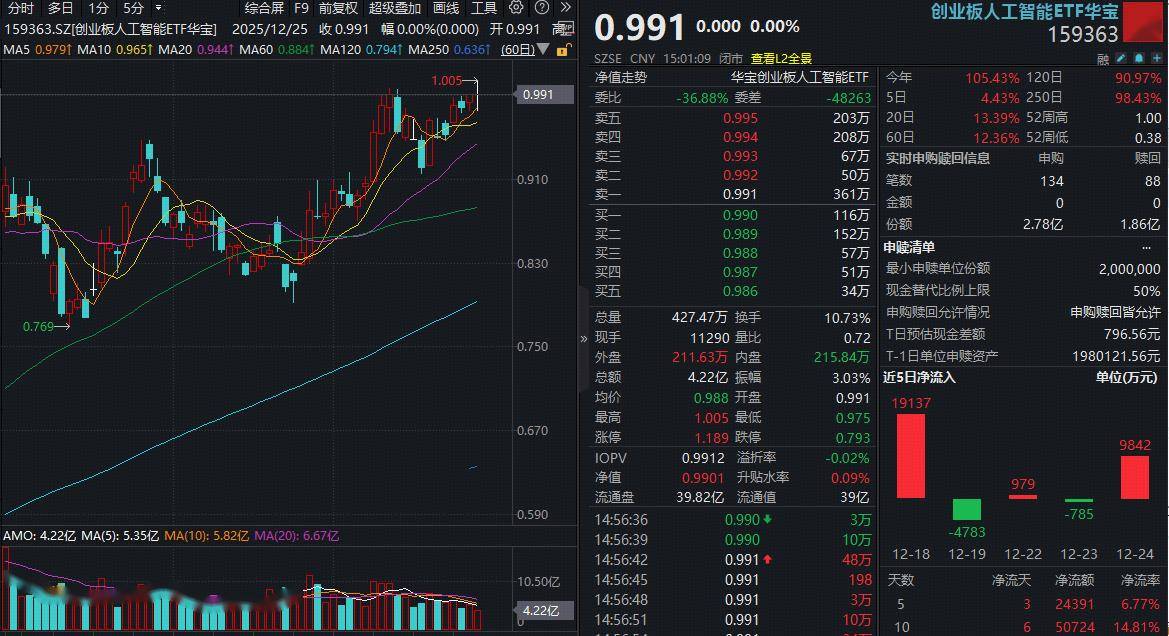
12月30日早盘,创业板人工智能开盘冲高,AI应用概念股涨幅居前,汉得信息、蓝色光标领涨超5%,易点天下、昆仑万维、芒果超媒等多股涨超2%。热门 ETF方面,同类流动性最佳的创业板人工智能ETF(159363)场内上扬逾1%冲击前高, 把握以光模块为核心的算力方向以及AI应用机会,建议重点关注全市场首只创业板人工智能ETF(159363)及场外联接(A类023407、C类023408),标的 指数重点布局光模块龙头"易中天",光模块含量最新超56%。从赛道分布看,逾七成仓位布局算力,超两成仓位布局AI应用,能够高效捕捉AI主题行情。 (截至2025.11.30) 同类对比看,截至12月29日,创业板人工智能ETF华宝(159363)最新规模超38亿元,近1个月日均成交额超6亿元,在跟踪创业板人工智能指数的7只ETF 中排行第一! 数据来源:沪深交易所等。注:"全市场首只"是指首只跟踪创业板人工智能指数的ETF。 风险提示:创业板人工智能ETF华宝被动跟踪创业板人工智能指数,该指数基日为2018.12.28,发布日期为2024.7.11。创业板人工智能指数2020-2024年年度 涨跌幅分别为:20.1%、17 ...


航天+卫星再狂飙!航天环宇冲击20CM涨停,重仓航空航天的通用航空ETF(159231)涨超1.7%冲击四连阳
Xin Lang Cai Jing· 2025-12-29 06:18
Group 1 - Aerospace and satellite internet sectors are showing strong performance, with companies like Aerospace Universe rising over 19%, Guangwei Composite increasing by more than 15%, and Haige Communication hitting a 10% limit up [1][6] - The General Aviation ETF Huabao (159231) is experiencing a price increase of 1.72%, marking a strong four-day upward trend [1][6] Group 2 - The private rocket company "New Space Aerospace" announced on December 27 the initiation of key technology engineering tests for the recovery and reuse of the Chitu-1 rocket, indicating accelerated development in low-cost, high-reliability, and reusable space technology [3][8] - Under the national strategy to upgrade "Aerospace Power" and position commercial aerospace as a new growth engine, the industry is at a historic development turning point, with significant downstream application demand in satellite internet constellation construction [3][8] - The General Aviation ETF Huabao (159231) and its linked funds cover 50 constituent stocks across various sectors, including low-altitude economy, large aircraft, military aircraft, commercial aerospace, satellite navigation, and drones, with the aerospace industry accounting for over 37% [3][8]


