
柯力传感

Search documents
人形机器人明年交付量有望迎来爆发 多只业绩高增长概念股已大幅回撤
Zheng Quan Shi Bao Wang· 2025-12-03 08:13
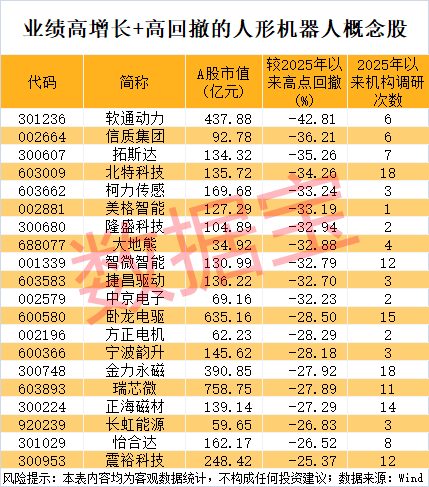
Group 1 - The Chinese humanoid robot industry chain has formed a complete layout, with multiple A-share listed companies making breakthroughs in various segments [1] - Several listed companies have entered the mass supply stage, and the delivery volume is expected to see a significant increase next year [1] - In the first three quarters of this year, humanoid robot concept stocks with a year-on-year net profit growth of 20% (including turning losses into profits) have seen 36 stocks retreat over 20% from their annual highs as of December 3 [1] Group 2 - Among the 36 humanoid robot concept stocks, five have a rolling price-to-earnings ratio below 30 times, including Zhongding Co., Huaqin Technology, Changhong Energy, Mingke Precision, and Jihong Co. [1] - The market capitalization of several companies has significantly decreased from their peak values, with Softcom Power down 42.81%, Xinzhi Group down 36.21%, and Tuosida down 35.26% [2] - The number of institutional research visits for these companies varies, with Softcom Power receiving 6 visits and Tuosida receiving 7 visits [2]





山西证券研究早观点-20251203
Shanxi Securities· 2025-12-03 01:04
Market Trends - The domestic market indices showed a decline, with the Shanghai Composite Index closing at 3,897.71, down 0.42%, and the Shenzhen Component Index at 13,056.70, down 0.68% [4]. Industry Commentary: Chemical Raw Materials - The new materials sector saw an increase of 3.23%, although it underperformed compared to the ChiNext Index by 1.31%. The synthetic biology index fell by 1.80%, while electronic chemicals rose by 0.45% [6]. - Key price tracking for amino acids showed valine at 12,500 CNY/ton (-0.40%), arginine at 21,400 CNY/ton (unchanged), and tryptophan at 30,500 CNY/ton (-3.17%) [6]. - The IPO guidance for Yushu Technology has been completed, which is expected to accelerate the development of the humanoid robot industry. The company is on the verge of becoming the first humanoid robot stock in A-shares, potentially leading to a market size of 10 trillion CNY for humanoid robots in China [6][7]. Industry Commentary: Electric Equipment and New Energy - The launch of the Lingxin platform by Zhiyuan Robotics allows users to customize robot interactions easily, marking a significant innovation in the industry [9]. - UBTECH's total order amount for humanoid robots in 2025 has reached 1.3 billion CNY, indicating strong market demand [9]. - The National Development and Reform Commission is addressing issues of price disorder in the market, which could impact competition and pricing strategies [9]. - Recent pricing data shows that polysilicon prices remain stable, with dense material averaging 52.0 CNY/kg and granular silicon at 50.0 CNY/kg [9][13]. Investment Recommendations - The report recommends focusing on companies involved in humanoid robots, particularly those producing core components like electronic skin and dexterous hands. Notable companies include Hanwei Technology and Fule New Materials [6][7]. - In the electric equipment and new energy sector, companies such as Aishuo Co., Longi Green Energy, and Daqo New Energy are highlighted for their potential in new technology and supply-side strategies [11].
新材料周报:宇树科技IPO辅导收官,有望推动人形机器人产业发展加速-20251202
Shanxi Securities· 2025-12-02 10:28
Investment Rating - The report maintains a "Leading Market-B" rating for the new materials sector [2]. Core Insights - The new materials sector index increased by 3.23%, underperforming the ChiNext index by 1.31% over the past week [2]. - The demand for energy storage is surging, particularly benefiting the materials related to humanoid robots, as the industry transitions from a research phase to a scaling phase [5]. - The report highlights the expected domestic demand for humanoid robots to exceed 100 million units, with a market size potentially reaching 10 trillion yuan [5]. Summary by Sections 1. Market Performance - The new materials sector saw a mixed performance with the synthetic biology index down by 1.80%, semiconductor materials down by 0.71%, electronic chemicals up by 0.45%, biodegradable plastics down by 1.26%, industrial gases up by 0.86%, and battery chemicals down by 4.43% [2][18]. - The overall market performance for the week (November 24-28, 2025) showed the CSI 300 index rising by 1.64% and the Shanghai Composite Index by 1.4% [14]. 2. Price Tracking - Amino acids prices showed slight declines: valine at 12,500 yuan/ton (-0.40%), tryptophan at 30,500 yuan/ton (-3.17%), and methionine at 18,900 yuan/ton (-2.83%) [3]. - Prices for biodegradable materials remained stable, with PLA (injection grade) at 17,800 yuan/ton and PBS at 17,500 yuan/ton [3]. 3. Investment Recommendations - The report suggests focusing on core components for humanoid robots, such as electronic skin and dexterous hand transmission devices, which are expected to benefit from the industry's growth [5]. - Specific stocks to watch include Hanwei Technology, Fule New Materials, and Jinghua New Materials, which are involved in electronic skin technology [5]. 4. Individual Stock Performance - In the new materials sector, 73.03% of stocks achieved positive returns, with notable performers including Yishitong (25.54%) and Tianyue Advanced (15.12%) [24]. - The report notes significant net inflows for stocks like Placo New Materials (319 million yuan) and Anji Technology (253 million yuan) [24].
柯力传感跌2.02%,成交额1.11亿元,主力资金净流出1374.47万元
Xin Lang Cai Jing· 2025-12-02 05:45
Core Viewpoint - The stock price of Keli Sensor has experienced a decline of 4.76% this year, with a recent drop of 2.02% on December 2, 2023, indicating potential market volatility and investor sentiment concerns [1] Company Overview - Keli Sensor Technology Co., Ltd. was established on December 30, 2002, and went public on August 6, 2019. The company specializes in the research, production, and sales of strain sensors and instruments, as well as providing various system integration services [2] - The main revenue composition includes: 48.70% from mechanical sensors and instruments, 41.12% from industrial IoT and system integration, and 5.02% from other services [2] Financial Performance - As of September 30, 2023, Keli Sensor reported a revenue of 1.082 billion yuan, representing a year-on-year growth of 17.72%, and a net profit attributable to shareholders of 254 million yuan, reflecting a growth of 33.29% [3] - The company has distributed a total of 453 million yuan in dividends since its A-share listing, with 251 million yuan distributed in the last three years [4] Shareholder Information - As of September 30, 2023, the number of shareholders decreased by 1.47% to 62,900, with an average of 4,467 circulating shares per person, which increased by 1.50% [3] - Notable institutional shareholders include Hong Kong Central Clearing Limited, which increased its holdings by 1.3078 million shares, and new entrants like E Fund National Robot Industry ETF [4]
国产六维力传感器市场进一步集中,头部厂商市占率已超70%
Huan Qiu Wang· 2025-11-28 01:00
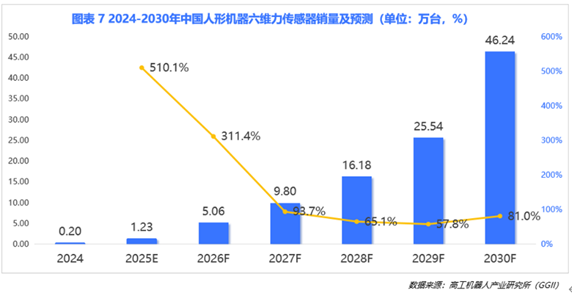
Core Insights - The humanoid robot industry in China is experiencing rapid growth, particularly in the six-dimensional force sensor market, which is crucial for real-time precision force control [1][2] - By 2025, the shipment volume of six-dimensional force sensors in China is expected to reach 12,300 units, representing a year-on-year increase of 510.1% [2] - The market is becoming increasingly concentrated, with leading companies capturing over 70% of the market share [2] Industry Overview - The six-dimensional force sensor is considered a top-tier product in the force sensor field, essential for humanoid robots to achieve precise force control [5] - These sensors are primarily installed in the wrists and ankles of humanoid robots to facilitate delicate operations and stable movement on uneven surfaces [5] - Future developments may see these sensors integrated into the fingertips of dexterous hands to enhance fine motor skills [5] Market Dynamics - Domestic companies are becoming market leaders due to their high cost-performance ratio, customization capabilities, and rapid response services [5] - Key players in the six-dimensional force sensor market include companies like Blue Dot Touch, Keli Sensor, Kunwei Technology, and Amperon, with Blue Dot Touch holding a market share of 72.6% in the first three quarters of 2025 [5] - The industry has seen eight financing events since 2025, indicating strong interest from the capital market in this sector [5] Future Projections - The shipment volume of six-dimensional force sensors is projected to grow approximately 40 times by 2030, exceeding 460,000 units [2] - Optimistically, the market could reach a scale of over 100 billion yuan by 2035 as humanoid robots penetrate consumer scenarios [2] - According to Morgan Stanley, the number of human-like robots could surpass 1 billion by 2050, with China aiming to solidify its leading position in this field [2]
报告:人形机器人六维力传感器市场进一步集中,头部厂商市占率已超70%
Zheng Quan Shi Bao Wang· 2025-11-27 06:58
Core Insights - The six-dimensional force sensor market in China is experiencing explosive growth due to the acceleration of humanoid robot industrialization, with a projected shipment of 12,300 units in 2023, representing a year-on-year increase of 510.1% [1][2] - The market is becoming increasingly concentrated, with leading company Blue Dot Touch holding a market share of 72.6% [1][2] - By 2030, shipments are expected to grow approximately 40 times to over 460,000 units, with optimistic projections suggesting the market could reach a scale of 100 billion by 2035 [1] Industry Overview - Six-dimensional force sensors are critical components for achieving real-time precise force control in humanoid robots, capable of measuring all possible movements of an object in space, including translation and rotation [1] - Unlike traditional industrial robots that perform repetitive tasks through pre-set programs, humanoid robots utilize a "perception-decision-execution" model for enhanced versatility [1] Market Dynamics - Currently, six-dimensional force sensors are primarily installed in the wrists and ankles of humanoid robots to facilitate delicate operations and stable walking on uneven surfaces [2] - Domestic companies dominate the market due to their cost-effectiveness, customization capabilities, and rapid response services, with key players including Blue Dot Touch, Keli Sensor, Kunwei Technology, Amperelong, Yuli Instruments, and Xinjingcheng [2] Company Performance - Blue Dot Touch achieved a market share of 72.6% in the first three quarters of 2025, with significant orders from leading humanoid robot companies such as Zhi Yuan, Xiaomi, and Xiaopeng [2] - The company’s joint torque sensors account for over 95% of domestic shipments, with more than 70,000 units shipped in the first half of 2025 [2] - The investment landscape is favorable, with eight financing events occurring in the six-dimensional force sensor industry since 2025, including two rounds of financing for Blue Dot Touch, the latest being over 100 million led by Sequoia China [2]
山西证券研究早观点-20251124
Shanxi Securities· 2025-11-24 01:56
Core Insights - The report highlights the significant growth potential of the electronic skin industry, projecting a market size of $756 million by 2030, driven by the demand for humanoid robots [6][7] - The report emphasizes the competitive landscape, noting that leading companies in the flexible tactile sensor market are predominantly based in Europe, the US, and Japan, holding 57.1% of the market share [6][7] - The report discusses the technological barriers in the electronic skin industry, focusing on materials, manufacturing processes, and algorithms as critical areas needing breakthroughs [6][7] Industry Overview - The electronic skin technology is categorized into five main types, with resistive, capacitive, and piezoelectric sensors being the most common [6] - The report indicates that the demand for humanoid robots is expected to drive the growth of the electronic skin market, with a long-term potential reaching trillions in the domestic humanoid robot market [6][7] - The report identifies key companies in the electronic skin sector, including Fulei New Materials, Hanwei Technology, and others, highlighting their technological advancements and market strategies [6][7] Company Analysis - The report provides an analysis of Zhongji Xuchuang (300308.SZ), noting a revenue of 25 billion yuan for the first three quarters of 2025, representing a year-on-year increase of 44.4% [8] - The company’s gross margin and net margin have shown continuous improvement, indicating a shift towards higher-end product offerings [8] - The report mentions the company's plans for an H-share listing to enhance its international strategy and financing capabilities [8]

山西证券: 电子皮肤为人形机器人交互关键 行业有望维持高速发展
智通财经网· 2025-11-21 06:45
Core Insights - Electronic skin is crucial for humanoid robots to achieve tactile perception, enhancing interaction capabilities [1] - The global market for electronic skin is projected to reach $756 million by 2030, driven by the demand for humanoid robots [4] - Domestic manufacturers in China are rapidly closing the technology gap with foreign competitors, supported by policy and manufacturing advantages [4] Industry Overview - The global market for flexible tactile sensors is dominated by foreign companies, which hold 57.1% of the market share [4] - The humanoid robot market in China is expected to reach a scale of trillions in the long term, with electronic skin as a core component [4] Technology Landscape - Electronic skin can be categorized into five main technical routes, with resistive, capacitive, and piezoelectric being the most common [2] - The choice of technology involves a trade-off between sensitivity, cost, and reliability, with multiple routes expected to coexist [2] Challenges and Barriers - Material challenges include the need for high sensitivity, durability, and environmental adaptability [3] - Manufacturing complexities and high costs hinder large-scale deployment of electronic skin [3] - Algorithmic challenges involve the need for advanced calibration mechanisms and multi-modal sensing capabilities [3] Key Companies - Fule New Materials (605488.SH): Completed pilot production and is supplying small batches of advanced flexible tactile sensors [5] - Hanwei Technology (300007.SZ): Holds core technologies in flexible sensors and has established partnerships with nearly 30 robotics manufacturers [5] - Keli Sensor (603662.SH): Engaged in strategic investments in the electronic skin sector, with products in development [6] - Shenhao Technology (300853.SZ): Focused on non-contact electronic skin applications for operational safety in robotics [6] - Jinghua New Materials (603683.SH): Developed flexible tactile sensors for precise perception in robotic applications [6] - Audiwei (920491.BJ): Expanding into tactile sensor products for humanoid robot functionalities [6]

电子皮肤行业深度报告:实现机器柔性触觉,感知世界触手可及
Shanxi Securities· 2025-11-21 05:18
Investment Rating - The report maintains an investment rating of "B" for the electronic skin industry, indicating a leading position in the market [1]. Core Insights - The electronic skin is a key tactile sensing system for humanoid robots, enabling them to interact with their environment through pressure and temperature sensing [13]. - The market for electronic skin is projected to reach $756 million by 2030, driven by the increasing demand for humanoid robots [4]. - The industry faces three major barriers: materials, manufacturing processes, and algorithms, which are critical for establishing competitive advantages [24][32]. Summary by Sections 1. Electronic Skin: Key to Humanoid Robot Interaction - Electronic skin mimics natural skin functions and is essential for humanoid robots to perceive their surroundings [13]. - The technology can be categorized into resistive, capacitive, and piezoelectric types, with resistive sensors being the most common in humanoid robots [2][21]. 2. Domestic Enterprises Accelerating Layout - Overseas companies dominate the high-end market, holding approximately 57.1% of the global flexible tactile sensor market share [4][41]. - Domestic companies are rapidly closing the technology gap, supported by favorable policies and manufacturing capabilities, with firms like Fulei New Materials and Hanwei Technology emerging as key players [5][46]. 3. Key Companies to Watch - Fulei New Materials has completed pilot production and is supplying small batches to leading clients in the dexterous hand sector [5]. - Hanwei Technology has established partnerships with nearly 30 robot manufacturers and is expanding its production capacity [5]. - Keli Sensor and other companies are also making strides in the electronic skin sector, focusing on multi-physical sensors and flexible tactile sensors [5][46].




上市公司认购私募产品须防四大风险
Guo Ji Jin Rong Bao· 2025-11-17 14:01
Core Insights - As of November 7, 2023, a total of 10 listed companies have disclosed information regarding the subscription or renewal of private placement products, with a cumulative subscription amount reaching 818 million yuan [1] - The trend of listed companies investing in private placement products is notable, with potential risks that need to be monitored [3][4] Group 1: Investment Trends - The total amount invested by the 10 listed companies varies, with Yaxing Anchor Chain leading by subscribing 263 million yuan, accounting for 32.15% of the total [1] - Other companies that invested 100 million yuan include Yongji Co., Zhongxing Junye, and Innovation New Materials, while companies like Keli Sensor and Rongtai Health invested smaller amounts of 10 million yuan and 5 million yuan respectively [1] - A majority of A-share listed companies are keen on financial management, with investment scales typically ranging from tens of millions to billions of yuan [1] Group 2: Private Fund Industry Growth - The private fund industry in China has grown significantly, with the total asset management scale of the asset management industry reaching 75.38 trillion yuan as of June 30, 2023 [2] - Private funds account for 20.60 trillion yuan of this total, positioning them as the second-largest segment in asset management [2] - The number of private fund products exceeds 140,000, representing 71.87% of the total 195,500 products in the market, indicating robust growth in the private fund sector [2] Group 3: Risks Associated with Private Placement Products - There are four main risks associated with listed companies subscribing to private placement products: 1. The risk of investment losses from private funds, which could negatively impact the performance of the listed companies [3] 2. Financial pressure on listed companies due to large investments in private products, potentially affecting liquidity [3] 3. The risk of fund managers absconding, which has been a recurring issue in the industry [4] 4. The risk of stock price manipulation, where private funds might collaborate with listed companies to influence stock prices for profit [4]