
鹏华

Search documents
个人养老三周年 这批养老基金赚钱了
Shang Hai Zheng Quan Bao· 2025-11-26 14:04
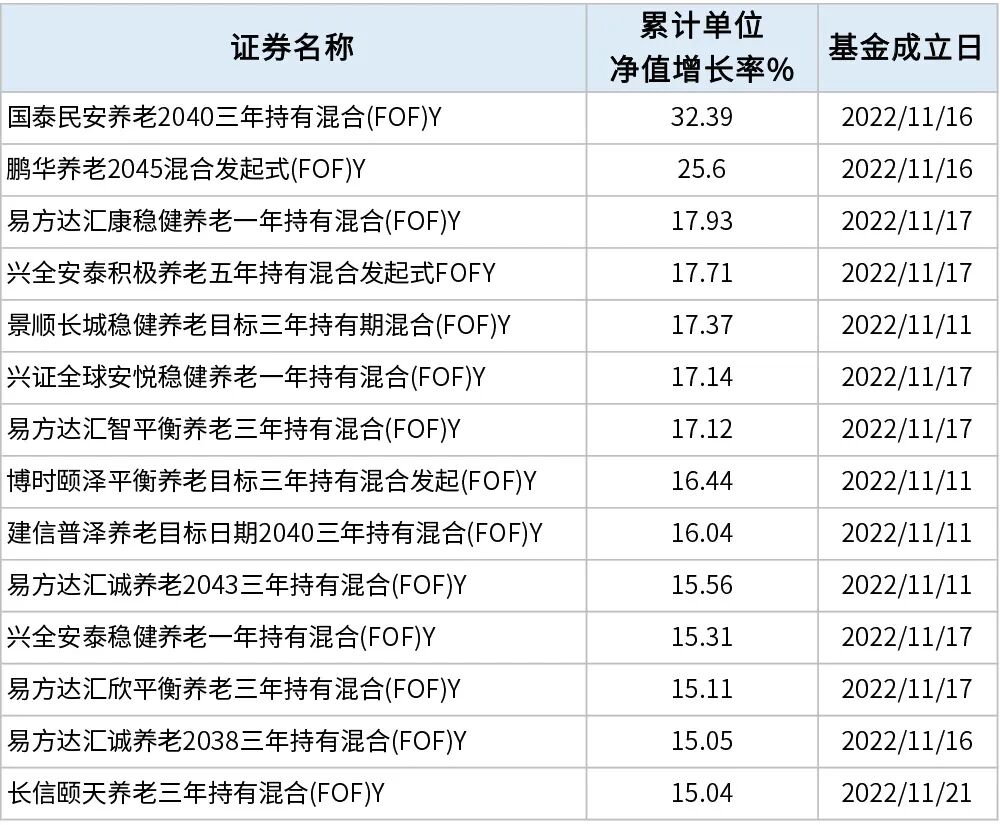
Core Insights - The first three-year performance report of personal pension funds shows that over 90% of the products achieved positive returns, with an average return exceeding 9% [1][2] - The personal pension investment system has been enhanced with the inclusion of various investment products, such as index funds and electronic savings bonds, showcasing the advantages of funds in competing with other financial products [1][2] Summary by Categories Performance of Personal Pension Funds - As of November 25, 2025, out of 129 personal pension funds, 120 achieved positive returns, resulting in a high success rate of 93% and an average return of 9.14% [2] - Notable funds include Guotai Min'an Pension 2040 with a return of 32.39% and Penghua Pension 2045 with 25.6%, with 12 funds exceeding a 15% return [2][3] Fund Categories and Returns - The total number of personal pension products has surpassed 1200, with 311 being fund products [2][4] - The average return for the 311 personal pension fund Y shares since inception is 13.33%, with passive index funds showing exceptional performance, some exceeding 40% [4] Investor Profile and Preferences - The majority of Y share holders prefer aggressive products (77%), while conservative products account for 18%, and balanced products only 5% [9][12] - The age distribution shows that the primary holders are aged 30-50, with males making up nearly 70% of the holders [12] Advantages of Y Shares - Y shares offer tax benefits, lower fees compared to other funds, and encourage systematic investment, promoting better investment habits [13] - Investing in equities is essential for young investors to combat inflation and maintain purchasing power over time [14] Investment Psychology - The investment experience is compared to dopamine (instant gratification) and endorphins (long-term satisfaction), emphasizing the importance of disciplined, long-term planning in pension investments [15]

24只ETF公告上市,最高仓位54.00%
Zheng Quan Shi Bao Wang· 2025-11-26 02:56
Core Insights - The E Fund CSI A500 Dividend Low Volatility ETF is set to be listed on December 1, 2025, with a total of 692 million shares for trading [1] - As of November 24, 2025, the fund's asset allocation shows 90.15% in bank deposits and settlement reserves, while stock investments account for 9.84% [1] - A total of 24 stock ETFs have announced listings in November, with an average allocation of only 20.03% [1] Fund Details - The E Fund CSI A500 Dividend Low Volatility ETF was established on November 17, 2025, and is currently in the accumulation phase [1] - The fund's investment strategy indicates a low stock allocation during its initial phase, which is common for newly listed ETFs [1] - Other ETFs with higher allocations include Morgan Stanley Hang Seng Stock Connect 50 ETF at 54.00%, and others like Bosera National Industrial Software Theme ETF and Southern CSI Hong Kong Stock Connect Internet ETF with allocations of 46.74% and 45.33% respectively [1] Institutional Holdings - Among the newly listed ETFs, the average institutional investor holding is 9.87%, with the highest being 31.99% for the Guolian An Hong Kong Stock Connect Technology ETF [2] - The E Fund CSI A500 Dividend Low Volatility ETF has a low institutional holding of 2.91% [2] - The data indicates a varied interest from institutional investors across different ETFs, with some showing significantly higher engagement [2]
“避险走强、进攻收缩”!ETF资金结构生变
Sou Hu Cai Jing· 2025-11-24 23:37
Core Insights - The ETF market is experiencing a shift in funding structure amid a volatile market and weak expectations, with a clear divergence in the scale changes of different ETFs [1][2] - Low-risk, low-volatility bond ETFs are seeing significant inflows, while broad-based equity ETFs and certain technology-themed ETFs are facing outflows [1][2][5] Group 1: Low-Risk Bond ETFs - Bond-related ETFs have become the main source of growth in the ETF market, with significant inflows recorded in the past month [2] - Specific bond ETFs such as the CSI Short Bond Index ETF, CSI AAA Technology Innovation Corporate Bond ETF, and others have seen substantial increases in scale, with inflows of 106.67 billion, 93.50 billion, 52.18 billion, and 43.12 billion respectively [2][3] - The demand for stable assets is evident as both institutional and individual investors seek to enhance portfolio stability through low-volatility bond ETFs [2][3] Group 2: Equity ETFs Under Pressure - In contrast to bond ETFs, broad-based equity indices are experiencing net outflows, with the CSI 300 Index ETF seeing a decrease of 387.60 billion, the STAR Market 50 Index ETF down by 63.97 billion, and others also facing declines [4] - Technology-themed ETFs are similarly under pressure, with significant outflows from products like the CSI Hong Kong Internet ETF, which decreased by 84.49 billion [4] - The market sentiment indicates a shift away from high-volatility and high-beta index products, reflecting a cautious risk appetite among investors [4][5] Group 3: Investor Behavior and Market Outlook - Investors are increasingly focusing on risk management, favoring stable assets in their portfolio adjustments amid limited incremental capital and cautious macro expectations [6] - The current market environment suggests that the trend of inflows into low-risk ETFs may continue, while growth and high-volatility sectors will depend on improvements in macro expectations and liquidity conditions [6]
首批7只科创创业人工智能ETF将在本周五集中发行
Ge Long Hui· 2025-11-24 12:59
Group 1 - Seven fund companies, including Huatai-PB, E Fund, ICBC Credit Suisse, Yongying, Invesco Great Wall, Penghua, and Morgan Asset Management, announced the launch of their AI-focused ETF on November 28 [1] - The ETF tracks the CSI Sci-Tech Innovation and Entrepreneurship Artificial Intelligence Index, which consists of 50 leading companies in AI technology research, hardware support, and commercial applications across various verticals [1] - The top three weighted industries in the index are communication equipment (37.92%), semiconductors (31.21%), and software development (9.29%), representing the forefront of "hard technology" and "high growth" in China [1] Group 2 - The top five weighted stocks in the index are Zhongji Xuchuang, Xinyisheng, Cambricon Technologies-U, Lanke Technology, and Kingsoft Office, all of which are well-recognized and representative leaders in the AI sector [1]


21只,新发!
Zhong Guo Ji Jin Bao· 2025-11-24 06:21
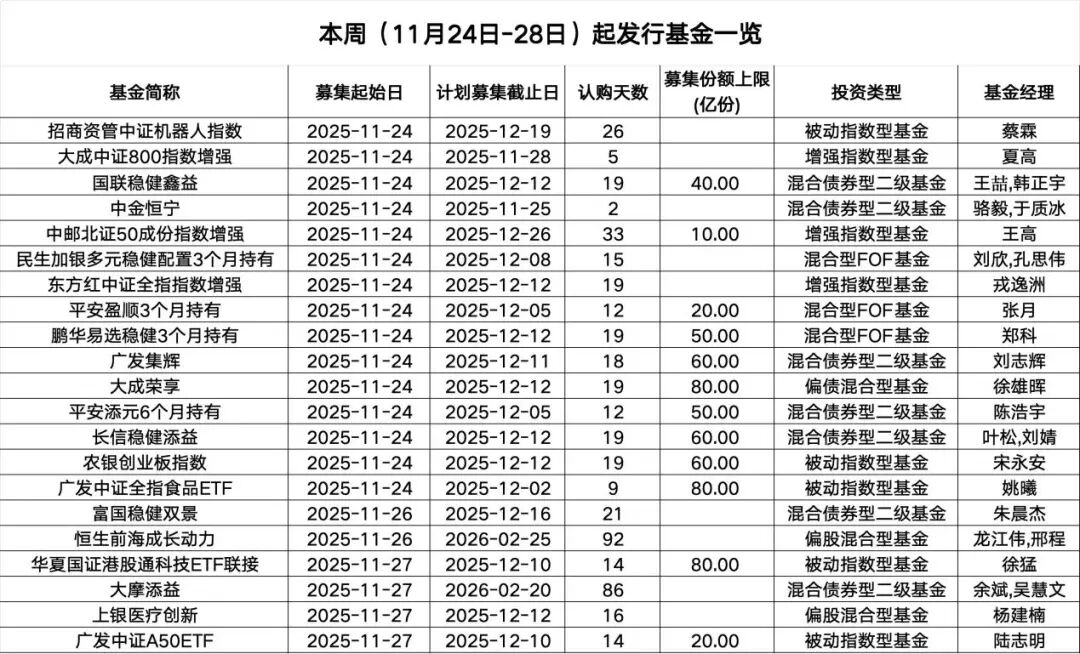
Core Insights - This week, 21 new funds are set to launch, primarily focusing on equity funds, although their proportion has decreased compared to previous weeks [1][4]. Fund Issuance Overview - A total of 21 new funds will be publicly offered this week, with 15 of them launching on Monday, accounting for over 70% of the week's total [2]. - The longest subscription period among these funds is three months, with funds like Hengsheng Qianhai Growth Power and Morgan Stanley's Tianyi [2][3]. - The average subscription period for the new funds is 23.29 days, which is longer than in previous weeks, likely due to recent market adjustments [3]. Fund Types and Categories - Equity funds remain the dominant type, with 11 out of 21 new funds classified as equity, although their share has declined [4]. - Among the equity funds, there are five index funds and three enhanced index funds, with the former making up over 45% of the equity category [4]. - Three actively managed equity funds are also being launched, all of which are mixed funds [5]. Fixed Income and Other Funds - The bond market has seen a slowdown in fund issuance, with no pure bond funds launched this week; however, seven secondary bond funds are debuting [6]. - A total of eight "fixed income plus" funds are being introduced this week, making up nearly 40% of the new offerings [6]. Fund Details - Specific funds include the China Post North 50 Index Enhanced Fund with a minimum fundraising target of 1 billion units, and several other funds with targets ranging from 10 billion to 80 billion units [3][7]. - Notable funds launching include the Dachen CSI 800 Index Enhanced Fund and the Guotai Junan Stable Xin Yi Fund, among others [7].
21只,新发!
中国基金报· 2025-11-24 06:17
【导读】本周 21 只新基金启动募集,权益基金为主力 中国基金报记者 天心 本周( 11 月 24 日 —11 月 28 日) 5 个交易日,将有 21 只新基金登台亮相,面向投资者公开发行。市场步入调整期,权益基金虽仍 为新基金发行主力,但占比较此前有所下滑,多只 " 固收 +" 品种强势登场。 本周 21 只新基金发行 具体来看,周一( 11 月 24 日)是新基金发行的关键日,本周 21 只新发基金中 15 只扎堆在周一发行,占本周新基金的七成以上;周 二、周五无新基金启动募集,周三、周四分别有 2 只、 4 只基金开始认购。 从认购天数来看,本周新基金中,认购天数最长为三个月,来自恒生前海成长动力、大摩添益等。中邮北证 50 成份指数增强、招商资管中 证机器人指数紧随其后;富国稳健双景认购天数为 21 天;国联稳健鑫益、东方红中证全指指数增强等认购天数为 19 天。 整体来看, 21 只新基金平均认购天数为 23.29 天,较此前有所拉长。 业内认为,这或与近期市场行情步入调整有关。尤其上周,在美联储降息预期减弱、全球流动性收缩,以及地缘政治冲突等因素影响下, 全球股市出现较大波动。 本周新基金中,认 ...
开盘:三大指数集体高开 赛马概念涨幅居前
Sou Hu Cai Jing· 2025-11-24 01:40
Market Performance - The three major indices opened higher, with the Shanghai Composite Index at 3848.66 points, up 0.36%, the Shenzhen Component Index at 12605.13 points, up 0.53%, and the ChiNext Index at 2946.46 points, up 0.90% [1] Economic and Policy Developments - China's Vice Premier He Lifeng emphasized the broad cooperation space and common interests between China and the U.S., suggesting that economic and trade relations should continue to be a stabilizing force in bilateral ties [2] - The Trump administration is reportedly considering approving the export of Nvidia's H200 AI chips to China, indicating potential easing of tech export restrictions [2] - The Ministry of Civil Affairs reported that marriage registrations in the first three quarters of this year reached 5.152 million pairs, an increase of 405,000 pairs compared to the same period last year [2] Industry Insights - The National Internet Information Office and the Ministry of Public Security have drafted regulations for personal information protection on large online platforms, requiring data collected in China to be stored domestically [3] - The 2025 China Aviation Industry Conference forecasts that the low-altitude economy market in China will reach 1.5 trillion yuan by 2025 and is expected to exceed 2 trillion yuan by 2030, driven by significant growth in the low-altitude equipment industry [3] - Longxin Storage has launched its latest DDR5 product series with speeds up to 8000 Mbps and a maximum chip capacity of 24 Gb, covering various sectors including servers and personal computers [3] Corporate Announcements - Huawai has released Flex:ai AI container software, which utilizes computing power partitioning technology to allow a single GPU/NPU card to support multiple AI workloads simultaneously [4] - Jiuhua Technology announced plans to acquire controlling interest in Shudun Technology, leading to a stock suspension [6] - A contract worth 1 billion yuan for new energy power battery assembly has been signed by Nenghui Technology, while Guangku Technology plans to acquire 99.97% of Suzhou Anjie Xun Optoelectronics for 1.64 billion yuan [5] Market Analysis - CITIC Securities noted that stable return-oriented funds are entering the A-share market, enhancing its internal stability, and suggesting that current risk release presents an opportunity for investors to reallocate towards A-shares and Hong Kong stocks [9] - Huatai Securities highlighted that recent debates around AI narratives, tightening liquidity, and geopolitical disturbances have contributed to increased market volatility, but adjustments may have reached a supportive level [9]
16只硬科技主题基金同日获批;中国旅游集团牵头组建新央企
2 1 Shi Ji Jing Ji Bao Dao· 2025-11-23 09:33
Group 1 - The Chinese Ministry of Foreign Affairs and the embassy in the Democratic Republic of the Congo have urged Chinese citizens and businesses in the eastern region, particularly South Kivu, to evacuate immediately and report their information to the embassy [1] - The National Internet Information Office and the Ministry of Public Security have drafted regulations for personal information protection on large online platforms, requiring that personal information collected within China be stored domestically [2] - China Tourism Group is leading the establishment of a new central enterprise for cruise operations, following a signing ceremony involving 17 units across key sectors such as new materials and artificial intelligence [3] Group 2 - The Chinese government has announced that electronic savings bonds will be included in the personal pension product range to support the development of a multi-tiered pension insurance system [6] - Sixteen new hard technology-themed funds have been approved, focusing on sectors like AI and chips, indicating a positive signal from regulators for strategic emerging industries [7] - The price of white duck down has increased by approximately 20% over the past two months, benefiting companies in the industry as demand for down jackets rises [8][9] Group 3 - The first large-capacity all-solid-state battery production line in China has been completed and is currently undergoing small-batch testing [10] - The lithium iron phosphate industry is experiencing cautious expansion among companies despite a recovery in industrial demand, as prices have not significantly increased [11] - Guangku Technology plans to acquire 99.97% of Suzhou Anjie Xun Optoelectronics for 1.64 billion yuan, enhancing its position in the optical communication sector [12] Group 4 - Huawei has introduced a breakthrough AI technology called Flex:ai, which significantly improves the utilization rate of computing resources by allowing a single GPU/NPU to handle multiple AI workloads [13] - Zhaoyi Innovation announced plans for several executives to reduce their holdings in the company, citing personal financial needs [14] - The U.S. is preparing to initiate new actions regarding Venezuela, with military presence in the Caribbean region, indicating potential geopolitical implications for the region [15] Group 5 - The Nasdaq index has seen a cumulative decline of nearly 3% this week, with Nvidia's stock dropping approximately 6% [17] - Upcoming significant events include the 2025 China Automotive Supply Chain Conference and the release of financial reports from major companies like Alibaba and NIO [18][24]
首批科创创业人工智能ETF 等16只硬科技基金获批 即将启动募集
Sou Hu Cai Jing· 2025-11-23 03:10
Core Viewpoint - The approval of 16 new hard technology investment products signals increased funding and support for the hard technology sector, indicating a positive regulatory stance towards strategic emerging industries [1] Group 1: Product Approval - 16 hard technology products have been rapidly approved, including ETFs focused on artificial intelligence and semiconductor sectors [1] - The approved products consist of 7 AI ETFs, 3 semiconductor ETFs, 4 semiconductor design theme ETFs, and 2 actively managed technology equity funds [1] - The approval process was notably swift, with some products receiving approval on the same day they were submitted for review [1] Group 2: Market Impact - The new products are expected to attract significant new capital focused on technology investments, enhancing the overall market for hard technology [1] - Industry insiders view the rapid approval as a strong signal of regulatory support for strategic emerging industries [1]
麦高视野:ETF观察日志(2025-11-20)
Mai Gao Zheng Quan· 2025-11-21 06:01
- The report introduces the **RSI (Relative Strength Index)** as a quantitative factor. The construction idea is to measure the relative strength of price movements over a specific period to identify overbought or oversold market conditions. The formula is: $ RSI = 100 - \frac{100}{1 + RS} $, where $ RS $ is the ratio of the average gain to the average loss over a 12-day period. An RSI > 70 indicates an overbought market, while RSI < 30 indicates an oversold market[2] - Another quantitative factor mentioned is **Net Purchase (NETBUY)**, which measures the net inflow or outflow of funds for ETFs. The formula is: $ NETBUY(T) = NAV(T) - NAV(T-1) \times (1 + R(T)) $, where $ NAV(T) $ is the net asset value on day $ T $, $ NAV(T-1) $ is the net asset value on the previous day, and $ R(T) $ is the return on day $ T $[2] - The report also tracks **Institutional Holdings** as a factor, which is derived from the latest annual or semi-annual reports of ETFs, excluding holdings by linked funds. This factor provides an estimate of institutional participation in the ETF[3] - The report includes **T+0 Trading** as a feature for certain ETFs, indicating whether same-day buy-and-sell transactions are allowed[2] - The report provides a detailed breakdown of ETF performance across various indices, including **broad-based indices** (e.g., CSI 300, CSI 500, CSI 1000) and **thematic indices** (e.g., semiconductor, renewable energy, artificial intelligence). Performance metrics include RSI, net purchase, and institutional holdings[4] - The **RSI values** for ETFs tracking broad-based indices range from 35.83 to 52.12, with thematic ETFs showing a wider range, such as 30.25 for robotics and 63.73 for banking[4] - **Net purchase values** vary significantly, with some ETFs showing large outflows (e.g., -10.82 billion for Nasdaq 100 ETFs) and others showing inflows (e.g., 10.01 billion for Hang Seng Technology ETFs)[4] - **Institutional holdings** also vary widely, with some ETFs having over 90% institutional participation (e.g., CSI 800 ETFs) and others below 20% (e.g., certain thematic ETFs like robotics)[4]