
NVIDIA

Search documents
Nebius Group (NBIS) Falls Below $100 on Trade Worries
Yahoo Finance· 2026-01-21 07:39
Company Performance - Nebius Group NV (NASDAQ:NBIS) experienced a significant decline, falling 8.68% to close at $99.29, reflecting overall market pessimism due to geopolitical tensions triggered by President Trump [1][3] - The decline in Nebius's stock price was part of a broader market trend, with the tech-heavy Nasdaq index dropping by 2.39% [3] Geopolitical Impact - President Trump announced plans to impose 10% tariffs on goods from eight countries opposing his takeover of Greenland, prompting the EU to threaten retaliation with $108 billion in levies [2] Technological Developments - Nebius Group NV plans to deploy the NVIDIA Rubin platform through Nebius AI Cloud and Nebius Token Factory, aiming to enhance AI capabilities for its customers starting in the second half of the year [4] - As an NVIDIA Cloud Partner, Nebius will be among the first AI cloud providers to offer this platform across its full-stack infrastructure in the US and Europe [4] Market Outlook - Despite the current challenges, there is potential for Nebius as an investment, although some analysts believe other AI stocks may offer better returns with lower risk [6]

Sovereign AI Selects Accenture and Palantir to Help Build Next Generation AI Infrastructure Across EMEA
Businesswire· 2026-01-21 06:59
Core Insights - Sovereign AI (S-AI) has partnered with Accenture and Palantir Technologies to develop next-generation AI data centers across EMEA, aimed at enhancing national security and industrial growth [1][2][3] Group 1: Partnership and Objectives - The collaboration is focused on building a resilient sovereign AI infrastructure for both commercial and government sectors [1][2] - S-AI plans to leverage Dell AI Factory and NVIDIA technology to create sovereign-grade AI capabilities, addressing the increasing demand for advanced AI infrastructure [2][3] Group 2: Market Trends and Investment - Recent research indicates that 60% of European organizations intend to increase investments in sovereign AI technology within the next two years, highlighting a growing market opportunity [2] - The initiative aims to support economic security and digital resiliency across EMEA, with future expansion plans into APAC [2] Group 3: Technological Framework - The project will involve the construction of advanced, NVIDIA-powered data centers capable of handling AI workloads, ensuring high performance for regulated industries [3][4] - Palantir's Chain Reaction software will manage the infrastructure, while Accenture will oversee digital transformation and operational excellence [4][5] Group 4: Strategic Vision - S-AI's CEO emphasized the commitment to building a robust industrial base for AI, ensuring that customers are prepared for the global digital economy [3] - The collaboration aims to set a new standard for AI infrastructure, positioning EMEA as a leader in industrial innovation and national security [5]



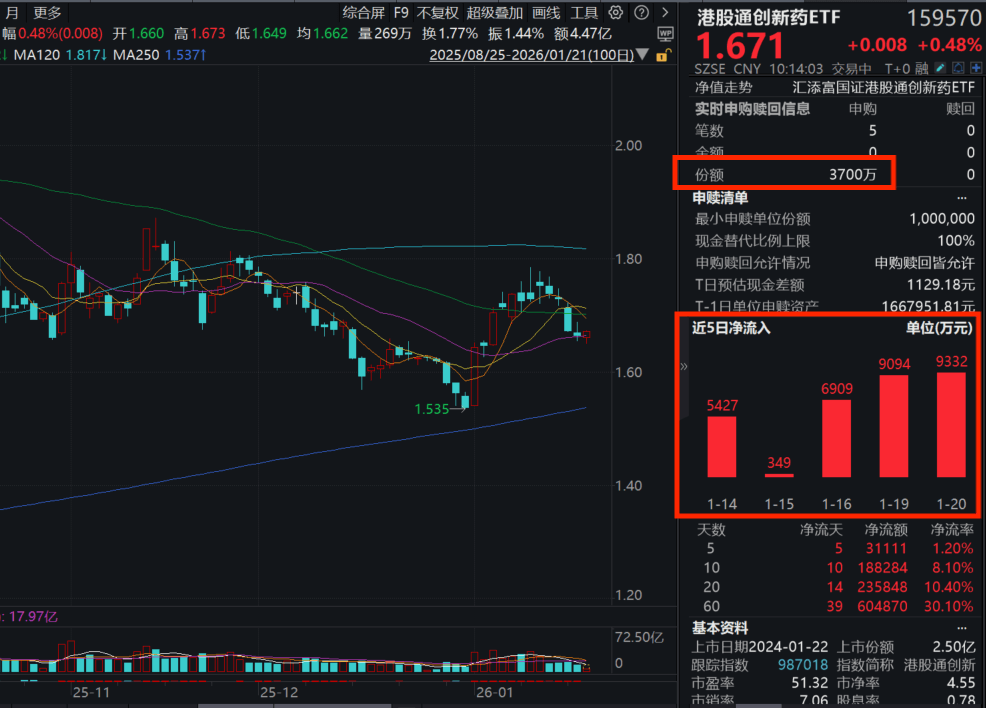
JPM收官,中国创新药加速全球化!港股通创新药ETF(159570)探底回升翻红,近5日净流入超3亿元,在全市场创新药ETF中规模领跑!
Xin Lang Cai Jing· 2026-01-21 02:41
Group 1 - The Hong Kong Innovation Drug ETF (159570) has seen a significant inflow of funds, with a recent trading volume exceeding 5 billion yuan and a net inflow of over 300 million yuan in the past five days [1] - As of January 20, the total size of the Hong Kong Innovation Drug ETF reached over 25.3 billion yuan, leading the market in terms of scale among innovation drug ETFs [1] - The index components of the ETF showed mixed performance, with notable gains from companies like Kingsoft Biotech and China Biologic Products, while companies like CanSino Biologics experienced declines [3][4] Group 2 - At the J.P. Morgan Healthcare Conference, several Chinese pharmaceutical companies showcased their advancements, including BeiGene's new drug approval in China and plans for accelerated approval in the U.S. [5] - Innovent Biologics and Pfizer are set to conduct five global Phase III trials for their drug SSGJ-707 by 2026, targeting various cancers [6] - The collaboration between NVIDIA and Eli Lilly aims to establish an AI innovation lab with a projected investment of up to 1 billion USD over five years, potentially transforming drug development processes [8] Group 3 - Tempus AI reported a revenue of approximately 1.27 billion USD for 2025, marking an 83% year-on-year increase, driven by significant growth in its diagnostic business [9] - The top ten components of the Hong Kong Innovation Drug ETF account for over 73% of its weight, highlighting the concentration of leading innovative drug companies within the ETF [10]
Jim Cramer States “Given How Competitive That World Is, Intel’s Actual Earnings May Not Be Big Enough”
Yahoo Finance· 2026-01-20 16:02
Core Viewpoint - Intel Corporation has shown significant improvement in stock performance following the appointment of Lip-Bu Tan as CEO, indicating a potential turnaround for the company in the competitive semiconductor industry [1][2]. Company Overview - Intel designs and manufactures processors, chips, memory, and related hardware, while also providing software, optimization solutions, and AI-enabled platforms [2]. - The company faced challenges from competitors like NVIDIA and AMD, particularly under the previous CEO Pat Gelsinger, whose ambitious plans negatively impacted Intel's performance [2]. Recent Developments - The appointment of Lip-Bu Tan as CEO has been pivotal, leading to a federal government bailout where the government took a nearly $9 billion stake in Intel [2]. - Following the government's involvement, NVIDIA also made a $5 billion investment in Intel, contributing to a positive shift in investor sentiment and stock performance [2]. - The cleanup of Intel's balance sheet has resulted in a more favorable narrative for the company, enhancing its attractiveness to investors [2].

投资者- 2026 展望:偏好 AI 优于非 AI;逻辑芯片与存储芯片均具吸引力-Investor Presentation-2026 Outlook Prefer AI to Non-AI; Both Logic and Memory Are Attractive
2026-01-20 03:19
Summary of Key Points from the Conference Call Industry Overview - The semiconductor industry is experiencing a shift towards AI-driven demand, with a preference for AI semiconductors over non-AI counterparts. This trend is expected to continue into 2026, with both logic and memory sectors being attractive for investment [6][10][87]. Key Companies Mentioned - **TSMC**: Identified as a top pick in the AI semiconductor space, with expected revenue CAGR of 60% from AI semis between 2024 and 2029 [6][33]. - **SMIC**: Mentioned as a significant player in the semiconductor industry [6]. - **MediaTek, Alchip, GUC, Winbond, Phison, Nanya Tech**: Other notable companies highlighted for their roles in the semiconductor landscape [6]. Core Insights - **Demand Drivers**: - Tech inflation is anticipated to impact demand due to rising costs in wafers, OSAT, and memory, creating margin pressures for chip designers [6]. - AI cannibalization is a concern, as AI technologies may replace certain human jobs, affecting overall demand [6]. - The proliferation of generative AI is expected to drive demand across various verticals, including robotics and AI glasses [6]. - **Market Dynamics**: - The semiconductor supply chain is prioritizing AI semiconductors, leading to shortages in non-AI semiconductors [6]. - The memory sector's stock prices are seen as leading indicators for logic semiconductors, with an attractive industry view on Greater China technology semiconductors [16]. Financial Metrics and Valuation - **TSMC**: - Current share price is 1,760 TWD with a target price of 2,088 TWD, indicating a 19% upside potential [8]. - Expected P/E ratios for 2025, 2026, and 2027 are 26.6, 18.9, and 15.7 respectively, with EPS growth rates of 46%, 40%, and 21% [8]. - **SMIC**: - Current share price is 77.0 HKD with a target price of 80.0 HKD, indicating a 4% upside potential [8]. - Expected P/E ratios are not meaningful (NM) due to negative growth projections [8]. Potential Risks - **Supply Chain Issues**: The semiconductor supply chain is facing challenges, including inventory management and the prioritization of AI semiconductors, which could lead to shortages in non-AI products [6][14]. - **Economic Factors**: Rising costs and inflation in the tech sector may impact overall demand and profitability for semiconductor companies [6]. Additional Insights - **Capex Trends**: Major cloud service providers (CSPs) are expected to increase capital expenditures significantly, with a projected 65% year-over-year increase in Q3 2025 [52]. - **AI Semiconductor Market Size**: The global semiconductor market size is projected to reach $1 trillion by 2030, driven largely by cloud AI [85]. This summary encapsulates the critical insights and data points from the conference call, providing a comprehensive overview of the current state and future outlook of the semiconductor industry, particularly in relation to AI technologies.
3 AI Stocks That May Be The Biggest Winners In 2026
247Wallst· 2026-01-19 21:30
Industry Overview - Artificial intelligence stocks have been among the best investments over the past year, outperforming the S&P 500 in 2025, with potential for continued success into 2026 and beyond [1] Company: IREN - IREN (NASDAQ:IREN) is an AI infrastructure company with a significant 5-year, $9.7 billion deal with Microsoft (NASDAQ:MSFT) for 200 megawatts, highlighting the demand for data centers and energy to support AI workloads [2] - The company has approximately three gigawatts in its pipeline, with its 1.4 gigawatt Sweetwater 1 site expected to be operational by April, ahead of competitors [3] - Although IREN started as a crypto miner, the Microsoft deal and potential for similar agreements are expected to shift its business trajectory, with the stock price increasing over 300% in the past year [4] Company: Rezolve AI - Rezolve AI (NASDAQ:RZLV) has a market cap of $1.5 billion and has seen a rally of over 90% in the past year, despite a 40% decline from its all-time highs [5] - The company exited 2025 with approximately $209 million in annual recurring revenue and anticipates reaching at least $500 million by the end of 2026, with projected earnings of $350 million in 2026 compared to $40 million in 2025 [6][7] Company: Aeluma - Aeluma (NASDAQ:ALMU) is a semiconductor company that has nearly tripled in value over the past year, attracting significant investment despite only generating $1.4 million in Q1 FY26 [8] - The company has secured new partnerships and extended contracts, including with NASA, and expects to generate $4 million to $6 million in revenue in fiscal 2026 as it expands into commercial markets [9] - Aeluma has no long-term debt and holds $38 million in cash, positioning it for potential significant returns if commercialization efforts succeed [10]



Bitzero Holdings Inc. Acquires NVIDIA Blackwell B300 GPU Servers to Launch AI Compute Pilot with Hydra Host
Prnewswire· 2026-01-19 21:00
Core Insights - Bitzero Holdings Inc. has announced the deployment of 64 next-generation NVIDIA Blackwell GPUs at its facility in Namsskogan, Norway, marking its entry into neocloud operations [1][2][5] - The deployment is expected to be completed in Q1 2026 and represents Bitzero's first direct investment in GPU compute hardware [2][5] - The partnership with Hydra Host will allow Bitzero to lease the servers as bare metal infrastructure for AI workloads, enhancing its market reach without the need for proprietary customer acquisition infrastructure [4][5] Deployment Details - The acquisition includes eight NVIDIA Blackwell B300 servers, totaling 64 GPUs, which will be utilized for validating GPU operations on Bitzero's existing infrastructure [3][5] - The pilot program aims to establish an operational framework for potential future expansion in GPU operations [3] Partnership with Hydra Host - Hydra Host's Brokkr platform will provide GPU lifecycle management capabilities, including provisioning and monitoring, and access to a global network of enterprise and AI-native customers [4] - This collaboration is expected to facilitate Bitzero's transition from a pure infrastructure provider to a compute operator, generating revenue directly from AI workloads [5] Company Overview - Bitzero Holdings Inc. specializes in sustainable blockchain and high-performance compute data center infrastructure, focusing on data center development and strategic hosting partnerships [6] - The company operates four data center locations in North America and Scandinavia, powered by clean, low-carbon energy sources [6]


中国汽车-2025 年 11 月激光雷达芯片市场份额如何洗牌-China Autos & Shared Mobility-How did LiDARAD chip market share reshuffle in 11M25
2026-01-19 02:29
Summary of Key Points from the Conference Call Industry Overview - **Industry Focus**: China Autos & Shared Mobility [1] - **Market Dynamics**: The LiDAR and AD chip markets are experiencing significant shifts in market share among key players [1] LiDAR Market Insights - **Market Share Trends**: - Huawei's market share decreased to 39% in November 2025, down 1.6 percentage points month-over-month but up 9.8 percentage points year-over-year [2] - Hesai maintained a market share of 31%, down 1.3 percentage points month-over-month but up 1.0 percentage point year-over-year [2] - Robosense's market share remained stable with a slight increase of 0.1 percentage points month-over-month [2] - Seyond showed improved sales momentum with a 1.9 percentage point increase month-over-month [2] - **Volume Sales Composition**: Main LiDAR accounts for approximately 60% of volume sales, with blind-spot LiDAR making up the remainder [2] AD Chip Market Insights - **Market Share Leaders**: - NVIDIA continues to dominate the AD chip market with a 52% volume share, an increase of 12 percentage points year-over-year [3] - Tesla China's market share fell by 11 percentage points year-over-year due to weaker domestic sales [3] - Horizon's market share increased by 1 percentage point year-over-year, reaching 9-10% [3] - **Localization Efforts**: China's initiative to localize auto chips has not yet resulted in significant changes in the AD chip market [3] Adoption of Advanced Driver Assistance Systems (ADAS) - **L2++ Adoption Growth**: Sales penetration for L2++ systems reached 34% in November 2025, reflecting a 4 percentage point increase month-over-month and a 20 percentage point increase year-over-year [12] - **Future Projections**: The risk to current sales penetration estimates for L2++ is skewed to the upside, indicating potential for higher adoption rates than previously forecasted [12] Technology Hardware Growth - **Content Growth**: Despite overall volume growth, the increase in content per vehicle is driving additional growth for technology hardware, specifically LiDAR and AD chips [12] - **Competitive Landscape**: Huawei leads in LiDAR sales due to broader model coverage, while Hesai remains a strong player among standalone LiDAR manufacturers [12] Conclusion - The LiDAR and AD chip markets in China are undergoing significant changes, with key players adjusting their strategies in response to competition and market demands. The growth in ADAS adoption suggests a positive outlook for technology hardware in the automotive sector [1][12]
Jim Cramer Says “Once They Cleaned Up the Balance Sheet, Intel Instantly Became a Much Better Story”
Yahoo Finance· 2026-01-18 17:48
Core Viewpoint - Intel Corporation has made a significant comeback, overcoming challenges posed by competitors like NVIDIA and AMD, particularly after leadership changes and federal investment [1]. Group 1: Company Overview - Intel Corporation (NASDAQ: INTC) designs and manufactures processors, chips, memory, and related hardware, while also providing software, optimization solutions, and AI-enabled platforms [2]. Group 2: Recent Developments - The company faced difficulties under former CEO Pat Gelsinger, but new CEO Lip-Bu Tan has successfully secured a nearly $9 billion investment from the federal government, which has positively impacted Intel's financial health [1]. - Following the federal investment, NVIDIA also made a $5 billion investment in Intel, contributing to a surge in the company's stock performance [1]. - The cleanup of Intel's balance sheet has led to improved investor sentiment and a stronger bottom line for the company [1].
The $56 Billion Draft: Follow TSMC’s CapEx Stream
Yahoo Finance· 2026-01-16 21:25
Core Viewpoint - TSMC's projected capital expenditure of $52 billion to $56 billion for 2026 is a critical indicator for the semiconductor supply chain, signaling significant liquidity entering the market [3][4]. Group 1: Financial Performance - TSMC reported a net profit of $16 billion for the fourth quarter of 2026, but the focus should be on the forward-looking guidance rather than just the bottom line [3]. Group 2: Capital Expenditure and Market Impact - The projected capital expenditure represents a substantial amount of liquidity that TSMC is required to invest in new factories, advanced machinery, and materials over the next year [4]. - This spending plan is expected to create a financial vacuum that will benefit TSMC's suppliers, as they will be pulled forward by the increased demand for AI chips [4]. Group 3: Investment Strategy - The strategy known as "Drafting the Titan" suggests that investors should focus on TSMC's suppliers, as they will benefit from TSMC's capital expenditures and the growing demand for AI chip manufacturing [4][5]. - The volatility of the AI chip market makes it challenging to identify the ultimate winner among chip manufacturers, but TSMC's role as a manufacturer for all high-performance AI chips remains constant [5]. Group 4: Equipment Demand - TSMC's expansion of manufacturing capacity for AI processors is driving increased demand for specialized equipment needed for advanced transistor architectures [6]. - The transition to new chip designs necessitates the purchase of specific machinery that cannot be replaced by competitor products, further solidifying TSMC's position in the market [6].