
vivo

Search documents
虹软科技:公司拥有丰富的针对智能手机、AI眼镜等移动智能终端以及智能汽车的视觉算法产品线
Zheng Quan Ri Bao Wang· 2026-02-13 13:44
Core Viewpoint - The company, Hongsoft Technology, is a leading supplier of visual artificial intelligence algorithms, focusing on mobile smart devices and smart vehicles [1] Group 1: Company Overview - Hongsoft Technology has a rich product line of visual algorithms tailored for smartphones, AI glasses, and smart cars [1] - The main source of revenue for the company comes from licensing its core technologies developed in-house [1] Group 2: Clientele - Major clients include globally recognized smartphone manufacturers such as Samsung, Xiaomi, OPPO, vivo, Honor, and Moto, as well as domestic and some joint venture and foreign automotive manufacturers [1] Group 3: Business Stability - The company reports healthy and stable business development, although its stock price may fluctuate due to various factors in the capital market [1]

「OV米耀」推出新春手机/配件:生肖logo几乎绝迹,厂商为何不搞马年专属了?
3 6 Ke· 2026-02-13 13:05
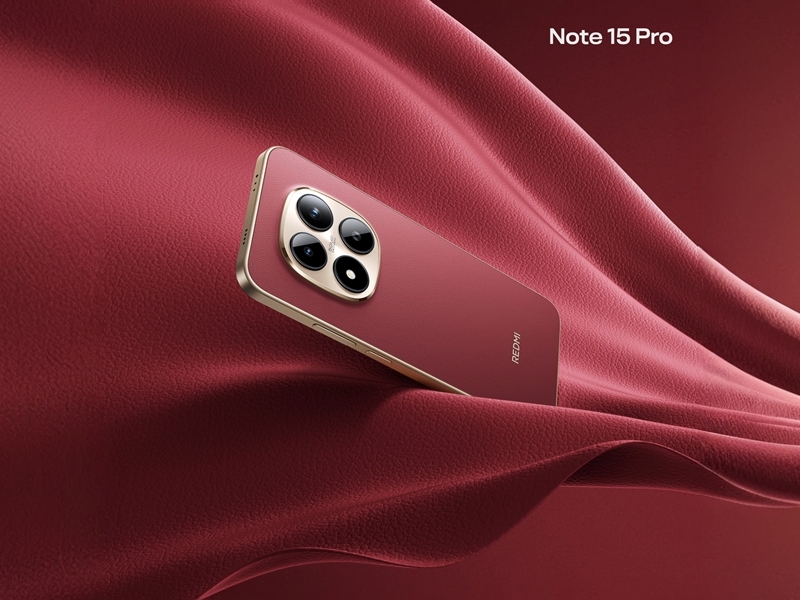
Core Viewpoint - The article discusses the strategies of various Chinese smartphone manufacturers as they launch new products ahead of the Lunar New Year, emphasizing the shift from traditional red-themed designs to more sophisticated and nuanced color choices that cater to evolving consumer preferences [1][39]. Group 1: Product Strategies - Several manufacturers have adopted distinct strategies for their Lunar New Year offerings, including traditional approaches, ecosystem-focused designs, and innovative marketing tactics [3]. - Redmi's Note 15 Pro features a "cherry red" color, appealing to consumers looking for a durable and practical gift option for family members, particularly older generations [4][8]. - Vivo's X300, marketed as a flagship device in "good luck red," targets younger consumers who desire a high-quality smartphone as a personal reward during the festive season [9][11]. - OPPO has opted for a clever marketing strategy by focusing on accessories rather than new phone models, offering a range of themed accessories that allow consumers to refresh their existing devices [20][24]. Group 2: Color Trends and Consumer Preferences - This year, orange has emerged as a notable color trend alongside traditional red, with brands like Honor introducing "light orange" and "sunrise orange" models, reflecting a shift in consumer aesthetics [25][27]. - The disappearance of zodiac-themed designs indicates a broader trend where manufacturers are moving away from overly customized products that may not retain value over time, focusing instead on timeless color choices [28][31]. - The evolving consumer mindset shows that younger buyers are now seeking premium, sophisticated designs rather than the traditional festive colors, leading to the introduction of more subdued shades like "cherry red" and "light-catching red" [38][39]. Group 3: Emotional and Cultural Significance - The article highlights that the competition among smartphone manufacturers has evolved from purely technical specifications to a focus on cultural and emotional value, aligning products with the sentiments associated with the Lunar New Year [39]. - Companies are leveraging the emotional significance of the holiday by incorporating elements like auspicious colors and health-related features into their products, aiming to enhance the festive experience for consumers [42].


智能硬件公司觉得自己无所不能
Jing Ji Guan Cha Wang· 2026-02-13 12:41
Core Insights - The technology and internet sectors are experiencing rapid changes in 2025, with companies facing intense competition in computing power and large model applications, while e-commerce is reshaping its foundations amid regulatory pressures [1] - The hardware industry is characterized by a collective illusion of being "omnipotent," with companies diversifying into various product categories, including smart glasses and drones, driven by the demand for AI to find physical world applications [2][3] Industry Trends - Major hardware manufacturers are expanding beyond their core businesses, with companies like DJI venturing into vacuum robots and other sectors, reflecting a trend of "disruptive diversification" [3] - The rise of smart hardware has led to a belief that all categories are worth re-exploring in the AI era, resulting in a surge of innovative products, including smart rings and AI toys [2] Investment Landscape - The venture capital scene is increasingly favoring hardware startups, particularly those emerging from established companies like DJI, with high valuations being achieved based on the founders' previous experiences [4][5] - After the disillusionment with purely software-based AI models, investors are now focusing on hardware as essential for AI applications, leading to a significant influx of capital into the hardware sector [5] Competitive Dynamics - The competition in the imaging sector has intensified, with companies employing unconventional strategies, including negative marketing tactics and patent disputes, to gain market share [6] - The smart ring market has seen over 200 brands enter within six months, leading to fierce price wars and diminishing profit margins, while the AI glasses market has also faced similar challenges due to technological homogeneity [7]
智能硬件公司觉得自己无所不能|TMT年度盘点
Jing Ji Guan Cha Wang· 2026-02-13 12:40
Core Insights - The technology and internet sectors are experiencing rapid changes in 2025, with companies aggressively competing in computing power and large model applications, while e-commerce is reshaping its foundations amidst regulatory pressures [2][3] - The era of easy financing through simple presentations is over; companies must demonstrate technological, commercial, and ecological advantages to survive in the TMT industry [3] Industry Dynamics - The smart hardware industry is characterized by a collective confidence among manufacturers, leading to innovations such as multifunctional cleaning robots and cross-industry expansions by companies like DJI and others [4][6] - The underlying logic for the explosive growth in the smart hardware sector is the urgent need for AI to find physical world applications, prompting a re-evaluation of all product categories in the AI era [5][6] Strategic Shifts - Major hardware companies are increasingly diversifying their product lines, with firms like DJI and others venturing into new markets, including automotive and robotics, reflecting a trend of "not sticking to one's main business" [6][7] - The competitive landscape is marked by a rush to establish ecosystems, with companies striving to integrate their core technologies into various electronic devices [6][7] Investment Trends - The influx of capital into the smart hardware sector is driven by a belief that hardware is essential for AI applications, leading to a surge in investments from various funding sources [8][9] - Startups emerging from established companies are attracting significant investment, with former employees of leading firms being particularly sought after for their experience and potential [8][9] Competitive Environment - The competition in the smart hardware industry has intensified, with companies employing unconventional strategies, including aggressive marketing tactics and patent disputes [10][11] - The market for smart rings and AI glasses has become saturated, leading to fierce price wars and diminishing profit margins, with some products seeing prices drop significantly [11]



巨兽出山,围堵大疆
36氪· 2026-02-13 10:14
以下文章来源于硬氪 ,作者张子怡 硬氪 . 专注全球化、硬科技报道。36kr旗下官方账号。 当巨头"敢为人后"。 文 | 张子怡 编辑 | 袁斯来 来源| 硬氪(ID:south-36kr) 封面来源 | 企业官方 大疆躺着赚钱的赛道,终于被更凶悍庞大的对手纳入狙击范围。 近日,vivo官方确认正式立项独立vlog相机产品,产品形态将直接对标大疆Osmo Pocket系列。而此前,媒体曾报道OPPO的首席 产品官刘作虎,正亲自带队攻坚类似产品。 OPPO和vivo这样经历过无数血战,仍然屹立不倒的巨头,绝非大疆想要遭遇的对手。 但这场交锋,在Pocket 3爆红的那一刻已经埋下伏笔。 很少有消费电子单品能在很长一段时间中独占市场,大疆Osmo Pocket 3做到了。根据媒体报道,Pocket 3全球销量一年就超千万 台,单款产品贡献营收超200亿元。由于产能不足,过去很长一段时间里,Osmo Pocket 3被戏称为"电子茅台",二手溢价一度超 过30%。直到大疆去年下半年主动降价,一货难求的故事才宣布告终。 大疆Osmo Pocket 3(图源/官网) 更重要的是,在用户心智中,云台相机某种程度上已经等同 ...

通信行业月报:北美云厂商资本开支强劲,CPO商业化应用拐点临近
Zhongyuan Securities· 2026-02-13 08:24
Investment Rating - The report maintains an "Outperform" investment rating for the communication industry [4][7]. Core Insights - In January 2026, the communication industry index increased by 5.47%, outperforming the Shanghai Composite Index (+3.76%), CSI 300 Index (+1.65%), Shenzhen Component Index (+5.03%), and ChiNext Index (+4.47%) [3][13]. - The capital expenditure of the four major North American cloud providers is expected to grow over 60% year-on-year, indicating a turning point for CPO commercialization applications [4][6]. - The retail sales of communication equipment in China increased by 20.9% year-on-year in December 2025, driven by the demand for smartphones [6][44]. - The three major telecom operators in China achieved a total telecom business revenue of 1.75 trillion yuan in 2025, a year-on-year increase of 0.7% [6][45]. Summary by Sections Market Review - The communication industry index rose by 5.47% in January 2026, outperforming major indices [3][13]. - Sub-sectors such as cables, other communication equipment, and system equipment saw increases of 19.70%, 10.72%, and 7.85% respectively [16]. Industry Tracking - The capital expenditure of North American cloud providers reached $126 billion in Q4 2025, a 62% year-on-year increase, with a forecast of over $660 billion for 2026 [24][25]. - AI applications are increasingly driving cloud business growth, with significant investments in AI infrastructure by major cloud providers [30][34]. Telecom Industry Insights - The telecom industry in China is experiencing stable growth, with a focus on new information infrastructure such as 5G and gigabit networks [45]. - The revenue from emerging businesses like cloud computing and big data reached 450.8 billion yuan in 2025, growing by 4.7% year-on-year [45]. Smartphone Market - Global smartphone shipments are projected to grow by 2% in 2025, reaching 1.25 billion units, with AI smartphones expected to penetrate 34% of the market [6][44]. - The latest AI smartphones feature advanced NPU chips with processing power between 60 to 200 TOPS, enhancing user experience through real-time interactions [6]. Investment Recommendations - The report suggests focusing on companies involved in optical devices, optical chips, optical modules, and AI smartphones, including Tianfu Communication, ZTE, and China Mobile [7].
1月中国智能手机销量排名:华为/苹果/OPPO前三
Ju Chao Zi Xun· 2026-02-13 08:10
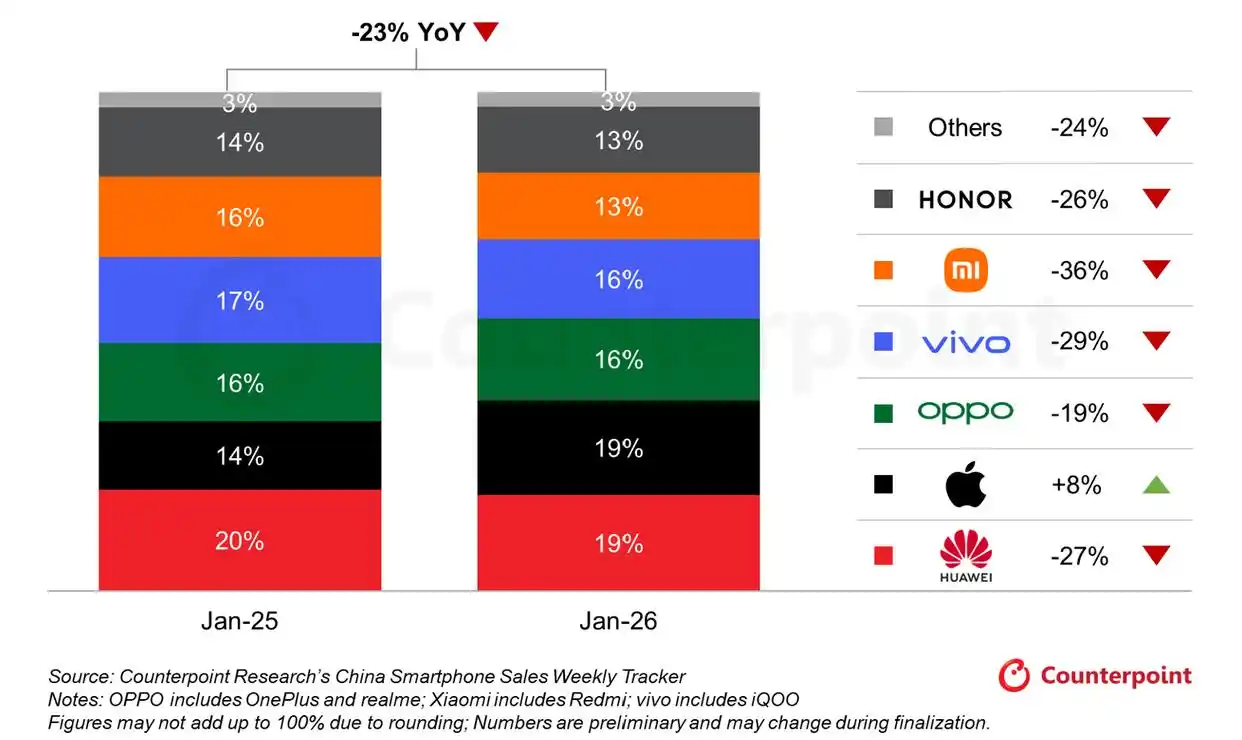
Core Insights - The overall smartphone market in China is projected to decline by 23% year-on-year in January 2026, primarily due to the high base effect from subsidy policies in early 2025, reduced subsidy intensity in 2026, and the impact of the Lunar New Year on consumer spending [1][3] Group 1: Market Performance - Huawei leads the market with a 19% share but faces a 27% year-on-year decline in sales, influenced by high base effects and underperformance of the Nova series [1] - Apple is the only major brand to achieve growth, with an 8% increase in sales and market share reaching its highest level in nearly five years, driven by the popularity of the iPhone 17 series [3] - Other domestic brands experienced significant declines: Xiaomi (including Redmi) down 36%, vivo (including iQOO) down 29%, OPPO (including OnePlus and realme) down 19%, and Honor down 26% [3] Group 2: Market Dynamics - The decline in sales for many brands is attributed to the "overdraft effect" of the subsidy policy from early 2025, which pulled forward demand due to the timing of the Lunar New Year promotions [3] - Despite the January market slump, there is an optimistic forecast for February, as seasonal consumption during the Lunar New Year is expected to boost sales, providing a critical window for inventory clearance and performance improvement for manufacturers [3]

通信行业月报:北美云厂商资本开支强劲,CPO商业化应用拐点临近-20260213
Zhongyuan Securities· 2026-02-13 07:38
Investment Rating - The report maintains an "Outperform" investment rating for the communication industry [4][7]. Core Insights - In January 2026, the communication industry index increased by 5.47%, outperforming the Shanghai Composite Index (+3.76%), CSI 300 Index (+1.65%), Shenzhen Component Index (+5.03%), and ChiNext Index (+4.47%) [3][13]. - The capital expenditure of the four major North American cloud providers is expected to grow significantly, with a projected increase of over 60% in 2026 [6][24]. - The procurement results for special optical cables by China Mobile indicate that eight manufacturers, including Tongding Interconnection and Yangtze Optical Fibre and Cable, have been selected, highlighting the focus on key sectors such as industrial manufacturing and digital government [6][7]. Summary by Sections Industry Performance - The communication industry index showed a strong performance in January 2026, with a 5.47% increase, outperforming major indices [3][13]. - Sub-sectors within the communication industry saw varied performance, with cable, other communication equipment, and system equipment rising by 19.70%, 10.72%, and 7.85% respectively [16]. Telecommunications Sector - In 2025, the telecommunications business revenue reached CNY 1.75 trillion, a year-on-year increase of 0.7% [6][45]. - By December 2025, 5G mobile phone users accounted for 65.9% of total mobile phone users, with a monthly data usage (DOU) of 23.04GB per user, reflecting a 17.0% year-on-year increase [6][45]. Cloud Infrastructure Investment - The combined capital expenditure of the four major North American cloud providers in Q4 2025 was USD 126 billion, marking a 62.0% year-on-year increase [24][25]. - For 2026, the total capital expenditure guidance for these providers exceeds USD 660 billion, with an expected growth of 61.0% [24][25]. AI and Smartphone Market - The retail sales of communication equipment in China increased by 20.9% year-on-year in December 2025, driven by the demand for smartphones [44]. - The global smartphone shipment is projected to grow by 2% in 2025, reaching 1.25 billion units, with AI smartphones expected to penetrate 34% of the market by 2025 [6][44]. Investment Recommendations - The report suggests focusing on companies involved in optical devices, optical chips, optical modules, and AI smartphones, including Tianfu Communication, ZTE, and China Mobile [7][6].




内存价格翻倍上涨,涨价还是减配,手机行业进退两难
3 6 Ke· 2026-02-13 03:33
Core Insights - The rapid increase in memory prices since Q4 2025 has significantly raised costs for smartphone manufacturers, leading to a potential retreat in the industry as companies face tough choices between raising prices or reducing specifications [1][5][8] - Counterpoint research indicates that memory prices may rise by approximately 40% before Q2 2026, further increasing material costs for manufacturers [2] - The smartphone market is experiencing a shift, with manufacturers adjusting their strategies to cope with rising costs, leading to a potential decline in overall market volume and increased competition among brands [8][10] Price Increases and Cost Management - Recent statistics show that new models from brands like Xiaomi, OPPO, and vivo have seen price increases ranging from 100 to 600 yuan compared to previous models, with mid-range models experiencing a price gap increase from 300 to between 400 and 600 yuan [3] - Memory typically accounts for 15% of a smartphone's Bill of Materials (BoM), rising to 20% in mid-range models, while most Chinese smartphone brands have hardware gross margins between 10% and 20% [4] - The price of the mainstream "12GB+256GB" memory configuration has surged by 75% over the past year, raising concerns about consumer willingness to absorb these costs [5] Market Dynamics and Manufacturer Strategies - The pressure from rising memory costs is affecting upstream suppliers, with manufacturers reluctant to pass on costs to consumers for fear of reduced sales, leading to downward adjustments in business plans for 2026 [6][7] - Manufacturers are increasingly focusing on structural adjustments to manage costs, such as changing suppliers or reducing specifications in less noticeable areas [5][7] - The competition is intensifying, with leading brands like Apple and Samsung having more leverage due to their financial stability and long-term supply agreements, while smaller brands face greater challenges [7][8] Market Outlook and Future Trends - The smartphone market in China is projected to see a slight decline in shipments, with major brands like Xiaomi and OPPO reducing their 2026 order quantities by over 20% [8][10] - The trend of "flagship-ifying" mid-range models is reversing, as manufacturers face supply pressures and must focus on high-end models and overseas markets for growth [10] - The global smartphone market is expected to enter a phase of "scale contraction and price increase," with IDC and Counterpoint predicting at least a 2% decline in global smartphone sales this year [10]

未知机构:Counterpoint数据显示2026年1月中国智能手机销量同比-20260213
未知机构· 2026-02-13 02:00
Counterpoint 数据显示,2026 年 1 月中国智能手机销量同比下降 23%,主要受到去年补贴推动形成的高基数影 响,以及农历新年时间变化的冲击。 尽管销量下降 27%,华为仍以 19% 的市场份额领跑市场,这得益于激进的以旧换新优惠和补贴。 苹果是唯一实现增长的主要品牌,随着 iPhone 17 的热销并符合政府补贴条件,其 1 月市场份额升至五年来新 高。 Counterpoint 数据显示,2026 年 1 月中国智能手机销量同比下降 23%,主要受到去年补贴推动形成的高基数影 响,以及农历新年时间变化的冲击。 尽管销量下降 27%,华为仍以 19% 的市场份额领跑市场,这得益于激进的以旧换新优惠和补贴。 苹果是唯一实现增长的主要品牌,随着 iPhone 17 的热销并符合政府补贴条件,其 1 月市场份额升至五年来新 高。 整体需求依然疲软,但随着农历新年季节性购买到来,预计 2 月销量将有所改善。 2025 年 1 月各品牌市场份额:华为 20%、苹果 14%、OPPO 16%、vivo 17%、小米 16%、荣耀 14%、其他品牌 3%。 2026 年 1 月各品牌市场份额:华为 19% ...