
江西铜业

Search documents
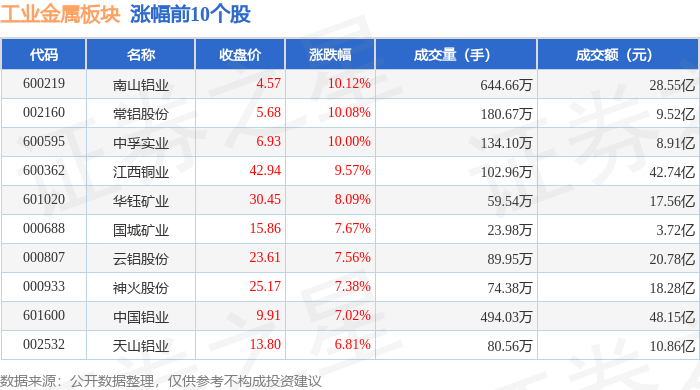
工业金属板块10月29日涨4.89%,南山铝业领涨,主力资金净流入35.15亿元
Zheng Xing Xing Ye Ri Bao· 2025-10-29 08:33
Group 1 - The industrial metal sector increased by 4.89% on October 29, with Nanshan Aluminum leading the gains [1] - The Shanghai Composite Index closed at 4016.33, up 0.7%, while the Shenzhen Component Index closed at 13691.38, up 1.95% [1] - Key stocks in the industrial metal sector showed significant price increases, with Nanshan Aluminum rising by 10.12% to a closing price of 4.57 [1] Group 2 - The industrial metal sector saw a net inflow of 3.515 billion yuan from main funds, while retail investors experienced a net outflow of 2.07 billion yuan [2] - Major stocks like Jiangxi Copper and Nanshan Aluminum had notable net inflows from main funds, indicating strong institutional interest [3] - The trading volume for Nanshan Aluminum reached 6.4466 million shares, reflecting high investor activity [1]



大爆发!尾盘,多股30%涨停!
证券时报· 2025-10-29 08:30
Market Overview - The A-share market experienced a strong rally on October 29, with the Shanghai Composite Index surpassing 4000 points, reaching a 10-year high. The ChiNext Index rose nearly 3%, and the North Exchange 50 Index surged over 8% [1][2]. Shanghai Composite Index - The Shanghai Composite Index closed at 4016.33 points, up 0.7%. The Shenzhen Component Index increased by 1.95% to 13691.38 points, while the ChiNext Index rose by 2.93% to 3324.27 points. The North Exchange 50 Index saw a significant increase of 8.41% [2][4]. Trading Volume - The total trading volume across the Shanghai, Shenzhen, and North exchanges reached 22909 billion yuan, an increase of approximately 1250 billion yuan compared to the previous day [2]. Sector Performance Photovoltaic Industry - The photovoltaic sector saw explosive growth, with stocks like Sungrow Power Supply rising over 15%, reaching a historical high. Other companies such as Longi Green Energy, Tongwei Co., and JA Solar Technology also hit their daily limit [2][9]. - The market capitalization of Sungrow Power Supply is now nearly 400 billion yuan [9]. Nonferrous Metals Sector - The nonferrous metals sector performed strongly, with companies like China Tungsten High-Tech and Jiangxi Copper nearing their daily limit. The sector was driven by rising prices in tungsten and aluminum [13][15]. - Tungsten prices have increased due to growing demand and supply constraints, with black tungsten concentrate prices rising to 288,000 yuan per ton [15]. Securities Sector - The securities sector also saw gains, with companies like Huashan Securities and Northeast Securities reaching their daily limit during intraday trading [2]. Hainan Free Trade Zone - Stocks related to the Hainan Free Trade Zone, such as Hainan Development and Hainan Airlines, also experienced significant gains, hitting their daily limit [2]. Regulatory Developments - The China Securities Regulatory Commission (CSRC) announced plans to improve the listing mechanism for the North Exchange, aiming to enhance the quality of listed companies and stimulate market activity [7]. Future Outlook - Analysts suggest that the recent adjustments in the North Exchange have created new valuation opportunities, particularly for newly listed companies with strong profit potential and innovative attributes [7]. Conclusion - The A-share market's strong performance on October 29 reflects a shift in investor focus towards sectors like photovoltaic and nonferrous metals, driven by regulatory support and improving market conditions [1][2][7].





刚刚!暴力拉升!
Zhong Guo Ji Jin Bao· 2025-10-29 07:57
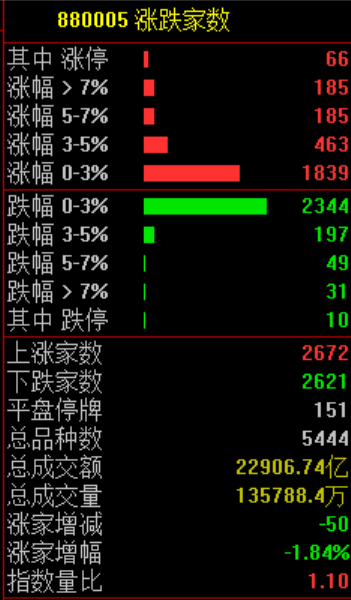
Market Overview - The A-share market experienced a significant rally on October 29, with the Shanghai Composite Index surpassing 4000 points and the North Exchange 50 Index soaring over 8% [1][2] - The closing figures showed the Shanghai Composite Index up by 0.7%, the Shenzhen Component Index up by 1.95%, and the ChiNext Index up by 2.93% [2] Stock Performance - A total of 2672 stocks rose, with 66 hitting the daily limit up, while 2621 stocks declined [3] - The photovoltaic and energy storage sectors saw notable gains, with stocks like Longi Green Energy and Tongwei Co. hitting the daily limit up, and Sungrow Power Supply reaching a new high [5] - Lithium mining stocks also performed well, with companies like Dazhong Mining seeing significant increases [6] Sector Highlights - The non-ferrous metals sector rallied, with stocks such as Chang Aluminum and Jiangxi Copper showing strong performance [7][8] - Hainan Free Trade Zone concept stocks surged, with Haiqi Group experiencing a significant increase [9] Banking Sector - The banking sector faced declines, with Chengdu Bank dropping over 5% [10] Positive Developments - The chairman of the Beijing Stock Exchange announced plans to accelerate the launch of the North Exchange 50 ETF and explore after-hours fixed-price trading [11] - The Ministry of Commerce and other departments released the "Urban Commercial Quality Improvement Action Plan," aiming to enhance urban commercial systems and promote a fair business environment [12][13][14] - Additional supportive measures for commercial real estate projects and new service consumption scenarios were introduced [15][16] - The Beijing Municipal Financial Committee announced opinions to promote high-quality development in venture capital and equity investment [17] - The State Administration of Foreign Exchange released policies to facilitate cross-border trade and support foreign trade development [17] - A significant meeting between Chinese and U.S. leaders is scheduled, which may impact market sentiment [18]
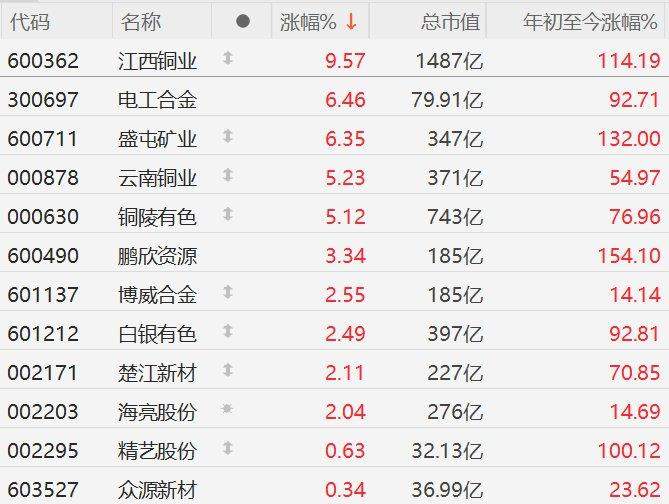
国际铜价创历史新高,A股铜概念股拉升,江西铜业逼近涨停,电工合金、盛屯矿业涨超6%,云南铜业、铜陵有色涨超5%
Ge Long Hui· 2025-10-29 07:29
Core Viewpoint - The A-share market's copper concept stocks experienced a significant rally, driven by record-high copper prices on the London Metal Exchange (LME) due to increased supply risks from mine shutdowns [1]. Group 1: Market Performance - Jiangxi Copper approached the daily limit up, with a rise of 9.57%, and a total market capitalization of 148.7 billion [2]. - Electric Alloy and Shengtun Mining both increased by over 6%, with Electric Alloy rising by 6.46% and a market cap of 7.991 billion [2]. - Yunnan Copper and Tongling Nonferrous Metals both saw increases of over 5%, with Yunnan Copper rising by 5.23% and a market cap of 37.1 billion [2]. - Pengxin Resources rose by 3.34%, with a market cap of 1.85 billion [2]. Group 2: Price Movements - The LME copper price reached a record high, increasing by 0.9% to $11,136 per ton [1].



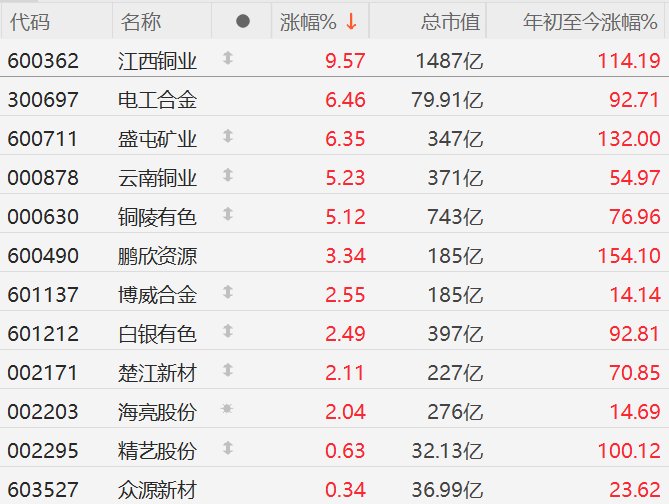
A股异动丨铜价创历史新高,铜概念股尾盘进一步拉升,江西铜业逼近涨停
Ge Long Hui A P P· 2025-10-29 07:20
Group 1 - The core viewpoint of the news is that copper concept stocks in the A-share market experienced significant gains, driven by record-high copper prices on the London Metal Exchange (LME) due to supply risks from mine shutdowns [1][2] - Jiangxi Copper approached the daily limit increase, while other companies like Electric Alloy and Shengtun Mining saw gains exceeding 6%, and Yunnan Copper and Tongling Nonferrous Metals rose over 5% [1][2] - The LME copper price reached a record high of $11,136 per ton, with a notable increase of 0.9% [1] Group 2 - Jiangxi Copper's stock increased by 9.57%, with a total market capitalization of 148.7 billion and a year-to-date increase of 114.19% [2] - Electric Alloy's stock rose by 6.46%, with a market cap of 7.991 billion and a year-to-date increase of 92.71% [2] - Yunnan Copper and Tongling Nonferrous Metals saw increases of 5.23% and 5.12%, respectively, with market caps of 37.1 billion and 74.3 billion [2]
收评:北证50指数大涨8.41%,沪指站稳4000点,光伏储能、有色金属板块集体爆发
Xin Lang Cai Jing· 2025-10-29 07:08
Market Performance - The three major A-share indices collectively rose, with the Shanghai Composite Index increasing by 0.7%, the Shenzhen Component Index by 1.95%, and the ChiNext Index by 2.93% [1] - The North Stock 50 surged by 8.41% [1] - The total trading volume in the Shanghai, Shenzhen, and Beijing markets reached 22,907 billion yuan, an increase of 1,254 billion yuan compared to the previous day [1] - Over 2,600 stocks in the market experienced gains [1] Sector Performance - The leading sectors included Hainan Free Trade Zone, photovoltaic equipment, industrial metals, batteries, securities, gaming, and quantum technology, all showing significant gains [1] - The banking sector, film and television industry, liquor, and local stocks from Fujian province saw declines [1] Notable Stocks - The photovoltaic equipment and energy storage sectors saw a strong afternoon rally, with stocks like Canadian Solar, LONGi Green Energy, and Tongwei Co. hitting the daily limit [1] - Sungrow Power Supply reached a new intraday high [1] - The non-ferrous metals sector also performed well, with copper and zinc leading the gains; major stocks like Zhongjin Lingnan Nonfemet Company and Jiangxi Copper Company saw significant increases [1] - The Hainan Free Trade Zone stocks, including Hainan Development Holdings, Hainan Airlines, and Hainan Haishi, also performed actively [1] Market Dynamics - There was a rotation among various sectors, including securities, gaming, and quantum technology [1] - Conversely, several banks experienced declines, with Chengdu Bank, Shanghai Pudong Development Bank, and Xiamen Bank leading the losses [1] - Local stocks from Fujian province showed mixed performance, with companies like Xiamen Xinda, Haixia Environmental Protection, and China Wuyi experiencing declines [1]
安泰科:多晶硅市场交投整体清淡 短期或维持弱势平稳运行
Zhi Tong Cai Jing· 2025-10-29 07:02
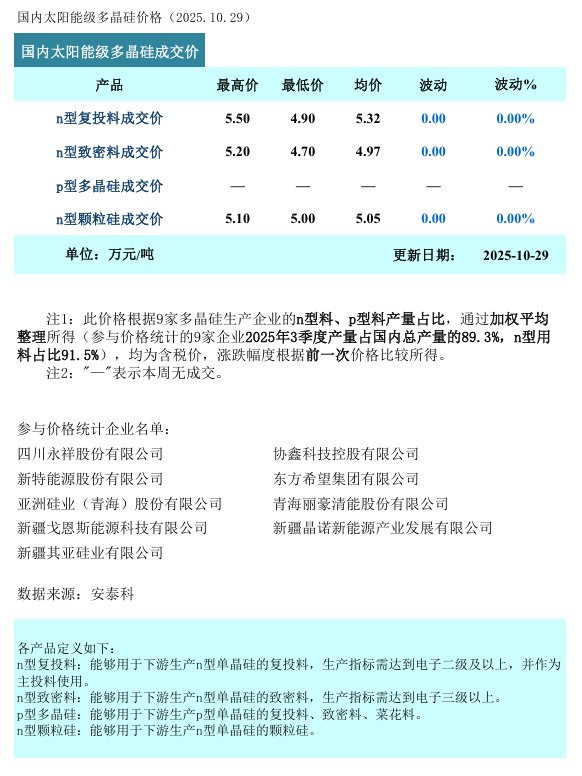
Core Insights - The current market for polysilicon remains oversupplied, with prices stabilizing due to weak demand and limited supply adjustments [1][2] Price Trends - The transaction price range for n-type recycled polysilicon is between 49,000 to 55,000 CNY/ton, with an average price of 53,200 CNY/ton, showing no change from the previous period [1] - The average price for n-type granular silicon is 50,500 CNY/ton, also remaining stable [1] - The average price for n-type dense silicon is 49,700 CNY/ton, with no fluctuations reported [3] Supply and Demand Dynamics - The domestic polysilicon market is experiencing low activity, with only 3-4 main signing companies and a decrease in order scale [1] - The monthly production of polysilicon is expected to rise to approximately 130,000 tons in Q4, an increase of 8.3% month-on-month, but many companies are nearing saturation in order intake [1][2] - In October, domestic polysilicon production reached about 137,000 tons, a month-on-month increase of 6.2%, exceeding expectations by 5.4% [1] Future Outlook - Production plans for major manufacturers in the Southwest region indicate significant reductions in output for November and December, with total monthly production expected to drop to 125,000 to 130,000 tons [2] - Despite stable downstream operating rates, the inventory accumulation of polysilicon is anticipated to slow down in the last two months of the year, yet the industry inventory is likely to exceed 400,000 tons by the end of 2025 [2]
尾盘铜矿股异动拉升 江西铜业触及涨停
Mei Ri Jing Ji Xin Wen· 2025-10-29 06:54
Core Viewpoint - Copper mining stocks experienced a significant surge, with Jiangxi Copper hitting the daily limit, driven by the rise in London copper prices reaching a historical high of $11,130 per ton [1]. Group 1: Company Performance - Jiangxi Copper reached its daily limit, indicating strong investor interest and confidence in the stock [1]. - Other companies such as Yunnan Copper, Northern Copper, Tongling Nonferrous Metals, Luoyang Molybdenum, and Jincheng Mining also saw their stock prices increase in response to the market movement [1]. Group 2: Market Trends - The main contract for copper on the London Metal Exchange (LME) broke through the $11,130 per ton mark, setting a new historical high [1].
[安泰科]多晶硅周评-累库压力仍存 市场弱稳延续(2025年10月29日)
中国有色金属工业协会硅业分会· 2025-10-29 06:49
Group 1 - The core viewpoint of the article indicates that the domestic polysilicon market is experiencing low activity, with stable prices influenced by weak supply and demand dynamics [1][2]. - The average transaction price for n-type recycled polysilicon is reported at 53,200 yuan/ton, while n-type granular silicon averages 50,500 yuan/ton, both showing no change from the previous period [1][3]. - The number of main signing enterprises in the market has decreased to 3-4, and order volumes have declined compared to the previous period, reflecting a weak trading atmosphere [1][2]. Group 2 - In October, domestic polysilicon production reached approximately 137,000 tons, a month-on-month increase of 6.2%, exceeding expectations by 5.4% due to some companies slightly increasing their operating rates to reduce costs [2]. - It is anticipated that inventory levels will exceed 20,000 tons in October, marking a new high for monthly cumulative inventory this year [2]. - The monthly production of polysilicon is expected to decline to 125,000 to 130,000 tons in November and December due to planned production cuts by major manufacturers in the Southwest region and maintenance in Inner Mongolia [2].
美联储降息在即,金价反弹!费率最低的黄金股ETF飙涨5%,有色金属ETF基金涨3%
Ge Long Hui A P P· 2025-10-29 06:05
Group 1 - The non-ferrous metal sector experienced a comprehensive rebound, with Huayu Mining, Jiangxi Copper, and Laofengxiang rising by 7%, 5.5%, and 5.2% respectively, leading to a 5% increase in the gold stock ETF and a 3.19% rise in the non-ferrous metal ETF fund [1] Group 2 - Overnight spot gold briefly fell below $3,900 per ounce, marking a decline of over 11% from its recent peak, the largest pullback in nearly two years, but rebounded to above $3,970 per ounce during the Asian trading session [2] - The market anticipates the Federal Reserve will lower interest rates on Thursday, with expectations for another rate cut in December [2] - The Bank of Korea is considering increasing its gold reserves for the first time since 2013, reflecting a global trend of central banks increasing gold holdings [2] - Despite potential short-term downward pressure on gold prices, factors such as a likely long-term weakening of the dollar, increased global liquidity, ongoing central bank gold purchases, geopolitical risks, and inflation expectations suggest that gold may stabilize after short-term pressures are released [2] Group 3 - Notable products to watch include the low-cost gold and silver-related ETF: Gold Stock ETF (159562), which rose by 5% with a net inflow of 1.2 billion yuan over the past 20 trading days, tracking an index dominated by gold and copper, also including silver-related companies [2] - The balanced allocation of mainstream metals is represented by the Non-Ferrous Metal ETF Fund (516650), which increased by 3.25%, with major stocks including Zijin Mining (copper, gold), Luoyang Molybdenum (copper, molybdenum, cobalt), Northern Rare Earth (rare earth), Huayou Cobalt (cobalt, copper), and China Aluminum (aluminum) [2]