
国电南瑞

Search documents
电力设备:欧美需求高景气,国内特高压核准确收将提速
2025-09-18 14:41
Summary of Conference Call Records Industry Overview: Power Equipment Key Points on Industry Demand and Trends - **European Market**: Significant investment in grid renovation and energy storage subsidies, with countries like Germany and Italy planning substantial funding for energy storage. The focus is on distribution and transmission networks, with a projected increase in demand for low-voltage transformers and ultra-high voltage equipment starting in 2025, indicating sustainable growth in the European grid construction sector [1][3] - **North American Market**: High demand for transformers and switchgear driven by data center construction, but lagging grid development has led contractors to prefer self-built substations. There is a notable shortage of supply for canned circuit breakers and transformers due to low profit margins, discouraging large manufacturers from entering this segment [4][8] - **Domestic Market (China)**: Acceleration in the approval process for ultra-high voltage projects, with expectations that contract volumes in the second half of 2025 will exceed those in the first half. The overall approval pace for ultra-high voltage projects is significantly faster than last year, with a projected increase in order volumes for 2026 [5][9] Investment Opportunities and Challenges - **Investment in Distribution Networks**: Despite a focus on main networks, there remains substantial investment potential in distribution networks, with a growth rate of approximately 15% expected this year. However, the low coverage of smart terminals in rural areas poses a challenge that needs addressing [6][7] - **Smart Grid Investment**: A projected 60% year-on-year increase in smart grid investment in 2025, with ongoing demand for smart terminals and communication capabilities indicating further investment opportunities in these areas [7] Company-Specific Insights Key Companies and Their Performance - **Siyuan Electric**: Approximately 40% of its overseas business is in high-end markets like Europe and North America, focusing on industrial and renewable energy sectors. The company anticipates a net profit growth of about 30% this year, with a valuation around 28 times earnings [10] - **Pinggao Electric**: Experienced a rapid order growth in the first half of the year, with high-voltage segment orders increasing by 23%. The company expects a full-year growth rate of 20-25% with a valuation of around 16 times [11] - **Xidian**: Notable improvement in gross margins, particularly in transformers, with an overall margin increase of nearly 2 percentage points expected to be maintained throughout the year [12] - **XJ Electric**: Anticipates a revenue of 8 billion RMB from ultra-high voltage converters, with a significant order backlog and expected revenue growth of around 20% this year [15] - **Samsun Medical**: Recently entered the U.S. market with a significant order for smart meters, indicating strong growth potential in overseas markets [16] Emerging Business Areas - **Sifang Co.**: Orders in the first half of 2025 exceeded expectations, with a 20% growth in distribution network orders and a 60-70% increase in overseas business orders [20] - **Hua Min Equipment**: Plans to increase overseas revenue to 40-50% in the next 3-4 years, with significant growth in markets like Saudi Arabia and the U.S. [17] - **Guodian NARI**: Increased revenue guidance for the year, with a focus on low-carbon energy and smart grid-related businesses, projecting a revenue growth of 14-15% [18] Market Dynamics - **Regional Procurement**: The impact of regional procurement on major companies' performance is significant, with expectations that orders will be confirmed in the coming year, indicating a potential low point in current performance [2][7] Conclusion The power equipment industry is experiencing robust growth driven by significant investments in grid infrastructure, particularly in Europe and North America. Companies are adapting to market demands with strategic focuses on high-end markets and emerging technologies, while also navigating challenges related to supply shortages and investment in smart grid capabilities.
中国可持续发展_中国目标到 2027 年实现 180 吉瓦储能-China Sustainability_ Pulse_ China targets 180GW storage by 2027
2025-09-18 13:09
Summary of Key Points from the Conference Call Industry Overview - The conference call discusses the **Battery Energy Storage System (BESS)** industry in China, particularly focusing on the ambitious targets set by the Chinese government for energy storage capacity by 2027 [3][5]. Core Insights and Arguments - **Target Capacity**: China aims for a cumulative BESS capacity of **180 GW** by **2027**, supported by an investment of **RMB 250 billion** (approximately **US$ 35 billion**) [8]. - **Current Status**: As of the first half of 2025, China had already achieved **95 GW** of BESS capacity, surpassing the **14th Five-Year Plan** target of **30 GW** ahead of schedule [8]. - **Technology Focus**: The plan emphasizes the continued dominance of **lithium-ion batteries** while encouraging pilot projects for alternative technologies such as **sodium-ion**, **vanadium redox flow**, **compressed air**, and **hydrogen** [3][5]. - **Market Participation**: BESS will be allowed to participate independently in **spot power trading** and **ancillary service markets**, which is a significant shift that could enhance the monetization of BESS assets [4][8]. Implications for the Sector - **Beneficiaries**: Major battery producers like **CATL** (300750.SZ) and **BYD** (002594.SZ / 1211.HK) are expected to benefit significantly from the policy due to their established positions in lithium-ion technology [6][9]. - **System Integrators**: Companies like **Sungrow** (300274.SZ) are likely to see increased demand for integrated storage solutions, supporting their vertical integration strategies [9]. - **Smart Grid Providers**: Firms such as **NARI Technology** (600406.SH) will benefit from the need to manage more distributed storage assets and balance power flows across provinces [9]. Risks and Challenges - **Overcapacity Risks**: The rapid build-out of storage capacity could lead to overcapacity and margin pressure, similar to challenges faced in the solar sector [9]. - **Market Pricing Mechanisms**: Without robust market pricing mechanisms for storage services, there is a risk of stranded assets if compensation mechanisms do not keep pace with regulatory ambitions [9]. Conclusion - The policy represents a decisive step in China's energy transition strategy, aiming to reduce curtailment of renewable energy and enhance the flexibility of the power system while solidifying China's position as a leader in the global energy storage market [5][6].




中国充电联盟:1-8月充电基础设施增量为453万个 同比上升88.5%
智通财经网· 2025-09-18 09:29
Core Insights - The China Charging Alliance reported that from January to August 2025, the increment of charging infrastructure reached 4.53 million units, a year-on-year increase of 88.5% [1] - As of the end of August 2025, the total number of electric vehicle charging infrastructure (guns) in China reached 17.348 million, reflecting a year-on-year growth of 53.5% [1] Charging Infrastructure Overview - The increment of public charging facilities was 737,000 units, a year-on-year increase of 37.2%, while private charging facilities saw an increment of 3.793 million units, up 103.3% [1] - The total number of public charging facilities reached 4.316 million, with a year-on-year growth of 37.8%, and private charging facilities totaled 13.032 million, reflecting a 59.6% increase [1] Regional Distribution - The top 10 regions (Guangdong, Zhejiang, Jiangsu, Shandong, Shanghai, Henan, Sichuan, Anhui, Hubei, Hebei) accounted for 66.6% of the public charging facilities [1] - The majority of charging electricity is concentrated in provinces such as Guangdong, Jiangsu, Hebei, Sichuan, Zhejiang, Shanghai, Shandong, Fujian, Henan, and Shaanxi, primarily serving buses and passenger vehicles [1] Operator Performance - As of August 2025, the top 15 charging operators managed a total of 84.2% of the charging piles, with the leading operators being Telecharge (821,000), Star Charge (707,000), and Yun Kuai Charge (669,000) [2] - The remaining operators accounted for 15.8% of the total charging infrastructure [2] Charging Infrastructure vs. Electric Vehicle Sales - In the first eight months of 2025, the increment of charging infrastructure was 4.53 million, while domestic sales of new energy vehicles reached 8.088 million, indicating a charging pile to vehicle ratio of 1:1.8, which suggests that the infrastructure development is keeping pace with the rapid growth of new energy vehicles [2]
中国卫星通信大提速时代开启,央企创新驱动ETF(515900)小幅上涨,烽火通信午后涨停
Xin Lang Cai Jing· 2025-09-18 05:34
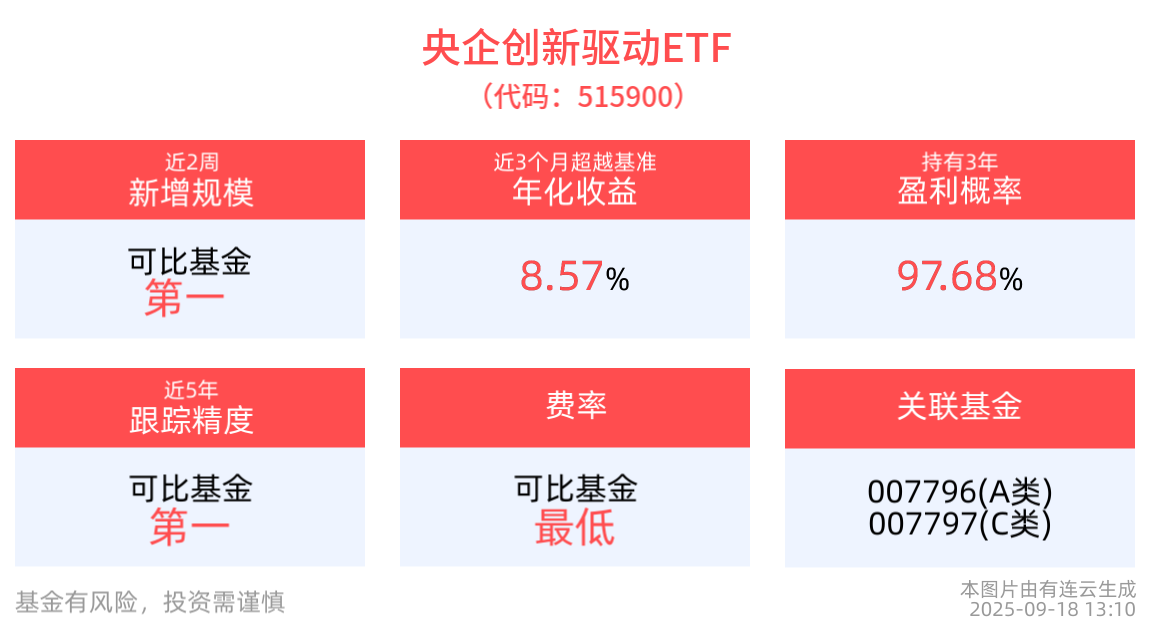
Group 1 - The China Central Enterprises Innovation-Driven Index rose by 0.29% as of September 18, 2025, with notable increases in stocks such as Fenghuo Communication (up 10.02%) and China Automotive Research (up 7.35%) [3] - The Central Enterprises Innovation-Driven ETF (515900) increased by 0.26%, with a latest price of 1.56 yuan, and a cumulative increase of 0.65% over the past week [3] - The ETF had a turnover rate of 0.44% during the trading session, with a transaction volume of 15.55 million yuan, and an average daily transaction volume of 24.47 million yuan over the past week, ranking first among comparable funds [3] Group 2 - China Mobile recently launched two domestically produced satellite communication chips based on the RISC-V architecture, aimed at enhancing cellular signal coverage and meeting IoT connectivity needs [3] - The Ministry of Industry and Information Technology (MIIT) issued guidelines to promote the development of the satellite communication industry, targeting over 10 million satellite communication users by 2030 [4] - The satellite internet industry is experiencing accelerated growth driven by policy support, technological breakthroughs, and capital investment, with a focus on satellite manufacturing and rocket launch services in the short term [4] Group 3 - The Central Enterprises Innovation-Driven Index evaluates the innovation and profitability quality of listed central enterprises, selecting 100 representative companies to reflect the overall performance of innovative central enterprises [5] - As of August 29, 2025, the top ten weighted stocks in the index accounted for 33.39% of the total index, including companies like Hikvision and China Unicom [5]


“2025中国服务业企业500强”发布!(附榜单)
Zhong Guo Zheng Quan Bao· 2025-09-18 04:51
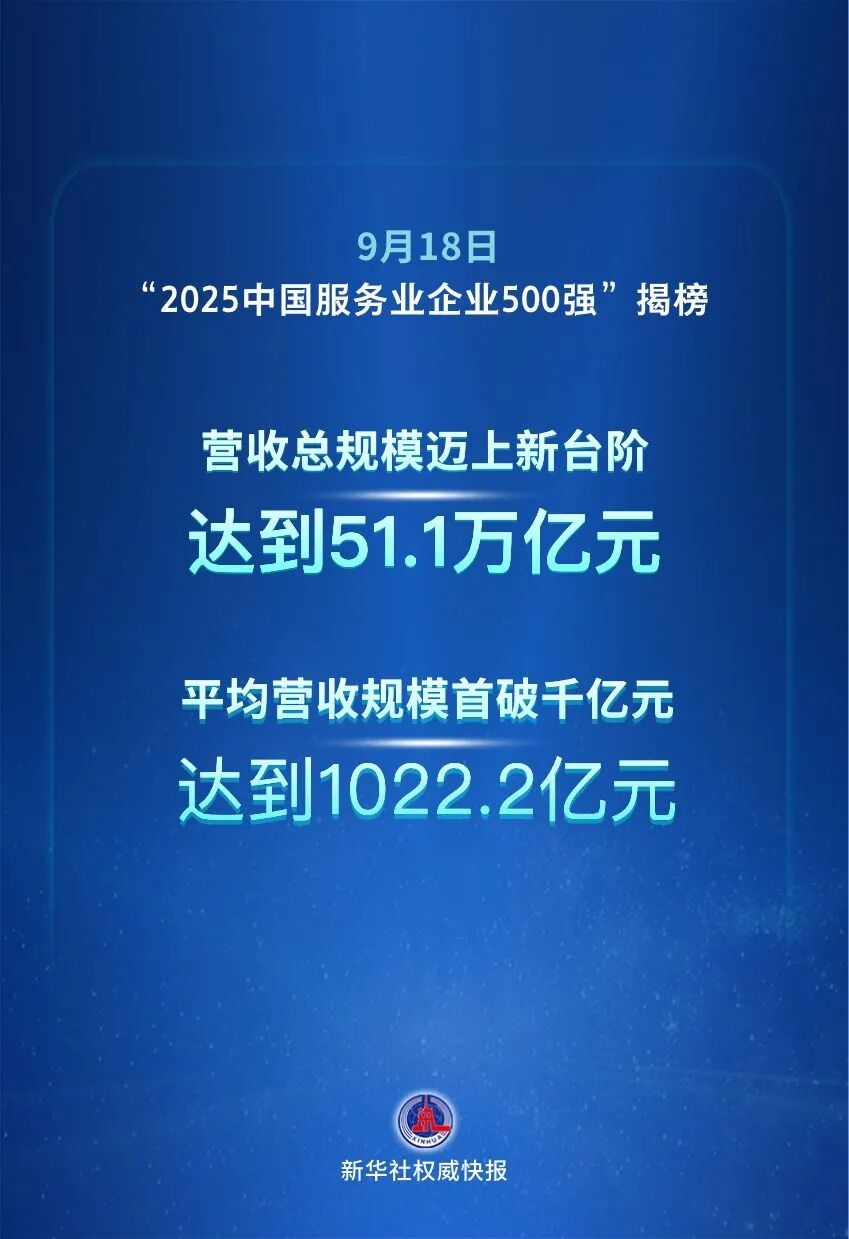
Core Insights - The "2025 China Service Industry Top 500" list was released, showing a significant increase in total revenue and average revenue per company, marking a new milestone for the service industry in China [2][4]. Revenue Growth - The total revenue of the top 500 service companies reached 51.1 trillion yuan, indicating a substantial growth [4]. - The average revenue per company surpassed 1 billion yuan for the first time, reaching 1.0222 billion yuan [2][4]. Profitability and Efficiency - The revenue growth rate for the service industry has accelerated, with profit levels also showing rapid growth [4]. - Per capita revenue and per capita net profit reached historical highs of 3.281 million yuan and 215,000 yuan, respectively [4]. Emerging Services - New emerging services, particularly in internet and information technology, finance, logistics and supply chain services, and business services, have shown remarkable performance, with 184 companies from these sectors making the list [4].



京东位列第十, “中国企业500强”榜单发布,入围门槛实现23连升
Sou Hu Cai Jing· 2025-09-18 02:55
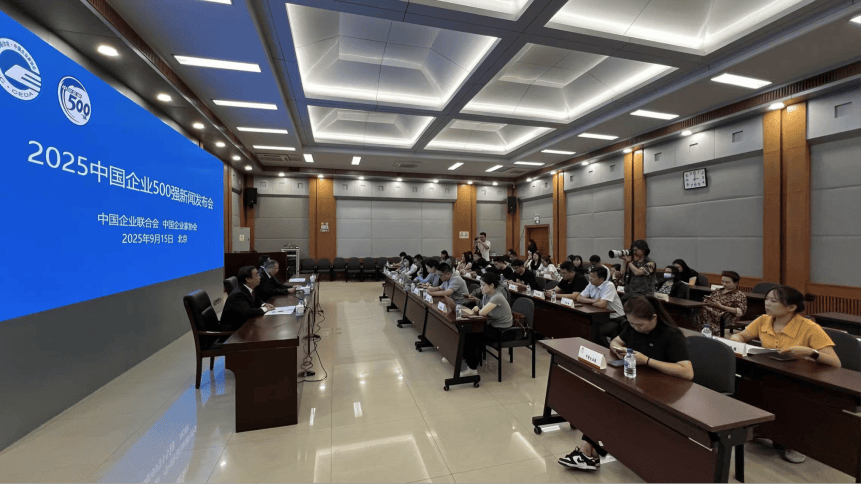
Core Insights - The "2025 China Top 500 Enterprises" list was officially released by the China Enterprise Confederation and the China Enterprise Directors Association, marking the 24th consecutive year of publication [2][4] - The top ten companies include State Grid, China National Petroleum, Sinopec, China State Construction, and JD Group, which ranks tenth with a revenue of 115.88 billion yuan [4][5] Group 1: Rankings and Revenue - The top ten companies by revenue are: 1. State Grid Corporation: 394.59 billion yuan 2. China National Petroleum Corporation: 296.90 billion yuan 3. Sinopec: 293.20 billion yuan 4. China State Construction: 218.71 billion yuan 5. Industrial and Commercial Bank of China: 162.91 billion yuan 6. Agricultural Bank of China: 141.99 billion yuan 7. China Construction Bank: 141.48 billion yuan 8. Bank of China: 126.47 billion yuan 9. China Railway Engineering Group: 116.08 billion yuan 10. JD Group: 115.88 billion yuan [5][6] Group 2: Economic Performance - The total revenue of the "2025 China Top 500 Enterprises" reached 110.15 trillion yuan, showing an increase from the previous year [6] - The threshold for entry into the list has risen for 23 consecutive years, now standing at 47.96 billion yuan, an increase of 579 million yuan [6] Group 3: Innovation and R&D - The top 500 companies invested a total of 1.73 trillion yuan in R&D, with a research intensity reaching a new high of 1.95%, marking an increase for eight consecutive years [6][8] - The total number of valid patents held by these companies is 2.24 million, an increase of 214,000 patents or 10.54% from the previous year [6] Group 4: Future Directions - Companies are encouraged to play a leading role in innovation-driven development by increasing investment in fundamental research and key technologies [8] - There is a focus on nurturing new productive forces by investing in strategic emerging industries such as artificial intelligence and green energy [8] - Companies should also lead industrial transformation and upgrade by enhancing digital capabilities across the supply chain [9] - Ensuring the safety and stability of supply chains is emphasized as a critical requirement for building a modern industrial system [9]


中国企业500强门槛10年翻一倍:能源巨头坚挺 数字新贵突围
Xin Jing Bao· 2025-09-17 14:13
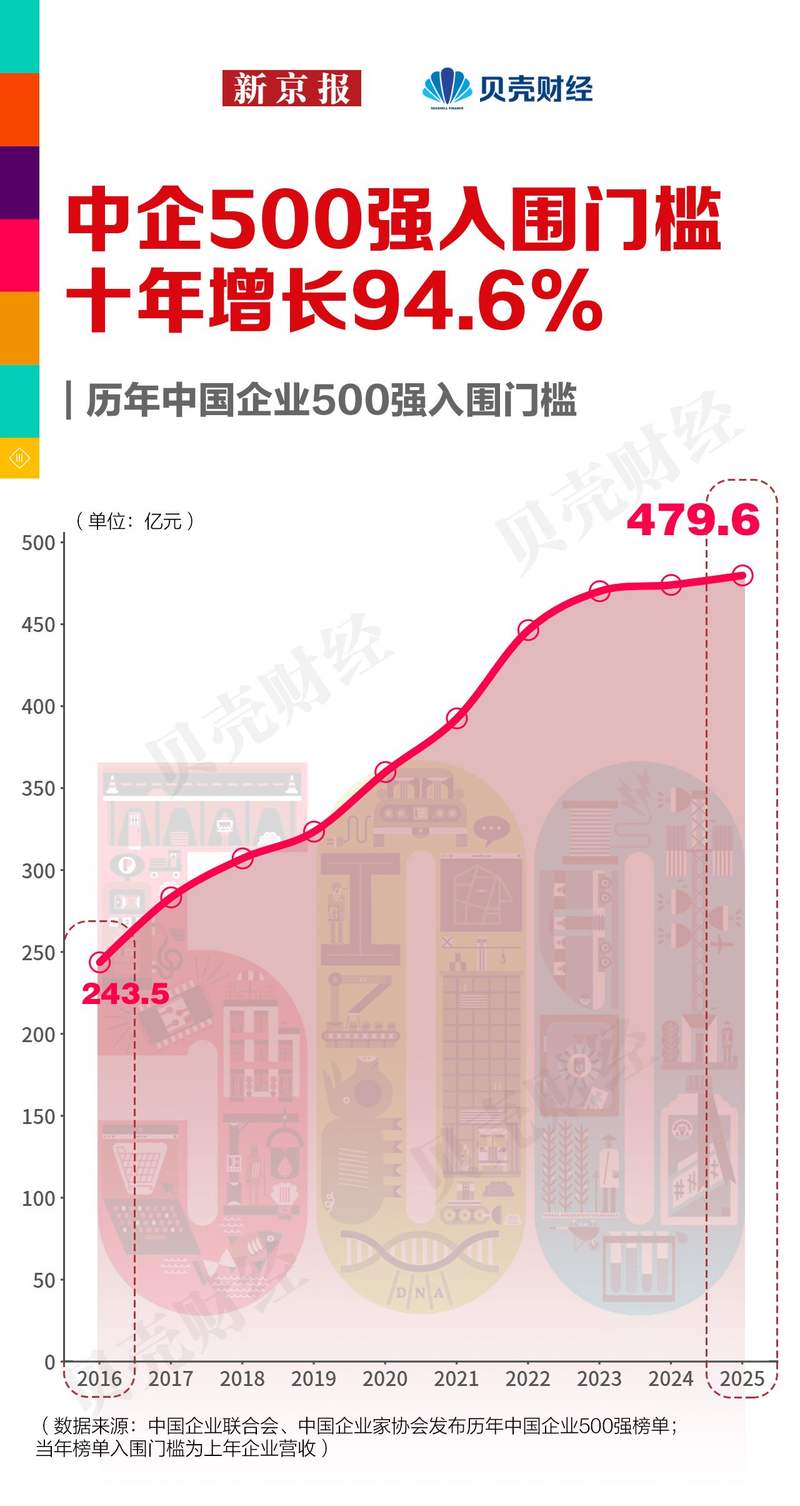
Group 1 - The core point of the article is the release of the 2025 China Top 500 Enterprises list, highlighting the increasing revenue threshold for entry and the emergence of new players in the rankings, particularly in the internet sector [1][10][20] - The entry threshold for the 2025 list is set at 47.96 billion yuan, an increase of 579 million yuan from the previous year, marking a continuous rise for 23 years [2][6] - Over the past decade, the entry threshold has surged by approximately 94.6%, from less than 25 billion yuan in 2016 to nearly 48 billion yuan in 2025, indicating the need for companies to grow faster than their competitors [2][6] Group 2 - In the 2025 list, 15 companies have entered the "trillion club," with the top three being State Grid, China Petroleum, and China Petrochemical, collectively generating over 900 billion yuan in revenue [10][11] - The top ten rankings have seen significant changes, with JD.com making its debut in the top ten, reflecting the growing influence of private internet companies [11][12] - The ranking dynamics show that while traditional industries still hold a significant share, emerging markets and upgraded traditional enterprises are also capable of reaching the entry threshold [6][20] Group 3 - The list features 11 companies that barely made it onto the list with revenues below 50 billion yuan, indicating fierce competition among these "threshold" companies [6][9] - The industries represented by these threshold companies include traditional sectors like construction and civil engineering, as well as emerging fields such as pharmaceutical manufacturing and capital market services [6][9] - The article notes that the ability to maintain growth and avoid dropping out of the rankings depends on companies' responses to market competition and their strategic foresight in technological and industrial transformations [6][20] Group 4 - The 2025 list includes 23 new entrants over the past decade, reflecting the growth of the digital economy and green industries, with companies like Zall Intelligent and NIO making their first appearances [30][33] - The new entrants span various sectors, including internet services, new energy vehicles, and traditional manufacturing, showcasing the diverse landscape of China's economic transformation [30][33] - The article emphasizes that the competition among companies is not just about entering the list but also about maintaining and improving their rankings through strategic innovation and market adaptability [20][34]

8月,接收投诉2966件
中国能源报· 2025-09-17 11:36
Core Viewpoint - The report from the National Energy Administration highlights the complaints, appeals, and reports received through the 12398 energy supervision hotline in August 2025, indicating significant issues in the electricity supply sector and the response of energy companies to these complaints [1]. Complaint Situation - In August 2025, the 12398 energy supervision hotline received a total of 2,966 complaints, with 2,802 related to the electricity sector and 164 concerning renewable energy [2]. - The main complainants were the State Grid Corporation (2,136 complaints), Southern Power Grid Company (616 complaints), and Inner Mongolia Power Group (54 complaints) [2]. - The primary complaint categories included power outage repairs, electricity installation applications, and meter measurement issues [2]. Complaint Handling Situation - Energy companies were required to resolve 3,063 complaints in August, achieving a timely resolution rate of 99.9% [5]. - The satisfaction rate from follow-up calls after complaint resolution was 90.23% [5]. Complaint Hotspots - Issues reported included inadequate equipment maintenance and unstable voltage in regions like Shaanxi and Sichuan, affecting daily life [8]. - Complaints from Guizhou and Shanxi highlighted problems with overdue payments leading to power outages and inadequate repair management [8]. - In Yunnan and Jiangxi, users faced challenges with non-standard acceptance of electricity applications and increased costs due to poor service [8]. Appeal Situation - In August 2025, a total of 255 appeals were received, resulting in a complaint appeal rate of 8.29%, with the majority concerning the State Grid Corporation [9]. - The appeals primarily focused on electricity installation applications, power outage repairs, and meter measurement issues [10]. Appeal Hotspots - In Guangdong and Jiangxi, issues were raised regarding incomplete implementation of the "three zero" policy and inconsistent standards for application reviews [11]. - Complaints from Hainan and Hebei pointed to irregularities in overdue payment management and delays in repair services [11]. - Concerns in Jiangxi and Liaoning included lack of transparency in the assessment of distributed energy sources connecting to the grid [11]. Report Situation - The hotline received 75 reports in August 2025, with the majority related to electrical facility licensing and renewable energy grid connection [13]. - The National Energy Administration handled 100 reports, resolving 122 issues, with actions taken against verified violations [16]. Report Hotspots - Reports from Shaanxi and Hubei indicated misuse of electrical worker certificates by some companies during licensing processes [16]. - In Hebei and Jiangsu, reports highlighted violations in processing grid connection applications for users not meeting the criteria [16]. Work Requirements - Energy companies are urged to enhance power supply quality, improve equipment maintenance, and optimize user-side distribution [17]. - There is a need to standardize electricity installation management and ensure strict adherence to the "three zero" policy [17]. - Companies should refine outage management processes and ensure timely restoration of power [17]. - Strengthening management of renewable energy grid connections and transparently communicating connection standards to users is essential [17].

国家能源局12398能源监管热线投诉举报处理情况通报(2025年8月)
国家能源局· 2025-09-17 07:17
Complaint Situation - In August 2025, the 12398 Energy Regulatory Hotline received a total of 2,966 complaints, with 2,802 related to the electricity sector and 164 to the renewable energy sector [3] - The main complainants were the State Grid Corporation with 2,136 complaints and the Southern Power Grid Company with 616 complaints, focusing on issues such as power outage repairs, electricity application processes, and meter measurement [3][8] - The complaint handling rate was 99.9%, with a satisfaction rate of 90.23% for follow-up calls after resolving complaints [6] Complaint Handling - The State Grid Corporation had a timely handling rate of 99.95% and a follow-up satisfaction rate of 89.98% [8] - The Southern Power Grid Company achieved a 100% timely handling rate with a satisfaction rate of 90.80% [8] - Complaints were primarily about inadequate equipment maintenance, unstable voltage, and improper management of power outages in various regions [8] Appeal Situation - In August 2025, the hotline received 255 appeals, resulting in a complaint appeal rate of 8.29%, with the State Grid Corporation receiving the majority of appeals [9] - The main issues in appeals were related to electricity application processes, power outage repairs, and meter measurement [11] Report Situation - The hotline received 75 reports in August 2025, with the majority concerning electrical facility licensing and renewable energy grid connection [15] - The National Energy Administration handled 100 reports and resolved 122 issues, addressing violations through regulatory discussions and administrative penalties [18] Work Requirements - Energy companies are required to enhance power supply quality, optimize equipment maintenance, and improve user-side distribution [19] - There is a need to standardize electricity application management and ensure compliance with the "three zero" policy [19] - Companies must strengthen outage management and improve the efficiency of power restoration processes [19]

政策利好不断,储能行业或迎黄金发展期,央企现代能源ETF(561790)涨超0.5%
Sou Hu Cai Jing· 2025-09-17 07:06
Core Viewpoint - The recent developments in China's energy sector, particularly in new energy storage, indicate a significant growth phase driven by policy support, market demand, and technological advancements [3][4]. Group 1: Market Performance - As of September 17, 2025, the China Securities National New State-Owned Enterprise Modern Energy Index rose by 0.28%, with notable increases in stocks such as China Coal Energy (up 4.10%) and China Western Power (up 2.03%) [3]. - The Central State-Owned Enterprise Modern Energy ETF (561790) increased by 0.52%, with a latest price of 1.17 yuan, and has seen a cumulative increase of 2.93% over the past month [3]. Group 2: Policy Developments - The National Development and Reform Commission and the National Energy Administration have issued the "New Energy Storage Scale Construction Special Action Plan (2025-2027)", aiming for market-oriented development and technological innovation in the energy storage sector by 2027 [3][4]. - Additional policies released in September include notifications to improve pricing mechanisms for renewable energy and guidelines for the continuous operation of electricity spot markets, emphasizing the importance of energy storage [4]. Group 3: Industry Outlook - Experts suggest that the confluence of policy incentives, surging market demand, rapid technological iterations, and strategic capacity layouts are propelling the energy storage industry into a "golden development period" characterized by simultaneous increases in volume and price [4]. - The index tracking the Central State-Owned Enterprise Modern Energy ETF includes 50 listed companies involved in green energy and fossil energy, with the top ten stocks accounting for 48.28% of the index [4].



