
vivo

Search documents
抢占AI手机入口,豆包手机助手还需迈过两道坎
Xin Lang Cai Jing· 2025-12-03 01:12
Core Insights - ByteDance has officially launched the "Doubao Phone Assistant" in collaboration with ZTE, marking its entry into the AI mobile operating system space with a technology preview version priced at 3499 yuan [1] - The Doubao Phone Assistant allows users to interact via voice commands and can perform tasks across multiple apps, indicating ByteDance's strategy to capture the AI OS market [1] - The product has generated significant interest, selling out within a day and leading to a secondary market where resellers are marking up prices by 700 to 1500 yuan [1] Industry Trends - The industry is divided on the future of human-computer interaction, with some believing that smartphones will remain the primary interface, while others anticipate the emergence of new devices [2] - Companies like Apple and Alibaba are also exploring AI operating systems, with Apple collaborating with major models and Alibaba launching the Quark AI glasses, indicating a competitive landscape [2][3] - The smartphone market is becoming increasingly saturated, making it difficult for new players to gain traction, as seen with ByteDance's decision to partner with existing manufacturers rather than develop its own hardware [3] Challenges - The collaboration model poses challenges regarding control and market share, as manufacturers may be reluctant to cede AI OS access to partners, potentially limiting Doubao's market penetration [3] - The Doubao Phone Assistant faces hurdles related to third-party app permissions, as its ability to compare prices across platforms could disrupt existing business models, leading to potential pushback from major e-commerce platforms [4] - Despite the uncertainties surrounding Doubao's future, its introduction may inspire further exploration of AI operating systems among other tech companies in China [4]


智动力:目前合作手机品牌包括三星、OPPO、vivo等,未为豆包手机供货
Mei Ri Jing Ji Xin Wen· 2025-12-03 00:56
Core Viewpoint - The company Zhihui Dongli (智动力) confirmed that it does not have a partnership with Doubao and is not supplying components for Doubao smartphones [1]. Group 1: Company Information - Zhihui Dongli's functional components, structural components, and precision optical components are applicable to smartphones and AI phones [1]. - Current smartphone brand partnerships include Samsung, OPPO, and vivo [1].

“豆包AI助手”手机售罄
3 6 Ke· 2025-12-03 00:51
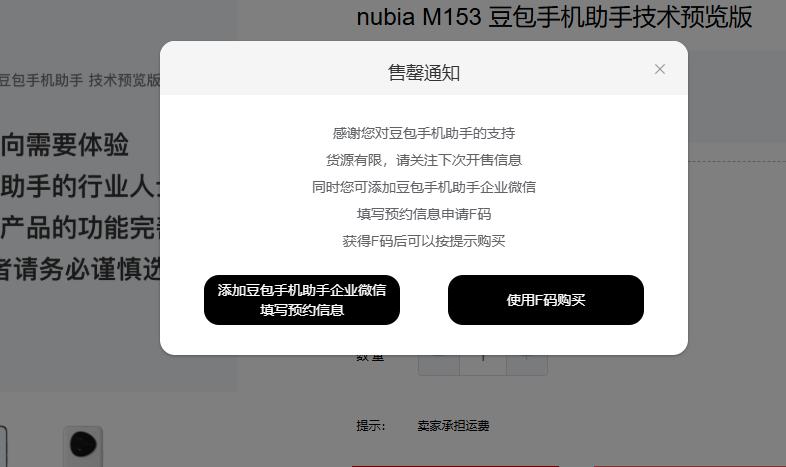
Core Insights - The nubia M153 smartphone, featuring the "Doubao AI Assistant," has gained significant attention, with prices ranging from 3999 to 4599 yuan on second-hand platforms, and the official preview version sold out at 3499 yuan [1][3][4] Group 1: Product Overview - The nubia M153 is described as an engineering sample primarily aimed at industry professionals for experiencing the Doubao AI Assistant, rather than a consumer product [4] - The official website indicates that the F-code for purchasing the phone is available for those interested in testing the AI assistant, with a caution for ordinary consumers regarding the product's functionality [3] Group 2: Industry Collaboration and Competition - Doubao is in discussions with multiple smartphone manufacturers for potential collaborations but has no plans for self-developed smartphones [5] - Major smartphone manufacturers like Huawei, Xiaomi, and OPPO have already been exploring AI assistants, indicating a competitive landscape [5] Group 3: Challenges and Industry Standards - The integration of AI assistants into smartphones faces significant challenges, including the need for ecosystem cooperation and authorization from major internet application providers [5][6] - Morgan Stanley's report highlights that deep system-level integration may require modifications to operating systems, which could conflict with the interests of smartphone manufacturers [7]
【e公司观察】“豆包助手”手机未发先火!移动终端新一轮卡位战打响
Zheng Quan Shi Bao Wang· 2025-12-02 16:07
Core Viewpoint - The launch of the "Doubao Phone Assistant" by ByteDance marks a new phase in the competition for control over the mobile terminal ecosystem in the AI era, as it collaborates with ZTE to create an AI-powered smartphone assistant [1][3]. Group 1: Product Launch and Market Reaction - On December 1, ByteDance's Doubao team released the technical preview of the "Doubao Phone Assistant," showcasing its capabilities on the ZTE Nubia M153 prototype, including cross-application task execution [1]. - Following the announcement, stocks of ZTE, Tianyin Holdings, Furong Technology, and Daoming Optics hit the daily limit, indicating strong market interest [1]. - The first batch of "Doubao Assistant" phones sold out quickly, with prices on second-hand platforms reaching a premium of up to 3,500 yuan [1]. Group 2: Industry Context and Competitors - The development of AI assistants in smartphones is not new, with major brands like Huawei, Apple, OPPO, Xiaomi, and Vivo already having established AI voice assistants [2]. - Huawei's HarmonyOS 6 has launched over 80 AI agents across various sectors, while Honor has integrated over 4,000 ecological MCPs and supports 3,000 automated scenarios [2]. Group 3: Future Trends and Strategic Implications - The industry anticipates that AI smartphones will evolve into personal assistants, with AI voice assistants serving as the primary interface for human-computer interaction [3]. - The collaboration between ByteDance and ZTE is seen as a strategic move to gain a competitive edge in traffic distribution, highlighting the ongoing battle for influence in the mobile terminal ecosystem [3]. - The current lack of a unified standard for collaboration among participants in the AI agent era suggests that various companies will seek to carve out their share of the market [3].

e公司观察“豆包助手”手机未发先火!移动终端新一轮卡位战打响
Zheng Quan Shi Bao Wang· 2025-12-02 15:47
Core Viewpoint - The launch of the "Doubao Phone Assistant" by ByteDance marks a significant step in the competition for control over the mobile terminal ecosystem in the AI era, with partnerships between internet companies and smartphone manufacturers becoming increasingly important [1][3]. Group 1: Product Launch and Market Reaction - On December 1, ByteDance's Doubao team released the technical preview of the "Doubao Phone Assistant," showcasing its capabilities on the ZTE Nubia M153 prototype, including the ability to execute tasks across applications automatically [1]. - Following the announcement, stocks of ZTE, Tianyin Holdings, Furong Technology, and Daoming Optics hit the daily limit, indicating strong market interest [1]. - The first "Doubao Assistant" phone sold out quickly, with prices on second-hand platforms reaching a premium of up to 3,500 yuan [1]. Group 2: Competitive Landscape - Major smartphone manufacturers like Huawei, Apple, OPPO, Xiaomi, and Vivo have been developing AI capabilities for years, with each having their own AI voice assistants [2]. - Huawei's HarmonyOS 6 has launched over 80 intelligent agents covering various fields, while Honor has integrated over 4,000 ecological MCPs and intelligent agents [2]. - The industry anticipates that AI phones will evolve into personal assistants, with AI voice assistants serving as the primary interface for human-computer interaction, potentially transforming the mobile ecosystem [3]. Group 3: Future Trends and Collaborations - The collaboration between ByteDance and ZTE is seen as a strategic move to seize control over traffic distribution in the evolving AI landscape, indicating a new wave of competition for influence in the mobile terminal market [3]. - The likelihood of replicating the Doubao and ZTE partnership with mainstream smartphone brands is low, but opportunities may exist with smaller brands or other consumer electronics like glasses, headphones, and smartwatches [3]. - The industry has yet to establish a unified standard for collaboration in the intelligent agent era, with various participants vying for a share of the emerging market [3].
“豆包AI助手”手机售罄
财联社· 2025-12-02 14:34
Core Viewpoint - The nubia M153 phone, featuring the "Doubao AI Assistant," has gained significant attention, with its technical preview version selling out at a price of 3499 yuan, indicating strong market interest in AI-integrated mobile devices [4][6]. Group 1: Product Overview - The nubia M153 is marketed primarily to industry professionals for experiencing the Doubao AI Assistant, with a caution that it is not a fully mature product for general consumers [6]. - The phone is an engineering sample developed in collaboration with Doubao, which leads the product definition and experience, while nubia focuses on hardware engineering and technology development [8]. Group 2: Market Dynamics - On second-hand platforms, the nubia M153 is being resold for prices ranging from 3999 to 4599 yuan, with F codes being sold for around 100 yuan [8]. - Doubao is in discussions with multiple smartphone manufacturers for potential collaborations, but there are currently no confirmed partnerships [9]. Group 3: Competitive Landscape - Major smartphone manufacturers like Huawei, Xiaomi, and OPPO have already developed their own AI assistants, indicating a competitive landscape in the AI mobile assistant space [9]. - The integration of AI into mobile operating systems is being explored by various manufacturers, with a focus on creating platform-level AI capabilities [9]. Group 4: Challenges and Considerations - The successful implementation of mobile AI assistants requires overcoming ecological challenges, including obtaining permissions from major internet application providers like Alibaba and Tencent [11]. - The integration of AI and mobile technology necessitates modifications to operating systems, which could conflict with the core interests of smartphone manufacturers [12].

福蓉科技:公司生产的高强度铝制结构件材料已用于MR、AR眼镜
Zheng Quan Ri Bao· 2025-12-02 12:08
Core Insights - Furong Technology has confirmed that its high-strength aluminum structural components are being utilized in MR and AR glasses, with major brands including Samsung and Vivo [2] Company Summary - Furong Technology produces high-strength aluminum structural components [2] - The company's products are currently used in MR and AR glasses [2] - Key clients include prominent brands such as Samsung and Vivo [2]


50%的安卓税,网易带头抵制:比苹果还高,全球最高了
Sou Hu Cai Jing· 2025-12-02 10:57
Core Viewpoint - The article discusses the significant impact of the high "Android tax" imposed by domestic smartphone manufacturers on game developers, leading to a shift in distribution strategies towards more cost-effective platforms like short video and social media channels [1][3][10]. Group 1: Android Tax and Its Implications - The "Android tax" in China is notably high at 50%, which is criticized by game developers as the highest globally compared to Apple's and Google's 30% cut [1][5]. - Major game companies like NetEase, Tencent, and Alibaba are moving away from traditional app stores to avoid the high fees, opting for platforms like Douyin and WeChat for distribution [3][5][10]. Group 2: Changes in Distribution Strategies - The formation of the "Hardcore Alliance" by major smartphone manufacturers in 2014 has historically enforced the 50% cut, making it difficult for game developers to bypass this fee [7][8]. - The rise of short video and social media platforms has provided game developers with alternative, lower-cost distribution channels, allowing them to reach users directly without incurring the high fees [8][10]. Group 3: Future Outlook - The shift in distribution strategies is seen as a "burden reduction" for game developers, potentially leading to a more competitive environment for users, with lower prices and more promotional activities [12]. - Smartphone manufacturers may respond by adjusting their commission rates or enhancing services to attract game developers back to their platforms, indicating a potential evolution in the market dynamics [12].


具身觉醒:AI 从感知到行动的能力跃迁
Tai Mei Ti A P P· 2025-12-02 10:10
Group 1: Core Concepts - Embodied intelligence is becoming a central consensus in the AI revolution, marking a transition from digital to physical worlds, with hardware as a key medium for interaction [2][3] - The industry is converging towards a future where AI completes a full loop of "perception - decision - action" in real physical spaces, supported by a next-generation full-stack AI technology system [3][20] Group 2: AI Hardware - AI hardware is undergoing a fundamental identity transformation, evolving from functional devices to intelligent partners, with a market size in China expected to exceed 1 trillion yuan this year [4][5] - The core of this transformation is the shift from passive response to proactive service, exemplified by devices that can autonomously adjust settings based on user intent [5][6] - AI smartphones are experiencing a deep transformation, with major manufacturers collaborating with large models to enhance user experience [5][6] Group 3: Intelligent Driving - The paradigm of intelligent driving is shifting from rule-based systems to emergent capabilities, driven by data models like Vision-Language-Action (VLA) [10][11] - VLA technology is expected to significantly enhance the driving experience, with predictions of a tenfold improvement in the next year [11][12] - The demand for computational resources for intelligent driving is growing exponentially, with significant investments in GPU resources by leading companies [12][13] Group 4: Robotics - Robotics represents the purest embodiment of intelligent concepts, facing challenges in bridging the gap between digital intelligence and physical entities [15][19] - The industry is divided on the approach to building robotic intelligence, with debates on whether to use unified models or layered architectures [16][17] - The commercial application of robotics is accelerating, with robots already automating processes in retail and manufacturing [19][20] Group 5: Future Outlook - Future competition will focus on an integrated ecosystem of "endpoints - entities - spaces," with AI driving the transition from passive to proactive and isolated to collaborative systems [20] - The key drivers of this evolution will be technological breakthroughs, data loops, and practical applications, with the first to integrate algorithms, hardware, and ecosystems likely to define the next intelligent era [20]
涉苹果、三星等,印度电信部要求手机制造商预装官方APP引争议
Guan Cha Zhe Wang· 2025-12-02 09:47
Core Viewpoint - The Indian Ministry of Telecommunications has mandated smartphone manufacturers, including Apple, Samsung, Vivo, Xiaomi, and OPPO, to pre-install a government-developed cybersecurity app called "Sanchar Saathi" on all new devices sold in India, which cannot be uninstalled by users [1][3]. Group 1: Government Mandate - The Indian government issued a directive on November 28, requiring smartphone companies to pre-install the "Sanchar Saathi" app within 90 days on all new devices sold in the Indian market [1]. - Existing devices must receive the app through software updates as per the government's instructions [1]. Group 2: App Functionality - "Sanchar Saathi," launched in January 2025, aims to help users block and track lost or stolen smartphones and identify fraudulent mobile connections [3]. - The app has reportedly assisted in recovering over 700,000 lost phones since its launch, with 50,000 recoveries occurring in October alone [3]. Group 3: Industry Response - Concerns have been raised regarding user consent and potential government surveillance, with critics arguing that the mandate infringes on user rights [3]. - Apple’s response to the mandate is uncertain, as the company traditionally resists pre-installing government or third-party apps on its devices [4]. - Counterpoint Research reported a 5% year-over-year increase in smartphone shipments in India for Q3 2025, with sales revenue up 18%, marking a historical high [4].

