
中国财险

Search documents
智通港股通资金流向统计(T+2)|10月7日
智通财经网· 2025-10-06 23:33
Group 1 - On September 26, the top three stocks with net inflows from southbound funds were Alibaba-W (09988) with 34.60 billion, Yingfu Fund (02800) with 14.02 billion, and Tencent Holdings (00700) with 11.06 billion [1][2] - The top three stocks with net outflows were China Mobile (00941) with -6.35 billion, China Telecom (00728) with -3.59 billion, and China Construction Bank (00939) with -3.38 billion [1][2] - In terms of net inflow ratio, GX Hengsheng Technology (02837) led with 462.02%, followed by Green Power Environmental (01330) with 156.44%, and Anjii Food (02648) with 127.61% [1][2] Group 2 - The top ten stocks with the highest net inflows included Xiaomi Group-W (01810) with 11.00 billion and Huahong Semiconductor (01347) with 8.23 billion [2] - The top ten stocks with the highest net outflows included China Petroleum & Chemical Corporation (00386) with -2.16 billion and Changfei Optical Fiber Cable (06869) with -1.53 billion [2] - The net outflow ratios for the top ten stocks included Tianjin Chuangye Environmental Protection (01065) at -123.57% and China Telecom (00728) at -113.73% [3][4]



智通港股通资金流向统计(T+2)|10月6日
智通财经网· 2025-10-05 23:34
Key Points - On September 26, 2023, the top three stocks with net inflows from southbound funds were Alibaba-W (09988) with 34.60 billion, Yingfu Fund (02800) with 14.02 billion, and Tencent Holdings (00700) with 11.06 billion [1][2] - The top three stocks with net outflows were China Mobile (00941) with -6.35 billion, China Telecom (00728) with -3.59 billion, and China Construction Bank (00939) with -3.38 billion [1][2] - In terms of net inflow ratio, GX Hang Seng Technology (02837) led with 462.02%, followed by Green Power Environmental (01330) with 156.44%, and Anjuke Food (02648) with 127.61% [1][2] - The top three stocks with the highest net outflow ratios were Tianjin Chuangye Environmental Protection (01065) at -123.57%, China Telecom (00728) at -113.73%, and China Pacific Insurance (02328) at -110.28% [1][2] Net Inflow Rankings - The top ten stocks by net inflow included: - Alibaba-W (09988): 34.60 billion, 13.44% [2] - Yingfu Fund (02800): 14.02 billion, 9.22% [2] - Tencent Holdings (00700): 11.06 billion, 8.77% [2] - Xiaomi Group-W (01810): 11.00 billion, 4.71% [2] - Huahong Semiconductor (01347): 8.23 billion, 15.41% [2] - The top ten stocks by net outflow included: - China Mobile (00941): -6.35 billion, -61.43% [2] - China Telecom (00728): -3.59 billion, -113.73% [2] - China Construction Bank (00939): -3.38 billion, -18.39% [2] - China Pacific Insurance (02328): -2.86 billion, -110.28% [2] - China Petroleum & Chemical Corporation (00386): -2.16 billion, -51.00% [2] Net Inflow Ratio Rankings - The top three stocks by net inflow ratio were: - GX Hang Seng Technology (02837): 462.02%, 16.14 million [3] - Green Power Environmental (01330): 156.44%, 3.21 million [3] - Anjuke Food (02648): 127.61%, 1.14 million [3] - The top three stocks by net outflow ratio were: - Tianjin Chuangye Environmental Protection (01065): -123.57%, -2.42 million [3] - China Telecom (00728): -113.73%, -3.59 billion [3] - China Pacific Insurance (02328): -110.28%, -2.86 billion [3]


人保财险落地首批概念验证与小试保险和中试验证保险
Xin Hua She· 2025-10-03 03:47
Core Insights - The company has successfully issued its first batch of concept validation and pilot insurance, providing risk coverage for key R&D projects of eight technology enterprises and research institutions [1] - The projects are located in Xiong'an New Area, Jiangsu, Anhui, Hubei, and Liaoning, covering various fields such as AI diagnostics, healthcare, fine chemicals, optical materials, ship engineering, and pharmaceutical processing [1] - The new insurance products aim to address the challenges and uncertainties faced during the concept validation, pilot, and mid-term testing phases, helping technology companies focus on core technology development without fear of errors or setbacks [1] Product Development - The company has established a product system that covers the entire life cycle of technology activities, including R&D, achievement transformation, and application promotion [1] - Specialized risk solutions have been formed in niche sectors such as aerospace, new energy, and biomedicine [1] - The introduction of these two new products enhances the risk protection chain for early-stage technological innovation, ensuring continuous risk coverage from the early validation phase of technological achievements [1]
人保财险落地首批专利池运营责任保险
Xin Hua Wang· 2025-10-02 09:31
Core Insights - The launch of the first batch of patent pool operation liability insurance by PICC Property and Casualty in Wuxi, Jiangsu, and Ningbo, Zhejiang aims to provide precise risk protection for patent pool operators facing risks such as patent infringement, invalidation, or breach of licensing agreements [1][2] Group 1: Patent Pool Operation - A patent pool is a management and utilization model that consolidates patents from multiple rights holders in a specific technology field to create a shared resource pool for efficient management and operation [1] - Patent pools are typically initiated and operated by industry players with significant innovation advantages and influence, or managed by third-party organizations [1] Group 2: Insurance Product Features - The insurance product specifically covers losses due to operator negligence leading to patent infringement, invalidation, or breach of licensing agreements, thereby alleviating concerns for patent pool operators [2] - PICC Property and Casualty plans to continuously improve its intellectual property insurance product and service system to support patent conversion, technological innovation, and industrial innovation [2]
“深圳惠家保”已受理报案80起:保险业持续赶考超强台风
Nan Fang Du Shi Bao· 2025-09-30 15:12
Core Insights - The article highlights the rapid response of the insurance industry in Shenzhen following Typhoon Haikui, particularly focusing on the "Shenzhen Huijia Bao" insurance product which was launched less than two months prior to the typhoon [2][3] Group 1: Product Overview - "Shenzhen Huijia Bao" is a public welfare family property insurance product developed by 23 property insurance companies in Shenzhen under the guidance of the Shenzhen Insurance Association [2] - The product covers major household risks including fire, explosion, typhoons, heavy rain, and falling objects, and is applicable to both owned and rented properties [2] - Since its launch, "Shenzhen Huijia Bao" has provided risk coverage for over 54,000 households, becoming a crucial safety net for families against natural disasters [2] Group 2: Claims and Response - As of September 30, the "Shenzhen Huijia Bao" received 80 claims related to the typhoon, with a total loss amounting to 139,200 yuan, and 77 claims have been processed [2] - Specific case examples include a tenant whose property suffered water damage due to the typhoon, receiving a compensation of 2,900 yuan on the same day the claim was filed [3] - Another case involved a homeowner whose balcony glass shattered, receiving a compensation of 2,000 yuan within an hour of reporting the claim [3] Group 3: Operational Efficiency - The insurance claims process for "Shenzhen Huijia Bao" is designed for efficiency, with online claim assessments and payments being completed within hours [3] - The insurance coverage typically becomes effective within three days of purchase, allowing for quick protection against unforeseen events [3]

国信证券:8月保费短期增幅提升 长期负债结构优化
智通财经网· 2025-09-30 08:27
Core Viewpoint - The insurance industry is experiencing a recovery in premium growth driven by savings-type insurance products, particularly dividend insurance, since 2025. The recent adjustments in predetermined interest rates are expected to influence product attractiveness and sales strategies within the industry [1][2]. Industry Overview - As of the end of August 2025, the insurance industry achieved a total original premium income of 47,999 billion yuan, marking a year-on-year increase of 9.63%, with growth accelerating for five consecutive months. Life insurance accounted for 37,999 billion yuan, reflecting an 11.32% increase [2][3]. - The life insurance sector saw a significant monthly premium income growth of 47.24% in August, driven by short-term "炒停售" (speculative suspension) activities [3][4]. Product Insights - The predetermined interest rates for ordinary products, dividend insurance, and universal insurance have been lowered to 2.0%, 1.75%, and 1.0%, respectively, with reductions of 50 basis points, 25 basis points, and 50 basis points. This adjustment is expected to stimulate premium income in the short term [4][5]. - Dividend insurance is becoming a core product in a low-interest-rate environment, as it offers a "low guaranteed return + high floating return" structure, allowing insurance companies to share investment risks with policyholders and reduce rigid repayment costs [5][6]. Financial Performance - In the first eight months of 2025, property insurance companies reported a total premium income of 12,201 billion yuan, a year-on-year increase of 4.67%. Notably, auto insurance premiums reached 6,006 billion yuan, up 4.33%, while non-auto insurance premiums grew by 5.0% [6]. Recommendations - Companies with strong sales foundations, such as China Ping An (601318.SH) and China Property & Casualty Insurance (02328), are recommended for attention due to their potential benefits from the current market dynamics [7].


五年裁撤超万家网点,险企“瘦身”再加速
Xin Lang Cai Jing· 2025-09-30 06:12
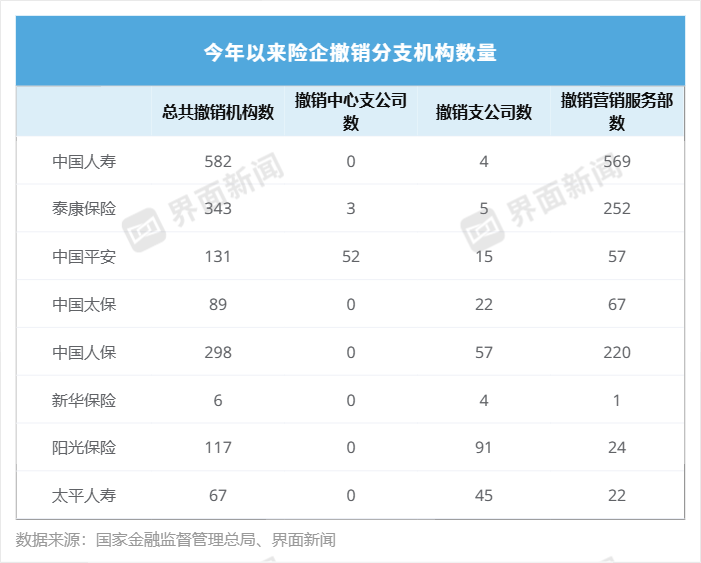
Core Insights - The insurance industry in China is accelerating the closure of branch offices, with 2,436 branches having exited the market in 2023 alone, compared to 2,012 in 2024, indicating a significant trend towards downsizing [1][2][6] Summary by Sections Branch Closures - Major insurance companies are focusing on reducing their branch networks, particularly in lower-tier cities and rural areas, as part of a strategy to enhance efficiency and reduce costs [2][3] - China Life Insurance has closed 582 branches this year, with 569 being marketing service departments, reflecting an increased pace of downsizing compared to previous years [2][4] - China Pacific Insurance and China Property & Casualty Insurance have also made significant cuts, with 89 and 298 branch closures respectively [4][5] New Branch Openings - Despite the closures, insurance companies have opened a total of 268 new branches this year, with China Ping An leading with 32 new branches [5][6] - The new branches primarily consist of marketing service departments, indicating a shift in focus rather than a complete withdrawal from the market [5] Long-term Trends - Since 2021, the insurance sector has seen over 10,000 branch closures, with the peak occurring in 2022, likely influenced by regulatory requirements and the need for operational efficiency [6][7] - The shift towards digitalization has led to an increase in online insurance purchases, with online purchase rates rising from 73% in 2023 to 78% in 2024, further reducing reliance on physical branches [6][7] Strategic Adjustments - Companies are adjusting their branch strategies to focus on core customer groups and optimize their networks, particularly in response to declining consumer spending in lower-tier cities [3][6] - The role of physical branches is evolving, with a potential shift towards providing comprehensive services such as wealth management and elder care, rather than just sales [7][8]



辅具租赁服务纳入烟台市长期护理保险保障范围
Qi Lu Wan Bao Wang· 2025-09-30 01:48
Core Points - Starting January 1, 2025, Yantai City will include assistive device rental services in its long-term care insurance coverage, allowing disabled individuals to voluntarily choose this service, which alleviates financial burdens on families [1][2] - The assistive device rental policy not only reduces economic pressure on insured individuals but also allows for timely adjustments and replacements based on their needs, catering to diverse care requirements [1] - The cost of using an electric nursing bed through the long-term care insurance rental policy is significantly lower, with insured individuals only needing to pay 72 yuan per month, equating to a daily cost of 2.4 yuan, compared to the market price of over a thousand yuan for direct purchase [1] Industry Insights - The long-term care insurance program in Yantai City has established four designated assistive device service institutions, providing a variety of essential and often expensive nursing aids, covering two main categories and five subcategories of care devices [2] - The service model emphasizes personalized service supply through "self-selection and agreement," enhancing flexibility in service provision to meet the specific needs of disabled individuals [2]
交强险服务升级如何利好车主
Ren Min Ri Bao· 2025-09-29 22:30
Core Insights - The mandatory traffic accident liability insurance (known as "Jiaoqiangxian") is expanding its coverage and improving its service, with significant growth in insured vehicles and compensation payouts in 2024 [1][2] Group 1: Insurance Coverage and Financials - In 2024, Jiaoqiangxian covers 372 million vehicles, a year-on-year increase of 4.2% [1] - The total guaranteed amount reached 74.3 trillion yuan, also reflecting a 4.2% growth [1] - Compensation expenditures amounted to 226.28 billion yuan, marking an 11.6% increase compared to the previous year [1] Group 2: Disaster Response and Claims Management - The insurance industry is enhancing its disaster response mechanisms, particularly during extreme weather events, to expedite claims processing and improve service efficiency [1][2] - Collaboration among insurance companies during disasters allows for unified disaster prevention, assessment, and claims processing, ensuring quicker compensation for policyholders [1] Group 3: Technological Innovations - The insurance sector is leveraging technology by creating "disaster risk maps" and utilizing IoT devices for monitoring water levels in vulnerable areas [2] - These innovations aim to alert vehicle owners about potential risks and enhance preparedness for disasters [2] Group 4: Social Assistance Fund - In 2024, the social assistance fund for road traffic accidents extracted 1.1 billion yuan, providing crucial support for accident victims [2][3] - The fund assists victims whose medical expenses exceed Jiaoqiangxian limits or in cases where the responsible vehicle is uninsured or has fled the scene [2] Group 5: Innovative Management Practices - The insurance industry is implementing innovative measures in managing the social assistance fund, such as establishing a "24-hour response, one-stop service" mechanism in collaboration with local police [3] - Various regions are developing streamlined processes for fund disbursement, enhancing the efficiency of medical expense payments for accident victims [3]
提升大灾应对效能 强化事故兜底保障 交强险服务升级如何利好车主
Ren Min Ri Bao· 2025-09-29 22:13
Core Insights - The mandatory traffic accident liability insurance (known as "Jiaoqiangxian") is expanding its coverage and improving its service, with a notable increase in the number of insured vehicles and compensation payouts in 2024 [1][2]. Group 1: Insurance Coverage and Financials - In 2024, Jiaoqiangxian covers 372 million vehicles, a year-on-year increase of 4.2% [1] - The total guaranteed amount reached 74.3 trillion yuan, also reflecting a 4.2% year-on-year growth [1] - Compensation expenditures amounted to 226.28 billion yuan, marking an 11.6% increase compared to the previous year [1] Group 2: Disaster Response and Technological Integration - The insurance industry is enhancing its disaster response mechanisms, particularly during extreme weather events, by implementing a collaborative damage assessment process among different insurance companies [1][2] - The development of "disaster accident vehicle insurance risk maps" and the use of IoT devices for water level monitoring are being introduced to help prevent risks [2] Group 3: Social Assistance Fund - In 2024, the social assistance fund for road traffic accidents extracted 1.1 billion yuan, providing crucial support for victims [2] - The fund assists victims whose medical expenses exceed the Jiaoqiangxian liability limits or in cases where the responsible vehicle is uninsured or has fled the scene [2] Group 4: Innovative Measures in Fund Management - Various innovative measures have been implemented in managing the assistance fund, including a 24-hour response mechanism and streamlined processes for quick fund disbursement [3] - The insurance industry is committed to enhancing the efficiency and transparency of the assistance fund management [3]