指南针

Search documents
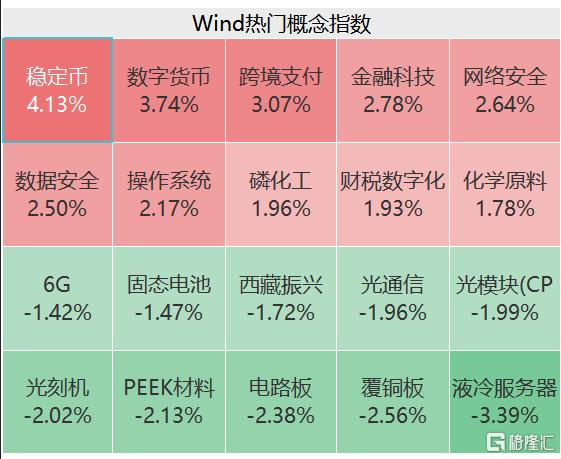
数字货币板块领涨,金融科技ETF、金融科技ETF华夏年内涨超36%
Ge Long Hui A P P· 2025-08-21 05:57
Core Viewpoint - The A-share market is experiencing significant growth in sectors such as stablecoins, digital currencies, cross-border payments, and financial technology, indicating a bullish trend in the financial landscape [1][2]. Financial Technology Sector - The financial technology ETF has seen a year-to-date increase of over 36%, with specific ETFs like Huaxia and Huabao showing gains of 37.21% and 36.46% respectively [2][3]. - Key companies in the financial technology ETF include industry leaders such as Dongfang Caifu, Tonghuashun, and Hengsheng Electronics, which contribute to the sector's stability and growth potential [3]. Margin Financing and Securities Lending - The margin financing balance has recently increased by 39.5 billion yuan, marking the largest single-day increase in 2024 and surpassing 2.1 trillion yuan for the first time in a decade [4]. - As of August 20, the margin financing balance reached 2,147.569 billion yuan, continuing a streak of eight consecutive increases [5]. Relationship Between Savings and Stock Market - There is a notable negative correlation between household savings and the total market capitalization of A-shares, with a current savings-to-market cap ratio of 1.7, suggesting that the influx of funds into the market is likely to continue [5]. - Historical data indicates that the savings-to-market cap ratio typically ranges between 1.1 and 2.0, positioning the current ratio at a high level, which may drive further market activity [5]. Financial IT Sector Dynamics - The financial IT sector is characterized by its dual nature of stability from financial services and growth from technological innovation, benefiting from increased market activity and improved institutional performance [6]. - The sector's performance is expected to mirror past bull markets, with significant gains during the initial phases driven by valuation expansion and heightened risk appetite [6]. Future Outlook for Financial IT - The transition from the mobile internet era to the AI era presents new growth opportunities for financial IT, with advancements in large language models potentially transforming the industry [7]. - Companies focused on consumer-facing financial technology are projected to see substantial revenue growth, with estimates suggesting over 50% year-on-year growth in Q2 2025 [7].

黑神话又出杰作,创业板软件ETF华夏(159256)持仓股长亮科技涨幅超7%
Mei Ri Jing Ji Xin Wen· 2025-08-21 04:46
Core Viewpoint - The article highlights the performance of the Chinese gaming market in the first half of 2025, showcasing significant growth in revenue and user base, alongside the emergence of AI applications in the gaming industry [1]. Group 1: Market Performance - The domestic gaming market's actual sales revenue reached 168 billion yuan in the first half of 2025, marking a year-on-year increase of 14.08%, setting a new record [1]. - The number of gaming users in China reached approximately 679 million, reflecting a year-on-year growth of 0.72%, also a historical high [1]. Group 2: Industry Trends - The gaming industry is experiencing robust demand, supported by local government policies encouraging the gaming sector [1]. - AI technology is increasingly applied in the gaming industry, enhancing production efficiency and enabling innovative applications such as AI NPCs and AI-driven user-generated content [1]. - The expectation is set for more AI-native games to emerge, potentially leading to a revaluation of the gaming industry's value [1]. Group 3: ETF and Investment Opportunities - The Huaxia Software ETF (159256) tracks the Entrepreneurial Software Index (399264), focusing on 50 quality AI software stocks in the entrepreneurial board, with a significant emphasis on AI applications in finance, gaming, and IT services [2]. - The software development and IT services sectors account for 70% of the ETF's composition, with major stocks including Tonghuashun, Runhe Software, and Deepin Technology [2].

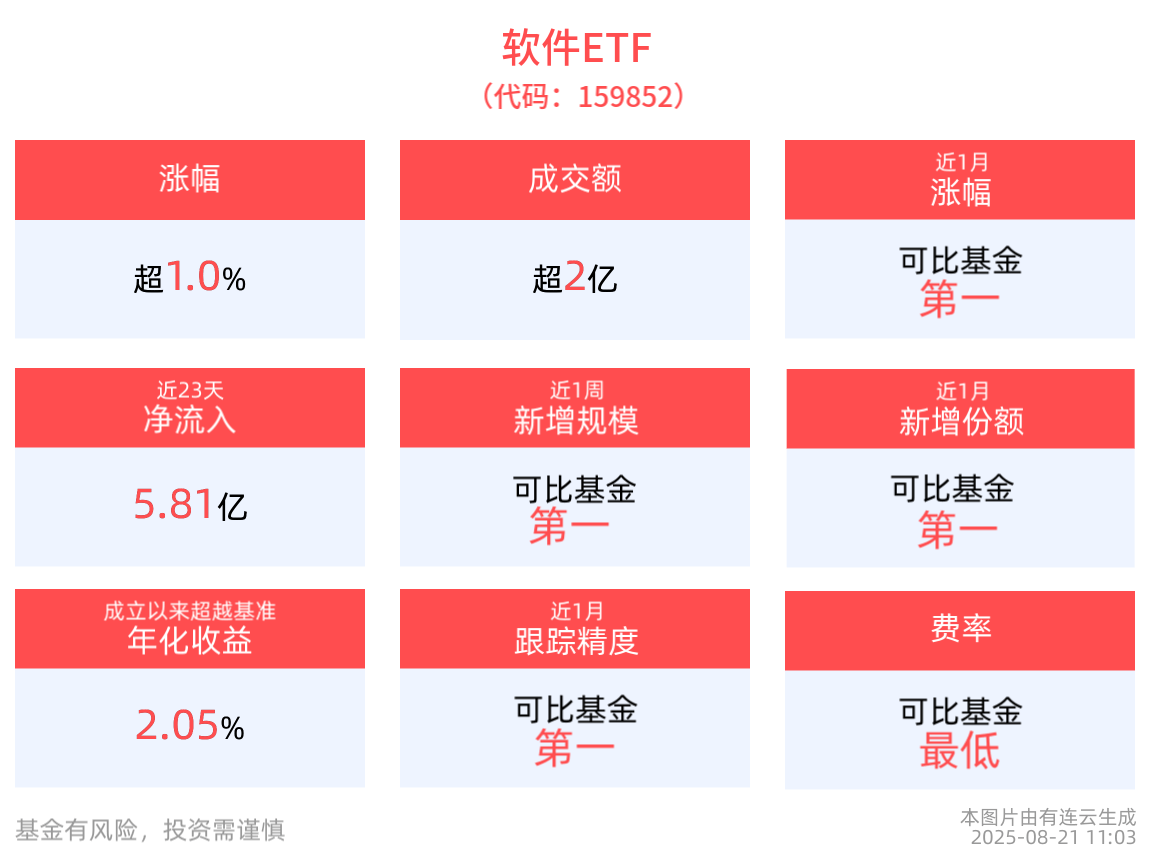
单日“吸金”超亿元,软件ETF(159852)盘中上涨1.08%,机构:预计中国软件市场规模年复合增长率达8%
Sou Hu Cai Jing· 2025-08-21 04:14
Group 1: ETF Performance - The software ETF has a turnover rate of 5.37% and a transaction volume of 285 million yuan [3] - Over the past week, the software ETF has seen an average daily transaction volume of 569 million yuan, ranking first among comparable funds [3] - The software ETF's scale increased by 23.98 million yuan in the past week, also ranking first among comparable funds [3] - The software ETF's share increased by 641 million shares in the past month, achieving significant growth and ranking first among comparable funds [3] - The latest net inflow of funds into the software ETF is 105 million yuan, with 13 out of the last 23 trading days showing net inflows totaling 581 million yuan [3] - As of August 20, the software ETF's net value has increased by 19.02% over the past three years [3] - The highest monthly return since the inception of the software ETF is 39.35%, with the longest consecutive monthly increase being three months and a maximum increase of 69.40% [3] - The average return in the months of increase is 9.75% [3] Group 2: AI Market Insights - According to Markets and Markets, the AI Agent market is projected to reach 5.1 billion USD in 2024 and 47.1 billion USD by 2030, with a compound annual growth rate (CAGR) of 44.8% [3] - For the Chinese market, the AI Agent market is expected to reach 147.3 billion yuan in 2024, with a penetration rate of less than 5%, and is projected to exceed 3.3 trillion yuan by 2028 [3] - Dongwu Securities indicates that AI is significantly transforming the computer and software development industry, moving from technology validation to large-scale application [4] - The Chinese software market is expected to exceed 3.5 trillion yuan by 2030, with a CAGR of 8%, driven by the acceleration of the digital economy and the demand for enterprise digital transformation [4] - AI is enhancing software development efficiency by 20%-30% through automated code generation, vulnerability detection, and performance optimization [4] - Natural language processing technology is promoting the widespread use of applications such as intelligent customer service and voice assistants [4] - AI technology is transitioning from a marginal tool to a core decision-making system, driving the industry towards efficiency and inclusivity [4] Group 3: Key Stocks and Investment Opportunities - As of July 31, 2025, the top ten weighted stocks in the CSI Software Service Index include iFLYTEK, Kingsoft Office, Tonghuashun, Hang Seng Electronics, Runhe Software, 360, Tuo Wei Information, Yonyou Network, Guiding Compass, and Softcom Power, collectively accounting for 61.39% of the index [4] - Investors can also consider the software ETF linked fund (012620) to capitalize on AI software investment opportunities [4]

指南针上涨6.45%,报132.32元/股
Jin Rong Jie· 2025-08-21 03:50
Group 1 - The stock price of Beijing Guiding Compass Technology Development Co., Ltd. increased by 6.45% on August 21, reaching 132.32 CNY per share, with a trading volume of 6.805 billion CNY and a turnover rate of 8.92%, resulting in a total market capitalization of 80.47 billion CNY [1] - The company specializes in the development of securities analysis software and securities information services, and has expanded into full-license securities businesses such as brokerage, proprietary trading, and asset management through the acquisition of Mai Gao Securities [1] - The company has built a digital financial technology service platform that integrates investment tools, intelligent trading, and wealth management, leveraging its strong R&D capabilities and data processing technology [1] Group 2 - As of March 31, the number of shareholders of Guiding Compass was 70,900, with an average of 8,326 circulating shares per person [2] - For the period from January to March 2025, the company achieved operating revenue of 542 million CNY, representing a year-on-year growth of 84.68%, and a net profit attributable to shareholders of 139 million CNY, reflecting a year-on-year increase of 725.93% [2]

涨超2%!金融科技ETF(516860)继续领跑,自去年924以来涨超152%
Ge Long Hui A P P· 2025-08-21 02:13
Group 1 - The A-share digital currency concept stocks have shown strong performance, with Tianyang Technology rising over 12% and Sifang Jingchuang increasing over 7%, contributing to a more than 2% rise in the Financial Technology ETF (516860), which has gained over 36% year-to-date [1] - Market sentiment has improved significantly, with the Shanghai Composite Index reaching new highs and trading volume exceeding 2 trillion yuan for six consecutive days. As of August 18, the margin trading balance has surpassed 2.1 trillion yuan, marking the first time in 10 years that it has crossed this threshold, with an increase of 281.24 billion yuan since the beginning of the second half of the year [1] - Historically, financial technology has been a leading sector in bull markets, with the Financial Technology ETF (516860) net asset value soaring over 152% since September 2022, ranking among the top three in the entire market [1] Group 2 - The Financial Technology ETF (516860) has attracted 726 million yuan in new investments in the second half of the year, bringing its total size to 1.814 billion yuan. The ETF covers various sub-sectors, including internet brokerage, financial IT, and mobile payments, combining the stability of finance with the growth potential of technology [1] - Key stocks in the Financial Technology ETF include industry leaders such as Dongfang Wealth, Tonghuashun, Hengsheng Electronics, Runhe Software, Guiding Compass, Newland, Donghua Software, Yinzhijie, Sifang Jingchuang, and Guangdian Yuntong [1] - According to Shenwan Hongyuan Securities, the short-term bull market sentiment is expected to continue dominating the market, with the core condition for a bull market being the cyclical improvement of the fundamental economy by mid-2026 and the potential initiation of a positive cycle of incremental capital [1]
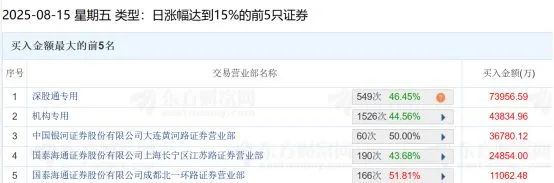
剖析新牛市的涨停板“敢死队”:游资打板收益与风险双向扩张
Mei Ri Jing Ji Xin Wen· 2025-08-20 12:53
Core Insights - The A-share market has undergone significant restructuring, particularly with differentiated daily price limits, which has notably altered the traditional speculative strategies of retail investors [1][3][10] Group 1: Market Dynamics - The emergence of new generation speculators, represented by "Chen Xiaoqun," has gained attention due to their frequent appearances on the trading leaderboard [2][4] - The expansion of daily price limits from 10% to 20% and 30% has transformed the market's volatility and the operational strategies of speculators [3][10][12] - The current market structure has led to a layered liquidity effect, attracting high-risk capital and resulting in rapid fluctuations in market activity [12][16] Group 2: Trading Strategies - Traditional trading strategies, such as the "limit-up" approach, have been challenged by the new price limit regime, necessitating adjustments in risk management and operational tactics [11][15] - The maximum theoretical daily profit potential has increased significantly under the new price limit rules, but so have the associated risks [13][14] - The success rate of speculative trading has decreased, with the average success rate for top trading seats being below 50% [8][10] Group 3: Speculator Behavior - Speculators are adapting their strategies in response to the new market conditions, moving from "confirmation on the board" to "pre-purchase points" and diversifying their tactics [15][16] - The credibility of rumored trading seats associated with well-known speculators is considered relatively high, as market participants closely monitor their activities [6][7] - Despite the potential for high returns, following the trades of speculators does not guarantee profits, as their trading patterns can be unpredictable [9][10]
中证500增强ETF(159678)跌0.64%,半日成交额266.76万元
Xin Lang Cai Jing· 2025-08-20 11:22
Core Viewpoint - The China Securities 500 Enhanced ETF (159678) experienced a decline of 0.64% as of the midday close on August 20, with a trading volume of 2.6676 million yuan [1] Group 1: ETF Performance - The China Securities 500 Enhanced ETF (159678) closed at 1.233 yuan, with a year-to-date return of 24.26% since its inception on February 13, 2023 [1] - The ETF's performance over the past month has been a return of 9.40% [1] Group 2: Major Holdings - Key stocks in the ETF include: - Shenghong Technology down 6.09% - Zhina Compass down 2.69% - Dongwu Securities down 0.97% - Nine Company down 0.48% - Light Media down 0.86% - Deepin Technology down 2.76% - Ruixin Micro up 2.60% - Changjiang Securities down 0.88% - Perfect World up 0.46% - Goldwind Technology down 0.19% [1]
牛市来了,但要小心
3 6 Ke· 2025-08-20 09:40
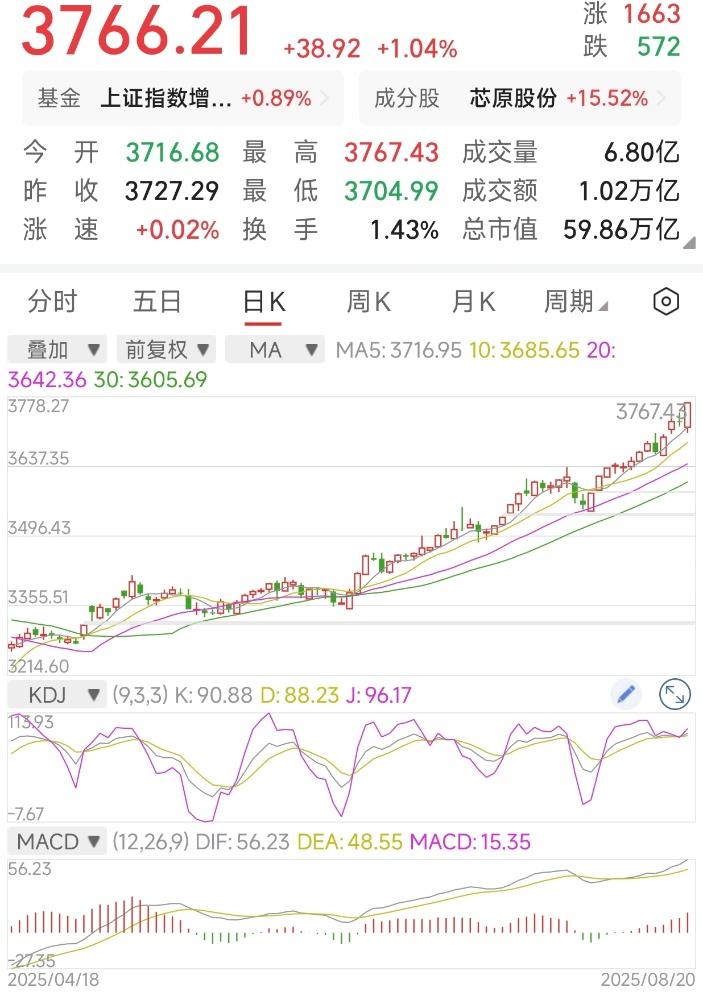
Core Insights - The A-share market is experiencing a significant rally, with the Shanghai Composite Index reaching a nearly ten-year high of 3767 points, driven by increased trading volumes and investor confidence [1][3][9] - A notable shift in capital flows is observed, with a decrease of 1.1 trillion yuan in household deposits and a rise of 2.14 trillion yuan in non-bank deposits, indicating a movement of savings into the stock market [1][9] - The total market capitalization of A-shares has surpassed 100 trillion yuan for the first time, reflecting strong market sentiment and participation [3][9] Market Performance - On August 20, the A-share market saw a total trading volume of 2.41 trillion yuan, maintaining high activity levels despite a slight decrease from August 18 [1] - The market is characterized by a broad-based rally, with over 3600 stocks rising and 86 stocks hitting the daily limit-up [6][9] - The financial sector has been a standout performer, with significant gains in key stocks such as Zhongjin and Tonghuashun, indicating strong investor interest [7][9] Economic and Policy Factors - The current bull market is supported by multiple favorable factors, including a steady recovery in the Chinese economy, improved export data, and supportive monetary policies from the central bank [9] - The People's Bank of China has maintained liquidity through measures such as interest rate cuts, which have encouraged investment in the stock market [9] - Global monetary easing, particularly anticipated rate cuts by the Federal Reserve, has made A-shares attractive to international investors [9] Historical Context - The recent surge in margin trading balances, which have exceeded 2 trillion yuan, draws comparisons to the 2015 bull market, but experts note significant differences in market conditions and regulatory environments [10][15] - Unlike the rapid and speculative nature of the 2015 market, the current environment is described as a "slow bull" with stricter controls on leverage, contributing to greater market stability [10][15] Investor Sentiment and Behavior - The current market enthusiasm is reminiscent of previous bull markets, with widespread optimism among retail investors and increased marketing efforts from brokerage firms [4][6] - However, there are warnings about potential risks associated with high valuations and increased leverage, which could lead to market volatility if sentiment shifts [12][15] - Investors are advised to maintain a rational approach, focusing on quality stocks and avoiding excessive speculation or leverage [15]
96.75亿元主力资金今日撤离计算机板块
Zheng Quan Shi Bao Wang· 2025-08-20 09:04
Market Overview - The Shanghai Composite Index rose by 1.04% on August 20, with 30 industries experiencing gains, led by the beauty and personal care sector at 2.42% and the petroleum and petrochemical sector at 2.36% [1] - The computer industry saw an increase of 0.58% [1] Capital Flow Analysis - The main capital flow showed a net outflow of 30.229 billion yuan across the two markets, with 10 industries experiencing net inflows [1] - The electronics industry had the largest net inflow of 5.522 billion yuan, with a daily increase of 2.32%, followed by the food and beverage sector with a net inflow of 2.494 billion yuan and a daily increase of 1.39% [1] Computer Industry Performance - Within the computer industry, there were 335 stocks, with 170 rising and 156 falling; 4 stocks hit the daily limit up while 1 hit the limit down [2] - The top net inflow stocks included Inspur Information with 2.275 billion yuan, followed by Unisplendour and Zhongke Shuguang with 507 million yuan and 407 million yuan respectively [2] - The top net outflow stocks included Huasheng Tiancheng with a net outflow of 1.369 billion yuan, followed by Runhe Software and Guiding Compass with 1.119 billion yuan and 804 million yuan respectively [2][3] Top Gainers in Computer Industry - The top gainers in the computer industry included: - Inspur Information: +10.01% with a turnover rate of 11.13% and a main capital flow of 2.275 billion yuan - Unisplendour: +5.76% with a turnover rate of 6.42% and a main capital flow of 507 million yuan - Zhongke Shuguang: +4.29% with a turnover rate of 6.90% and a main capital flow of 407 million yuan [2] Top Losers in Computer Industry - The top losers in the computer industry included: - Huasheng Tiancheng: -7.30% with a turnover rate of 43.97% and a main capital flow of -1.368 billion yuan - Runhe Software: -2.25% with a turnover rate of 16.67% and a main capital flow of -1.119 billion yuan - Guiding Compass: -1.78% with a turnover rate of 10.37% and a main capital flow of -804 million yuan [3]


最火游资不再是方新侠、章盟主、佛山无影脚?这名95后声名鹊起
Mei Ri Jing Ji Xin Wen· 2025-08-20 04:53
Group 1 - The emergence of a new generation of retail investors, particularly represented by Chen Xiaoqun, is notable in the context of the expanded daily price limit system in the A-share market [1][10][12] - The changes in the price limit system, from a traditional 10% to 20% and 30%, have significantly altered the trading strategies and risk profiles of retail investors [2][11][14] - The trading environment has become more volatile, with increased liquidity and a more complex market structure, leading to a "pulse-like" liquidity characteristic [11][12] Group 2 - The trading success rate of top retail investor seats has been relatively low, with an average success rate of around 42% to 44% in recent years, indicating that following these investors does not guarantee profits [9][12] - The new price limit system has led to a geometric increase in both potential returns and risks, with maximum theoretical daily returns rising significantly while maximum potential losses have also increased [11][13][14] - The strategies of retail investors are evolving in response to the new market conditions, with a shift from traditional methods to more diversified and quantitative approaches [14]