
美的集团

Search documents
中国家电板块 2026 展望:补贴相关消费调研显示不同品类需求分化-China Consumer Appliances Sector_ Outlook 2026_ Consumer survey on subsidies shows diverging demand across categories
2026-01-15 06:33
Summary of Key Points from the Conference Call Industry Overview - **Industry**: China Consumer Appliances Sector - **Outlook**: The major appliance sector is entering a post-subsidy downcycle in H225-27, with expectations of subdued domestic demand in H126 due to fading subsidy benefits. However, demand may stabilize in H226 and potentially turn around in 2027 [2][11]. Core Insights - **Domestic Demand**: Anticipated declines in shipments for air conditioners (AC), washing machines (WM), refrigerators, and range hoods by 5%, 2%, 4%, and 5% YoY respectively in 2026, as trade-in subsidies continue to impact the market [2]. - **Average Selling Price (ASP)**: Expected to remain stable in 2026, with potential product mix downgrades offset by industry-wide price hikes led by Midea due to rising copper prices [2][36]. - **Consumer Survey Findings**: A UBS Evidence Lab survey indicated limited upside in white goods demand for 2026, with a median household budget for home appliances expected to drop by 11% YoY, particularly in tier-1 cities where the decline is projected at 27% [3][27]. Export Challenges and Opportunities - **Exports**: Global white goods demand is projected to grow by 1.5% YoY in 2026, but Chinese exports of AC, WM, and refrigerators are expected to decline by 4.0%, 0.2%, and 4.3% YoY respectively. Exports to Europe and the US are likely to remain muted due to US tariffs and capacity relocation [4][16]. - **Emerging Markets**: There is potential for demand growth in emerging markets and the US, particularly with lower interest rates [4][16]. Stock Recommendations - **Buy Ratings**: Midea, Haier, Hisense, and Roborock are recommended for their potential to consolidate market share and grow margins through price hikes. Midea is favored for its overseas demand exposure, Haier for its margin upside from US rate cuts, and Roborock as a beneficiary of trade-in subsidies [5][10]. - **Sell Rating**: Gree is viewed as vulnerable to domestic headwinds [5]. Earnings Forecast Adjustments - **Earnings Forecasts**: Adjustments made due to lower-than-expected domestic appliance sales and rising raw material prices, particularly copper. Price targets for major appliance companies have been revised upwards as valuations are rolled forward to 2027 [7][8]. Consumer Behavior Insights - **Purchase Intentions**: The survey revealed a decline in purchase intentions across most categories, with notable increases for TVs and cleaning appliances. The largest declines were seen in AC and WM, likely due to prior subsidy usage [3][27]. - **RVC Market**: Purchase intentions for leading robot vacuum cleaner brands (Ecovacs, Roborock, Dreame) have increased, indicating a shift towards these products due to improved affordability and consumer education [3][44]. Additional Insights - **Subsidy Impact**: The impact of trade-in subsidies has been significant, with 128 million units purchased in 2025. However, the demand pull-forward effect suggests limited upside for 2026 [19][26]. - **Market Trends**: The importance of smart features and integration with smart home platforms is rising among consumers when selecting RVCs, indicating a trend towards more technologically advanced products [45]. This summary encapsulates the key points from the conference call, highlighting the current state and future outlook of the China consumer appliances sector, along with consumer behavior trends and stock recommendations.





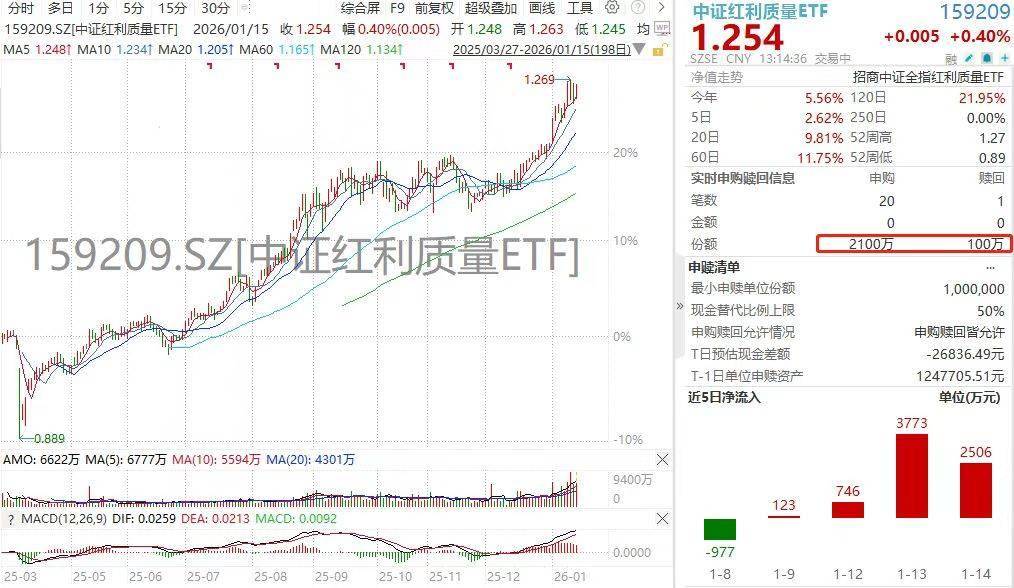
不愧是A股红利涨幅王!中证红利质量ETF(159209)逆市走强,山金国际、中国神华逆市红盘
Sou Hu Cai Jing· 2026-01-15 05:33
Core Insights - The A-share market is experiencing a weak consolidation, with the China Securities Dividend Quality ETF showing a counter-trend increase of 0.40% despite declines in major stocks [1] - The fund has seen a continuous net inflow for five days, indicating sustained investor interest [1] Group 1: Market Performance - As of January 15, the China Securities Dividend Quality ETF (159209) has outperformed the market with a 0.40% increase, while major stocks like Kweichow Moutai and 37 Interactive Entertainment have seen declines of 0.11% and 0.64% respectively [1] - The fund has attracted approximately 25 million in net inflows during the trading session, reflecting strong market interest [1] Group 2: Fund Strategy and Recognition - The China Securities Dividend Quality Total Return Index achieved a remarkable 20.36% increase in 2025, leading among similar A-share dividend indices [3] - The fund's recent approval for a linked fund and its inclusion as a margin trading product by the Shenzhen Stock Exchange enhances its liquidity and participation depth [3] - The "Dividend Quality" strategy focuses on high dividend and high profitability quality companies, effectively avoiding traditional high dividend "value traps" [3] - The fund offers a competitive fee structure of "0.15% + 0.05%" and a monthly dividend assessment mechanism, providing unique advantages in long-term cost and cash flow experience [3]


广货行天下 行出个“广东智造”的海阔天空
Nan Fang Du Shi Bao· 2026-01-15 04:53
Group 1 - The "Guangdong Goods Going Global" spring event was launched on January 15, featuring over 1,300 local home appliance companies, showcasing high-quality products and conducting live-streaming sales [1][2] - The event highlights the importance of the home appliance industry in Guangdong's traditional advantages, emphasizing the ambition for intelligent upgrades and renewal in "Guangdong Manufacturing" [2][4] - The initiative represents a digital evolution of the long-standing practice of sourcing goods from Guangdong, with over 30 key activities involving more than 6,000 enterprises across various sectors [3] Group 2 - Guangdong is recognized as a manufacturing powerhouse, with a robust industrial base and a vast consumer market, which allows for the continuous transformation of supply advantages into market strengths [2][4] - The event serves as a platform for real-time consumer engagement, showcasing innovative products and technologies, thus enhancing the purchasing experience [3][4] - Guangdong's manufacturing capabilities extend beyond traditional goods, with significant contributions to emerging sectors such as biomanufacturing, low-altitude economy, and humanoid robotics [4]
广东制造爆款频出,董明珠们点赞“广货行天下”
Sou Hu Cai Jing· 2026-01-15 04:43
Core Viewpoint - The article emphasizes the importance of quality in both consumer and corporate life, highlighting the robust quality awareness ingrained in Guangdong's manufacturing culture [1]. Industry Overview - Guangdong produces one out of every three smartphones sold globally, with the Greater Bay Area's smart home appliance industry accounting for approximately 30% of the global market [2]. - By November 2025, Guangdong's home appliance exports are expected to represent nearly half of the national total [2]. Historical Context - The "Four Great Kings" of Guangdong, which include traditional products like "Pearl River Water, Guangdong Grain, Lingnan Clothing, and Cantonese Home Appliances," have evolved significantly since the 1980s [3]. Current Industry Developments - "Pearl River Water" now symbolizes Guangdong's extensive trade logistics, with cross-border e-commerce import and export volume increasing 66 times over nine years, holding over one-third of the national market share [4]. - The food industry in Guangdong aims to exceed 1.5 trillion yuan in output value by 2027, with Cantonese mooncakes accounting for 75% of national production and 90% of exports [4]. - Guangdong's clothing and home appliance sectors are innovating in smart wearables and smart home technologies, with 40% of global smartphones and 70% of consumer drones labeled as "Made in Guangdong" [5]. Ecosystem and Supply Chain - Guangdong's manufacturing ecosystem is characterized by deep collaboration and a complete industrial chain, enabling rapid product development and delivery [8]. - In the textile and apparel sector, a micro-ecosystem in Guangzhou allows for clothing production from design to delivery in as little as one day [8]. - The consumer electronics sector benefits from a "one-hour industrial circle" around Dongguan, facilitating efficient assembly of over 95% of smartphone components [8]. Innovation and Technology - The article discusses a transformation in Guangdong's manufacturing driven by AI and user experience, with companies like Gree and Skyworth leading the charge in smart technology integration [12][13]. - The shift in mindset from "what I can produce" to "how I can serve your needs" is highlighted as a key factor in enhancing product offerings [13]. Market Expansion Initiatives - The "Guangdong Goods Going Global" initiative aims to enhance market access for over 6,000 enterprises across various sectors, supported by major e-commerce platforms [15]. - The initiative employs a model of "government support, platform assistance, and enterprise participation," promoting products through cultural integration [15]. Future Outlook - Experts suggest that Guangdong's manufacturing must enhance its brand image and focus on high-value products to compete globally [20][22]. - The importance of leveraging traditional Lingnan culture for creative inspiration in product development is emphasized, alongside the need for technological innovation [22].

“广货行天下”春季行动首站走进佛山,全力托举家电销售
2 1 Shi Ji Jing Ji Bao Dao· 2026-01-15 04:22
Core Viewpoint - The "Guangdong Goods Going Global" spring action has been launched to enhance the visibility and market influence of high-quality Guangdong products, particularly in the home appliance sector, aiming for breakthroughs in online sales and long-term brand building [1][2]. Group 1: Event Overview - The event was co-hosted by various provincial departments and the Foshan municipal government, marking the start of a large-scale online promotion campaign for 2026 [1]. - The home appliance sector is the first focus of this initiative, with plans to expand to other advantageous industrial clusters in Guangdong [1]. Group 2: Participation and Innovation - Major e-commerce platforms like Taotian, Vipshop, and Xinxuan announced plans to create dedicated sections for "Guangdong Goods," showcasing quality products and providing promotional support through data-driven marketing [2]. - The event featured an innovative "live demonstration area," where over 30 leading Guangdong home appliance companies showcased their products through live streaming, enhancing consumer engagement and sales [2]. Group 3: Supporting Policies - Foshan's broader "Warm Winter Shopping Season" initiative aligns with national and provincial policies to stimulate consumption, including a "trade-in" program and local promotional activities, creating a synergistic effect with the spring action [2].
成交额超116亿,A500ETF基金(512050)交投活跃,机构称阶段性调整有助于行情延续
Xin Lang Cai Jing· 2026-01-15 03:54
Group 1 - The core viewpoint of the news highlights the strong performance of the A-share market, with significant trading activity and a notable increase in the A500 ETF fund's scale [1][2] - The A500 index has shown a slight increase of 0.01%, with several constituent stocks like Guanglianda and Wolong Nuclear Materials rising by over 10% [1] - The A500 ETF fund has experienced a substantial growth of 165.61 billion yuan in scale over the past month, indicating a robust market interest [1] Group 2 - The A500 index tracks 500 large-cap, liquid securities across various industries, reflecting the overall performance of representative listed companies [2] - As of December 31, 2025, the top ten weighted stocks in the A500 index account for 20.33% of the index, including major companies like Ningde Times and Kweichow Moutai [2] - The A500 ETF fund has several related products, including various connection funds and enhanced index funds, indicating a diverse investment offering [2]
沪深300ESGETF(561900)跌0.30%,半日成交额68.32万元
Xin Lang Cai Jing· 2026-01-15 03:42
Core Viewpoint - The performance of the CSI 300 ESG ETF (561900) shows a slight decline, indicating market volatility and mixed performance among its major holdings [1] Group 1: ETF Performance - As of the midday close on January 15, the CSI 300 ESG ETF (561900) decreased by 0.30%, trading at 0.995 yuan with a transaction volume of 683,200 yuan [1] - Since its inception on July 6, 2021, the fund has returned -0.23%, while its return over the past month is 3.39% [1] Group 2: Major Holdings Performance - Among the major stocks in the CSI 300 ESG ETF, Kweichow Moutai fell by 0.47%, CATL increased by 0.01%, and China Merchants Bank rose by 0.37% [1] - Other notable movements include Zhongji Xuchuang down by 1.07%, Changjiang Electric up by 0.30%, Midea Group up by 0.71%, BYD down by 0.32%, Industrial Bank down by 0.10%, and Heng Rui Pharmaceutical down by 1.37% [1]





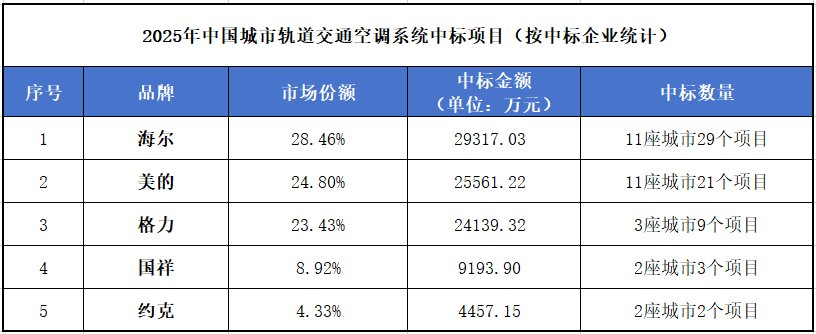
海尔、格力、美的包揽中国城轨空调超7成市场
Xin Lang Cai Jing· 2026-01-15 03:32
Core Insights - The report reveals that Haier, Midea, and Gree dominate the Chinese urban rail air conditioning market, collectively holding over 76% market share, indicating a significant shift from foreign brands that were once prominent in this sector [1][2]. Market Share and Bidding Data - Haier holds a market share of 28.46%, with a winning bid amount of 29,317.03 million yuan across 29 projects in 11 cities [2] - Midea follows with a 24.80% market share and a bid amount of 25,561.22 million yuan for 21 projects in 11 cities [2] - Gree has a market share of 23.43%, securing 24,139.32 million yuan in bids for 9 projects in 3 cities [2] - Other brands like Guoxiang and York hold smaller shares, with Guoxiang at 8.92% and York at 4.33% [2] Historical Context - Initially, foreign brands dominated the urban rail air conditioning market in China, starting from the first Beijing subway line in 1965, with local brands just beginning to emerge in the 1990s [2][3]. - Haier's breakthrough came in 2005 when it won a bid for the Guangzhou Metro Line 3, marking the end of foreign brand monopoly [3]. Competitive Landscape - Chinese brands have developed unique strategies: Midea focuses on high-efficiency systems and smart controls, while Gree emphasizes the localization of core components [5]. - Other specialized brands like Guoxiang and Shenling have established technical barriers in niche markets, contributing to a multi-layered competitive landscape among Chinese brands [5]. Future Outlook - The competition is shifting from a focus on foreign versus domestic brands to how Chinese brands can innovate in greener and smarter technologies, driving sustainable development in urban rail transportation both in China and globally [5].
2025年1-11月中国房间空气调节器产量为24536.1万台 累计增长1.6%
Chan Ye Xin Xi Wang· 2026-01-15 03:29
Group 1 - The core viewpoint of the article highlights the decline in the production of room air conditioners in China, with a significant year-on-year decrease of 23.4% in November 2025 [1] - The cumulative production of room air conditioners from January to November 2025 reached 24,536.1 million units, reflecting a modest growth of 1.6% compared to the previous year [1] - The article references a report by Zhiyan Consulting that analyzes the market status and development prospects of the air conditioning industry in China from 2026 to 2032 [1] Group 2 - Listed companies in the air conditioning sector include Gree Electric Appliances (000651), Midea Group (000333), Haier Smart Home (600690), Hisense Home Appliances (000921), TCL Technology (000100), and Harbin Air Conditioning (600202) [1] - The data source for the production statistics is the National Bureau of Statistics, with the information compiled by Zhiyan Consulting [2]

恒生科技、港股通科技走势分化,阿里宣布千问更新,百度筹备“入通”
Mei Ri Jing Ji Xin Wen· 2026-01-15 03:08
Group 1 - The Hong Kong stock market showed strong performance in the real estate and financial sectors, while the Hang Seng Technology Index exhibited mixed trends [1] - Leading gainers among Hang Seng Technology constituents included BYD, Sunny Optical Technology, Horizon Robotics, Li Auto, Midea Group, BYD Electronics, and Haier Smart Home [1] - Ctrip's stock price adjusted due to an antitrust investigation, with the company stating it will actively cooperate with regulatory authorities [1] Group 2 - Alibaba announced that its AI application, Qwen, will be fully integrated into its ecosystem, including Taobao, Alipay, and other services, allowing users to order food and book flights with AI [1] - Baidu's stock rose over 1% as it considers upgrading its secondary listing in Hong Kong to a "dual primary listing" to attract mainland capital [1] - The Hang Seng Internet ETF focuses on major Hong Kong internet companies, with expectations that the impact of the "subsidy war" on profitability may gradually diminish, leading to stronger performance driven by AI application commercialization [2]