
光迅科技

Search documents
重磅!2025年中国光模块行业政策汇总及解读(全)
Qian Zhan Wang· 2026-02-04 07:11
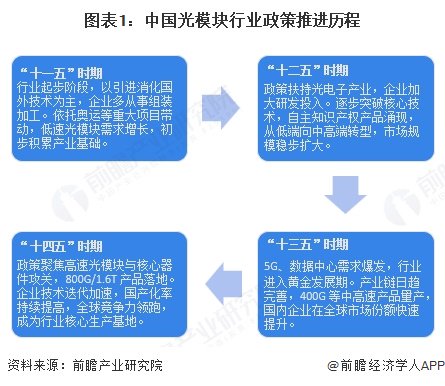
Core Insights - The Chinese optical module industry has evolved from technology introduction during the "11th Five-Year Plan" to achieving technological independence, product upgrades, and scale expansion, becoming a core player in the global optical module market during the "14th Five-Year Plan" period, focusing on high-end and domestic production driven by 5G and computing power demands [1] National Policy Summary - Recent policies in China show a collaborative effort between national and local governments, focusing on technological breakthroughs and practical applications in the optical module industry. The Ministry of Industry and Information Technology (MIIT) has issued multiple documents, including the "2025-2026 Action Plan for Stable Growth in the Electronic Information Manufacturing Industry," which aims to promote the trial of 10G optical networks and the layout of computing power infrastructure [4][5] - Key areas of focus include integrating CPO (Co-Packaged Optics) and high-speed optical modules into critical technological breakthroughs, supporting the mass production of products like 800G and 1.6T [4][5] Provincial Policy Summary - Various provinces have developed their own policies aligned with the national "14th Five-Year Plan," emphasizing the development of optical communication, millimeter-wave, 5G enhancement, and quantum communication technologies. Local governments are also providing funding support for core technology research and development [13] - For instance, Beijing's policies include promoting advanced packaging technology for 1.6T silicon optical modules and enhancing broadband network capabilities to support user experiences exceeding 100 Mbps by 2025 [14] - Shanghai's initiatives focus on deploying 50G PON and 400G optical transmission technologies, aiming to create a fully optical direct connection network for data centers [17] Industry Development Trends - The optical module industry is expected to see significant growth driven by the increasing demand for high-speed data transmission in AI, industrial internet, and other applications. Policies are encouraging the development of high-reliability, low-power products suitable for industrial scenarios [4][5] - The goal is to enhance the domestic production rate of key components and technologies, with specific targets set for the market share of domestic CPO modules to reach 40% by 2025 [5][6] Investment Opportunities - The ongoing policy support and technological advancements present substantial investment opportunities in the optical module sector, particularly for companies involved in high-speed optical modules and related technologies. The focus on domestic production and technological independence further enhances the attractiveness of this sector for investors [1][4][5]





国内外AI年报分析展望




2026-02-04 02:27
Summary of the Conference Call on AI Annual Report Analysis Industry Overview - The conference focused on the analysis and outlook of AI annual reports, particularly in the TMT (Technology, Media, and Telecommunications) sector, with a specific emphasis on domestic and international AI companies [1][2][4]. Key Points and Arguments General Market Sentiment - The period from October 31 to March is characterized as a performance vacuum, where the focus is on thematic investments rather than immediate earnings results [2][3]. - The spring market is expected to see a resurgence, with significant activity anticipated around March [3][4]. North American Companies - North American companies, particularly those involved in AI and cloud computing, have reported earnings that exceeded expectations, indicating strong capital expenditure in AI [4][6]. - Companies like Microsoft and Meta have shown robust spending on AI infrastructure, reflecting a positive outlook for the sector [4][6]. - Despite some domestic companies underperforming, their stock prices have rebounded, suggesting that market sentiment is more focused on thematic trends rather than immediate earnings [5][6]. Domestic AI Companies - Domestic AI companies are experiencing a supply-demand imbalance, with strong demand for AI-related products and services, despite some companies reporting earnings below expectations [6][7]. - The industry is characterized by a shortage of materials and components, which is driving prices up and creating a favorable environment for growth [6][7][10]. Future Growth Projections - There is a consensus that the growth trajectory for AI companies will continue to be strong, with expectations for significant growth in 2026 and beyond [8][9]. - Many companies are currently undervalued, trading at price-to-earnings (P/E) ratios between 15x to 20x, which presents a potential investment opportunity [8][9]. Specific Company Insights - Companies like Wan, Tianfu Communication, and others are highlighted for their potential despite recent earnings misses, as the overall industry outlook remains positive [4][6][7]. - The demand for GPUs and AI chips is expected to remain high, with domestic companies like Cambrian facing challenges but still showing potential for recovery [9][10]. Application and Innovation - The conference emphasized the importance of AI applications, particularly in gaming and media, with companies like Tencent and ByteDance leading the charge [14][15]. - The emergence of AI-driven applications is seen as a significant growth area, with expectations for increased investment and innovation in this space [14][15]. Regulatory and Market Concerns - There are concerns regarding potential regulatory impacts on the gaming industry, but these are largely viewed as unfounded and not likely to affect the overall market significantly [15][16]. - The market is currently experiencing volatility, but analysts suggest that this presents buying opportunities for fundamentally strong companies [21][22]. Additional Important Insights - The conference highlighted the importance of monitoring capital expenditure trends among major tech companies, as this will influence the demand for AI infrastructure and services [36][37]. - The potential for new technologies, such as diamond-based cooling materials for semiconductors, was discussed as a future growth area [24][25]. - Analysts recommend focusing on companies with strong fundamentals and growth potential, particularly in the AI and semiconductor sectors, as the market continues to evolve [22][23][39].
2025年中国光电子器件产量为19233.9亿只(片、套) 累计增长8.8%
Chan Ye Xin Xi Wang· 2026-02-03 03:07
Core Viewpoint - The report by Zhiyan Consulting highlights the trends and forecasts for the optoelectronic device industry in China from 2026 to 2032, indicating a slight decline in production in December 2025 but an overall growth in annual production for the year [1] Group 1: Industry Overview - In December 2025, China's optoelectronic device production reached 173.3 billion units, reflecting a year-on-year decrease of 0.6% [1] - For the entire year of 2025, the cumulative production of optoelectronic devices in China was 1,923.39 billion units, showing a cumulative growth of 8.8% [1] Group 2: Market Research and Insights - Zhiyan Consulting is recognized as a leading industry consulting firm in China, specializing in in-depth industry research reports, business plans, feasibility studies, and customized services [1] - The firm emphasizes its commitment to providing comprehensive industry solutions to empower investment decisions through professional insights and quality services [1]






趋势研判!2026年中国光通信测试仪器市场政策、产业链全景、发展现状及未来发展趋势分析:发展动能持续强劲,2029年规模将突破65.9亿元[图]
Chan Ye Xin Xi Wang· 2026-02-03 01:15
Core Insights - The optical communication testing instruments are essential tools for ensuring the efficient operation of fiber optic communication systems, supported by national policies as a strategic emerging industry [1][5] - The global electronic measurement instrument market is projected to grow from $10.08 billion in 2020 to $12.93 billion by 2024, with China's market expected to increase from ¥23.85 billion to ¥35.38 billion during the same period [8] - The optical communication testing instruments market is driven by the growth in data traffic and demand for optical modules, with the global market expected to rise from $0.95 billion in 2024 to $2.02 billion by 2029, and China's market projected to grow from ¥3.30 billion to ¥6.59 billion [10][11] Industry Overview - Optical communication testing instruments are specialized electronic devices used to measure, analyze, and verify the performance of fiber optic communication systems, ensuring transmission quality and reliability throughout the product lifecycle [1][4] - These instruments can be categorized by core functions, testing objects, form factors, and technical principles, catering to various testing needs in the optical communication sector [1][3] Development Background - The optical communication testing instruments have been included in national strategic emerging industries and key core technology initiatives, supported by a comprehensive policy framework aimed at fostering technological innovation and market application [5][6] Market Trends - The optical module market, which is crucial for optical communication systems, is expected to see significant growth, with data centers becoming the primary application scenario, leading to accelerated iterations of optical modules [13] - The industry is anticipated to evolve towards high-end technology, domestic independence, and diversified application scenarios, with a focus on upgrading testing capabilities and breaking reliance on imports [14][15][16] Industry Chain - The optical communication testing instruments industry chain consists of upstream core components, midstream testing instrument manufacturing, and downstream applications, with domestic companies making strides in increasing their market share [11][12] Future Outlook - The industry is expected to focus on high-speed and intelligent technology iterations, with an emphasis on automation and precise diagnostics, while also pushing for domestic innovation in core components [14][15] - The expansion of application scenarios and the transformation of business models towards integrated solutions will open new growth opportunities for the industry [16]

在“好设计”上下功夫,让新房旧屋都变成“好房子”
Xin Lang Cai Jing· 2026-02-02 12:51
三代同堂家庭如何实现差异化的居住需求?老旧房屋如何通过设计更新提升现代居住体验?怎样的设计 能助力老年人安心"原居养老"?在近日举办的全国"好房子"设计大赛成果发布会上,一系列创新方案给 出了回答。 记者在设计大赛一等奖作品"新三代同堂之家"中看到,针对约140平方米的住宅,设计者提出了全新 的"生活圈"理念,打破了传统房间布局,规划了通透有趣的小孩空间、安全适老休闲的老年人空间等。 同时,明厨明卫、南北通透的公共区域串联整体,可分可合可融的玄关设计有机连接小家庭与大家庭, 创造了既独立又紧密联系的家庭互动模式。 "设计打破了以往每个房间只是一张床、一间房的概念,提出一个'生活圈'的概念,重新定义'新三代同 堂之家'。"中机国际工程设计研究院有限责任公司副总建筑师万飞说,通过深度洞察三代人在隐私、情 感、生活习惯等方面的不同诉求,传统住宅中不同代际成员动线交错、采光通风不足、功能适配性弱等 痛点得到有效解决。 立足人民群众多样化居住需要,由住房城乡建设部主办的全国"好房子"设计大赛,以"为人民而设计 ——更好的房子、更美的生活"为主题,设置了新建住房和既有住房更新改造2个方向的赛题,获奖作品 正在北京首钢国际 ...
研判2026!中国光通信芯片行业壁垒、产业链、产量、需求量、市场规模、竞争格局及研发趋势:市场将保持快速增长,国产化率水平提高[图]
Chan Ye Xin Xi Wang· 2026-01-30 01:25
Core Viewpoint - The optical communication chip market in China is experiencing continuous growth driven by advancements in artificial intelligence, data center expansion, consumer electronics, and 5G deployment, with significant increases in production and demand projected for the coming years [1][4]. Industry Definition and Classification - Optical communication chips are defined as chips that enable the conversion of optical and electrical signals and are essential for the transmission of optical communication signals [1][3]. - These chips can be categorized into laser chips and detector chips, with further classifications based on their emission structure [1][3]. Current Industry Status - The global demand for optical communication chips is surging due to the rapid development of new information technologies such as mobile internet, 5G, and cloud computing [4]. - In China, the demand for optical communication chips is expected to reach 1.198 billion units by 2024, with a market size of 15.16 billion yuan, and further growth is anticipated in subsequent years [4][5]. Market Size and Growth Projections - By 2024, China's optical communication chip production is projected to grow to 867 million units, with demand reaching 1.198 billion units and a market size of 15.16 billion yuan [1][4]. - The market size is expected to increase to approximately 16.02 billion yuan by 2025, with continued rapid growth anticipated through 2026 [1][4]. Industry Chain - The optical communication chip industry chain consists of upstream materials and equipment, midstream chips and modules, and downstream application markets, with a focus on domestic production and high-speed upgrades [5][6]. Industry Barriers - The optical communication chip industry faces high entry barriers due to significant capital investment, core technology accumulation, and brand recognition, with a strong reliance on intellectual property protection [5][6]. Competitive Landscape - China is becoming a significant player in the global optical communication chip market, with several domestic companies, such as Huagong Technology and Guangxun Technology, leading in technology and production capacity [5][6]. - The market share of Chinese optical communication chip manufacturers is increasing, with notable advancements in high-speed optical communication chips [5][6]. Research and Development Trends - Future trends in optical communication chip development include green communication, silicon photonics technology, and photonic integrated circuit (PIC) technology, which are expected to drive innovation and efficiency in the industry [12][14][16]. - The focus on large-capacity transmission and all-optical networks is also highlighted as key areas for future development [16][17].






苏超新赛季:“泼天的流量”能否再续?
2 1 Shi Ji Jing Ji Bao Dao· 2026-01-29 08:44
Core Insights - The 2026 Jiangsu Province Urban Football League (referred to as "Su Super") is set to continue the momentum generated by its inaugural season in 2025, with a strong lineup of sponsors and heightened public interest [1][2]. Sponsorship and Financial Aspects - The 2026 season has attracted 24 sponsors, including notable brands such as Jiangsu Bank, Suhao Holding Group, Heineken, Adidas, and Ant Financial, showcasing a robust sponsorship portfolio [1][2]. - The total sponsorship amount for the 2026 season was previously reported to exceed 202 million yuan, although this figure is subject to confirmation due to pending agreements [2]. Audience Engagement and Popularity - The inaugural season of Su Super saw significant audience engagement, with a total attendance of 2.43 million across 85 matches, averaging 28,000 spectators per match, and online viewership reaching 2.2 billion [3]. - The league has generated a cultural phenomenon, with various social media trends and memes emerging from the matches, indicating a strong community connection [3][5]. Socioeconomic Context - The success of Su Super is attributed to the unique competitive spirit among the 13 cities in Jiangsu, which has historical and cultural significance, fostering a sense of rivalry and community pride [4][5]. - The league's rapid growth in sponsorship and popularity is also linked to the local government's effective governance and ability to connect with surrounding industries [4]. Changes and Innovations for the New Season - The 2026 season will introduce a new competition format, including a total of 91 matches, with a shift from single-elimination to two-legged knockout rounds in the playoffs, enhancing the competitive excitement [7]. - The league will also expand its sponsorship model to include small and micro enterprises, allowing them to participate alongside larger brands, which has been positively received by the public [8]. Broader Implications and Future Prospects - The success of Su Super has inspired other regions to replicate its model, although experts suggest that each area must leverage its unique cultural and social dynamics to achieve similar success [9].



中原证券:光模块上游关键物料供应持续紧张 行业头部大客户率先转向硅光方案
智通财经网· 2026-01-29 08:05
Core Insights - The report from Zhongyuan Securities indicates that China's optical module exports are projected to total 37.46 billion yuan in 2025, reflecting a year-on-year decline of 15.6% [1][3] - CignalAI forecasts that the total shipment of high-speed optical modules (400G and above) will reach 42 million units in 2025, with a compound annual growth rate (CAGR) exceeding 20% for the optical module market from 2024 to 2029 [1][3] - The supply of key materials in the optical communication industry, particularly optoelectronic chips, remains tight, which is expected to constrain market growth until the end of 2026 [3] Optical Module Market - The total export value of optical modules from China in December 2025 showed a slight year-on-year decrease of 0.5% [3] - In the first eleven months of 2025, the telecommunications business revenue reached 1.6096 trillion yuan, marking a year-on-year increase of 0.9% [1] - Major telecom operators are focusing on key sectors such as industrial manufacturing, digital government, healthcare, education, and energy, leveraging the integration of cloud and network technologies [1] Key Companies and Recommendations - Companies to watch in the optical chip/device/module sector include: - SourceJ Technology (688498.SH) - Shijia Photon (688313.SH) - Tianfu Communication (300394.SZ) - Taicheng Light (300570.SZ) - Zhongji Xuchuang (300308.SZ) - New Yisheng (300502.SZ) - Guangxun Technology (002281.SZ) - Huagong Technology (000988.SZ) [4] - In the optical fiber and cable sector, domestic manufacturers are expected to gain more market share due to technological and cost advantages [4] - For AI smartphones, companies such as Xinwei Communication (300136.SZ) and ZTE Corporation (000063.SZ) are recommended [4] - Telecom operators to consider include China Mobile (600941.SH), China Telecom (601728.SH), and China Unicom (600050.SH) [4]

F5G概念板块领涨,上涨2.54%
Di Yi Cai Jing· 2026-01-28 10:22
Group 1 - The F5G concept sector leads the market with an increase of 2.54% [1] - Among the top performers, Hengtong Optic-Electric rose by 8.04%, Tefa Information increased by 6.8%, and Changxin Bochuang grew by 6.69% [1] - Other companies such as Fenghuo Communication, Zhongji Xuchuang, and Guangxun Technology also saw gains exceeding 2% [1]
继续看多商业航天与AI产业
2026-01-28 03:01
Summary of Conference Call Notes Industry and Company Focus - The conference call primarily discusses the **AI industry** and **commercial aerospace** sector, with a specific emphasis on **Agent technology** and **multi-modal applications**. Key Points and Arguments AI Industry and Agent Technology 1. The call emphasizes a bullish outlook on the **AI industry** and **commercial aerospace**, particularly focusing on the **Agent** sector and its potential impact on various industries [1][2]. 2. Recent product iterations in the **Agent** space, such as **Automic's Skills** and **Minimax's Agent 2.0**, indicate a significant acceleration in product development and capabilities [2][3]. 3. The evolution of **Agent technology** is moving from single-task completion to handling complex tasks and cross-application operations, suggesting that Agents may become the core of the next-generation operating systems [3][4]. 4. The interaction paradigm is shifting from programming languages to natural language, indicating a fundamental change in how users will interact with computers [4][5]. 5. Recent funding rounds for vertical-specific Agents, such as AI intelligence platforms, show a growing interest and investment in this area, with valuations reaching **$50 million** for some startups [5][6]. Product Developments and Market Trends 6. Products like **CoWork** and **Minimax's Agent 2.0** are designed to enhance workflow integration, showcasing the trend towards human-machine collaboration [7][8]. 7. The **Agent** products are expected to evolve to include capabilities for automatic perception and proactive responses, enhancing their utility in various applications [9][10]. 8. The future of **Agent technology** is projected to include multi-agent systems that can collaborate and self-iterate, as well as expand into physical interactions through robotics [11][12]. Multi-Modal Applications 9. The call highlights the importance of **multi-modal** capabilities, with companies like **ByteDance** and **Kuaishou** making significant advancements in this area, leading to increased user engagement and revenue growth [13][14]. 10. The **multi-modal** products are addressing industrial challenges and enhancing the consistency and effectiveness of generated content, which is expected to drive further adoption [14][15]. 11. The **AI industry** is anticipated to see a surge in demand for **multi-modal** applications, particularly in the realm of AI-generated content, such as **AI comics** and videos [16][17]. Investment Opportunities 12. Investment focus areas include: - Large tech companies involved in **CapEx** and ecosystem investments. - Companies in the **Agent** space focusing on digital governance and vertical applications, such as **Kingdee International** and **Dingjie Smart** [19][20]. - Cloud service providers and chip manufacturers, particularly those involved in private cloud deployments and AI applications [20][21]. 13. The **satellite communication** sector is highlighted as a key growth area, particularly with advancements in **LEO satellites** and laser communication technologies, which are expected to address latency and bandwidth issues [22][23]. 14. The market for satellite communication is projected to reach **$83 billion** by 2023, with significant contributions from companies like **SpaceX** and their **Starlink** project [24][25]. Conclusion 15. The call concludes with a strong recommendation to focus on the **Agent** and **multi-modal** sectors for investment, as they are expected to drive significant changes in both B2B and B2C software landscapes [26][27].