
光通信芯片

Search documents
公司问答丨长光华芯:通过全资子公司出资成立苏州星钥光子科技有限公司,已提前布局这下一代技术路线,预计今年年底完成通线
Ge Long Hui A P P· 2026-02-26 08:48
Core Viewpoint - The company emphasizes its role in the transition of the optical communication industry from "electric-dominated" to "light-dominated" due to advancements in silicon photonic integration technology [1] Industry Summary - Silicon photonic integration is driving the optical communication sector to overcome the limitations of Moore's Law by replacing electrical signals with optical ones, which supports exponential growth in AI computing power [1] - The evolution of next-generation technologies such as 3.2T modules and quantum optical chips is expected to deeply integrate with the global digitalization process, establishing silicon photonic integration as an irreversible technological trend in optical communication [1] Company Summary - The company has proactively invested in the next-generation technology route by establishing a wholly-owned subsidiary, Suzhou Xingyao Photonic Technology Co., Ltd., which is expected to complete its line by the end of this year [1]

【光通信芯片】行业市场发展现状:市场将保持快速增长,国产化率水平提高
Xin Lang Cai Jing· 2026-02-09 10:21
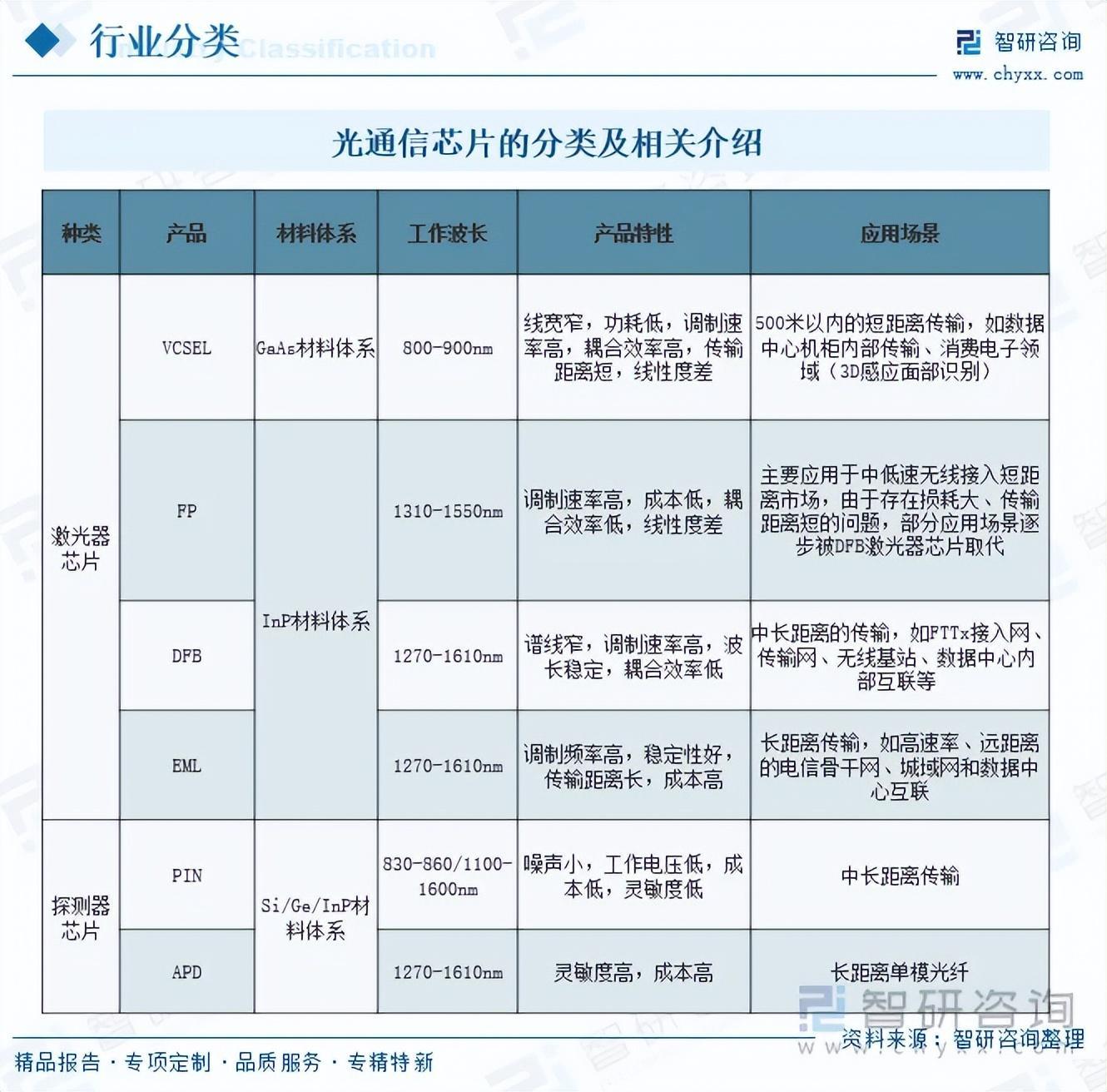
Core Insights - The optical communication chip market in China is experiencing continuous growth driven by artificial intelligence, data center expansion, consumer electronics, and 5G deployment [1][20][27] - The production and demand for optical communication chips are projected to increase significantly, with production reaching 867 million units and demand reaching 1.198 billion units in 2024, resulting in a market size of 15.16 billion yuan [1][20][27] - The market is expected to maintain rapid growth, with production estimated at 904 million units and demand at 1.249 billion units in 2025, leading to a market size of approximately 16.02 billion yuan [1][20][27] Industry Definition and Classification - Optical communication chips are defined as chips that convert optical signals and are used for generating, modulating, amplifying, and detecting optical communication signals [2][21] - These chips can be classified into laser chips and detector chips, with laser chips further divided into surface-emitting and edge-emitting types [2][21] Current Industry Status Global Market - The global optical communication chip market is projected to reach $5.43 billion in 2024, with North America accounting for $1.317 billion, Europe for $829 million, and the Asia-Pacific region for $3.048 billion [5][24] - The demand for optical communication chips is driven by the rapid development of new information technologies such as mobile internet, 5G, and cloud computing [5][24] Chinese Market - The Chinese optical communication chip market is expected to see a demand increase to 1.198 billion units in 2024, with high-speed optical communication chips accounting for approximately 13.98% of the total demand [8][27] - The market size for optical communication chips in China is projected to reach 15.16 billion yuan in 2024, with high-speed chips contributing 50.6 billion yuan [8][27] Industry Supply and Competition - The number of companies entering the domestic optical communication chip industry is increasing, leading to improved production technology and a rising domestic production rate [11][30] - The production of optical communication chips in China is expected to grow from 517 million units in 2018 to 867 million units in 2024 [11][30] Industry Value Chain - The optical communication chip industry value chain consists of upstream materials and equipment, midstream chips and modules, and downstream application markets [13][32] - The current landscape shows a monopoly in high-end materials and equipment by overseas companies, while domestic companies dominate the lower-end applications [13][32]




每日研究一家上市公司——第六十五家三安光电(湖北)
Sou Hu Cai Jing· 2026-02-06 08:48
Core Viewpoint - Sanan Optoelectronics is a leading player in the compound semiconductor industry, particularly in the LED chip and third-generation semiconductor sectors, with a strong focus on technological innovation and a comprehensive industrial layout [5][20][54]. Company Overview - Sanan Optoelectronics Co., Ltd. was established in November 2000 and listed on the Shanghai Stock Exchange in 2008, focusing on the research, production, and sales of compound semiconductor materials and devices [5][6]. - The company has transformed from a single LED chip manufacturer to a platform enterprise covering both LED chips and integrated circuits, establishing a business structure that balances mature cash flow with high-growth new businesses [5][7]. Historical Performance - The stock price reached a historical high of 44.72 yuan in 2021, driven by industry trends, performance improvements, and significant investments in Mini/Micro LED technology [10][11]. - The stock price has since declined, with the latest price at 15.38 yuan as of February 6, 2026, reflecting a 26.58% increase since 2025 [2]. Market Position - Sanan Optoelectronics holds a global market share of 28%-32% in the LED chip sector, leading both domestically and internationally [20]. - The company is also a key player in the Mini/Micro LED market, achieving over 120% year-on-year growth in chip shipments in 2023 [20]. Business Segments - The main business segments include LED epitaxial chips, integrated circuit products, and power electronic devices, with LED epitaxial chips accounting for approximately 65% of total revenue in the first half of 2025 [21][22]. - The company is recognized for its advanced technology in the third-generation semiconductor field, particularly in silicon carbide and gallium nitride RF chips [20][22]. Financial Performance - For the first three quarters of 2025, the company reported total revenue of 138.17 billion yuan, a year-on-year increase of 16.55%, but faced a net profit decline of 64.15% to 88.61 million yuan [29][30]. - The gross profit margin improved to 13.65%, although it remains below the industry average [30]. Competitive Advantages - Sanan Optoelectronics boasts strong technological innovation capabilities, with over 4,200 patents and significant R&D investment, amounting to 13.23 billion yuan in 2024 [24][54]. - The company has established a full industrial chain in the silicon carbide sector, enhancing its cost control and quality assurance [24][25]. Shareholder Structure - The controlling shareholder is Xiamen Sanan Electronics Co., Ltd., with a significant portion of shares pledged, raising concerns about share stability [38][39]. - Institutional investors hold over 50% of the company's shares, indicating strong market confidence [45]. Investment Outlook - The company is positioned for long-term growth in the compound semiconductor sector, despite facing short-term challenges related to competition and profitability [54][63]. - The focus on high-value products and new business developments is expected to drive future revenue growth [54].

研判2026!中国光通信芯片行业壁垒、产业链、产量、需求量、市场规模、竞争格局及研发趋势:市场将保持快速增长,国产化率水平提高[图]
Chan Ye Xin Xi Wang· 2026-01-30 01:25
Core Viewpoint - The optical communication chip market in China is experiencing continuous growth driven by advancements in artificial intelligence, data center expansion, consumer electronics, and 5G deployment, with significant increases in production and demand projected for the coming years [1][4]. Industry Definition and Classification - Optical communication chips are defined as chips that enable the conversion of optical and electrical signals and are essential for the transmission of optical communication signals [1][3]. - These chips can be categorized into laser chips and detector chips, with further classifications based on their emission structure [1][3]. Current Industry Status - The global demand for optical communication chips is surging due to the rapid development of new information technologies such as mobile internet, 5G, and cloud computing [4]. - In China, the demand for optical communication chips is expected to reach 1.198 billion units by 2024, with a market size of 15.16 billion yuan, and further growth is anticipated in subsequent years [4][5]. Market Size and Growth Projections - By 2024, China's optical communication chip production is projected to grow to 867 million units, with demand reaching 1.198 billion units and a market size of 15.16 billion yuan [1][4]. - The market size is expected to increase to approximately 16.02 billion yuan by 2025, with continued rapid growth anticipated through 2026 [1][4]. Industry Chain - The optical communication chip industry chain consists of upstream materials and equipment, midstream chips and modules, and downstream application markets, with a focus on domestic production and high-speed upgrades [5][6]. Industry Barriers - The optical communication chip industry faces high entry barriers due to significant capital investment, core technology accumulation, and brand recognition, with a strong reliance on intellectual property protection [5][6]. Competitive Landscape - China is becoming a significant player in the global optical communication chip market, with several domestic companies, such as Huagong Technology and Guangxun Technology, leading in technology and production capacity [5][6]. - The market share of Chinese optical communication chip manufacturers is increasing, with notable advancements in high-speed optical communication chips [5][6]. Research and Development Trends - Future trends in optical communication chip development include green communication, silicon photonics technology, and photonic integrated circuit (PIC) technology, which are expected to drive innovation and efficiency in the industry [12][14][16]. - The focus on large-capacity transmission and all-optical networks is also highlighted as key areas for future development [16][17].

“十五五”造芯路线图!广州发布重磅征求意见稿,全链条扶持IC产业
Shang Hai Zheng Quan Bao· 2026-01-13 10:04
Core Viewpoint - Guangzhou's Industrial and Information Technology Bureau has released a draft policy aimed at promoting high-quality development of the integrated circuit industry during the 14th Five-Year Plan period, focusing on innovation, scale development, and efficient collaboration to establish Guangzhou as a core area for national integrated circuit industry development. Integrated Circuit Design Industry Policy - Enhance chip design innovation capabilities by supporting the development of high-end general-purpose chips and specialized chips, with subsidies for eligible enterprises covering up to 50% of the first round of wafer costs, capped at 5 million yuan per enterprise annually [2] - Establish an emergency supply coordination mechanism for small and medium-sized design enterprises to ensure capacity support from local production lines [2] Integrated Circuit Manufacturing Industry Policy - Strengthen manufacturing capabilities by supporting advanced IDM and foundry enterprises in establishing R&D and production centers, particularly for 12-inch wafer production lines, with potential support for major projects [3] - Encourage technology upgrades in manufacturing enterprises with post-investment rewards for new equipment purchases, capped at 30 million yuan per project [3] Integrated Circuit Packaging and Testing Industry Policy - Promote advanced packaging and testing technologies, providing subsidies for new equipment purchases up to 20% of costs, with a maximum of 2 million yuan per project [4] - Encourage technology upgrades in packaging and testing enterprises with similar rewards as mentioned above [4] Integrated Circuit Materials and Equipment Policy - Focus on developing high-end materials and equipment, providing subsidies for new material products and equipment, with specific caps on funding [5] - Support enterprises in developing new materials and equipment with financial incentives based on sales prices [5] Integrated Circuit Collaborative Policies - Encourage collaboration across the supply chain and support enterprises in achieving automotive-grade certifications with financial assistance [6][7] - Promote efficient cooperation between integrated circuit enterprises and sectors like smart vehicles and AI through organized supply-demand meetings [5] Integrated Circuit Element Guarantee Policy - Accelerate the construction of specialized industrial parks for integrated circuits, with potential rewards for infrastructure development [6] - Promote financial support for major projects through loans and investments, encouraging participation from various financial institutions [6][7] Continuous Optimization of Industry Development Environment - Enhance the role of the new display and integrated circuit industry development office in facilitating major project progress and supporting high-level international events [7]
利好!事关芯片,广州公开征求意见
是说芯语· 2026-01-13 08:22
Core Viewpoint - The article outlines Guangzhou's policies aimed at promoting high-quality development of the integrated circuit industry during the "15th Five-Year Plan" period, focusing on innovation, scale development, and efficient collaboration to establish Guangzhou as a core area for national integrated circuit industry development [2]. Integrated Circuit Design Policies - The policy aims to enhance chip design innovation capabilities, supporting the development of high-end general-purpose chips and specialized chips, with subsidies covering up to 50% of the first round of wafer fabrication costs, capped at 5 million yuan per enterprise annually [3]. - A mechanism will be established to ensure capacity support for small and medium-sized design enterprises, prioritizing those involved in national technology projects [3]. Integrated Circuit Manufacturing Policies - The policy supports advanced IDM and foundry enterprises in establishing R&D and production centers, particularly for 12-inch wafer production lines, with significant projects receiving up to 20% support for new equipment purchases [3][4]. - Encouragement for technology upgrades in manufacturing enterprises includes post-investment rewards of up to 30 million yuan for new equipment purchases and 5 million yuan for construction projects [4]. Integrated Circuit Testing and Packaging Policies - The initiative promotes advanced packaging technologies and testing methods, providing subsidies of up to 20% for new equipment purchases, with a maximum of 20 million yuan per project [5]. - Companies are encouraged to invest in technology upgrades, with rewards similar to those in manufacturing policies [5]. Integrated Circuit Materials and Equipment Policies - The policy focuses on developing high-end materials and equipment, supporting enterprises in producing key materials and equipment, with subsidies for new material applications capped at 300,000 yuan per product and 800,000 yuan per enterprise annually [6]. Integrated Circuit Collaborative Policies - The policy encourages collaboration across the supply chain, supporting enterprises in various sectors to engage with integrated circuit companies through regular meetings and application scenarios [7]. - Support for certification of automotive-grade products includes subsidies of up to 30% of certification costs, capped at 200,000 yuan per enterprise annually [7]. Integrated Circuit Resource Assurance Policies - The initiative aims to accelerate the construction of specialized industrial parks for integrated circuits, with rewards of up to 50 million yuan for developing public facilities and services [8]. - Financial support for major projects includes encouraging banks and financial institutions to provide loans and financing, with incentives for industry leaders to support significant projects [8]. Additional Policies - The policy emphasizes optimizing the industrial development environment and promoting high-level international cooperation in the integrated circuit sector [9].

事关芯片,广州公开征求意见
Zheng Quan Shi Bao· 2026-01-13 08:12
Group 1 - The article discusses Guangzhou's initiative to promote high-quality development in the integrated circuit industry, aligning with national strategies [1] - The city aims to secure support from national and provincial integrated circuit industry development funds for major project construction [1] - Financial institutions are encouraged to support project construction and enterprise operations through various financing methods, including bank credit and leasing [1] Group 2 - There is a focus on accelerating the design of high-end general-purpose chips, including processors, storage chips, and edge computing chips [2] - The development of specialized chips such as RISC-V, automotive-grade, display drivers, sensors, optical communication, and 6G is actively supported [2] - Subsidies of up to 50% of the wafer fabrication costs are offered to qualifying enterprises for chips with independent intellectual property rights at 28nm or below [2]
利好!事关芯片,广州公开征求意见
Zheng Quan Shi Bao· 2026-01-13 04:52
Group 1 - The article discusses Guangzhou's initiative to promote high-quality development in the integrated circuit industry, aligning with national strategies [1] - The city aims to secure support from national and provincial integrated circuit industry development funds for major project construction [1] - Financial institutions are encouraged to support project construction and enterprise operations through bank credit and financing leasing [1] Group 2 - There is a focus on accelerating the design of high-end general-purpose chips, including processors, storage chips, and edge computing chips [2] - The development of specialized chips such as RISC-V, automotive-grade, display drivers, sensors, optical communication, and 6G is actively supported [2] - Subsidies of up to 50% of the wafer costs are offered for companies meeting specific criteria for self-owned intellectual property in 28nm and below chips [2]
福建90后接班,押宝10倍大牛股赛道
投中网· 2026-01-08 02:23
Core Viewpoint - The recent leadership change at Jinziham (金字火腿) with the appointment of 90s-born Zheng Hu as president raises questions about the company's future direction and potential growth under new management [4][5]. Group 1: Leadership Transition - Zheng Hu, born in 1991, has taken over as president of Jinziham after a brief tenure of 5 months by the previous president, Guo Bo, who resigned for personal reasons [4][5]. - Zheng Hu's background includes significant experience in the luxury car sector, having worked with Aston Martin for 7 years, which may influence his strategic vision for Jinziham [5]. - The transition marks a generational shift in leadership, with Zheng Hu representing the second generation of the Zheng family in the company [6]. Group 2: Strategic Investments - Jinziham has diversified its investments, including a 300 million yuan stake in Zhongsheng Microelectronics, a company focused on optical communication chips [4][8]. - The company has established two wholly-owned semiconductor subsidiaries, indicating a strategic pivot towards high-tech industries [8]. - Zhongsheng Microelectronics has developed core chips for high-speed optical modules, which are crucial for the growing demand in AI and telecommunications [9]. Group 3: Market Trends - The optical communication industry is experiencing significant growth, with a projected compound annual growth rate of 17% from 2025 to 2030 [9]. - The domestic optical communication market is expected to reach approximately 147.3 billion yuan in 2024, with a compound annual growth rate of 5.67% from 2019 to 2024 [9]. - The shift towards domestic alternatives in high-end optical chips is accelerating, driven by policy support for self-sufficiency [9]. Group 4: Generational Shift in Business Leadership - The rise of "second-generation" entrepreneurs is notable, with many 90s and 00s born leaders stepping into significant roles, bringing fresh perspectives and strategies [13][14]. - These new leaders often have international educational backgrounds and diverse experiences, leading to a willingness to invest in high-growth sectors like AI, semiconductors, and biotechnology [14]. - The transition poses challenges, including the need to balance traditional business cash flow with long-term investments in technology [15].


福建90后接班,押宝10倍大牛股赛道
3 6 Ke· 2026-01-06 05:13
Group 1: Company Leadership Changes - The management of Jinziham (002515.SZ), known as the "first ham stock," has undergone a significant leadership change with the appointment of 90s-born Zheng Hu as the new president, following the resignation of Guo Bo after only five months [1][2] - Zheng Hu, born in 1991, has a background in luxury car sales, having worked with Aston Martin for seven years, which may influence his approach to leading the company [1][2] Group 2: Strategic Investments - Jinziham has diversified its investments by acquiring a 3 billion yuan stake in Zhongsheng Microelectronics, a company specializing in optical communication chips, indicating a strategic shift towards the semiconductor industry [1][3] - The company has established two wholly-owned semiconductor subsidiaries focused on integrated circuit design and chip development, with Zheng Hu as the legal representative [3] Group 3: Market Trends and Opportunities - The optical communication industry is experiencing significant growth, driven by AI computing, cloud expansion, and increasing bandwidth demands, with a projected compound annual growth rate of 17% from 2025 to 2030 for global optical communication chipsets [4] - Domestic market predictions estimate the optical communication market to reach approximately 147.3 billion yuan in 2024, with a compound annual growth rate of 5.67% from 2019 to 2024 [4] Group 4: Emerging Leadership Trends - The rise of "second-generation" entrepreneurs, such as Zheng Hu, reflects a broader trend where younger leaders are taking charge of family businesses, often with a focus on high-growth sectors like AI, semiconductors, and biotechnology [6][7] - A survey indicates that 7% of family-owned enterprises in A-shares have completed generational transitions, up from 4.6% in the previous year, highlighting a growing trend of younger leaders in the market [7]