惠泰医疗

Search documents
2026中国创新医疗图景:源头活水何在,产业生态又将如何重塑?
Xin Lang Cai Jing· 2026-01-26 06:56
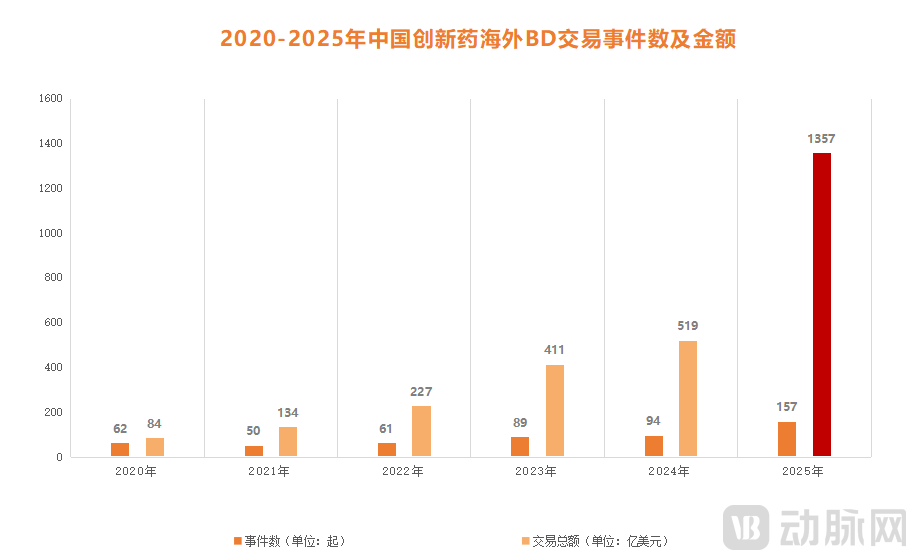
Core Insights - The Chinese healthcare industry experienced a significant surge in 2025, marked by a record number of innovative medical devices and drugs approved for market entry, indicating a growing focus on innovation in the sector [1][3] - The total value of overseas business development (BD) transactions for innovative drugs reached $135.7 billion in 2025, accounting for 49% of the global total, surpassing the United States for the first time [3] - The IPO market for healthcare companies in China saw a revival, with 37 companies successfully listed in 2025, doubling the number from 2024, reflecting strong investor interest in the sector [7] Innovation in Medical Devices and Drugs - In 2025, 109 innovative medical devices were approved, with a 19.67% year-on-year increase in Class III devices, while 76 innovative drugs were approved, focusing on advanced fields like oncology and autoimmune diseases [1] - The rapid growth in innovative drug approvals and medical device registrations highlights China's increasing capabilities in healthcare innovation [1][8] Business Development and Market Dynamics - The number of overseas BD transactions for innovative drugs reached 157 in 2025, with a total transaction value of $135.7 billion, both figures representing historical highs [3] - The increasing recognition of Chinese innovative drugs by global pharmaceutical companies is evident, particularly as they face pressures from patent expirations and global competition [8] IPO Activity and Market Sentiment - The healthcare sector in China saw a resurgence in IPO activity, with 37 companies going public in 2025, compared to 17 in 2024, indicating a robust market sentiment [7] - Over 60 healthcare companies are currently in the IPO pipeline on the Hong Kong Stock Exchange, reflecting sustained investor enthusiasm for the healthcare sector [7] Challenges and Industry Landscape - Despite the growth, challenges persist, including difficulties in financing and market entry for medical companies, exacerbated by domestic healthcare cost controls and intensified competition [7] - The industry is undergoing significant consolidation, presenting both opportunities and challenges for companies navigating this complex landscape [7][11] AI Integration in Healthcare - AI technology is increasingly integrated into the healthcare sector, enhancing the efficiency and safety of medical devices and drug development processes [10] - The shift towards data-driven, proactive healthcare solutions is transforming traditional practices, with AI expected to play a crucial role in future clinical pathways [10] Investment Trends and Future Outlook - The investment landscape in the healthcare sector is shifting towards high-tech, innovative companies, with a notable decrease in the number of financing events but an increase in total investment amounts [16] - The next 5-10 years are anticipated to be a golden period for innovation in Chinese healthcare, with a focus on projects that address unmet clinical needs [17]


银河通用成为2026春晚指定具身大模型机器人,医疗创新ETF(516820)连续6天净流入
Xin Lang Cai Jing· 2026-01-26 02:17
Group 1 - The core viewpoint of the news highlights the performance of the medical innovation sector, with the China Securities Medical and Medical Device Innovation Index showing mixed results among its constituent stocks, led by Hualan Biological at a 0.90% increase [1] - The Medical Innovation ETF has seen continuous net inflows over the past six days, with a peak single-day net inflow of 40.54 million yuan, totaling 84.99 million yuan and an average daily net inflow of 14.17 million yuan [1] - Central China Television announced that Galaxy General Robotics will be the designated humanoid robot for the 2026 Spring Festival Gala, marking a significant milestone for the company established in May 2023, which focuses on a wide range of applications including retail, industrial, medical, and cultural tourism [1] Group 2 - The China Securities Medical and Medical Device Innovation Index consists of 30 publicly listed companies with strong profitability, growth potential, and research innovation capabilities, reflecting the overall performance of the medical and medical device sector [2] - As of December 31, 2025, the top ten weighted stocks in the index include WuXi AppTec, Hengrui Medicine, Mindray Medical, and others, collectively accounting for 63.75% of the index [2] Group 3 - The current medical device sector is at a turning point, with performance recovery expected in 2026, driven by new technologies such as AI in healthcare, brain-machine interfaces, and surgical robots, leading to a continuous revaluation of innovative products with global competitiveness [1]

医疗耗材行业周报:持续关注医疗卫生基层市场扩容-20260126
Xiangcai Securities· 2026-01-26 02:03
Investment Rating - The industry investment rating is maintained at "Overweight" [3] Core Insights - The medical consumables sector saw a weekly increase of 1.72%, outperforming the CSI 300 index by 0.23 percentage points [5][10] - The current PE ratio for the medical consumables sector is 37.73X, with a PB ratio of 2.71X, indicating a slight increase in valuation metrics compared to the previous week [6][18][20] Industry Performance - Over the past month, the medical consumables sector has shown a relative return of 9%, while the absolute return over the last 12 months is 22% [4] - The sector's performance is compared to other sub-sectors, with notable fluctuations in the medical and pharmaceutical industries [12] Industry Dynamics and Key Announcements - The 2026 National Health System Grassroots Health and Financial Work Conference emphasized the importance of strengthening basic medical services and expanding rehabilitation and nursing services, which is expected to drive demand for consumables [7][21] - The focus on grassroots healthcare institutions is anticipated to enhance the demand for consumables related to common and chronic diseases, as well as rehabilitation equipment [21] Investment Recommendations - The report suggests focusing on leading companies with strong cost control and innovation capabilities, particularly in the context of ongoing procurement normalization [8][23] - Companies with a diverse product line and strong market presence in high-value consumables, such as HuiTai Medical and MaiPu Medical, are highlighted as potential investment opportunities [8][23]
【1月26日IPO雷达】北芯生命申购
Xuan Gu Bao· 2026-01-26 00:07
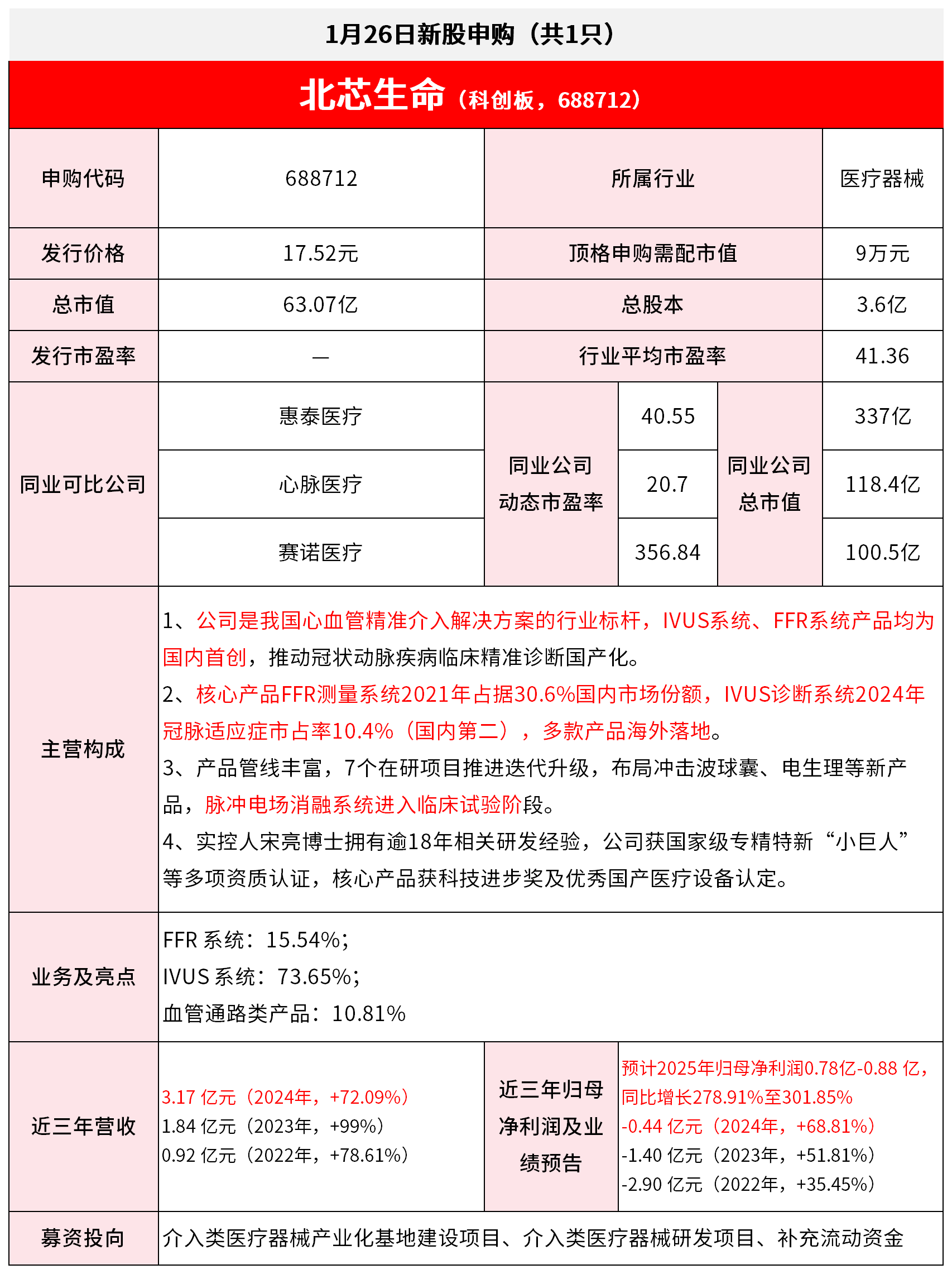
Core Viewpoint - The article discusses the upcoming IPO of Beixin Life (科创板, 6887), highlighting its market position and financial performance in the cardiovascular intervention solutions sector. Group 1: Company Overview - Beixin Life is recognized as a leader in China's cardiovascular precision intervention solutions, focusing on clinical precision diagnosis for coronary artery diseases [2] - The company has a total market capitalization of 6.307 billion yuan and an issuance price of 17.52 yuan per share [2] - The controlling shareholder, Dr. Song Liang, has over 18 years of relevant R&D experience and the core products have received multiple certifications and awards [2] Group 2: Product and Market Position - The core product, the FFR measurement system, held a 30.6% market share in the domestic coronary indication market, ranking second with a 10.4% overall market share [2] - The product pipeline includes seven ongoing projects, with the pulse electric field ablation system currently in clinical trials [2] Group 3: Financial Performance - The company reported revenues of 318 million yuan for 2024, reflecting a 72.09% increase [3] - In the past three years, the company's revenue has shown significant growth: 184 million yuan in 2023 (+99%), and 92 million yuan in 2022 (+78.61%) [3]
新股三分钟数读IPO∣北芯生命(科创成长层)
Sou Hu Cai Jing· 2026-01-26 00:05
Core Viewpoint - The company is a national high-tech enterprise focused on innovative medical devices for precise diagnosis and treatment of cardiovascular diseases, aiming to transform solutions for cardiovascular care [7]. Company Overview - The company specializes in the research, development, production, and sales of innovative medical devices for cardiovascular disease diagnosis and treatment [7]. - It is the first domestic medical device company with a combination of vascular functional FFR and imaging IVUS products, filling a market gap and changing the reliance on imported products for coronary artery disease clinical diagnosis in China [12]. Financial Data - Projected revenue for 2024 is 3.17 billion yuan, up from 1.84 billion yuan in 2023 and 0.92 billion yuan in 2022 [8]. - The company reported a net loss of 0.54 billion yuan in 2024, an improvement from a loss of 1.55 billion yuan in 2023 and 3.00 billion yuan in 2022 [8]. - Cash flow from operating activities per share is expected to be 0.08 yuan in 2024, recovering from negative cash flows in previous years [8]. Industry Context - The cardiovascular disease market is expected to grow due to an aging population, with projections indicating that by 2030, the population aged 65 and above in China will reach 270 million, accounting for 19.6% of the total population [12]. - The increasing prevalence of obesity, hypertension, and diabetes is expected to drive the demand for cardiovascular disease diagnosis and treatment solutions [12]. SWOT Analysis Strengths - The company has a strong focus on independent research and technological innovation, which is crucial for developing solutions for cardiovascular diseases [12]. - It possesses a mature commercialization network recognized globally and regionally [12]. Opportunities - The trend of population aging and increasing regulatory focus on innovative medical devices present significant growth opportunities for the company [13]. Weaknesses - The company faces challenges due to the high difficulty and risk associated with developing Class III medical devices, which involve complex and lengthy processes [14]. - There is significant competition from established foreign manufacturers, and the company has relatively weak financial strength [14].
研判2026!全球及中国冠脉通路器械行业发展背景、患病人数、市场规模、企业布局及未来发展趋势分析:高端市场外资主导,基层扩容增量可期[图]
Chan Ye Xin Xi Wang· 2026-01-24 02:30
Core Insights - The coronary access devices are essential consumables for percutaneous coronary intervention (PCI) surgeries, directly impacting surgical outcomes and complication control [1][6] - The industry is supported by a series of policies in China, including centralized procurement, innovation approvals, and grassroots medical construction, laying a solid foundation for high-quality development [6][10] - The number of coronary artery disease patients is steadily increasing globally and in China, with projections indicating 220 million patients worldwide and 27.879 million in China by 2024, highlighting significant growth potential for the industry [10] Industry Overview - Coronary access devices are specialized medical equipment and consumables used in PCI surgeries to establish and maintain access from the body surface to the coronary arteries, ensuring the smooth execution of angiography, balloon dilation, and stent implantation [1][6] - The devices are categorized into four main types: puncture devices, catheter systems, sheath sets, and auxiliary devices for pressure monitoring and vascular closure [3][4] Development Background - The development of coronary access devices is crucial for reducing cardiovascular disease mortality, enhancing medical accessibility, and promoting high-end device localization [6][8] - Recent policies in China aim to improve centralized procurement mechanisms, accelerate innovation device approvals, and standardize medical insurance payments, providing guidance for industry development [6][10] Market Analysis - The global coronary balloon dilatation catheter market is expanding, with functional balloons growing at a faster rate; the market size is expected to increase from $560 million in 2020 to $960 million in 2024, with a compound annual growth rate (CAGR) of 8.49% [12][14] - In China, the market is characterized by structural adjustments and rapid growth, with the general balloon market experiencing a temporary decline due to centralized procurement but expected to rebound, while functional balloons are projected to grow significantly, with a CAGR of 19.28% from 2024 to 2028 [14][16] Competitive Landscape - The competitive landscape of the coronary access device industry is tiered, with foreign companies dominating the high-end market while domestic leaders are accelerating their market penetration; by 2024, domestic companies are expected to capture 54.9% of the coronary balloon market [14][15] Future Trends - The industry is expected to evolve along three main directions: technological upgrades, deepening domestic substitution, and expansion of grassroots markets [16] - Innovations such as biodegradable materials and smart functions will drive high-end product iterations, while local companies will enhance core component localization through material and manufacturing process advancements [17][18] - The promotion of tiered diagnosis and treatment will reshape market demand, with a growing need for cost-effective and standardized products suitable for grassroots settings [18]


药品零售行业高质量发展意见发布,科创医药ETF嘉实(588700)一键布局生物医药产业
Xin Lang Cai Jing· 2026-01-23 03:43
Group 1 - The core viewpoint of the news highlights the strong performance of the pharmaceutical and medical services sectors, with the Shanghai Stock Exchange Sci-Tech Innovation Board Biomedicine Index rising by 1.52% as of 11:05 AM on January 23, 2026, driven by significant gains in stocks such as Chengdu Xian Dao (+5.48%) and BGI Genomics (+4.25%) [1] - The Ministry of Commerce and eight other departments have issued opinions to promote high-quality development in the drug retail industry, encouraging retail enterprises to participate in centralized drug procurement and to enhance their bargaining power through joint purchasing [1] - The Chinese pharmaceutical industry is at a pivotal point for global value reassessment, with 2026 being a critical year to validate transformation outcomes, as highlighted by CITIC Securities [1] Group 2 - As of December 31, 2025, the top ten weighted stocks in the Shanghai Stock Exchange Sci-Tech Innovation Board Biomedicine Index include companies like United Imaging Healthcare and BeiGene, collectively accounting for 48.85% of the index [2] - The CSI Innovation Medicine ETF closely tracks the Shanghai Stock Exchange Sci-Tech Innovation Board Biomedicine Index, providing an easy investment option for those without stock accounts through the linked fund [3]


湘财证券晨会纪要-20260123
Xiangcai Securities· 2026-01-23 01:10
Industry and Company Overview - The medical consumables industry is undergoing significant changes with the recent announcement of the sixth batch of national high-value medical consumables centralized procurement, which took place on January 13, 2026. This procurement includes 12 types of medical consumables, with 496 products from 227 companies bidding, and 440 products from 202 companies selected [2][4]. - The procurement process emphasizes principles such as "stabilizing clinical use, ensuring quality, preventing internal competition, and avoiding collusion." This includes grouping products based on demand and supply capabilities to ensure that clinically recognized and capable products are selected [4]. Procurement Results and Implications - The results of the procurement are expected to be implemented by May 2026, allowing patients to access more reasonably priced and quality-assured products. The inclusion of drug-coated balloons and urological intervention consumables marks a significant step in addressing previously unaddressed areas in procurement [4]. - The procurement rules have been optimized to discourage traditional low-price competition strategies, pushing companies to focus on clinical value, supply stability, and innovation. This creates a more favorable environment for both large and small enterprises, particularly those with innovative products [4]. Investment Recommendations - The medical consumables industry, particularly high-end implantable devices such as orthopedic implants, cardiovascular intervention devices, and neurosurgical implants, is expected to benefit from policy support. The optimized procurement rules are likely to stabilize expectations and mitigate low-price competition [5]. - Companies with strong cost control, continuous innovation capabilities, and those that can achieve market share growth through domestic substitution are recommended for investment. Specific attention should be given to companies with product advantages in rehabilitation and chronic disease management [5].
富国消费主题混合C基金近3年单位净值下跌23.03% 长期重仓白酒股
Xi Niu Cai Jing· 2026-01-22 14:45
Core Insights - The performance of the Fuqua Consumer Theme Mixed Fund has attracted market attention, particularly since the establishment of its C-class shares, which has seen a decline in net asset value [2][4] Fund Performance - The C-class shares of the Fuqua Consumer Theme Mixed Fund have experienced a 29.9% decline in net asset value since their inception on January 18, 2021, with a 23.03% drop over the past three years and a modest 1.03% increase over the last year [2][3] - As of January 19, 2026, the fund's net asset value stood at 2.1520, with a recent monthly performance of -0.55% and a three-month decline of 6.19% [3] Fund Management - The fund is managed by Wang Yuanyuan, who has been with Fuqua Fund since April 2015 and has held various positions, including industry researcher and senior equity fund manager [3][4] - As of the end of Q3 2025, the fund's net asset value was approximately 4.241 billion, with 91.4% of its assets allocated to stocks and no bonds held [3] Investment Strategy - The fund has historically maintained a heavy allocation to liquor stocks, particularly Kweichow Moutai, which saw a 6.47% decline in stock price in 2025 [4] - Wang Yuanyuan indicated in the fund's Q3 report that the fund is looking to increase its allocation to the liquor sector based on low valuation levels and potential stabilization in 2026, while also screening for opportunities in the new consumption sector [4] - The fund aims to focus on high-quality growth companies in the domestic consumer sector, emphasizing brand concentration and international expansion as key growth drivers [4]

国产创新器械“第一股”井喷:多个细分赛道集体冲刺IPO
Xin Lang Cai Jing· 2026-01-22 10:08
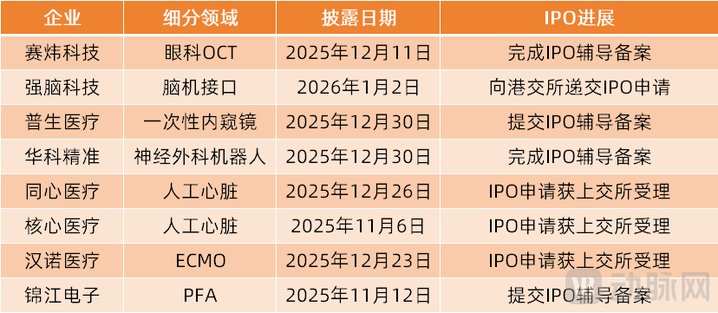
Core Viewpoint - The innovative medical device market is witnessing a surge in IPO activities across various segments, indicating a shift towards capitalization and maturity in the industry [1][20]. Group 1: IPO Developments - Several innovative medical device companies are moving towards IPO, including Saiwei Technology in the ophthalmic OCT field, Qiangnao Technology in brain-computer interfaces, and Pusong Medical in single-use endoscopes [1][19]. - The emergence of these IPOs suggests that multiple niche markets are collectively advancing, marking a new phase of high-end and capitalized development for domestic innovative medical devices [20]. Group 2: Investment Trends - Since 2020, there has been a significant influx of investment in the innovative medical device sector, with the number of financing events increasing from 118 in 2019 to 475 in 2021, although it has slightly decreased in subsequent years [5][21]. - The single-use endoscope sector has seen substantial funding, with companies like Ruipai Medical completing multiple rounds of financing, contributing to rapid industry growth [23]. Group 3: Policy and Market Support - Recent government policies have been implemented to support the high-quality development of innovative medical devices, facilitating their commercialization and market entry [8][24]. - For instance, the inclusion of artificial heart surgeries in insurance coverage has reduced patient financial burdens, leading to increased market growth for related companies [9][25]. Group 4: Future Outlook - The upcoming years are expected to see more niche markets achieving their first IPOs, particularly in areas like oral and hair transplant surgical robots, which have demonstrated commercial viability [30][31]. - The successful IPOs of these companies are anticipated to further accelerate industry growth and market penetration, fostering a more mature market landscape [32].