荣耀

Search documents
“智能憨憨”引发AI玩具热行业同质化严重智能化不足
Zheng Quan Shi Bao· 2025-12-03 17:38
Core Insights - The launch of Huawei's "Smart Hanhai" AI toy at a price of 399 yuan has sparked a new wave of interest in the AI toy market, with high demand leading to sellouts and significant pre-order volumes [1][2] - The AI toy market is experiencing growth, with major companies entering the space, indicating a shift in focus from traditional consumer electronics to innovative products [2][3] - Despite the excitement, the industry faces challenges such as product homogenization and high return rates, which hinder its development [4][5] Market Trends - The AI toy market is projected to grow significantly, with estimates suggesting a market size of approximately 246 billion yuan in 2024, increasing to 290 billion yuan in 2025, and potentially exceeding 1 trillion yuan by 2030 with a compound annual growth rate of over 50% [3] - Major companies like UBTECH and JD.com are launching their own AI toys, indicating a competitive landscape where traditional electronics firms are diversifying their product offerings [2][3] Industry Challenges - The AI toy sector is plagued by severe product homogenization, with many toys utilizing similar models and features, leading to consumer dissatisfaction and high return rates, which can reach up to 40% initially [4][5] - The lack of unique intellectual property and reliance on generic models contribute to the perception that many AI toys do not meet consumer expectations, resulting in a high rate of returns [5][6] Future Outlook - The AI toy market is expected to undergo a "shakeout" phase within the next five years, where companies lacking unique offerings or comprehensive capabilities may exit the market [6][7] - Experts predict that the market will eventually be dominated by three types of players: major consumer electronics companies, content-driven firms like LEGO and Disney, and specialized service providers focusing on niche markets [6][7]
【市场】全球折叠屏手机份额出炉 三星第1 华为第2 摩托罗拉第3
Xin Lang Cai Jing· 2025-12-03 13:21
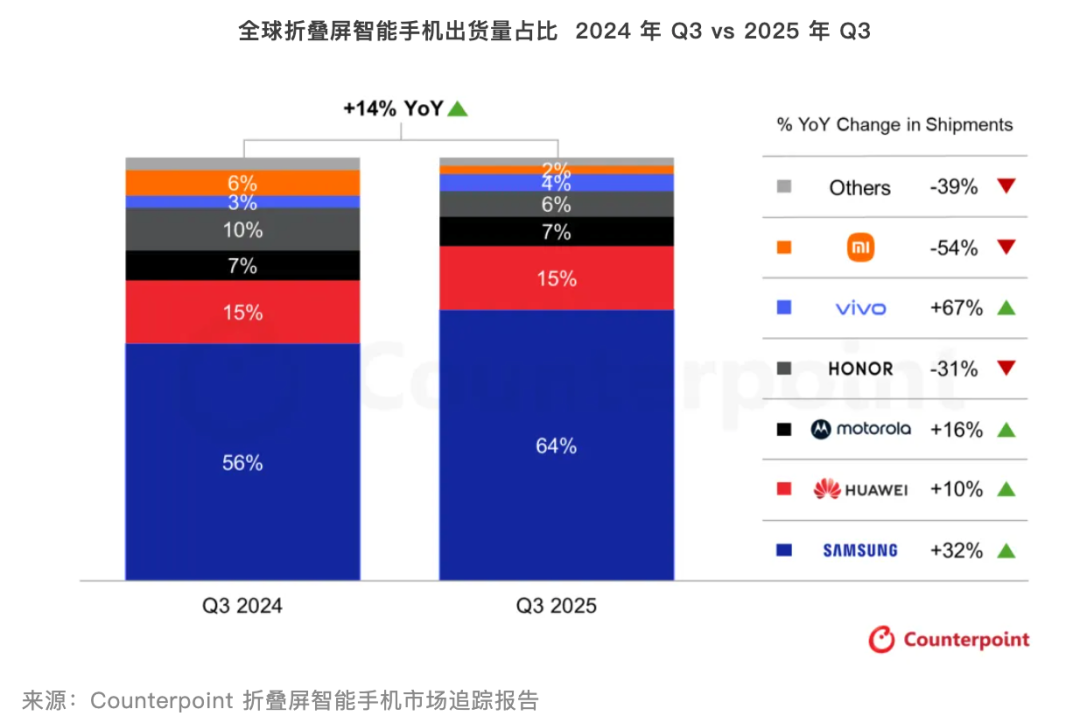
此前曾给大家整理了研究机构IDC发布的2025年第三季度(7-9月)中国折叠屏手机市场报告,现在全球折叠屏手机市场也有相关数据出炉,来看看各家 表现如何~ 如上图所见,研究机构Counterpoint更新的数据显示,2025年第三季度全球折叠屏市场份额TOP 5依次是:①三星(64%份额)②华为(15%份额)③摩托 罗拉(7%)④荣耀(6%)⑤vivo(4%)⑥小米(约2%份额)。 对比去年同期数据来说,三星、华为、摩托罗拉、vivo等品牌均有不同幅度的增长,报告中还提到第三季度全球折叠屏智能手机出货量同比增长14%,创 下该品类出货量的季度历史新高。问问大家,你现在生活中看到的折叠屏多吗? 此前曾给大家整理了研究机构IDC发布的2025年第三季度(7-9月)中国折叠屏手机市场报告,现在全球折叠屏手机市场也有相关数据出炉,来看看各家 表现如何~ 如上图所见,研究机构Counterpoint更新的数据显示,2025年第三季度全球折叠屏市场份额TOP 5依次是:①三星(64%份额)②华为(15%份额)③摩托 罗拉(7%)④荣耀(6%)⑤vivo(4%)⑥小米(约2%份额)。 对比去年同期数据来说,三星、华为、摩托 ...


安凯微:拟3.26亿元收购物联网芯片设计企业85.79%股权 快速丰富产品序列
Zhong Guo Zheng Quan Bao· 2025-12-03 13:21
Core Viewpoint - Ankai Micro plans to acquire 85.79% of Sichao Technology for a total consideration of RMB 326 million, which will make Sichao a subsidiary of Ankai Micro [2] Group 1: Acquisition Details - The acquisition involves cash payment for Sichao Technology, which specializes in innovative, high-performance, ultra-low-power IoT chip design [2] - The registered capital of Sichao Technology is USD 339,200 [2] Group 2: Business Synergies - The acquisition is expected to create business synergies in product, technology, market, and supply chain areas [2][3] - Sichao Technology will enhance Ankai Micro's product offerings in low-power Bluetooth processors, particularly in smart home and wearable technology [3] Group 3: Technical Integration - Ankai Micro will leverage Sichao Technology's core technologies in ultra-low power, Bluetooth communication, analog RF, power management, and graphics engines to enhance its overall technical capabilities [3] - The integration of R&D resources is aimed at improving product competitiveness [3] Group 4: Market and Customer Expansion - The collaboration will utilize both companies' market and customer advantages to consolidate existing market share and explore new market opportunities [3] - The integration of supply chain resources is expected to create scale effects and enhance supply chain advantages [3] Group 5: Overall Business Development - The transaction will enrich Ankai Micro's product categories and accelerate the technological upgrade of IoT application processor chips [3] - The partnership aims to improve customer solution capabilities and strengthen market development efforts [3]


传音赴港上市,非洲之王的估值困局与增长破局
Xin Lang Cai Jing· 2025-12-03 13:21
Core Viewpoint - Transsion Holdings, known as the "King of Africa," has submitted an application for a dual listing on the Hong Kong Stock Exchange, following its debut on the STAR Market in 2019, reflecting its strategic moves in emerging markets amidst challenges in growth and competition in the mid-to-low-end smartphone sector [2][18]. Group 1: Market Position and Performance - By 2024, Transsion is projected to be the third-largest smartphone manufacturer globally, with sales of 201 million units, including 106 million smartphones, primarily dominating the emerging markets [3][19]. - In 2024, Transsion holds market shares of 61.5% in Africa, 15.4% in the emerging Asia-Pacific, and 22.8% in the Middle East, leading in all these regions [3][19]. - The company’s smartphone average selling price (ASP) is around 548 RMB, significantly lower than competitors like Xiaomi, whose ASP exceeds 1,000 RMB [6][22][23]. Group 2: Competitive Strategy - Transsion's success in emerging markets is attributed to its localized production and tailored products that meet the specific needs of these markets, such as long battery life and multi-SIM capabilities [4][20]. - The company has established a robust distribution network with approximately 2,900 long-term partners and over 2,000 service points, creating a localized sales and after-sales system that is difficult for new entrants to penetrate [4][20]. - Transsion is diversifying its product offerings beyond smartphones, venturing into IoT products, energy storage brands, and electric vehicles, indicating a shift towards becoming a comprehensive smart living service provider [4][20]. Group 3: Financial Performance and Challenges - In the first half of 2025, Transsion's smartphone revenue declined by 16.95%, while feature phone revenue dropped by 34.77%, indicating significant challenges in maintaining growth momentum [9][25]. - Despite a decline in revenue, Transsion's smartphone shipments in Q3 2025 increased by 13.6% year-over-year, reaching 29.2 million units, regaining market share and ranking [10][27]. - The company’s Q3 2025 revenue was 2.047 billion RMB, a 22.6% increase from the previous year, showing signs of recovery after a challenging first half [10][27]. Group 4: Valuation and Market Perception - Transsion's A-share price has dropped by 24.33% this year, reflecting market concerns about its future prospects, with a current market valuation of approximately 804 billion RMB [15][31]. - In contrast, Xiaomi's H-share has seen a cumulative increase of 16.58%, with a market valuation of 1.05 trillion HKD, indicating a more favorable market perception [15][31]. - The valuation disparity between Transsion and Xiaomi highlights the challenges Transsion faces in sustaining high valuations in the Hong Kong market, where growth sustainability and global brand recognition are prioritized [15][31][32].

物联网芯片新布局!安凯微拟3.26亿元收购思澈科技85.79%股权
Xin Lang Cai Jing· 2025-12-03 13:04
Core Viewpoint - Ankai Micro plans to acquire 85.79% of Siche Technology for a total cash consideration of RMB 325,991,258.12, which will enhance its position in the IoT chip market [1][4][5] Group 1: Acquisition Details - The acquisition consists of two parts: RMB 22 million for 36.00% of Siche Technology from the founding team and RMB 304 million for 49.79% from investor shareholders [1][5] - Upon completion, Siche Technology will become a subsidiary of Ankai Micro and will be included in its consolidated financial statements [4][5] Group 2: Strategic Rationale - The acquisition is expected to create synergies in product offerings, technology, market access, and supply chain integration [5] - In terms of products, the deal will enrich Ankai Micro's IoT application processor chip product line, expanding its applications in smart wearables, health devices, smart homes, and industrial instruments [5] - Technologically, Ankai Micro aims to leverage Siche Technology's expertise in ultra-low power, Bluetooth communication, and other core technologies to enhance its R&D capabilities and overall competitiveness [5] - Market-wise, the collaboration will allow both companies to utilize their respective market strengths to increase market share and explore new market opportunities [5] - Supply chain integration is expected to yield economies of scale and enhance supply chain advantages [5] Group 3: Company Profile - Siche Technology specializes in high-performance, ultra-low power IoT microcontrollers and related chip designs, targeting markets such as smart wearables and smart home devices [6] - The company has established a strong reputation with its products being adopted by well-known brands like Xiaomi, Honor, and OnePlus [6] - The acquisition reflects a broader trend in the integrated circuit design industry, where companies are pursuing mergers and acquisitions to expand product lines and achieve technological synergies [6] - For Ankai Micro, successfully integrating Siche Technology represents a significant step towards becoming a platform provider of IoT chip solutions [6]
荣耀双十一遇冷:销量降14%,市场份额跌至第六
Xi Niu Cai Jing· 2025-12-03 12:44
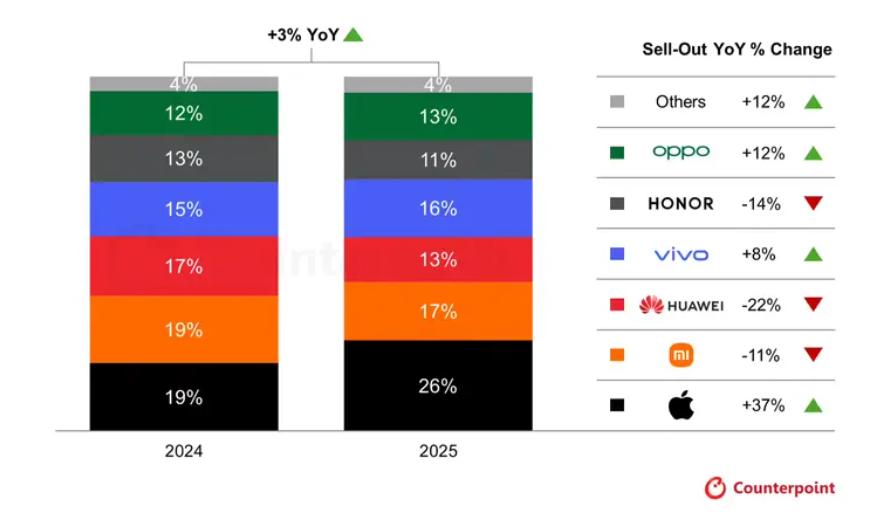
Core Insights - The Chinese smartphone market is expected to see a slight year-on-year increase of 3% in sales during the 2025 Double Eleven shopping festival, primarily driven by Apple's iPhone 17 series, which experienced a significant year-on-year sales surge of 37% [1][3] Market Performance - Excluding Apple's contribution, the actual market sales would have declined by 5% year-on-year, highlighting the stark contrast between Apple's growth and the struggles of domestic brands [3] - Honor's sales fell by 14% year-on-year, with a market share of 11%, down 2% from the previous year, ranking sixth among major brands [3] Competitive Landscape - Honor's third-quarter sales decreased by 8.1%, the largest drop among mainstream manufacturers, with its market share falling to 14.4%, ranking fifth in the domestic market [5] - Honor's Magic series faces intense competition from Apple's iPhone, Huawei's Mate series, and Xiaomi's digital Ultra series, indicating a need for breakthroughs in brand appeal and unique technological selling points [5][6] Product Performance - The weekly sales of Honor's Magic 8 series were reported at 248,000 units, which is relatively low compared to other flagship models during the same period [5] - The initial sales of the Honor Magic 8 series were over 50,000 units, approximately 50% of the previous generation's first-day sales [5] Market Challenges - Despite recovering market share since its independence, Honor's growth model is seen as heavily reliant on its previous channel system and technology legacy from Huawei [6] - The return of Huawei and the aggressive push from other domestic brands may pose further risks to Honor's market share, especially as consumer upgrade cycles lengthen and purchasing decisions become more cautious [6]

全球折叠屏手机Q3出货量创历史新高!联想(00992)摩托罗拉同比大涨16%
智通财经网· 2025-12-03 11:06
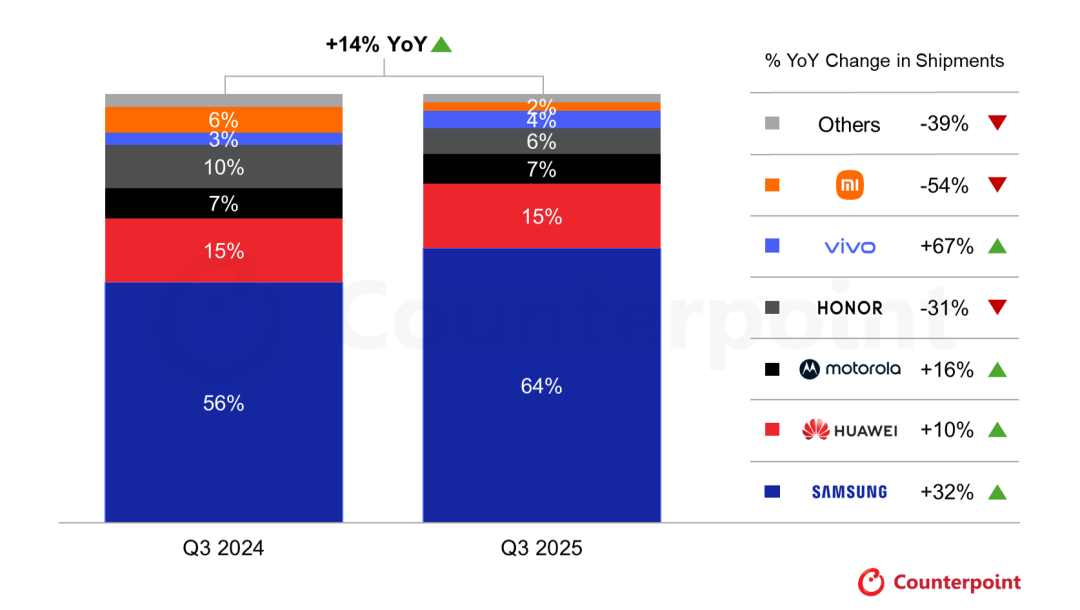
Core Insights - The global foldable smartphone shipment is expected to grow by 14% year-on-year in Q3 2025, reaching a historical high of 2.5% of total smartphone shipments [1][6] - Lenovo's Motorola has emerged as a key player in the clamshell foldable segment, with a 16% increase in shipments, securing a position among the top three globally [1][3] - Vivo has also seen a significant increase in shipments, rising by 67% [1] Company Performance - Lenovo's Motorola has effectively expanded its foldable smartphone user base through competitive pricing, strong channel partnerships, and positive product usability ratings [3] - In the US and European markets, Motorola has achieved a breakthrough in market share, competing effectively against established players like Samsung and Honor [3][6] - The Razr 60 model leads the market with a 15% share, and when combined with the Razr 50, the total share reaches approximately 27%, comparable to last year's champion model [5] Market Trends - The foldable smartphone market is projected to close 2025 with a stable growth rate of around 16% year-on-year, driven by high-end users seeking larger screens for productivity and durability [6] - The market is expected to enter a significant expansion phase in 2026, influenced by improvements in durability, thinner and lighter designs, optimized hinge and panel structures, and enhanced AI-driven software experiences [6] - Lenovo is actively promoting its "one body, multiple ends" strategy, launching various AI smartphone products to capture more market share, which will be crucial for competition in the foldable and overall smartphone markets [6]

全球折叠屏手机Q3出货量创历史新高!联想摩托罗拉同比大涨16% 小米、荣耀大幅下跌
Ge Long Hui· 2025-12-03 10:55
Core Insights - The global foldable smartphone shipment is projected to grow by 14% year-on-year in Q3 2025, reaching a historical quarterly high, with a market share of 2.5% in global smartphone shipments [1] - Lenovo Motorola has emerged as a key player in the clamshell foldable segment, with a 16% year-on-year increase in shipments, securing a position among the top three globally [1][2] - Vivo has seen a significant increase in shipments by 67%, while Xiaomi and Honor experienced declines of 54% and 31%, respectively [1] Company Performance - Lenovo Motorola has effectively expanded its foldable smartphone user base through competitive pricing, strong channel partnerships, and excellent product usability ratings [2] - In the mainstream markets of the US and Europe, Motorola has achieved a breakthrough in market share, competing effectively against established players like Samsung and Honor [2][6] - The Razr series, particularly the Razr 60, has led the market with a 15% share in the first half of 2025, and combined with the Razr 50, the total share reaches approximately 27% [3] Market Trends - The foldable smartphone market is expected to close 2025 with a stable growth rate of around 16% year-on-year, driven by high-end users preferring larger screens for productivity and durability [6] - The market is anticipated to enter a significant expansion phase in 2026, fueled by improvements in durability, thinner and lighter designs, optimized hinge and panel structures, and enhanced AI-driven software experiences [6] - Lenovo is actively promoting its "one body, multiple ends" strategy, launching various AI smartphone products, which is expected to be a crucial competitive area in the foldable smartphone market and the overall smartphone industry [6]

传音越来越“小米”了
华尔街见闻· 2025-12-03 10:32
Core Viewpoint - The article discusses the challenges and strategies of Transsion Holdings as it prepares for its IPO in Hong Kong, highlighting its declining profits and increasing competition in the African market from companies like Xiaomi and Honor [1][5][18]. Group 1: Financial Performance - Transsion Holdings reported a revenue of 49.543 billion yuan and a net profit of 2.148 billion yuan for the first three quarters of 2025, representing a year-on-year decline of 3.33% and 44.97% respectively [1][5]. - The company's gross margin fell to 18.59% in Q3 2025, marking the lowest quarterly figure in five years [11]. - The company's market value has decreased by over 30% since the end of 2024, with a maximum drawdown exceeding 50% [19]. Group 2: Market Competition - Despite maintaining a market share of 51% in Africa with over 10 million units shipped in Q3 2025, Transsion's growth rate was only 25% year-on-year [7]. - Competitors like Xiaomi and Honor have shown significant growth in the African market, with year-on-year growth rates of 34% and 158% respectively for the same period [8]. - Xiaomi's localized strategies, such as launching the REDMI 15C smartphone with a 6000mAh battery, have enhanced its competitiveness in Nigeria [9]. Group 3: Strategic Initiatives - Transsion is expanding its product offerings beyond smartphones to include AIoT devices and electric vehicles, aiming to create a comprehensive smart ecosystem [20][21]. - The company has launched various sub-brands like Oraimo and Syinix, focusing on digital accessories and home appliances [21]. - Transsion is also venturing into the electric vehicle market in Africa, introducing brands like Revoo and TankVolt to cater to personal and business transportation needs [24][25]. Group 4: IPO and Future Prospects - The upcoming IPO in Hong Kong is Transsion's first equity financing since its 2019 listing on the STAR Market, aimed at addressing supply chain pressures and enhancing its competitive position [2][13]. - The company seeks to improve its brand recognition in Southeast Asia, where it faces stiff competition from Samsung and Xiaomi [14][15]. - Transsion's strategy to diversify its financing channels and enhance its international brand image is crucial for its long-term growth [17].

AI智能体正在重写手机安全规则,该不该让“豆包助手”模拟你的手指?
第一财经· 2025-12-03 10:13
Core Viewpoint - The article discusses the implications of the nubia M153 engineering phone's access to the INJECT_EVENTS permission, which allows applications to simulate user input events, raising concerns about security and privacy risks associated with such high-level permissions [5][6][7]. Group 1: Technical Aspects - The INJECT_EVENTS permission is classified as a high-risk permission in the Android system, typically reserved for system-level applications or those deeply integrated with the hardware manufacturer [5][6]. - Only applications signed with the manufacturer's system private key can obtain this permission, which effectively integrates them into the operating system rather than treating them as third-party applications [9][11]. - The collaboration between AI applications like Doubao and hardware manufacturers is essential to access such permissions, which can enhance the capabilities of AI applications significantly [7][11]. Group 2: Security Concerns - Granting INJECT_EVENTS permission to third-party applications poses significant security risks, including potential unauthorized access to sensitive information such as banking details [6][7]. - The article highlights the need for a dual authorization mechanism between users and applications to mitigate risks associated with AI interactions with third-party apps [11]. - Concerns about user privacy and data security are paramount, as the integration of AI capabilities into mobile operating systems could lead to identity theft and data breaches [10][11]. Group 3: Industry Dynamics - The competition among mobile manufacturers, AI model developers, and traditional app developers is characterized as a struggle for data access and user engagement [11]. - The current focus of the Doubao assistant is primarily on developers rather than ordinary consumers, indicating a niche market for this technology [11]. - The article emphasizes the importance of maintaining user habits and minimizing disruption during the integration of AI functionalities into existing operating systems [10].