
GlobalFoundries

Search documents
Navitas Semiconductor Announces Fourth Quarter and Full Year 2025 Financial Results
Globenewswire· 2026-02-24 21:05
Accelerating strategic pivot to Navitas 2.0 with focus on GaN and high-voltage SiC solutions targeting high growth, high-power markets (AI Data Centers, Grid and Energy Infrastructure, Performance Computing and Industrial Electrification) totaling $3.5 billion serviceable available market (SAM) in 2030High-power markets represented majority of quarterly revenue for the first time in the Company’s history with mobile declining to less than 25%Anticipates a return to top-line sequential growth beginning in t ...


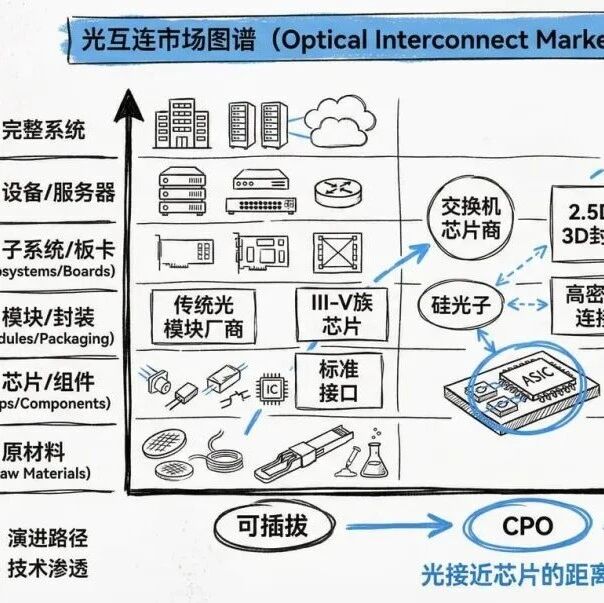
光互联的市场图谱
傅里叶的猫· 2026-02-21 14:13
Core Insights - The article discusses the evolution of optical interconnect technology, highlighting three key structural patterns in the market: vertical integration vs. specialization, the scarcity of light generation, and the rise of SiPho foundries [5][6][10]. Group 1: Market Structure - Vertical integration offers structural advantages during technological transitions, as companies that can design across multiple layers can optimize the entire tech stack [9]. - Companies like Broadcom exemplify vertical integration, appearing across multiple layers of the value chain, while most others focus on specific segments [8]. - The semiconductor industry has historically shown that such advantages may not be permanent, as standardization can lead to the emergence of fabless models [9]. Group 2: Scarcity of Light Generation - The difficulty of producing light sources (Layer 1 and Layer 0) is highlighted, with InP and GaAs materials requiring specialized technology and equipment [12][13]. - Companies capable of mass-producing high-performance InP lasers are few, creating a concentrated market [13][14]. Group 3: Rise of SiPho Foundries - Layer 2, which focuses on SiPho foundries, is gaining attention as traditional semiconductor manufacturers like TSMC and GlobalFoundries enter the photonics space [17]. - TSMC's potential to optimize both AI chips and optical interconnects within the same ecosystem could disrupt existing vertical integration advantages [17]. Group 4: Layer Analysis - Layer 0 involves substrate supply, with companies like AXT benefiting from increased demand for III-V substrates, although geopolitical risks exist due to production in China [21][22]. - Layer 1 is dominated by Coherent and Lumentum, both of which manufacture InP lasers and are expanding production amid high demand [24][25]. - Layer 2 focuses on SiPho foundries, with companies like GlobalFoundries and TSMC leading in manufacturing photonic integrated circuits [27][29]. - Layer 3, represented by DSPs, faces potential obsolescence as CPO technology advances, with companies like Broadcom and Marvell adapting to this shift [33][36]. - Layer 4 sees companies like Innolight and Eoptolink currently leading in the pluggable module market, but their positions may be challenged as the industry shifts towards CPO [40][42]. Group 5: Future Signals - Key indicators to watch include pJ/bit energy consumption metrics, which reflect technological advancements and efficiency [56]. - The ongoing standardization efforts, such as OIF and UCIe, will shape the future market landscape and influence competitive dynamics [57][59]. - Recent mergers and acquisitions signal strategic directions in the industry, with notable deals like Marvell's acquisition of Celestial AI [60][62]. - The choices made by major cloud service providers like Google and AWS regarding their technology partnerships will ultimately determine market trajectories [63][64].



GlobalFoundries expects strong quarterly revenue on chips demand from data centers
Reuters· 2026-02-11 12:44
Core Viewpoint - GlobalFoundries has forecasted first-quarter revenue that exceeds Wall Street expectations, driven by strong demand for its chips, and has announced a $500 million share buyback program, positively impacting its stock price [1] Group 1: Financial Performance - The company anticipates first-quarter revenue to surpass analyst expectations, indicating robust demand for its semiconductor products [1] - The announcement of a $500 million share buyback program is expected to enhance shareholder value and reflects confidence in the company's financial health [1] Group 2: Market Demand - Strong demand for chips is a key factor contributing to the positive revenue forecast, suggesting a favorable market environment for GlobalFoundries [1]


QuickLogic Announces Orders for Strategic Radiation Hardened FPGA Development Kit
Prnewswire· 2026-01-14 12:00
Core Insights - QuickLogic Corporation has received orders for its Strategic Radiation Hardened FPGA Development Kit, which includes test chips fabricated on GlobalFoundries' 12 nm process technology [1][2] Group 1: Product Development - The SRH FPGA Development Kit is designed to meet the requirements of large Defense Industrial Base customers with ongoing programs [2] - The delivery of the SRH FPGA Dev Kit is scheduled for late Q1 2026 [1] Group 2: Company Overview - QuickLogic is a fabless semiconductor company specializing in eFPGA Hard IP, discrete FPGAs, and endpoint AI solutions [3] - The company combines advanced technology with open-source tools to provide customizable, low-power solutions across various markets including industrial, aerospace, consumer, and computing [3]


Everspin Technologies (NasdaqGM:MRAM) FY Conference Transcript
2026-01-13 20:17
Everspin Technologies FY Conference Summary Company Overview - **Company**: Everspin Technologies (NasdaqGM:MRAM) - **Industry**: Semiconductor, specifically in MRAM (Magnetoresistive Random Access Memory) technology - **Founded**: Spun off from Freescale in 2008, went public in 2016 - **Key Milestones**: - Partnership with GlobalFoundries in 2014 to scale MRAM densities from less than 32 megabits to 1 gigabit using STT MRAM technology - Commercialization of DDR-like interface with 1 gigabit density, shipping to IBM since 2018 - Recent commercialization of XPi parts with densities from 4 megabit to 256 megabit, gaining traction in low Earth orbit satellite, FPGA, and aerospace markets [5][6][17] Product Portfolio - **MRAM Technologies**: - **Toggle MRAM**: Limited to 32 megabit, used in applications requiring fast data logging - **Spin Transfer Torque (STT) MRAM**: Scalable up to 1 gigabit, preferred for applications needing high density and low power consumption - **Applications**: - Industrial automation (e.g., Siemens, Mitsubishi) for real-time data logging - Casino gaming for rapid event recording - Aerospace and defense for low Earth orbit satellites due to radiation immunity and fast write speeds [12][14][15][20] Manufacturing and Partnerships - **Manufacturing Facilities**: - Owns an eight-inch factory in Chandler, Arizona for Toggle MRAM - Partners with GlobalFoundries for STT MRAM manufacturing on 12-inch wafers - **Government Interest**: U.S. government is interested in Everspin for national security applications, particularly in establishing a domestic 300mm MRAM production line [16][36][38] Market Opportunities - **Low Earth Orbit Satellites**: - Estimated 70,000 satellites to be launched in the next five years, with each satellite potentially using 4 to 10 MRAM units - Average Selling Price (ASP) of $50-$100 per unit, indicating significant revenue potential [27][28] - **Data Center Applications**: - Current focus on IBM for cache memory, with plans to develop socket-compatible products for broader market adoption [21][31] Competitive Landscape - **Competitors**: - Competes with NOR Flash, non-volatile SRAM, battery-backed SRAM, and ferroelectric RAM (FRAM) - Everspin does not compete in the embedded MRAM market, as it focuses on standalone MRAM [29][30] - **Market Size**: - Data logging market estimated at $700 million, while the NOR Flash market is $3-$4 billion [30] Licensing and Royalties - **IP Portfolio**: Over 650 patents developed with an investment of over $100 million - **Revenue from Licensing**: Targeting 10%-15% of revenue from licensing, which tends to be lumpy but high margin [22][23] Conclusion - Everspin Technologies is well-positioned in the MRAM market with a strong focus on innovation, manufacturing capabilities, and strategic partnerships. The company is targeting significant growth opportunities in aerospace, defense, and data center applications while maintaining a robust IP portfolio to support its licensing business [43][44]

印度芯片,来势汹汹
半导体芯闻· 2026-01-13 10:21
Core Insights - The Indian semiconductor market is projected to double from $52 billion in 2024 to $103.4 billion by 2030, indicating significant growth potential in the sector [1] - The establishment of India's first large-scale semiconductor manufacturing plant, backed by Tata Electronics with a $10 billion investment, marks a pivotal moment in India's ambition to reshape its position in the global technology landscape [1] - India's semiconductor strategy includes a comprehensive investment framework aimed at building a complete chip ecosystem, which has attracted interest from various international companies despite some hesitance due to infrastructure concerns [2][3] Group 1: Market Growth and Investment - The Indian semiconductor market is expected to grow from $52 billion in 2024 to $103.4 billion by 2030, reflecting a strong growth trajectory [1] - Tata Electronics is investing $10 billion to build India's first semiconductor manufacturing facility, which will produce 15 million chips daily for automotive, defense, and industrial applications [1] - The Indian government has launched the Indian Semiconductor Mission (ISM) to create an attractive investment framework, including a 75% cost subsidy for projects [2] Group 2: Challenges and Strategic Initiatives - Despite substantial government subsidies, global chip manufacturers remain cautious about investing in India due to the need for advanced infrastructure and technology [2][3] - The Indian semiconductor industry faces a significant talent gap, with only 1% of 600,000 annual electronics engineering graduates skilled in manufacturing and advanced packaging technologies [5][6] - The government is encouraging strategic partnerships and technology collaborations to enhance local capabilities and maintain national interests [3] Group 3: Outsourcing and Design Capabilities - India has a competitive advantage in Outsourced Semiconductor Assembly and Test (OSAT) due to lower capital intensity and a rich engineering talent pool [4] - The design incentive program by the Indian Semiconductor Industry Association aims to elevate India's position in the semiconductor value chain, with 23 chip design projects approved by mid-2025 [5] - Major global companies are investing heavily in India's semiconductor sector, with LAM Research investing over $1 billion and AMD establishing its largest design center in Bangalore [5] Group 4: Future Outlook - India's R&D spending is only 0.65% of GDP, significantly lower than the U.S. and China, which hampers innovation and competitiveness [6] - The next 12 to 18 months are critical as India prepares to launch its first commercial semiconductor manufacturing plants, facing stringent global standards [6] - The ultimate goal for India is to build a robust and self-sufficient domestic semiconductor market while establishing itself as a semiconductor hub in South Asia [6]

QuickLogic Announces Expanded Scope of Strategic Radiation Hardened FPGA Contract
Prnewswire· 2025-12-18 12:04
Core Insights - QuickLogic Corporation has announced an increase in the scope of its Prime U.S. government contract for the development of Strategic Radiation Hardened (SRH) FPGA technology, now including GlobalFoundries' 12LP fabrication process, raising the total ceiling value to $88 million over multiple years [1][3] Group 1: Contract Details - The total contract ceiling has been increased to approximately $88 million over the span of multiple years [3] - The project is sponsored by the Department of Defense's Trusted and Assured Microelectronics (T&AM) Program, with the Naval Surface Warfare Center (NSWC) Crane serving as the Government's technical lead [1] Group 2: Company Developments - QuickLogic has completed the design and tape out for an FPGA test chip that will be fabricated by GlobalFoundries on its 12LP process [2][3] - The company specializes in embedded FPGA (eFPGA) Hard IP, discrete FPGAs, and endpoint AI solutions, focusing on low-power, customizable solutions for various markets including aerospace and defense [2]

NVTS Deepens Global Partnerships: Will This Fuel Long-Term Gains?
ZACKS· 2025-12-04 15:02
Core Insights - Navitas Semiconductor (NVTS) is enhancing its position in high-power markets through strategic partnerships aimed at solidifying its supply chain and expanding its global reach [1] Partnerships and Collaborations - In late November, Navitas Semiconductor expanded its partnership with WT Microelectronics in Asia, which will lead customer engagement and logistics to improve support for high-power customers in the region [2] - A long-term partnership with GlobalFoundries was announced in mid-November, focusing on the development and manufacturing of next-generation Gallium Nitride (GaN) power devices, with production expected in late 2026 [3] - The company is also coordinating with foundry partners like Taiwan Semiconductor Manufacturing Company and Powerchip Semiconductor Manufacturing Corporation to prepare mid-voltage GaN and high-voltage Silicon Carbide (SiC) products for future AI server and grid applications [4] Strategic Direction - These partnerships align with the "Navitas 2.0" strategy, which reallocates resources toward high-power customers, reduces focus on lower-margin mobile business, and enhances collaboration with hyperscalers, GPU vendors, and system OEMs [5] - The strategic partnerships are expected to strengthen the supply chain, improve customer access, and prepare for significant opportunities as high-power markets scale in 2026 and 2027 [6] Competitive Landscape - Navitas Semiconductor faces competition from Wolfspeed and ON Semiconductor in supplying high-voltage solutions for AI data centers, with Wolfspeed investing $3 billion in a new fab for SiC applications [7] - ON Semiconductor is expanding its SiC portfolio and has partnered with NVIDIA to advance 800 Volts DC power systems for next-generation AI data centers [8] Financial Performance - Shares of Navitas Semiconductor have increased by 142.9% year to date, outperforming the Zacks Electronics – Semiconductors industry's growth of 49.7% [9] - The company trades at a forward price-to-sales ratio of 49.3X, significantly higher than the industry's average of 7.92X [12] - The Zacks Consensus Estimate indicates that the loss per share for 2025 is expected to narrow to 21 cents from 24 cents in the previous year, with similar expectations for 2026 [15]

西部证券晨会纪要-20251204
Western Securities· 2025-12-04 01:40
Core Conclusions - The report emphasizes that companies that are the first to enter mass production of silicon photonic modules are likely to enjoy high margins during the industry's acceleration phase and benefit from market share consolidation [1][8] - Leading silicon photonic module manufacturers are expected to receive priority supply chain support, with key materials such as silicon photonic chips and CW light sources likely to see accelerated domestic substitution and market share breakthroughs [1][8] Industry Overview - Since 2025, the optical module industry has maintained high prosperity due to the continuous growth in AI computing demand. Silicon photonic modules are gaining recognition from end customers due to their high integration, low energy consumption, and low cost. Additionally, silicon photonic solutions are becoming a key supplement to capacity supply amid shortages of EML raw materials [5] - Silicon photonic technology is currently in the phase of integration and application, with future trends pointing towards higher speeds, greater integration, advanced packaging, and broader application fields [5] Physical Structure Analysis - Key components of silicon photonic modules include: 1. Lasers: Responsible for converting electrical signals into optical signals, with external CW light sources being the mainstream solution. Heterogeneous bonding technology is expected to become the mainstream solution for on-chip lasers in the future. 2. Modulators: Currently dominated by silicon-based substrates, with MZM being the mainstream solution. Thin-film lithium niobate modulators are expected to see large-scale application in the 3.2T era. 3. Detectors: Silicon-based germanium detectors are the mainstream solution. 4. Other passive devices: Such as (de)multiplexers, resonators, etc. 5. Electrical chips: Such as DSP, TIA, Driver, etc. [6] Industry Chain Analysis - The silicon photonic module industry chain can be divided into several segments: 1. Upstream: Key materials, including silicon photonic chips, which are primarily designed by North American manufacturers. The wafer foundry segment has high process barriers, with capacity concentrated in Tower Semi, GF, and TSMC. 2. CW Light Sources: Mainly composed of InP, with major suppliers including Sumitomo Electric and AXT. Domestic suppliers include Yuanjie Technology and Shijia Photonics. 3. DSP: Mainly designed by Broadcom and Marvell, with TSMC responsible for foundry. 4. Midstream: Optical module packaging, with representative companies such as Zhongji Xuchuang and Xinyi Technology. 5. Downstream: System integrators or end customers [7] Investment Recommendations - Companies that lead in the mass production of silicon photonic modules are expected to enjoy high margins and benefit from market share consolidation during the industry's acceleration phase. Key areas of focus include: 1. Silicon photonic chip design: Attention should be paid to the layout and further participation of optical module manufacturers in the silicon photonic chip design segment, with recommendations to focus on Zhongji Xuchuang and Xinyi Technology. 2. Substrates and epitaxy: Focus on heterogeneous integration and InP material suppliers, recommending Sumitomo Electric and AXT. 3. Silicon photonic wafer foundry: Monitor capacity scale and expansion, as well as the potential for domestic substitution, recommending Tower Semi, GlobalFoundries, TSMC, and SMIC. 4. CW Light Sources: Look for investment opportunities amid supply-demand mismatches and capacity expansion, recommending Yuanjie Technology and Shijia Photonics. 5. Silicon photonic modules: Focus on companies that achieve early scale and technological leadership, which may significantly enhance profitability, recommending Zhongji Xuchuang, Xinyi Technology, Cambridge Technology, Tianfu Communication, and Guangxun Technology [8]
硅光模块行业深度报告:AI驱动高成长,从物理结构和产业链视角拆解硅光投资机会
Western Securities· 2025-12-03 09:33
Investment Rating - The industry investment rating is "Overweight" and has been maintained from the previous rating [11]. Core Insights - The report highlights that the silicon photonics module industry is experiencing high growth driven by increasing AI computing power demands and the advantages of silicon photonics technology, such as high integration, low energy consumption, and cost-effectiveness [7][10]. - The report identifies a shift in the industry towards silicon photonics as a key supply supplement due to shortages in EML raw materials, indicating a growing acceptance of silicon photonics solutions among end customers [27][28]. Summary by Sections Silicon Photonics Technology Overview, Industry Rhythm, and Development Trends - Silicon photonics technology utilizes silicon as the optical medium and is compatible with CMOS processes to manufacture photonic and optoelectronic devices, enabling applications in optical communication and computing [7][16]. - The current stage of silicon photonics technology is focused on integration and application, with future trends pointing towards higher speeds, greater integration, advanced packaging, and broader application fields [29]. Breakdown of Silicon Photonics Principles and Structural Components - Key components include: 1. Lasers: External CW lasers are the mainstream solution, with heterogeneous bonding technology expected to become prevalent for on-chip lasers [8]. 2. Modulators: Silicon-based substrates are predominant, with MZM being the mainstream solution [8]. 3. Detectors: Silicon-germanium detectors are the mainstream solution [8]. 4. Other passive devices include multiplexers and resonators [8]. Analysis of the Silicon Photonics Module Industry Chain - The industry chain is divided into three segments: 1. Upstream: Core materials, including silicon photonic chips, with design led by North American firms and manufacturing concentrated among a few foundries [9]. 2. Midstream: Module packaging, with leading companies closely collaborating with clients and maintaining high market shares [9]. 3. Downstream: System integrators or end customers [9]. Investment Recommendations - Companies that lead in the mass production of silicon photonics modules are expected to enjoy high margins and benefit from market share consolidation [10]. - Key areas of focus include: 1. Silicon photonic chip design: Companies like Zhongji Xuchuang and Xinyi Sheng are recommended for their strategic positioning [10]. 2. Substrate and epitaxy: Companies like Sumitomo Electric and AXT are highlighted for their roles in material supply [10]. 3. Silicon photonic wafer foundries: Tower Semiconductor, GlobalFoundries, TSMC, and SMIC are noted for their capacity and expansion potential [10]. 4. CW light sources: Companies like Yuanjie Technology and Shijia Photonics are recommended due to supply-demand mismatches [10]. 5. Silicon photonic modules: Companies like Zhongji Xuchuang, Xinyi Sheng, Cambridge Technology, Tianfu Communication, and Guangxun Technology are highlighted for their technological leadership [10].