Mercury

Search documents
喝点VC|a16z最新2026大预测:下一波可观测性的浪潮将是物理的,而非数字的
Z Potentials· 2026-02-13 02:27
Core Insights - The article discusses the emergence of an AI-native industrial foundation in the U.S., focusing on sectors like energy, manufacturing, logistics, and infrastructure, which are being revitalized through AI and software innovations [3][4]. - By 2026, AI applications will evolve to eliminate visible prompts, allowing for proactive suggestions based on user behavior, enhancing personal and professional interactions [19][26]. Group 1: American Dynamism and Industrial Revival - The U.S. is rebuilding its industrial base, emphasizing AI-driven solutions in energy, manufacturing, and logistics, creating significant opportunities in advanced energy systems and autonomous operations [4][5]. - Companies are adopting a "factory mindset" to tackle complex challenges by integrating AI and automation with skilled labor, leading to efficient production processes [5][6]. - The rise of "physical observability" through interconnected sensors and cameras will enhance real-time monitoring of critical infrastructure, paving the way for advancements in robotics and autonomous systems [7]. Group 2: AI in Business and Consumer Applications - AI is transforming business models by enhancing economic outcomes rather than merely automating tasks, with companies like Eve using data to improve legal service success rates [14][15]. - The consumer AI landscape is shifting from task-oriented applications to those that foster deeper human connections, with products designed to understand users better [26][27]. - The emergence of AI voice agents is streamlining business operations, allowing companies to automate various tasks and improve efficiency [17]. Group 3: Data and Infrastructure - The future of AI will be defined by the ability to harness vast amounts of unstructured data generated in industries, with companies focusing on data collection and model training [12][13]. - The electrical industrial stack is becoming crucial for the next industrial revolution, integrating software with physical manufacturing processes [8]. Group 4: Future Trends and Opportunities - By 2026, companies will increasingly rely on collaborative AI systems that work together across business processes, necessitating a rethinking of organizational structures and workflows [24][25]. - New AI startups will emerge, focusing on serving newly established companies, leveraging the opportunity to grow alongside them [29][30].


软件没有死,但“通用软件”已死
3 6 Ke· 2026-02-09 01:58
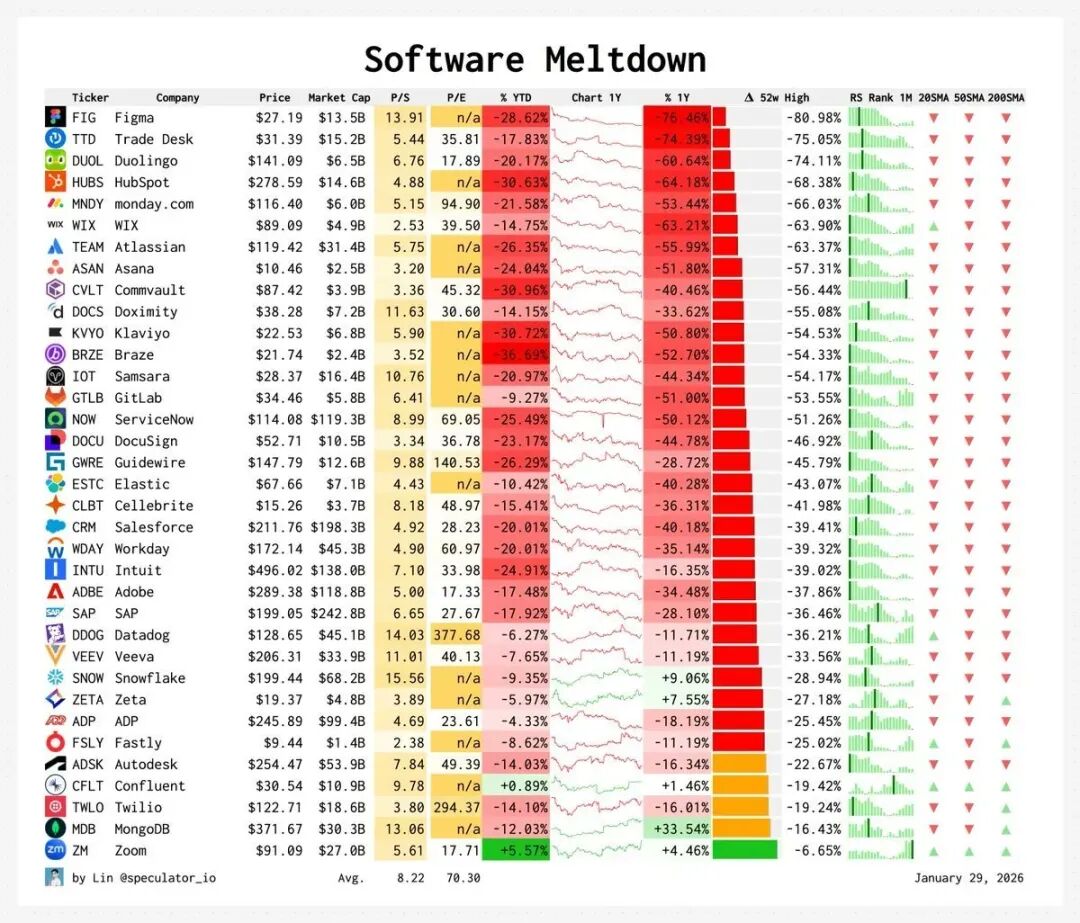
Core Insights - The software sector is experiencing a significant downturn, characterized by a broad sell-off rather than a tactical adjustment, indicating a potential capitulation phase across various software companies [1][4] - The current market sentiment reflects a loss of confidence in the business models of software companies, leading investors to simplify their holdings and view software stocks as a single trading entity rather than a diverse collection of business models [5] Market Performance - A detailed analysis of several software companies reveals substantial declines in stock prices, with many experiencing over 60% drops from their recent highs, indicating severe market distress [2] - Companies like Figma, Trade Desk, and Duolingo have seen year-to-date declines of 80.98%, 75.05%, and 60.64% respectively, highlighting the widespread impact of the downturn [2] Industry Dynamics - The competitive boundaries within the software industry are shifting, with companies like Robinhood expanding their service offerings beyond traditional brokerage functions to include comprehensive financial services [6][8] - The integration of software with financial and professional services is blurring traditional lines, prompting investors to focus on where disruptions may occur and their potential impact on existing profit pools [8] Disruption Framework - A framework for assessing software companies' vulnerability to disruption has been proposed, focusing on five key dimensions: record systems vs. surface tools, seat-based pricing vs. data-based economics, timeless data vs. ephemeral information, deep workflows vs. shallow automation, and durable structural advantages vs. shallow ones [47] - This framework encourages a nuanced understanding of software companies, moving beyond the assumption that all software stocks are equally at risk to a more detailed analysis of their underlying value structures [43][58] Strategic Considerations - Companies with core systems that are deeply embedded in client operations face higher switching costs and risks, while those that are merely supplementary tools may be more easily replaced [45] - The pricing model of a software company can indicate its resilience; those tied to human labor are at greater risk of being undermined by AI advancements, while those linked to long-term data or critical processes may be more secure [24][29] - The longevity of data value is crucial; companies that generate data with a long half-life are better positioned against disruption compared to those with rapidly depreciating data [30][31] Conclusion - The current sell-off in the software sector is not irrational but reflects a rational reassessment of the risks posed by AI and changing market dynamics [47][56] - Understanding the structural vulnerabilities and strengths of software companies is essential for investors navigating this turbulent landscape, as some companies are inherently more resilient than others due to their foundational business models and data assets [58][59]


2026 年,商业变革者将面对什么?a16z 的最新趋势观察
3 6 Ke· 2026-01-29 10:58
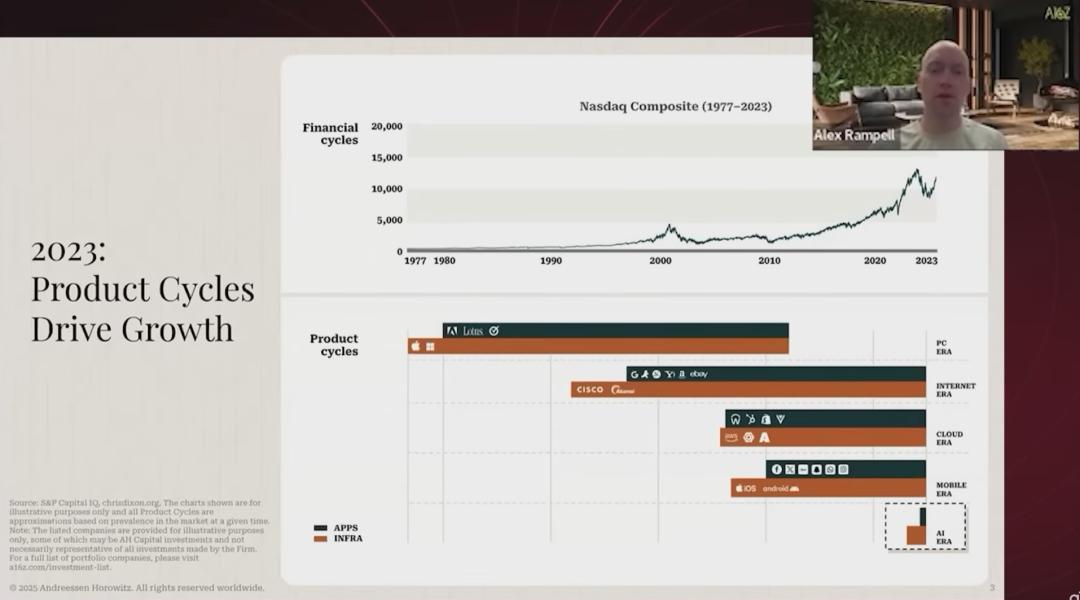
Group 1: AI Capabilities and Paradigms - Vertical AI is transitioning from information retrieval to "multi-agent mode," enabling unprecedented growth in industries like healthcare, legal, and housing, with companies achieving over $100 million in annual revenue [2] - By 2026, vertical AI will unlock "multi-agent mode," allowing for collaboration across various roles in industries, enhancing efficiency and understanding of complex workflows [3] - The emergence of "Agent-native" infrastructure will be crucial, as systems evolve to handle intelligent agent-driven workloads, requiring a redesign of control planes to manage high-frequency tool calls and complex concurrency [6][7] Group 2: Education and Talent Development - The first AI-native university is expected to emerge by 2026, focusing on real-time learning and self-optimizing educational systems, with courses and academic guidance adapting based on data feedback [4][5] - This AI-native university will train graduates proficient in system orchestration, addressing the talent gap in the new economy [5] Group 3: Content Creation and Media - 2026 is anticipated to be a pivotal year for multi-modal content creation, where AI can generate and edit content across various formats, enhancing creative control for users [8][9] - Video content will evolve into interactive environments, allowing for dynamic storytelling and user engagement, blurring the lines between creator and audience [10] Group 4: AI in Business Operations - The traditional metric of "screen time" as a value delivery indicator will be replaced by more complex ROI measures, focusing on outcomes rather than usage time [11] - Companies will increasingly adopt multi-agent systems to manage complex workflows, leading to a rethinking of organizational structures and roles [19][20] Group 5: Consumer AI and Personalization - Consumer-grade AI products will shift from productivity tools to enhancing personal connections and self-awareness, with a focus on understanding users' complete life contexts [21] - The trend towards personalized products will redefine how companies approach consumer engagement, moving from mass production to individualized experiences [13] Group 6: Research and Development - AI will play a significant role in accelerating scientific discovery through autonomous laboratories capable of conducting experiments and iterating research directions [15] - The integration of AI in research workflows will foster a new style of inquiry, emphasizing the relationships between ideas and enabling novel discoveries [22][23] Group 7: Data Privacy and Security - The need for transparent and auditable data access controls will become critical as AI systems operate autonomously, necessitating a shift towards "secrets as a service" to protect sensitive information [25] Group 8: Startup Ecosystem - A new wave of startups will emerge, focusing on providing services to newly established companies, leveraging the current AI product cycle to achieve scalability [26]
Nomura spinoff Laser Digital applies for OCC charter
Yahoo Finance· 2026-01-28 14:37
Core Viewpoint - Laser Digital, a spinoff from Nomura, has applied for a national trust bank charter to enhance its digital asset services and streamline regulatory compliance [1][2]. Group 1: Company Developments - Laser Digital plans to offer custody of digital assets and U.S. government securities, as well as spot trading and staking, but will not engage in direct deposits or trade securities [2]. - The application for the national trust bank charter aims to eliminate the need for state-by-state custody licenses, reflecting the company's strategic move to scale its operations [2]. - Steve Ashley, co-founder of Laser Digital, emphasized that the application aligns with the company's global ambitions and the importance of operating under stringent regulatory standards in the U.S. financial market [5]. Group 2: Industry Trends - The Office of the Comptroller of the Currency (OCC) has seen a significant increase in charter applications, with 18 de novo applications filed in 2025, indicating a growing interest among nonbank entities [2]. - The OCC conditionally approved national trust banking charters for five digital-asset firms in December, showcasing a trend towards regulatory acceptance in the digital asset space [3]. - Industry experts predict that the OCC will receive 25 novel charter applications in 2026, highlighting the evolving landscape of banking and the challenges to traditional banking franchise value [6].
a16z 终于把 AI 的投资逻辑说清楚了,真正值钱的,只剩这三条路
3 6 Ke· 2026-01-20 11:46
Core Insights - The article discusses the transformative impact of AI on various industries, emphasizing the need for sustainable business value as technology matures. It highlights the shift in competitive advantages towards application and data layers in a landscape where software can be rapidly replicated [1][4][19]. Investment Directions - Three promising investment areas are identified: 1. AI-native transformation of traditional software 2. Software replacing labor 3. Value reconstruction based on exclusive data [1][8][19]. AI and Human Needs - The article posits that AI aligns with the fundamental human desires to be "richer and lazier," which is driving its adoption across sectors. Approximately 15% of adults globally use ChatGPT weekly, indicating its integration into daily life [2][4][5]. Product Lifecycle and Market Dynamics - Historical product cycles reveal that infrastructure companies pave the way for application teams to develop real products. The current AI boom is seen as a continuation of this trend, with significant revenue growth in the software sector attributed to AI [2][4]. AI-native Transformation - Traditional software is undergoing AI-native transformation, creating investment opportunities. Companies like Mercury exemplify this shift by providing integrated banking and accounting services for startups [8][10]. Labor Replacement by Software - AI's potential to replace labor is highlighted as a significant market opportunity. Software can now perform up to 90% of core job functions, making it a viable alternative to human employees [9][10]. Data as a Competitive Advantage - The article emphasizes the importance of proprietary data as a competitive barrier. Companies that can create unique data ecosystems will have a significant edge in the market [15][19][20]. "Walled Garden" Concept - The "walled garden" concept is introduced, where companies like OpenAI transition from providing foundational models to developing end-user applications, creating exclusive data value [19][20]. Case Studies of Unique Data Value - Examples such as Flight Aware and Ancestry.com illustrate how companies leverage unique data to create competitive advantages. These firms have built proprietary databases that are difficult for competitors to replicate [20][21][22]. Market Expansion through AI - AI is seen as a tool to expand market opportunities, particularly in sectors like legal services, where it can lower the barriers for lawyers to take on more cases [11][14][25]. Conclusion - The article concludes that the future of AI will not only involve replacing human labor but also enhancing human efficiency, creating new job roles, and establishing strong data-driven business models [16][24].
畅想2026:第二部分
3 6 Ke· 2026-01-18 23:09
Core Insights - The article discusses the transformative impact of AI on various industries, emphasizing the shift towards native AI infrastructure and the revival of American manufacturing by 2026 [2][3][16]. Group 1: AI Infrastructure and Industry Transformation - The rise of native AI and software-first industry infrastructure is reshaping sectors like energy, manufacturing, logistics, and infrastructure, creating significant opportunities [2]. - Companies are moving away from modernizing past systems to building future-oriented solutions, particularly in advanced energy systems and autonomous operations [2]. - The integration of AI into manufacturing processes will lead to a new era of industrial strength, characterized by modular deployment of AI and automation technologies [3]. Group 2: Observability and Data Utilization - The concept of physical observability is becoming crucial, with over a billion connected cameras and sensors deployed across the U.S., enabling real-time insights into urban and infrastructure dynamics [5]. - The demand for data in key industries is increasing, with companies leveraging existing physical infrastructure to collect vast amounts of operational data at minimal costs [9][10]. Group 3: AI in Financial Services - Financial institutions are expected to modernize their foundational infrastructure to fully leverage AI, moving away from outdated vendor contracts to more integrated native AI solutions [16]. - The simplification and parallelization of workflows in financial services will lead to the emergence of new market leaders that can scale significantly beyond traditional firms [16]. Group 4: New Roles and Organizational Structures - The rise of multi-agent systems will necessitate a rethinking of organizational structures and workflows, leading to the creation of new roles such as AI workflow designers and agent supervisors [19]. - Companies will need to develop coordination systems to manage interactions among multiple AI agents, enhancing decision-making and operational efficiency [19]. Group 5: Consumer AI Evolution - By 2026, consumer AI products are expected to shift from productivity tools to enhancing personal connections and self-awareness, creating a more integrated part of daily life [20][21]. - The emergence of new companies driven by advanced reasoning and multi-modal capabilities will unlock previously impossible business models and applications [22]. Group 6: Startup Ecosystem and Growth Strategies - Startups are positioned to capitalize on the current AI product cycle by targeting new companies and growing alongside them, following a "greenfield" approach [23]. - The year 2026 is anticipated to witness a significant scaling of startups that adopt this strategy, focusing on underserved markets and innovative solutions [23].
Bunq re-applies for OCC license
Yahoo Finance· 2026-01-07 14:49
Core Viewpoint - Bunq has re-applied for a de novo banking license in the U.S. after previously withdrawing its application due to regulatory differences between the U.S. and the Netherlands [1][2]. Group 1: Company Developments - Bunq aims to launch its services in U.S. metropolitan areas with large expatriate communities if its application is approved [2]. - The platform will enable users to quickly build credit scores using European financial records and maintain both U.S. and European checking accounts if eligible [2]. - CEO Ali Niknam emphasized the need for a safe and user-friendly banking solution for users living across borders [3]. Group 2: Regulatory Context - Several fintech companies have recently applied for banking licenses with the Office of the Comptroller of the Currency (OCC), reflecting a trend of relaxed financial regulations [4]. - The OCC has conditionally approved applications for several digital asset firms and a de novo bank charter for Erebor Bank [4]. - Bunq's CEO indicated a preference for a thorough evaluation process rather than rushing the application [5].
战略即战略决策
3 6 Ke· 2026-01-06 12:13
Core Insights - The article emphasizes the importance of strategic decision-making in rapidly changing markets, defining effective strategy as the ability to make quick, high-quality decisions that are widely supported [2][29]. Group 1: Definition and Importance of Strategy - Strategy is defined as answering two fundamental questions: "Where do you want to go?" and "How do you want to get there?" [1] - Traditional strategic methods focus primarily on the first question, often neglecting the second, which is crucial in today's fast-paced market [1][29]. Group 2: Characteristics of Effective Strategic Decision-Making - Effective strategic decision-makers establish collective intuition, enabling faster and more accurate identification of threats and opportunities [30]. - High-performing companies exhibit significant differences in their strategic decision-making processes compared to lower-performing companies, often making decisions that are both quick and of high quality [3][29]. Group 3: Methods for Enhancing Decision-Making Efficiency - High-efficiency decision-makers utilize diverse teams and heuristic methods to stimulate rapid conflict, thereby improving decision quality [30]. - Maintaining a rigorous pace in decision-making processes is essential, with effective decision-makers adhering to a natural rhythm for strategic choices, typically taking two to four months for significant decisions [20][21]. Group 4: Political Dynamics in Decision-Making - Effective decision-makers actively work to mitigate political behaviors that can distort information and waste time, focusing instead on collaboration and shared goals [25][26]. - Establishing a balanced power structure and fostering a light-hearted atmosphere can help alleviate political tensions and enhance collaboration among decision-makers [26][28]. Group 5: Conclusion and Strategic Decision-Making Framework - The article concludes that frequent meetings, real-time metrics, diverse teams, and a focus on shared objectives are critical for effective strategic decision-making [30][31]. - These strategies help prevent destructive interpersonal conflicts and time-wasting political struggles, ultimately leading to more effective strategic outcomes [31][32].
IMG Sachsen-Anhalt: 2026 in Sicht - Sachsen-Anhalt gibt die Richtung für Zukunftsindustrien vor
Prnewswire· 2025-12-20 19:32
Group 1: Industry Developments - Wintipak is expanding its aseptic packaging solutions in Halle with the third construction phase in Star Park, enhancing its European production network's stability and committing to sustainable production processes [1] - Avnet is investing over 225 million euros to build a distribution center for electronic components in Bernburg, expected to create up to 700 new jobs and capable of shipping tens of thousands of packages daily starting in spring 2026 [2] - Mercury is establishing a development and production center in Schönebeck, set to open in spring 2026, which will employ around 200 skilled professionals to provide technical services for high-tech customers in Europe [3] Group 2: Major Projects and Employment - Daimler Truck has completed the largest spare parts center in Europe in Halberstadt within two years, creating over 650 jobs and implementing a CO-neutral energy concept for sustainable logistics [4] - Ramme Electric Machines, a manufacturer of electric ship motors, exemplifies successful medium-sized enterprises in Saxony-Anhalt, while Campo Amargo is expanding its specialty reagent production in the Bitterfeld-Wolfen chemical park [5] - Merz is investing 50 million euros in additional capacities for specialized active ingredients in the Biopharma Park Dessau-Roßlau, further enhancing the region's biotechnological expertise [5] Group 3: Regional Growth and Future Prospects - Saxony-Anhalt is building on its successes and aims for further milestones by 2026, positioning itself as an attractive location for companies seeking growth, innovation, and future viability [6]


FinTech Mercury Submits Applications to Become National Bank
PYMNTS.com· 2025-12-19 18:59
Core Viewpoint - FinTech company Mercury is seeking to establish itself as a national bank by applying for a national bank charter and federal deposit insurance, aiming to enhance its offerings and stability for its clients [1][2]. Company Overview - Mercury was founded in 2019 and initially provided checking and savings accounts through FDIC-insured partner banks, later expanding its services to include investment accounts, business charge cards, international wires, lending, consumer banking, and financial software for businesses [3][4]. - The company currently serves over 200,000 clients, including startups, venture capital firms, eCommerce companies, and small businesses [4]. Leadership and Strategy - Mercury has appointed Jon Auxier, a veteran from SoFi, as its chief banking officer, who will also become CEO and president of Mercury Bank upon regulatory approval [4][5]. - Auxier emphasized that few FinTechs possess the financial strength and operational discipline to pursue a charter at this scale, highlighting Mercury's profitability and strong balance sheet as foundational elements for its banking ambitions [6]. Product Development - The company aims to provide a powerful self-service banking option tailored for founders and individuals in the tech sector, as evidenced by the launch of Mercury Personal in April 2024 [6][7].