中间业务收入

Search documents
银行业从“吃息差”到“赚中收”
Jing Ji Wang· 2026-02-27 02:48
"2026年我们将着力强化财富管理与综合金融服务能力,提升中收对营收的支撑。做大财富管理、资产 托管、投行等轻资本业务,优化收入结构,应对息差压力。"某股份行北京分行相关负责人向中国证券 报记者表示。 近期,多家银行召开2026年工作会议,部署全年工作安排。在净息差持续收窄背景下,优化收入结构、 提升轻资本业务占比成为银行重塑盈利格局的新方向。财富管理业务作为银行中收增长的重要引擎,是 应对息差压力、实现高质量发展的关键抓手。 提高财富管理等业务中收贡献 多家银行在2026年工作会议中明确,将着力推动中收增长。兴业银行表示,2026年要突出重点稳增长, 全力拓资产、强负债、稳息差、增中收。该行将继续推动价值银行建设,以"资管+财富"为有效支撑, 积极承接产业金融的融资需求与零售客户的财富需求,推动形成更多中收增长来源。光大银行也提出, 2026年将提升客户经营价值,推动存款成本改善,促进金市业务专业化经营,着力提高财富管理、交易 银行、投行、托管业务中收贡献。 当下,财富管理业务作为银行中收的主要来源之一,在银行整体经营体系中的重要性愈发凸显。 这一变化也直接体现在银行基层考核导向的调整中。"今年已明确调整了 ...




从“吃息差”到“赚中收” 银行业2026年盈利格局料重塑
Zhong Guo Zheng Quan Bao· 2026-02-26 22:35
● 本报记者 石诗语 "2026年我们将着力强化财富管理与综合金融服务能力,提升中收对营收的支撑。做大财富管理、资产 托管、投行等轻资本业务,优化收入结构,应对息差压力。"某股份行北京分行相关负责人向中国证券 报记者表示。 这一变化也直接体现在银行基层考核导向的调整中。"今年已明确调整了零售考核指标,比较明显的变 化是,存款的指标权重和任务量下降了,理财、基金、保险、信托等产品的销售任务增加了,私行客户 的拉新和AUM提升任务加重。"某国有大行北京地区某支行零售业务负责人说。 此外,组织架构的调整也成为银行加码财富管理的重要举措。去年12月,交通银行(601328)副行长周 万阜在出席活动时表示,交行在总行层面已成立财富管理部,进一步强化财富金融特色,提升客户服务 能力。 息差承压倒逼转型 谈及银行加大财富管理业务布局的原因,业内人士认为,净息差持续承压,倒逼银行盈利模式转型,推 动银行盈利结构从"利息依赖型"向"多元均衡型"转变,增强盈利稳定性和抗周期能力。同时,随着居民 财富持续积累,由储蓄为主转向多元资产配置的进程已然开启,财富管理市场前景广阔。 国家金融监督管理总局最新披露数据显示,2025年四季度商 ...
从“吃息差”到“赚中收”银行业2026年盈利格局料重塑
Zhong Guo Zheng Quan Bao· 2026-02-26 20:28
谈及银行加大财富管理业务布局的原因,业内人士认为,净息差持续承压,倒逼银行盈利模式转型,推 动银行盈利结构从"利息依赖型"向"多元均衡型"转变,增强盈利稳定性和抗周期能力。同时,随着居民 财富持续积累,由储蓄为主转向多元资产配置的进程已然开启,财富管理市场前景广阔。 国家金融监督管理总局最新披露数据显示,2025年四季度商业银行净息差为1.42%,与三季度持平。业 内人士分析称,虽然自2025年二季度以来,商业银行净息差呈现企稳态势,但整体水平处于历史低位, 考虑到经济社会有降低融资成本的需求,商业银行净息差仍然有一定的下行压力。 近期,多家银行召开2026年工作会议,部署全年工作安排。在净息差持续收窄背景下,优化收入结构、 提升轻资本业务占比成为银行重塑盈利格局的新方向。财富管理业务作为银行中收增长的重要引擎,是 应对息差压力、实现高质量发展的关键抓手。 提高财富管理等业务中收贡献 多家银行在2026年工作会议中明确,将着力推动中收增长。兴业银行表示,2026年要突出重点稳增长, 全力拓资产、强负债、稳息差、增中收。该行将继续推动价值银行建设,以"资管+财富"为有效支撑, 积极承接产业金融的融资需求与零售客 ...
上市银行,迎密集调研!
证券时报· 2026-02-10 11:49
Core Viewpoint - Since 2026, listed banks have experienced intensive institutional research, particularly focusing on small and medium-sized banks in economically developed coastal regions [1] Group 1: Institutional Research and Credit Performance - As of February 9, 2026, 13 listed banks have undergone 54 institutional research sessions, with 386 participating institutions [2] - Key topics of interest include the performance of credit in the "opening red" period, the "14th Five-Year Plan," asset-liability management, and wealth management [2] - Multiple analysts noted that the credit performance in the opening of 2026 is strong, with banks actively developing wealth management and other intermediary businesses [2][4] Group 2: Focus on Credit Allocation - Credit allocation is primarily directed towards the technology and innovation sectors [3] - Banks reported that their credit issuance aligns with expectations, with overall performance better than the previous year [4] - For instance, Suzhou Bank and Hangzhou Bank indicated a good start to the "opening red" period, with increased credit issuance compared to the same period last year [4] - Shanghai Bank focuses on major strategic projects in Shanghai, while also expanding housing mortgages and loans for new energy vehicles in retail [4] Group 3: Intermediary Business Income - Banks are looking to expand intermediary business income as a core strategy to address margin pressure, with wealth management being a key area of focus [6][7] - Analysts from various banks believe that wealth management will continue to improve, driven by active capital market performance and a favorable environment for fee income [7] - The trend of "deposit migration" is not significantly observed, with many banks reporting an increase in new deposits compared to the previous year [7] Group 4: Preliminary Annual Performance Reports - As of February 9, 2026, 11 listed banks have released preliminary performance reports, showing positive growth in operating income and net profit [8][9] - Notably, Qingdao Bank and Qilu Bank reported net profit growth of 21.66% and 14.58%, respectively [9][10] Group 5: Asset Quality and Growth Trends - The asset scale of the listed banks has shown steady expansion, with many small and medium-sized banks growing at rates exceeding 10% [12] - The non-performing loan ratio remains stable, with no significant rebound observed [12] - Analysts expect that the recent implementation of structural monetary policy tools by the central bank will help stabilize net interest margin expectations and enhance credit issuance willingness [12]


上市银行,迎密集调研!
券商中国· 2026-02-10 10:30
Core Viewpoint - Since 2026, listed banks have experienced intensive institutional research, particularly focusing on small and medium-sized banks in economically developed coastal regions [1] Group 1: Institutional Research and Credit Performance - As of February 9, 2026, 13 listed banks have undergone 54 institutional research sessions, with 386 participating institutions [2] - Key topics of interest include the performance of credit in the "opening red" period, the "14th Five-Year Plan," asset-liability management, and wealth management [2] - Many banks reported a good start to the "opening red" period, with credit performance exceeding expectations compared to the previous year [4] Group 2: Focus on Credit Allocation - Credit allocation is primarily directed towards the technology and innovation sectors, with banks aligning their strategies with regional characteristics [3][4] - For instance, Shanghai Bank focuses on major strategic projects in Shanghai, while Qingdao Bank emphasizes technology finance and advanced manufacturing [5] - Analysts noted that the credit "opening red" performance is strong, with state-owned banks and high-quality city commercial banks showing positive feedback [5] Group 3: Middle Business Income Recovery - Banks are focusing on expanding middle business income as a core strategy to address margin pressure, with wealth management being a key area [6][7] - Many banks are enhancing their wealth management capabilities through diversified product offerings and improved customer service [7] - Analysts expect that wealth management will continue to drive fee income growth, supported by a favorable capital market environment [8] Group 4: Preliminary Annual Performance Reports - As of February 9, 2026, 11 listed banks have released preliminary performance reports, showing positive growth in operating income and net profit [9] - Notably, Qingdao Bank and Qilu Bank reported net profit growth of 21.66% and 14.58%, respectively [10] - The overall asset scale of these banks has expanded steadily, with many small and medium-sized banks achieving growth rates exceeding 10% [11] Group 5: Profit Growth Stability - Analysts believe that the stable profit growth of listed banks is due to a narrowing decline in interest margins and improved middle business income [12] - The recent implementation of structural monetary policy tools by the central bank is expected to stabilize net interest margin expectations and enhance credit issuance willingness [12]

宁波银行(002142):全年盈利平稳,中收增长亮眼
Dongxing Securities· 2026-01-22 04:47
Investment Rating - The report maintains a "Strong Buy" rating for Ningbo Bank [5] Core Views - Ningbo Bank's revenue and net profit for 2025 reached 71.97 billion and 29.33 billion respectively, with year-on-year growth of 8.0% and 8.1% [1][2] - The bank's annualized weighted average ROE was 13.11%, a decrease of 0.48 percentage points year-on-year [1] - The non-performing loan ratio remained stable at 0.76%, with a provision coverage ratio of 373.2%, down 2.8 percentage points from the previous quarter [1][3] Revenue and Profit Analysis - Revenue growth slightly declined compared to previous quarters, with net interest income increasing by 10.8% year-on-year, while non-interest income saw a significant rise of 30.7% [2] - Core revenue, which includes net interest income and non-interest income, grew by 12.5% year-on-year [2] - Other non-interest income decreased by 9% year-on-year, primarily due to adjustments in the bond market [2] Credit and Deposit Growth - Total assets increased by 16.1% year-on-year, with loans growing by 17.4%, indicating strong credit growth [3] - Deposits rose by 10.3% year-on-year, with a notable increase in demand deposits [3] - The bank actively optimized its deposit structure, resulting in a decrease in the interest rate on deposits by 44 basis points year-on-year [3] Asset Quality and Provisioning - The non-performing loan ratio remained stable at 0.76%, with a provision coverage ratio of 373.2%, indicating sufficient provisioning levels [3] - The decline in the provision coverage ratio was primarily due to increased risk in the retail sector and proactive write-offs [3] Future Profitability Forecast - The report projects net profit growth rates of 8.1%, 9.8%, and 9.9% for 2025, 2026, and 2027 respectively, with corresponding BVPS of 33.7, 37.5, and 41.6 yuan per share [4] - The closing price on January 20, 2026, corresponds to a PB valuation of 0.76 [4]

存款江湖变天
Di Yi Cai Jing Zi Xun· 2026-01-14 15:15
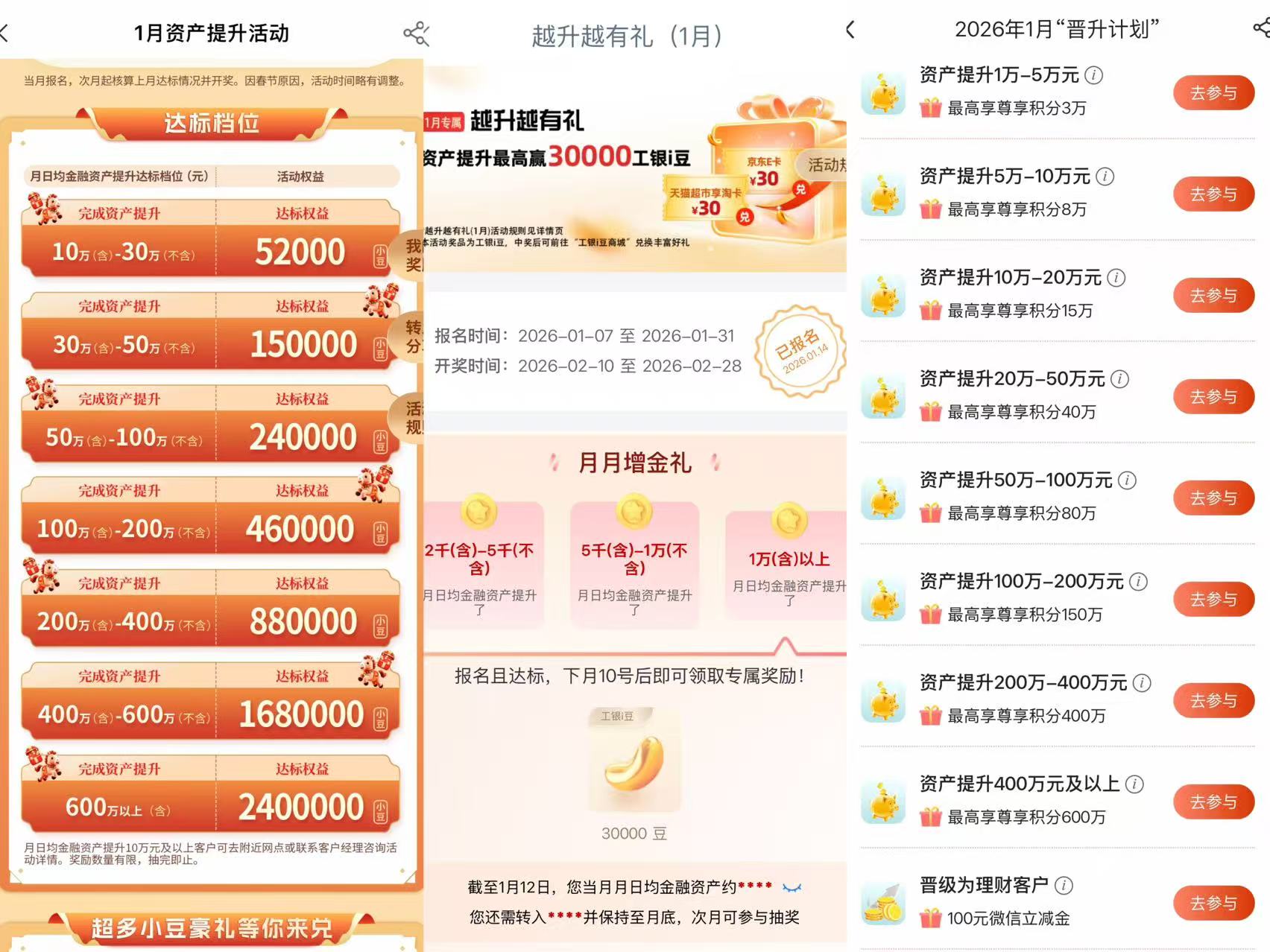
Core Viewpoint - Major banks are shifting their focus from attracting deposits to enhancing assets under management (AUM) and wealth management, especially as they face declining interest rates and pressure to reduce liability costs [2][3]. Group 1: Asset Enhancement Activities - National banks have launched attractive "asset enhancement" activities, with rewards for customers reaching up to over 10,000 yuan for meeting certain deposit thresholds [2]. - Agricultural Bank of China has set a unified asset enhancement activity from January to March 2026, with seven tiers of rewards based on AUM increases, ranging from 52,000 to 2,400,000 small beans [5][6]. - Industrial and Commercial Bank of China (ICBC) offers rewards based on monthly average financial asset increases, with tiers providing rewards of 5,000 to 30,000 ICBC beans [7]. Group 2: Market Dynamics and Strategies - Smaller banks are raising deposit rates to attract customers, with increases of up to 20 basis points, while larger banks focus on enhancing their wealth management strategies [2][10]. - The total amount of term deposits maturing in 2026 is estimated to be 67 trillion yuan, with a significant portion maturing in the first quarter, creating competitive pressure on banks [10]. - Banks are increasingly guiding customers with maturing deposits towards wealth management products, as traditional deposit rates are no longer competitive [11]. Group 3: Customer Engagement and Social Media Trends - Social media platforms are buzzing with strategies for customers to maximize benefits from various banks' asset enhancement activities, indicating a growing trend of consumer engagement in financial products [9]. - The competitive landscape is prompting banks to refine their customer relationship management, transforming traditional deposit products into tools for maintaining customer loyalty [11].
存款江湖变天
第一财经· 2026-01-14 15:06
Core Viewpoint - The article discusses the shift in focus of major banks in China from merely attracting deposits to enhancing asset management and wealth management services, particularly through promotional activities aimed at increasing the scale of various financial assets held by customers [5][6]. Group 1: Asset Enhancement Activities - Major state-owned banks have launched attractive "asset enhancement" activities, shifting their focus from deposit acquisition to increasing assets under management (AUM) and strengthening wealth management [5][6]. - For example, Agricultural Bank of China has set up a structured "Unified Asset Enhancement Activity" from January to March 2026, with rewards based on the increase in average financial assets compared to December 2025, offering rewards ranging from 52,000 to 2,400,000 "small beans" based on different tiers of AUM [6][8]. - The rewards can be exchanged for various products and services, with the highest tier potentially offering over 12,000 yuan in value [8]. Group 2: Competitive Strategies Among Banks - Different banks are implementing various strategies to attract and retain customers, such as Industrial and Commercial Bank of China's "Increasing Rewards" program, which targets customers with lower average financial assets and offers rewards based on asset increases [9]. - Other banks like China Construction Bank and Bank of China are also running similar promotional activities, with varying reward structures and incentives for asset retention [9][10]. - Some smaller banks have raised deposit rates to attract customers, with increases of up to 20 basis points, indicating a competitive environment for customer deposits [11][14]. Group 3: Market Context and Challenges - The banking sector is facing challenges due to declining deposit rates, with significant amounts of term deposits maturing in 2026, leading to increased competition for retaining these funds [12][13]. - The total amount of term deposits maturing this year is estimated at 67 trillion yuan, with a notable portion maturing in the first quarter, creating pressure on banks to retain customers [12][13]. - Banks are increasingly focusing on enhancing their middle-income strategies and wealth management capabilities to counteract the challenges posed by smaller banks and changing customer preferences [13].





银行开门红新风向:大行推“资产提升” 小行逆势提利率
Di Yi Cai Jing· 2026-01-14 13:59
Group 1 - The core focus of major banks has shifted from attracting deposits to enhancing assets under management (AUM) and strengthening wealth management, particularly as they face pressures from declining interest rates and expiring fixed deposits [2][9] - State-owned banks have launched attractive "asset enhancement" activities, offering significant rewards for customers who increase their financial asset holdings, with some rewards exceeding 10,000 yuan [1][4] - Smaller banks are responding to year-end deposit acquisition pressures by temporarily raising deposit interest rates, with increases of up to 20 basis points reported [1][11] Group 2 - Agricultural Bank of China has introduced a structured "asset enhancement activity" from January to March 2026, with various reward tiers based on the increase in monthly average financial assets, allowing customers to earn up to 7.2 million "small beans" for meeting the highest tier [4][5] - Industrial and Commercial Bank of China has also launched similar initiatives, offering rewards based on the increase in monthly average financial assets, with potential rewards ranging from 5,000 to 30,000 "ICBC beans" [6][9] - Other banks, including China Construction Bank and Bank of China, have introduced their own asset enhancement programs, with varying reward structures and incentives for customers [6][8] Group 3 - The upcoming maturity of a significant volume of fixed deposits, estimated at 67 trillion yuan in 2026, presents both challenges and opportunities for banks as they navigate customer retention and interest rate adjustments [9][10] - Some banks are strategically guiding customers with maturing fixed deposits towards wealth management products, as traditional deposit rates are no longer competitive [10][11] - The competitive landscape is intensifying as banks adapt their strategies to maintain customer relationships and mitigate deposit outflows to smaller banks, which may offer more attractive rates [10][11]
破局立新,价值回归:2025年银行业十大动向勾勒发展新图景
Mei Ri Jing Ji Xin Wen· 2025-12-29 13:22
Group 1 - The banking industry is accelerating transformation and restructuring, focusing on enhancing quality over quantity, with a clear path of reforms including consumer loan interest subsidies, penetrating regulation, and optimizing liability structures [12][28] - The introduction of the personal consumer loan interest subsidy policy marks a significant central government initiative to stimulate domestic demand, effective from September 1, 2025, providing a 1% subsidy on loans under certain conditions [13] - The cancellation of the cash withdrawal registration requirement for amounts over 50,000 yuan aims to balance risk prevention and service optimization, enhancing customer convenience [14] Group 2 - The ongoing decline in deposit rates reflects a broader trend in the banking sector, with many banks reducing rates to alleviate pressure on net interest margins, as one-year fixed deposit rates have fallen below 1% [17][24] - The restructuring of small and medium-sized banks is underway, with over 400 institutions expected to exit the market in 2025, indicating a significant consolidation phase [18] - The expansion of financial asset investment companies (AIC) is being promoted, with new AICs being established to enhance investment opportunities and support market-oriented debt-to-equity swaps [19] Group 3 - The issuance of technology innovation bonds (科创债) has gained momentum, with 64 banks participating and a total issuance nearing 300 billion yuan, reflecting a multi-tiered participation structure in the market [20] - The abolition of supervisory boards in several major banks aims to streamline governance and improve decision-making efficiency, with over 20 banks making similar adjustments [21] - The consensus against "involution" in the banking sector emphasizes a shift from scale-driven growth to value-driven strategies, promoting rational competition and operational stability [22][28] Group 4 - The rise in gold prices, surpassing 4,500 USD per ounce, has led banks to increase the minimum thresholds for gold accumulation products, reflecting the impact of international market trends [15][26] - The proposed amendments to the Banking Supervision Law aim to enhance regulatory measures and consumer protection, extending oversight to major shareholders and actual controllers of banking institutions [16]